

You’re probably here because marketing has started to feel like a stack of disconnected tasks.
One person told you to run Google Ads. Another said SEO takes longer but pays off. Someone else pushed social media, email automation, landing pages, video, and AI tools. Meanwhile, you still have a business to run, a team to manage, and revenue targets that don’t pause while you figure out acronyms.
That’s where the question becomes practical, not academic. What does a digital marketing agency do, day to day, and why would a business hire one instead of trying to piece everything together internally?
A digital marketing agency helps a business attract attention online, turn that attention into leads or sales, and measure whether the work is producing commercial results. The useful part isn’t the list of services. The useful part is the combination of strategy, execution, and reporting that ties those services to actual business goals.
The Core Mission of a Digital Marketing Agency
A lot of business owners think an agency is a vendor that posts on social media, writes a few blogs, or manages ads. That’s too narrow.
A good agency functions more like an external marketing team with specialists in different disciplines. You bring the business goals. They bring the people who know how to build a plan, launch campaigns, fix weak points, and track what’s working.

Why agencies became more specialized
The agency market has changed. Broad, vague positioning doesn’t hold up well when clients want sharper expertise and clearer accountability.
According to the 2025 digital agency industry report by Promethean Research, 84% of agencies in 2025 identify as specialists rather than generalists. The same report found that agencies that expanded services grew 9.7% in 2024, those that repositioned offerings grew 8%, and unchanged agencies grew 1.1%.
That matters to a client because specialization usually means deeper process knowledge in channels that directly affect pipeline and revenue. Instead of hiring one person who knows a little about everything, you get access to people who work in SEO, paid media, content, email, analytics, and conversion improvement every day.
Practical rule: If an agency can’t explain who handles strategy, who handles execution, and how results are measured, you’re probably looking at a vendor, not a growth partner.
What the agency is actually trying to do
The core mission is simple. An agency helps you get more from your online presence.
That can mean:
- Generating leads through search, paid ads, email, and landing pages
- Increasing sales by improving traffic quality and website conversion paths
- Reducing wasted effort by focusing on channels that match your business model
- Building a repeatable system instead of relying on random campaigns
Take a local service business. It doesn’t need “more marketing” in the abstract. It needs calls, quote requests, and booked jobs from people in the service area. An agency translates that business need into channel decisions, page improvements, targeting, messaging, and reporting.
An ecommerce brand has a different problem. It may already have traffic, but weak product pages, poor email follow-up, or expensive ad clicks can hold back revenue. A B2B company may have a decent website and no lead engine. Same phrase, different operational reality.
Where owners often get confused
Many people assume an agency only does promotion. In practice, agencies often work on the full path from attention to conversion.
That means they might:
- diagnose why traffic isn’t turning into leads
- adjust landing page structure
- rewrite offers and calls to action
- improve tracking
- align content with buyer intent
- coordinate multiple channels so they support each other
An agency’s value isn’t just doing tasks faster. It’s making the channels work together so the business isn’t paying for activity that goes nowhere.
So if you’ve been asking what does a digital marketing agency do, the short answer is this: it helps a business turn online marketing into a managed system with specialists, process, and measurable outcomes.
A Breakdown of Core Digital Marketing Services
Once the strategy is clear, the work turns into channels and deliverables. At this stage, most businesses first encounter agencies. They hear terms like SEO, PPC, email, and content, but they’re not always sure what each one does in practical terms.
The infographic below shows the main service categories you’ll run into.
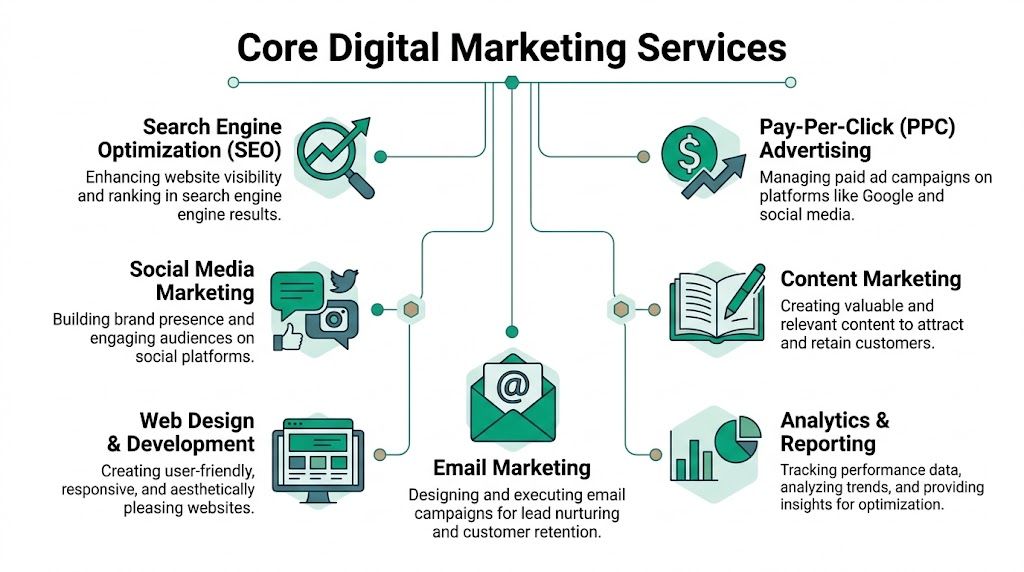
Search engine optimization
SEO helps your website appear in unpaid search results when people look for relevant products, services, or answers.
For a business owner, that sounds simple enough. Behind the scenes, it usually involves keyword research, page optimization, technical fixes, internal linking, schema markup, content planning, and performance monitoring. Agencies often use platforms like Ahrefs, SEMrush, Google Search Console, and Google Analytics 4 to do that work.
The technical side matters more than many people expect. According to White Hat SEO’s overview of agency SEO work, SEO can deliver average returns of 702–1,389% depending on industry, and agencies improve results through keyword research, technical audits, and on-page work such as schema markup, which can boost click-through rate by 20–30%.
Example: a local HVAC company wants to appear when someone searches for urgent repair help. The agency builds pages around service-specific search intent, improves speed and structure, and strengthens local relevance.
Business outcome: more qualified inbound traffic from people already looking for what the company sells.
Pay per click advertising
PPC means paid ads on platforms like Google Ads, Microsoft Ads, LinkedIn, Meta, or YouTube.
This is the fast lane. Instead of waiting for organic visibility to build, you pay to appear in front of a selected audience. But buying traffic isn’t the same as buying results. Agencies manage targeting, keyword selection, bidding, ad copy, landing pages, negative keywords, and budget allocation.
Example: a law firm wants leads for a specific practice area. The agency creates focused campaigns around high-intent search terms, sends traffic to dedicated landing pages, and tracks form fills and calls.
Business outcome: lead volume that can be scaled, reduced, or redirected based on budget and conversion quality.
Content marketing
Content marketing is the practice of creating useful material that helps prospects find you, trust you, and move toward a purchase.
That content can take many forms. Blog articles, product guides, email sequences, landing page copy, case studies, FAQ pages, downloadable resources, and video scripts all fall into this bucket.
For example, a software company may publish comparison pages and educational articles for buyers researching solutions. A home services business may build location pages and service explainers that answer common questions before a customer calls.
Content isn’t just about filling the website. It gives SEO something to rank, gives ads stronger landing experiences, and gives email and social media something worth sending.
Working test: If your website only talks about your company and never answers buyer questions, your content probably isn’t helping enough.
Social media marketing
Social media marketing covers both organic posting and paid promotion across channels like LinkedIn, Instagram, Facebook, TikTok, and others.
Organic social helps a business stay visible, answer questions, share updates, and build familiarity. Paid social is more direct. It lets an agency target audiences by interests, behaviors, job roles, or previous engagement.
Example: a regional medical practice may use social media to keep patients informed and support brand familiarity, while paid campaigns promote a service line to people in a defined geography.
Business outcome: audience engagement, brand visibility, and support for lead generation or remarketing.
Email marketing
Email marketing is one of the most practical services agencies manage because it reaches people who already know your business.
That can include newsletters, welcome flows, abandoned cart emails, re-engagement campaigns, lead nurturing, and post-purchase sequences. Agencies often segment lists, write subject lines, build templates, test sends, and monitor responses.
A retailer might use email to recover abandoned carts and announce launches. A B2B company might use it to nurture leads over time with useful content and meeting offers.
Website design and development
A lot of agency work leads back to the website because traffic only matters if the site can convert it.
This service may include full website redesigns, landing page builds, ecommerce page improvements, mobile usability updates, speed fixes, navigation changes, and form optimization. An agency may use WordPress, Shopify, Webflow, or custom systems depending on the business.
Example: an equipment supplier gets traffic but very few quote requests. The agency shortens forms, rewrites headings, improves product page clarity, and builds stronger call-to-action paths.
Business outcome: a higher percentage of visitors take the next step.
Analytics and reporting
This is the part many owners want most and receive least. Good reporting answers a business question. It doesn’t dump metrics into a PDF and call it insight.
Agencies set up tracking, define conversion events, build dashboards, interpret results, and recommend changes. They look at what traffic came in, which campaigns influenced action, where users dropped off, and which channels deserve more budget.
If you want a broader view of what modern service bundles often include, this digital marketing services overview is a useful reference point.
Emerging services for ecommerce and B2B
Some agencies now go beyond the standard channel list.
For ecommerce sellers, marketplace work may become part of the mix. If Amazon is a meaningful revenue channel, specialized resources on Amazon listing optimization can help clarify how product titles, images, and copy affect discoverability and conversion inside the marketplace itself.
For B2B firms, agencies may also manage cold outreach and AI-driven personalization. That can include prospect research, message sequencing, audience segmentation, and automated personalization layered into outbound campaigns. This work needs tighter legal and operational discipline than many businesses expect, which is why some firms prefer an agency with defined process rather than improvised outreach.
The Agency Process From Discovery to Reporting
The service list tells you what an agency can do. The process tells you how the relationship works.
Most strong agency engagements follow a sequence that feels less like ordering tasks and more like running a managed project. The names vary, but the underlying pattern is usually the same: understand the business, build a plan, execute the work, and report on what happened.

Discovery
At this point, the agency asks a lot of questions, and the good ones ask better questions than you expected.
They want to know what you sell, who buys it, how long the sales cycle takes, what marketing has already been tried, what your margins look like, where leads break down, and which competitors keep showing up in the same conversations. They’ll usually review your website, current campaigns, analytics setup, and market position.
A business owner sometimes thinks discovery is a slow start. In reality, it prevents expensive confusion later.
Here’s a common example. A B2B company says it needs more traffic. After discovery, the agency finds the bigger issue is that the existing site doesn’t explain the offer clearly, forms are weak, and sales rejects many inquiries as poor fit. More traffic would only increase waste.
Planning
Once the agency understands the situation, it builds a plan.
That plan should connect your business objective to channel choices and expected milestones. If the goal is lead generation, the plan may include SEO for long-term intent capture, paid search for immediate demand, landing page work to improve conversion, and email automation to nurture inquiries that aren’t ready to buy.
The planning stage should also define roles, timelines, approvals, and reporting expectations.
A clear plan usually answers questions like these:
- What are we trying to improve first
- Which channels will be used and why
- What needs to be built or fixed before campaigns launch
- How will success be measured
- How often will we review results and adjust
When an agency jumps straight to tactics without diagnosis, clients often end up buying activity instead of progress.
Execution
This is the visible part. Ads go live. Pages get rewritten. Tracking gets cleaned up. Content calendars appear. Email flows are built. Creative is produced. Technical SEO fixes get implemented.
Execution tends to be collaborative even when the agency is doing most of the hands-on work. Your team may need to approve messaging, share customer insights, clarify product details, or review creative before launch.
That collaboration matters because campaigns don’t work in a vacuum. The agency may know channel mechanics, but you know customer objections, sales conversations, and operational constraints.
A short walkthrough can help make the sequence feel real.