
You have leads coming in. Trade show scans. Contact forms. Newsletter signups. Demo requests that looked promising for a day and then disappeared. Your CRM looks active, but revenue doesn't reflect the activity.
That usually isn't a traffic problem. It's a qualification problem.
A lot of companies treat every new contact like a sales opportunity. Sales gets a list, reaches out, and finds out half the people aren't a fit, aren't ready, or were only mildly curious. Marketing says the campaign worked because leads came in. Sales says the leads were weak. Both teams are looking at the same spreadsheet and reaching opposite conclusions.
The fix is understanding what is a marketing qualified lead and using that definition consistently. An MQL is the point where a lead has shown enough fit and enough intent that they deserve structured follow-up, not just a place in the database.
When companies get this right, the downstream effect is hard to ignore. Forrester Research indicates companies excelling in lead nurturing achieve 50% more sales at 33% lower costs than competitors, while nurtured leads make 47% larger purchases, as reported by The Annuitas Group. However, 79% of MQLs fail to convert into sales primarily due to insufficient nurturing according to Salesgenie's roundup of marketing qualified lead statistics.
That gap tells the story. Generating interest isn't the hard part. Handling that interest with a clear system is where most businesses lose momentum.
From Clicks to Customers The MQL Mystery Explained
A business owner opens a lead export on Monday morning. There are dozens of names in it. Some came from a website form. Some downloaded a guide. A few signed up for emails months ago. One person visited the pricing page several times. Another only wanted a free template and never came back.
They all look like leads on paper. They are not equal in practice.
Why most lead lists fail
The problem starts when "lead" becomes a catch-all term. If someone enters an email address, many teams push them into the same pipeline as someone who requested pricing or attended a product webinar. Sales then wastes time sorting through people who were never close to buying.
An MQL solves that. It acts as a filter between general interest and actual buying potential.
A marketing qualified lead is a person or company that has shown enough engagement with your marketing to suggest genuine interest in your offer. That could mean downloading gated content, attending a webinar, repeatedly opening emails, or returning to key pages on your site. The exact actions vary by business. The principle doesn't. The lead has moved beyond casual awareness.
An MQL isn't "someone who exists in your CRM." It's someone who has earned more attention through behavior.
What changes when you define MQLs properly
Once you draw the line clearly, your pipeline gets easier to manage. Marketing stops counting every name as progress. Sales stops chasing weak contacts. Follow-up becomes more relevant because it matches the lead's actual level of interest.
That also changes how you spend time:
- Marketing gets cleaner feedback because campaigns can be judged by lead quality, not just volume
- Sales gets better timing because outreach starts when interest is visible
- Owners get clearer forecasting because the funnel reflects reality instead of optimism
Without that filter, every campaign can look busy while revenue stays flat.
The Lead Lifecycle From Subscriber to Sales Qualified Lead
Most businesses don't need more labels. They need clearer stages.
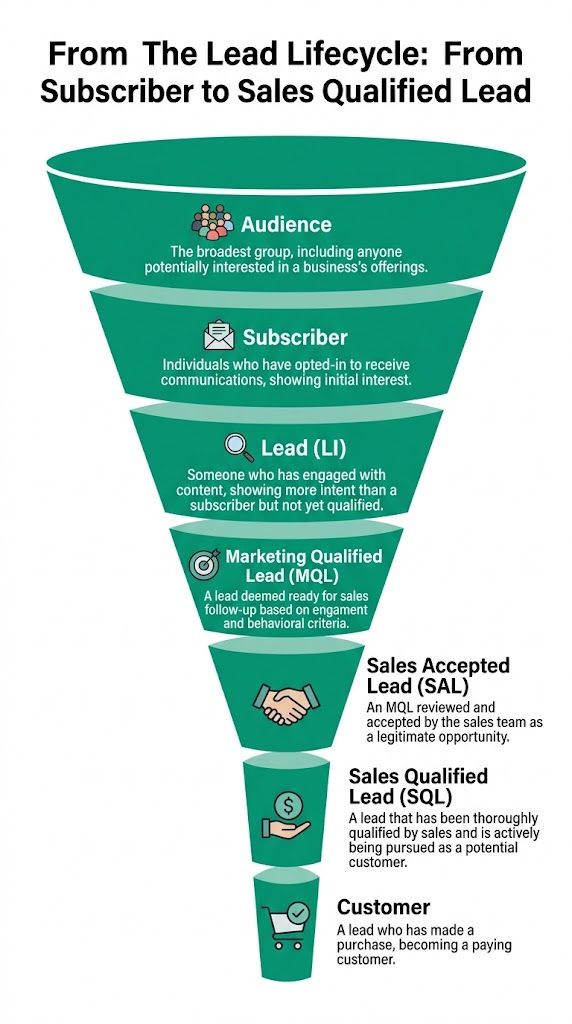
A simple way to understand what is a marketing qualified lead is to place it in the full lead lifecycle. Think of it less like a technical workflow and more like a progression in trust. Someone notices you, then engages, then shows intent, then agrees to a real sales conversation.
The stages in plain English
A person starts as part of your audience. They may see an ad, read a post, or hear about you from someone else. At this point, they know you exist, but that's it.
A subscriber is a step further. They've opted in to hear from you. Maybe they joined your newsletter or signed up for updates. That's interest, but it's still light.
A lead has taken an action that shows more intent than a subscriber. They might download a guide, fill out a form, or explore your site in a more deliberate way. If you want a broader view of how those contacts first enter the funnel, this guide on lead generation for SMB growth is a useful companion.
Then comes the MQL. At this stage, behavior starts to cluster. One action rarely tells you much. Several related actions do. Someone who downloads a whitepaper, returns to the site, and opens nurture emails is signaling a stronger level of interest than someone who only grabbed one checklist.
MQL versus SQL
This is the stage that confuses a lot of teams.
An MQL is marketing's signal that a lead looks ready for closer attention. A Sales Qualified Lead, or SQL, is a lead that sales has reviewed and confirmed as a real opportunity worth active pursuit. The difference matters because "interested" and "sales-ready" aren't the same thing.
A useful middle step is the Sales Accepted Lead. That's the moment sales says, "Yes, this fits. We'll work it." It prevents MQLs from being tossed over the wall with no accountability.
A subscriber wants to hear from you. A lead wants something from you. An MQL wants a solution badly enough to keep engaging. An SQL is willing to discuss buying.
What behavior usually signals movement
The transition from one stage to the next comes from observed actions and fit. In practice, teams often look for combinations like these:
- Subscriber to lead after a form fill, gated download, or deeper site visit
- Lead to MQL after repeat engagement across multiple touchpoints
- MQL to SQL after sales confirms need, authority, timing, budget, or another internal qualification standard
- SQL to customer after a real buying process begins and closes
The stage names are less important than the discipline behind them. If your team can't explain why one contact is getting sales attention and another isn't, your stages are too vague.
The real purpose of the lifecycle
This framework isn't for reporting alone. It tells your team what to do next.
Marketing should nurture people who are interested but not ready. Sales should engage people who match your buying criteria and have shown enough intent. When those lines are clear, your follow-up gets faster, cleaner, and easier to improve.
How to Build Your MQL Scorecard
A small business gets 40 new leads in a week. Marketing sees healthy engagement. Sales says only five were worth calling. That gap usually comes from one problem. Nobody agreed on what "qualified" means.
An MQL scorecard fixes that. It gives your team a shared filter for deciding which leads deserve sales attention now, which leads need more nurturing, and which leads should stay out of the pipeline entirely.
According to Monday.com's explanation of MQL qualification, poor qualification is a common reason outreach gets wasted on the wrong prospects. For SMBs, that waste shows up fast. Reps spend time chasing low-fit contacts, follow-up slows down for good opportunities, and marketing starts optimizing for volume instead of revenue.
Start with fit and intent
A useful scorecard measures two things.
Fit answers whether this person or company matches the type of customer you want.
Intent answers whether their actions suggest real buying interest.
You need both. A lead can be highly engaged and still be a bad prospect. A lead can also match your ideal customer profile and still be months away from a conversation.
That trade-off matters more for SMBs than for large enterprise teams. Smaller companies usually do not have the staff to let sales sort through every hand raise manually. The scorecard has to do some of that sorting upfront.
Sample lead scoring model
| Attribute | Criteria | Points |
|---|---|---|
| Company fit | Matches ideal industry or business type | 10 |
| Role fit | Decision-maker or strong influencer | 10 |
| Geography | Inside service area or target market | 5 |
| Website behavior | Viewed high-intent pages such as pricing or service pages | 15 |
| Content engagement | Downloaded a gated asset or registered for an event | 10 |
| Email engagement | Opened and clicked nurture emails repeatedly | 10 |
| Direct inquiry | Requested a quote, consultation, or demo | 20 |
| Negative signal | Unsubscribed, student inquiry, competitor, or irrelevant market | -10 to -20 |
The point values are not universal. They should reflect what predicts pipeline in your business.
For example, a pricing page visit may deserve more weight than an ebook download. A founder at a 20-person company in your service area may deserve more weight than a manager at a national brand you cannot realistically serve. Good scorecards reflect those business realities instead of copying a generic template.
Set the threshold, then define the action
A score only matters if it changes what happens next.
Pick a threshold that marks the lead as an MQL, then document the next step. Some companies send every qualified lead straight to sales. Others add a quick review step so a rep can confirm context before outreach. For many SMBs, that second option works better because it catches edge cases without slowing the team too much.
A practical setup looks like this:
- Collect fit data from forms, CRM fields, and account research
- Track intent signals across your website, email platform, chatbot, and event tools
- Assign points to actions and attributes tied to real sales conversations
- Set an MQL threshold based on patterns from closed deals, not guesswork
- Route the lead to sales, nurture, or review based on score and context
If your systems are already connected, the process gets much easier to maintain. Teams that use marketing automation for B2B lead scoring and routing can update scores automatically, trigger follow-up, and keep the CRM cleaner without relying on manual tagging.
What to score in a B2B company
B2B scorecards usually need a heavier fit component because one good contact does not always mean one good opportunity. The company itself has to make sense.
Use criteria such as:
- Role relevance, including owner, founder, director, VP, or department lead
- Company fit, based on industry, size, business model, and serviceability
- High-intent page visits, especially pricing, service, comparison, or case study pages
- Depth of engagement, such as repeat sessions, webinar attendance, and multiple content touches
Salesforce's guide to lead scoring also emphasizes combining demographic and behavioral data instead of relying on one signal alone. That matches what works in practice. Repeated engagement from the wrong account is still a weak lead. A strong-fit account with rising intent deserves attention sooner.
What to score in ecommerce
Ecommerce businesses usually get better results by scoring shopping behavior more heavily than form activity.
Useful signals include:
- Product interest through category views, product page depth, and return visits
- Cart behavior such as add-to-cart activity or checkout abandonment
- Purchase history for repeat purchase, upsell, or win-back campaigns
- Offer engagement from email clicks, SMS clicks, and promotion-focused browsing
This is less about lead qualification in the classic B2B sense and more about purchase readiness. The principle stays the same. Score the actions that correlate with buying, not the actions that create a bigger list.
What to score in a local service business
Local service companies need a shorter model.
Service area, job type, urgency, and form type usually tell you more than a long list of digital interactions. A homeowner requesting a quote for a high-margin service in your target zip code should score far above someone downloading a checklist from outside your market.
Practical rule: Score actions that suggest a conversation is likely, not actions that only suggest casual interest.
What breaks scorecards
Bad MQL programs usually fail for predictable reasons:
- Every action gets treated the same, even though a pricing visit and a blog view do not carry equal intent
- Sales adds exceptions on the fly, which makes the model impossible to trust
- The scoring model gets too detailed, so nobody can explain why a lead qualified
- Negative scoring is ignored, which lets stale or irrelevant leads stay inflated
The best scorecard is not the most advanced one. It is the one your team can use consistently, defend easily, and improve over time based on actual deal outcomes.
Bridging the Gap Between Marketing and Sales
Many MQL programs fail after the score is calculated.
Marketing marks a lead as qualified. Sales ignores it, challenges the definition, or follows up too late. The handoff breaks, and both sides blame the other. That pattern is common enough that DashThis notes 60% of marketers report poor sales-marketing alignment on lead definitions, and that misalignment is a primary reason only 28% of MQLs ultimately convert to opportunities.

Why the handoff breaks
The root problem usually isn't technology. It's missing agreement.
Marketing may define an MQL by engagement. Sales may care more about budget, timeline, or decision-making authority. Both views are reasonable. Trouble starts when nobody turns those views into one shared rule.
That shared rule should live in a short service level agreement, or SLA. Not a legal document. Just an operating agreement with enough detail that nobody can say, "I thought you meant something else."
What a practical SLA includes
A useful SLA answers four questions.
- What counts as an MQL based on fit and behavior
- How MQLs are routed to sales or to a review stage
- How fast sales responds after accepting the lead
- How feedback returns to marketing when a lead is weak, early, or off-target
This doesn't need enterprise complexity. A smaller business can run this on a CRM, a shared dashboard, and a recurring meeting.
A simple version might say:
| SLA area | Marketing commitment | Sales commitment |
|---|---|---|
| Definition | MQL must meet agreed fit and engagement rules | Review against the same rules |
| Handoff | Route qualified leads with full context in CRM | Accept or reject with a reason |
| Response | Deliver complete lead record | Contact accepted leads within the agreed window |
| Feedback | Review rejection patterns monthly | Mark outcome clearly in CRM |
Joint workshops fix more than debate
One meeting won't solve this. A working session with both teams usually will.
Bring sample leads. Review them together. Ask sales which ones deserved outreach and which ones didn't. Ask marketing what campaign or content created those leads. That exercise turns vague complaints into usable criteria.
If sales rejects a lead, the team should be able to point to a rule, not a mood.
Here’s a practical resource before teams make those decisions: