A storm hits your service area at night. Gutters overflow, sump pumps fail, pipes split, and homeowners reach for their phones. Your crews are ready, but the calls go elsewhere.
That usually isn't a service problem. It's a visibility problem.
Water damage SEO works differently from standard local SEO because the searcher isn't comparing five options over coffee. They're standing in water, trying to stop damage from spreading, and they call the business that looks available, credible, and easy to reach. If your company isn't visible at that exact moment, a competitor gets the job and often the follow-on work that comes with it.
Why Your Phone Isnt Ringing During a Storm
You already know demand exists when severe weather rolls through. The hard part is capturing it. In water damage, search behavior is compressed. People search, scan a few results, and act.
That speed changes everything about water damage seo. A slow website, a weak Google Business Profile, or vague service pages don't just hurt rankings. They block emergency calls.

The click is expensive because the lead is valuable
The paid search market tells you exactly how aggressive this niche is. Keywords like "water damage repair near me" can cost $102.45 per click, and "water damage repair Houston" can hit $114.43 per click, according to Restoration Marketing's water damage SEO analysis. Those aren't casual-search prices. They reflect a market where one emergency lead can justify heavy bidding.
The same analysis notes that these searches can convert at rates exceeding 50% for targeted keywords. That's the core economic reality behind this niche. If someone searches an emergency term, they're often ready to call now.
Practical rule: In this market, ranking for the right query matters more than generating broad traffic.
A lot of owners still judge SEO by impressions, sessions, or whether a page "looks optimized." That's not how emergency search works. A page can attract visitors and still fail if it doesn't answer three questions in seconds:
- Do you handle this exact problem such as a burst pipe, flood cleanup, or sewage issue
- Do you serve my area right now
- Can I reach a human immediately
Most competitors lose before the call
Some restoration websites still open with generic claims, stock photos, and a menu full of broad service labels. That approach wastes urgency. A homeowner with standing water doesn't want to decode your navigation. They want confirmation.
What wins is narrower and more direct:
- Specific service language such as water extraction, basement flood cleanup, and structural drying
- Visible local relevance through city and service-area references
- Immediate action paths with click-to-call buttons and short forms for after-hours overflow
When search intent is urgent, the first credible option gets the first call.
This is why the top results own so much of the market during storms. They don't just rank. They remove hesitation. If your business shows up late, looks vague, or feels harder to contact, the phone stays quiet while someone else books the job.
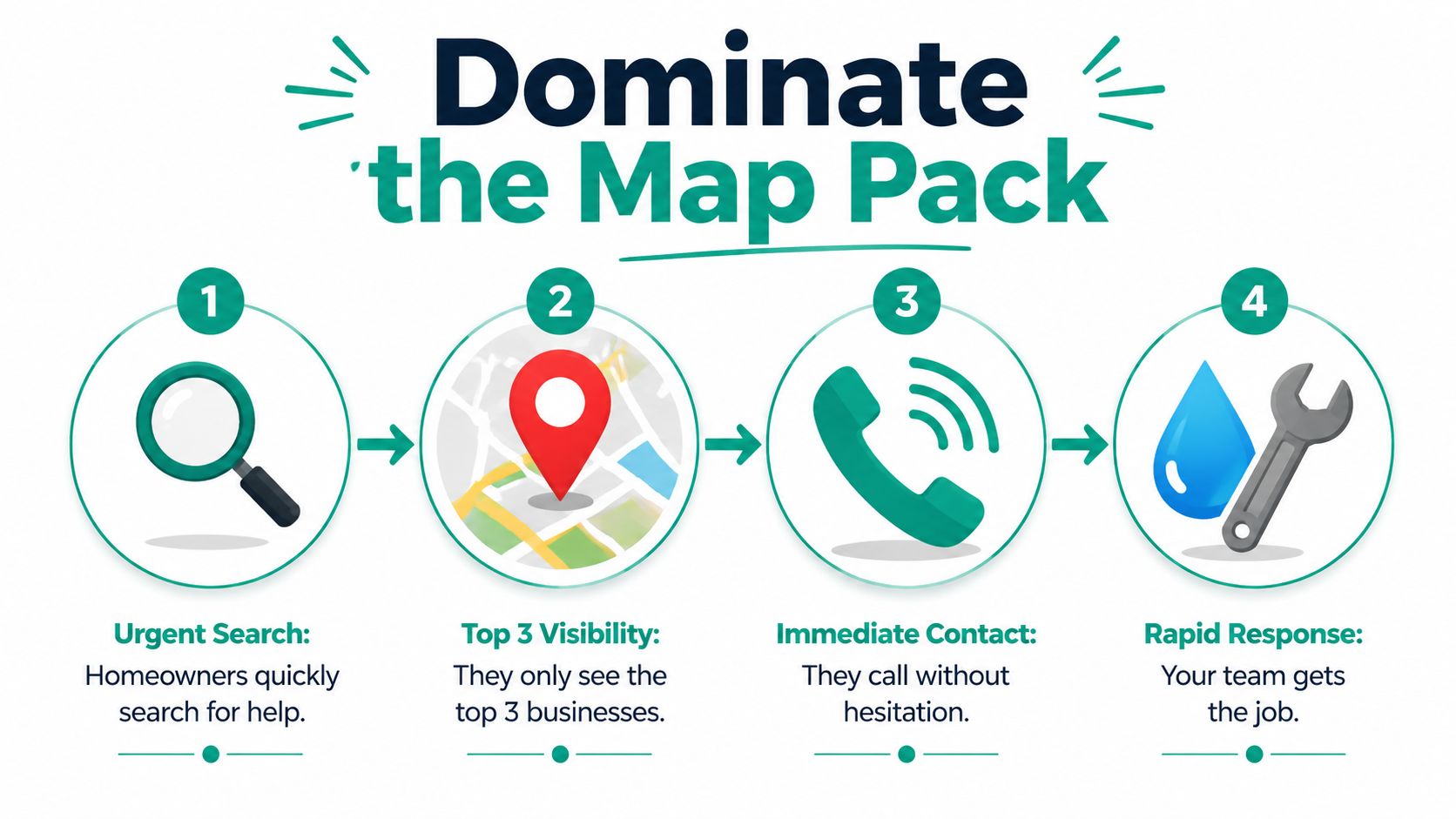
Dominate the Map When Disaster Strikes
In local emergency search, the Map Pack is where the call often happens. Homeowners don't want a research project. They want a nearby company with strong reviews, clear services, and a phone number they can tap.
That puts your Google Business Profile at the center of water damage seo.

Start with profile completeness and consistency
Map Pack gains can show up in 60 to 90 days when you focus on profile optimization and review velocity, based on Blueprint Digital's water damage restoration SEO benchmarks. That's fast compared with broader organic SEO, but only if the basics are handled correctly.
Your profile needs to be complete and current:
Primary service alignment Choose the most accurate primary category for your core work. Then add supporting services that match what you offer.
Service detail that matches search intent
List services in plain English. Use the phrases customers use during emergencies, not internal shorthand.Photos that reduce doubt
Upload team, vehicle, equipment, and jobsite photos. Clean, current photos make the listing feel active.Accurate operating signals
If you take emergency calls at all hours, your profile needs to reflect how customers can reach you.
If you want a useful benchmark for how people compare local providers, review a live local results page such as this resource on water damage companies near me. It shows the kind of local choice set homeowners sort through when urgency is high.
Reviews change click behavior
Blueprint Digital reports that a 4.8+ star rating can triple click-through rate compared with a 4.0 rating, and 93% of consumers check reviews before calling. For an emergency service, that means reviews are not a side task. They are part of lead generation.
Review strategy works best when it's operational, not occasional.
- Ask close to job completion when the customer is relieved and the outcome is fresh
- Request specific detail so reviews mention responsiveness, communication, and the type of job completed
- Keep the pace steady because the same source recommends aiming for 8 to 15 new reviews per month
- Respond to reviews so the profile shows active management
A profile with stale reviews tells Google less, and it tells customers even less.
The map strategy that actually moves rankings
A lot of businesses try to force Map Pack growth by stuffing keywords into the business name or posting random updates. That's weak strategy. Better gains come from profile quality, review flow, and consistent business details across the web.
For a cleaner breakdown of ranking factors that affect local visibility, this guide on how to rank higher on Google Maps is a practical companion.
The trade-off is simple. GBP work is lighter than a full site rebuild, but it requires discipline. If your profile is incomplete or your reviews come in bursts and then stop, your visibility usually stalls. The businesses that stay visible during storms are the ones that keep their map presence current before demand spikes.
Build a Website That Converts Panicked Visitors
Once someone clicks through, your website has to do one job well. It needs to move a stressed visitor from uncertainty to contact without friction.
Many water damage sites fail here. They load slowly, bury the phone number, and force the visitor through generic pages that don't match the emergency they searched for.

Build for the mobile emergency visit
Most emergency visitors arrive on a phone. They may have poor reception, one free hand, and no patience. Your page needs to load quickly, explain the service fast, and make calling obvious.
These page elements do the heavy lifting:
- A fixed click-to-call button that stays visible while scrolling
- A clear headline tied to the exact service and location
- Short service copy near the top that confirms what you handle
- Trust signals such as review excerpts, photos, and proof of real local operations
- A simple form for users who can't call immediately
Don't treat the homepage as the answer to everything. A person searching for sewage backup cleanup shouldn't land on a broad restoration overview and figure it out from there.
Separate pages beat broad pages
This structure works better than a single "services" page:
| Page type | Better approach |
|---|---|
| Water damage | Create a dedicated page for emergency water damage restoration |
| Basement flooding | Build a page focused on basement flood cleanup |
| Pipe failure | Add a page for burst pipe cleanup and water extraction |
| Contaminated water | Use a separate page for sewage backup cleanup |
| Local demand | Pair core services with city or area pages where relevant |
That structure helps both search engines and human visitors. It also improves message match. The query, the page title, the opening copy, and the call to action all line up.
Field note: If a visitor has to guess whether you handle their exact problem, many will leave and call the next company.
Good design choices matter here too. If you're reworking a service site, this guide on how to design a business website that converts is worth reviewing before you touch templates or page layouts.
A disciplined testing mindset also helps. Teams that make steady conversion gains usually test headlines, button placement, form length, and mobile layout instead of redesigning from instinct. If you want a practical overview, Otter A/B helps improve conversions with examples of what to test on service pages.
Technical SEO still affects calls
Technical work gets ignored because it isn't visible to customers until it fails. Then it costs you leads.
Use this short walkthrough as a gut check before you keep adding pages:

Pages should have clean titles, clear internal linking, and mobile-friendly layouts. Schema markup for services and locations helps search engines interpret the site. Canonical tags matter if you've created multiple similar city pages. Weak technical structure makes a high-intent site harder to rank and harder to use.
The trade-off is straightforward. A polished site with weak conversion paths still loses calls. A plain site with sharp service targeting and fast contact paths often wins.
Create Content That Answers Urgent Questions
Most content in this niche misses the intended searcher. It talks like a brochure when the customer is asking a direct question under pressure.
Better content starts with the moment. A homeowner sees water spreading from under a wall and searches for help. Another finds a soaked basement after a storm. A property manager needs immediate cleanup but also wants to know what to do in the next few minutes. Those are three different intents, and they shouldn't land on the same generic page.
Match the page to the situation
A tight content plan for water damage seo usually has three layers.
First, you need service pages for buyers who are ready now. These pages target direct commercial intent and should be built around the actual jobs you want.
Second, you need local pages for the places you serve. If you cover multiple cities or neighborhoods, each area needs a page with useful local context and unique copy. Thin duplication doesn't help.
Third, you need question-based articles for urgent informational searches. These often bring in people before they choose a provider, and they help your site cover the practical issues customers care about.
What this looks like in practice
Here are common search scenarios and the content that fits them best:
- A homeowner with a flooded basement searches for immediate cleanup in their city. That should land on a basement flood cleanup service page with a visible phone number.
- A landlord with a burst pipe wants to know the first actions to take before a crew arrives. That belongs in a short emergency guide.
- A family worried about hidden moisture searches for signs of damage behind walls. That topic works as an educational article tied to inspection and restoration services.
Helpful content earns trust before the customer decides who to call.
The biggest mistake here is writing broad "awareness" articles that never connect back to service intent. If a post answers a question, it should also direct the reader toward the next action, whether that's calling, requesting help, or moving to a relevant service page.
High-Intent Blog Post Ideas for Water Damage Companies
| Topic Category | Sample Blog Title |
|---|---|
| Immediate response | What to Do Right After a Pipe Bursts in Your Home |
| Basement flooding | When Basement Water Needs Professional Cleanup |
| Storm damage | How to Respond After Heavy Rain Causes Indoor Water Damage |
| Hidden moisture | Signs Water Damage May Be Spreading Behind Walls |
| Insurance questions | What Homeowners Should Document Before Water Cleanup Starts |
| Sewage issues | When a Sewage Backup Becomes a Restoration Job |
| Drying concerns | Why Some Water Damage Keeps Coming Back After Surface Drying |
| Local intent | Water Damage Cleanup in [City] and What Homeowners Usually Ask First |
Write like a dispatcher, not a brand team
That means short openings, direct answers, and no padded company history. Use headings that mirror how people search. Add internal links from blog posts to service pages so the site supports both discovery and conversion.
A content library built this way does more than fill your blog. It gives your business an answer for the exact problems people search when they need help fast.
Build Local Authority and Amplify Your Reach
Map visibility and a good website get you into the game. Local authority helps you stay there.
Search engines don't evaluate your business in isolation. They look for signs that your company is part of the local market and recognized by other relevant businesses. For water damage seo, that often means partnerships, citations, local mentions, and a paid channel that can keep lead flow moving while organic work compounds.

Local links that make business sense
The best local authority work usually starts offline. Water damage companies already overlap with plumbers, roofers, property managers, and insurance-adjacent professionals. Those relationships can turn into referrals, joint content, directory mentions, and links from relevant local websites.
Strong options include:
- Partner pages with local trades that refer complementary work
- Community sponsorships where your business is listed on local organization sites
- Association and directory profiles with consistent business information
- Useful local resources such as storm-prep guides or emergency response checklists hosted on your site
This works better than chasing random backlinks from unrelated websites. Relevance matters more than volume in a local service business.
SEO and LSAs serve different jobs
A lot of owners ask whether they should choose SEO or paid search. For restoration, that framing is too narrow.
Local Services Ads fill the top of the results page and can capture immediate demand while your organic presence strengthens. The verified data provided for this article notes that LSAs for restoration average 10 to 15% conversion rates, with some emergency campaigns reporting 25 to 40% for qualified leads. That makes LSAs useful for speed, especially when you're entering a new market or rebuilding visibility.
SEO plays a different role. It creates durable local presence through the Map Pack, service pages, and location pages that keep generating demand beyond ad spend.
Use LSAs for immediate coverage. Use SEO to build a lead source you don't rent month by month.
The trade-off is budget control versus asset building. LSAs can generate opportunities quickly, but they depend on continued spend and active management. Organic authority takes longer, yet it improves your position across maps, local pages, and long-tail searches that ads don't always cover efficiently.
When both channels support each other, your brand looks stronger at the moment of decision. The homeowner sees your reviews, your map listing, your site, and your paid placement together. That stacked presence often does more for trust than any single tactic alone.
Track Real Business Impact and Stop Wasting Money
A lot of water damage companies get monthly SEO reports full of ranking charts and traffic graphs, then still can't answer a simple question. Which efforts produced actual jobs?
That's the wrong reporting model for this niche.
The most useful insight in this market often isn't "we gained more impressions." It's whether a location page, a service page, or your Google Business Profile generated qualified calls from people who needed immediate help. That distinction matters because, in this industry, traditional on-page SEO may only produce 10 to 20% of leads, while strong review velocity on an optimized Google Business Profile can drive 70% more calls, according to this YouTube breakdown of restoration SEO ROI and GBP performance.
Track calls, not just clicks
If your reporting stops at sessions and keyword movement, you miss where the actual demand came from.
A better setup includes:
- Call tracking by source so you can separate organic website calls from Google Business Profile activity
- Form tracking by landing page to see which services bring in serious inquiries
- CRM tagging so booked jobs can be traced back to channel and page type
- Review monitoring because review growth can shift call volume faster than another blog post
That same source also notes an average lifetime value of $5K to $15K per restoration job. Once you look at SEO through that lens, weak reporting becomes expensive. If one source drives higher-value work, you need to know.
Rankings matter only when they connect to booked revenue.
Use a simple ROI model
You don't need a complicated attribution setup to improve decisions. Start with a basic framework and refine it later.
| Metric | What to look for |
|---|---|
| Qualified calls | Calls tied to actual service requests, not spam or vendors |
| Booked jobs | Jobs that came from organic pages or GBP interactions |
| Source mix | Which leads came from site pages versus profile actions |
| Revenue quality | Which pages attract better-fit emergency jobs |
| Spend context | What you paid for SEO work relative to booked value |
If you want a quick way to pressure-test assumptions, a tool like the BlazeHive SEO ROI calculator can help organize the numbers before you build a deeper report.
For ongoing reporting, use a structure that ties SEO outputs to business outcomes. This overview of what is SEO reporting is a solid reference for building a report that owners can use.
Vanity metrics hide expensive mistakes
A page can rank and still attract weak leads. A blog can pull traffic and never produce a call. A service page can get fewer visits but more booked work because the intent is better.
That's why mature water damage seo programs focus on revenue signals first. Once you see which pages and local assets create qualified calls, you stop spending on activity that looks busy and start investing in what produces jobs.
Essential Water Damage SEO Questions
How long does water damage SEO take to show results
Map Pack movement can happen faster than broader organic growth. The benchmark cited earlier from Blueprint Digital puts early Map Pack gains in the 60 to 90 day range when GBP optimization and review generation are handled consistently.
Website-driven growth usually takes longer because it depends on technical quality, service-page depth, local relevance, and authority. In less competitive areas, progress comes sooner. In heavier metros, patience and steady execution matter more.
Can you do this yourself or do you need an agency
You can handle parts of it internally. Many owners or office managers can manage review requests, add photos to the Google Business Profile, update service hours, and check whether core pages still reflect what the company offers.
The harder parts usually need specialist attention. Technical SEO, page architecture, local content systems, conversion tracking, and link acquisition all require experience. If your market is competitive and paid clicks are expensive, weak execution costs more than the agency fee you were trying to avoid.
What's more important, SEO or Google Ads
For most restoration businesses, this isn't an either-or decision. They solve different problems.
SEO builds long-term visibility through maps, service pages, and local organic rankings. Paid channels, including LSAs, can support immediate lead flow while your organic presence develops. If cash flow needs calls now, paid coverage helps. If you want a lead source that keeps working without paying for every click, SEO carries more long-term value.
What should you fix first
Start with the assets closest to the call:
Google Business Profile
Make sure it's complete, accurate, and actively managed.Core service pages
Build pages for the exact emergency services customers search for.Mobile conversion paths
Put click-to-call and clear contact actions above the fold.Tracking
Set up call and form measurement before expanding content.Authority work
Add local citations, partnership links, and reputation building after the foundation is in place.
How do you know whether your SEO is attracting the right leads
Look past total traffic. Review the calls and forms coming from your most important pages. Then compare them with booked work. If your site brings in broad questions but your GBP drives emergency calls, that tells you where to tighten the strategy.
Good water damage seo doesn't just increase visibility. It connects your business with urgent jobs that fit your service mix and service area.
If you want help turning water damage seo into a lead channel that produces real emergency calls, Ascendly Marketing can help you audit your local visibility, fix conversion leaks, and build a strategy around measurable business outcomes instead of vanity metrics.