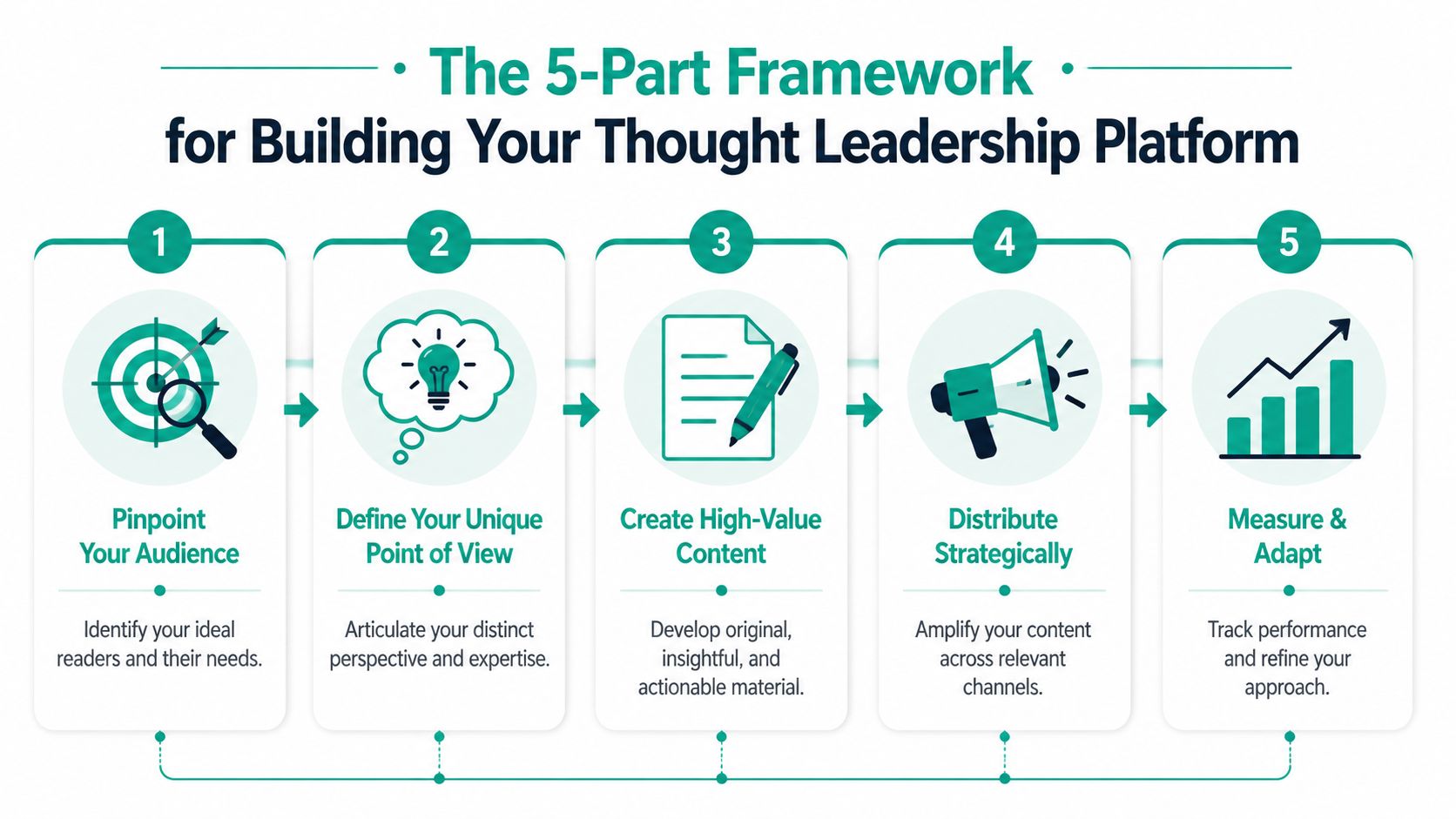
Most advice on marketing thought leadership starts in the wrong place. It tells you to post more often, publish longer articles, or put your founder on LinkedIn every day.
That's not the hard part.
The hard part is having something specific to say, saying it clearly, and proving that the idea helps the business. Without that, you don't have thought leadership. You have branded content with a more flattering label.
For SMBs, B2B firms, ecommerce brands, and regional service businesses, that distinction matters. Time is limited. Budgets are watched closely. If a marketing channel can't influence trust, sales conversations, or buying decisions, it gets cut. Marketing thought leadership works when it gives buyers a reason to take your company more seriously before they ever talk to sales.
What Is Marketing Thought Leadership (And What It Is Not)
The common definition is too loose. If every blog post, podcast clip, and social post counts as thought leadership, the term stops meaning anything.
Marketing thought leadership is a market position built through a clear point of view. That point of view needs to come from real experience, original analysis, customer insight, or proprietary data. It has to help buyers think differently, choose differently, or act differently.
A company can publish a steady stream of useful educational content and still have no thought leadership at all. A checklist article, a beginner guide, or a product page can support demand generation. That doesn't make it wrong. It just serves a different purpose. If you want to understand how that broader system fits together, this overview of branding and content marketing is a helpful companion.
What separates it from regular content
Here's the cleanest way to judge it.
Content type
Main job
What it sounds like
Basic content marketing
Explain and attract
“Here's how this works”
Product marketing
Sell and differentiate
“Here's why our solution is better for this use case”
Thought leadership
Reframe and influence
“The market is looking at this problem the wrong way”
The mistake most companies make is trying to jump to visibility before they've earned a position worth amplifying. They produce polished content around ideas everyone already agrees with. That creates activity, not authority.
What it is not
A few things get mislabeled constantly:
High volume publishing means you're prolific, not influential.
Executive ghostwriting without substance gives a leader a presence, but not a point of view.
Hot takes with no proof attract attention and burn trust.
Generic education helps early research but rarely changes how a buyer ranks vendors.
Practical rule: If a competitor could swap in their logo and publish the same article tomorrow, it isn't thought leadership.
Real thought leadership asks for commitment. You need to choose a lane, state an opinion, and risk excluding people who want safer, flatter content. That trade-off is the point. Broad content gets clicks. Distinct content gets remembered.
The price of entry is an actual opinion
This doesn't mean being loud or contrarian for effect. It means taking a position you can defend.
That position might come from customer patterns, sales objections, implementation lessons, internal testing, support tickets, sourcing decisions, or shifts you see in your market before others name them. For a manufacturer, it could be procurement insight. For an ecommerce brand, it could be category education. For a local service business, it could be a sharper read on customer behavior than competitors have.
If you don't have a real opinion yet, start there. Don't start by picking a format.
How Thought Leadership Drives Tangible Business Growth
Thought leadership gets dismissed as soft branding by companies that haven't tied it to buying behavior. Buyers don't separate “helpful insights” from “vendor evaluation” as neatly as many marketers do. They use one to inform the other.
According to research on thought leadership value, 55% of business decision-makers actively use thought leadership content to vet potential business partners, and 70% of C-suite executives say thought leadership has led them to reconsider current vendor relationships. That changes the role of content. It's not just top-of-funnel education. It becomes part of qualification, competitive displacement, and shortlist formation.
It changes who gets considered
Plenty of SMBs assume thought leadership is mostly for large brands that already have reach. The evidence points the other way. Strong ideas help smaller or less visible companies enter buying conversations they otherwise wouldn't reach.
Buyers often meet vendors through category pages, referrals, outbound outreach, or paid campaigns. They decide whether those vendors feel credible by reading what they publish. When your content shows clear thinking, grounded expertise, and useful judgment, you lower the buyer's uncertainty. That affects response rates, meeting quality, and how seriously your pitch gets heard.
This is also where thought leadership works well with other systems. Outreach tools, CRM workflows, and automated lead generation software can help teams create more sales conversations, but the content attached to those conversations still shapes whether a prospect trusts the company behind the message.
It improves sales context
Most sales teams would rather walk into a conversation with informed trust than start from total skepticism. Thought leadership helps create that condition.
A buyer who has already read your analysis doesn't need the same level of category education. They've seen how you think. They may already agree with your framing of the problem. Sales calls become less about proving you understand the space and more about whether your approach fits their situation.
That doesn't mean thought leadership replaces sales enablement. It makes sales enablement easier.
Buyers rarely say, “We chose this vendor because of one article.” They say, “These people seemed to understand the problem better than everyone else.”
It supports price and positioning
Companies that publish nothing but bottom-funnel comparison content tend to get trapped in feature-by-feature evaluation. Thought leadership gives you another route. It lets you shape the evaluation criteria before the buyer compares vendors.
That matters in crowded categories. If the buyer only compares turnaround time, product specs, or visible features, the conversation compresses around sameness. If your content has already reframed the issue around risk, implementation, compliance, customer retention, sourcing standards, or operational impact, you change what the buyer looks for.
A short explanation helps:
Without thought leadership the buyer evaluates offers.
With thought leadership the buyer also evaluates judgment.
That second layer is where margins, trust, and strategic fit get decided.
A practical discussion on this point is worth watching before you build a program from scratch: