You're probably dealing with some version of the same mess.
One location has a clean Google Business Profile but no local page worth ranking. Another has a strong page but the wrong phone number on directory listings. A third branch keeps getting reviews, yet nobody responds to them. Then corporate asks why “the brand” isn't showing up more often, as if multilocation local seo were one switch you could flip in a dashboard.
That's the trap. Multi-location brands usually don't fail because they ignore local SEO. They fail because they treat it as a collection of one-off tasks instead of a system. Once you have more than a handful of branches, every gap gets multiplied: weak page structure, inconsistent listings, duplicate copy, unmanaged reviews, scattered reporting, and local managers editing assets without any rules.
A single-location business can survive with a few shortcuts. A regional brand can't.
Take a common setup: a franchise group with locations across several cities. The marketing lead inherits pages built from one template, a stack of unclaimed listings, and store managers who update hours in one place but not another. Search visibility looks uneven, but the core problem isn't rankings alone. Revenue leaks out when customers hit the wrong number, land on a thin page, or choose the branch with clearer local signals.
That operating model has to decide four things. Where each location lives on the site. How each listing is governed. What makes every page local. Which data is treated as the single source of truth.
The brands that win here don't “do some local SEO.” They standardize the parts that should never vary, and they localize the parts that must.
Google Business Profile is where most multilocation local seo programs either gain control or lose it.
Before anyone touches descriptions, photos, posts, or review responses, build a master location sheet. Every row should represent one physical branch and include the approved business name, direct local phone number, exact address format, primary category, secondary categories, landing page URL, and local manager contact.
That sheet becomes your control document. Without it, teams start copying old data from websites, spreadsheets, invoices, and past directory submissions. That's how duplicate listings and mismatched fields spread.
Google requires all locations of the same business to share the same primary category, while secondary categories can vary by location, as noted in Search Engine Land's multi-location SEO guide . That means category control can't be left to individual branches.
When categories drift, visibility drifts with them. One manager picks a broad label. Another adds something barely related. A third changes the primary category because a competitor seems to use it. The fix is not more freedom. The fix is a category policy.
Once the location inventory is clean, train your team on local keyword intent before they start writing descriptions or page copy. A lightweight tool like identify profitable keywords for indie hackers can help surface actual query patterns and modifiers that map to branch-level demand.
A short walkthrough can help teams understand how Google expects profile data to be structured at scale.
Don't optimize chaos
Many teams start with the visible work because it feels productive. They upload photos, publish posts, and write business descriptions while ownership, categories, and URLs remain inconsistent.
That work doesn't hold if the foundation is wrong. Verified, controlled, and standardized profiles create a stable asset for every branch. Everything else sits on top of that.
Architecting Your Website for Local Search
Website structure decides whether your locations support each other or fragment authority.
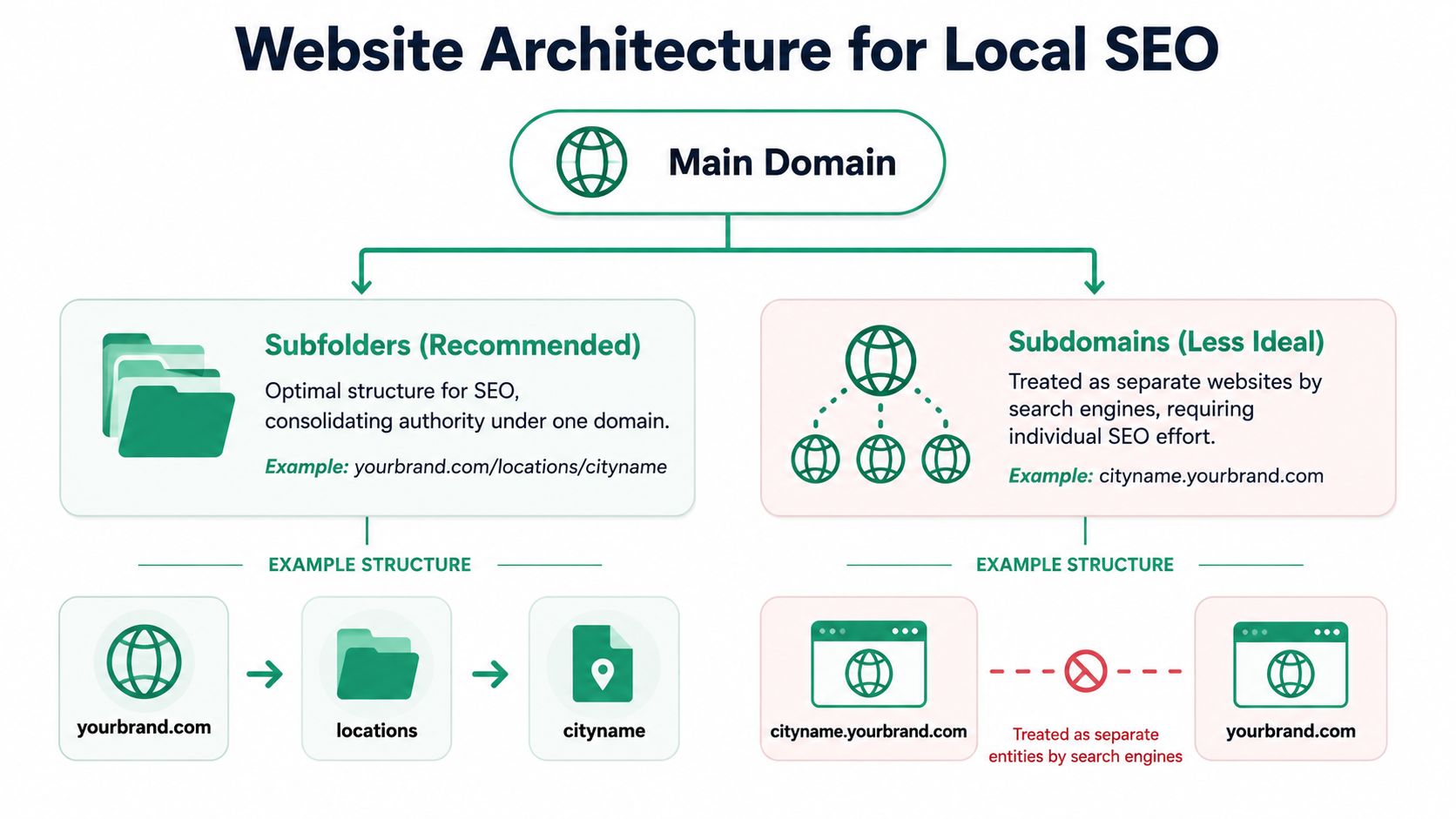
For most multi-location businesses, the right setup is straightforward: build a dedicated, indexable page for each branch in a subfolder under the main domain. Current implementation guidance recommends subfolders rather than subdomains because subfolders inherit the root domain's authority and trust signals. The same guidance recommends a master XML sitemap index with individual location sitemaps nested beneath it to improve crawl discovery and reduce fragmentation, as outlined in this multi-location architecture guide .
Why subfolders win
Subdomains look tidy in a slide deck. In practice, they split effort.
When a brand creates cityname.example.com for every branch, each location starts acting more like a separate property. Internal linking gets weaker, authority gets distributed poorly, and content governance becomes harder because teams often treat subdomains as semi-independent sites. For brands with limited technical resources, that usually turns into a maintenance problem.
Subfolders keep the whole location network under one roof. A structure like:
Page type
Example path
Main locations hub yourbrand.com/locations/
Individual branch page yourbrand.com/locations/city-name/
Branch service variation if needed yourbrand.com/locations/city-name/service/
That arrangement gives search engines a cleaner hierarchy and gives users a simpler path from brand-level navigation to branch-level detail.
What a scalable hierarchy looks like
A solid structure has three layers.
First, a central locations hub lists every branch and links to each page. Second, every branch page is indexable and internally linked from the hub. Third, each branch page supports nearby service or supporting content only when that content is useful and not just spun out for keyword coverage.
A single “contact us” page for every market doesn't scale. It collapses local relevance into one generic destination.
The page design matters too. If the branch page is hard to scan, weak on mobile, or missing location-specific conversion paths, you're wasting the structure you built. Site architecture and UX overlap in this context. Teams redesigning local landing pages often benefit from reviewing examples of website design for local business because the page has to serve both ranking and conversion.
Sitemap discipline matters at scale
Once a brand moves past a few locations, sitemap governance stops being optional. Keep a root sitemap index, then nest location sitemaps beneath it. That reduces crawl waste and gives you a cleaner way to validate whether new pages are discoverable.
What doesn't work is launching dozens of branch pages and hoping internal links alone will carry them. Search engines can find a lot. That doesn't mean they'll prioritize a messy location set the way you want.
Scaling Unique Content for Location Pages
Most multilocation local seo programs break at this point.
The pages exist. The URLs are clean. The listings point to the right destinations. Then you open the copy and find the same page repeated across every market with a city name swap in the H1, maybe a sentence about “proudly serving the area,” and nothing else that proves the branch is distinct.
Recent guidance on multi-location SEO points to duplicated copy as a core technical risk and recommends a repeatable system for scaling uniqueness through local team details, local reviews, and market-specific proof points, while separating brand consistency from location specificity, as explained in this guide to avoiding duplicate location pages .
Separate fixed modules from local modules
The cleanest way to scale content is to stop treating each page as either fully custom or fully templated.
Instead, build a modular framework. Some blocks stay consistent across the brand. Others must be local.
A practical split looks like this:
Fixed brand modules
Local proof modules
Operational modules
That separation solves two competing problems. Brand leaders keep consistency. Search engines and users get clear evidence that the branch is real and relevant to its market.
Build a collection workflow, not a writing scramble
The content issue usually isn't a writing problem. It's an input problem.
Head office asks for unique content. Local managers send nothing, or they send one blurry photo and two lines of generic text. Then the central team fills the gap with copy that sounds polished but says almost nothing specific. That creates thin pages with a nicer tone.
A better workflow uses a standard intake form for every branch. Ask for the details that create true uniqueness:
Local team details such as names, roles, specialties, or branch leadershipPhotos from the actual location including exterior, interior, staff, and signageNeighborhood references the branch servesCommon local customer questions heard by phone or in personBranch-specific testimonials or review excerpts when approved for useOperational notes such as parking, suite access, entrance instructions, or service coverage differences
If local managers can answer six structured questions and upload a few approved assets, your content team can produce pages that don't read like clones.
What thin pages look like in the wild
You can spot weak location content quickly.
Weak page pattern
What to publish instead
City name swapped into a master paragraph A branch intro tied to local context and real branch details
Generic service list copied across all locations Service descriptions adjusted for what that branch actually handles
No evidence of people or place Team details, local testimonials, neighborhood references, storefront imagery
One FAQ used everywhere FAQs based on questions that branch actually receives
The strongest location pages avoid sounding hyperlocal through awkward keyword repetition. They document the branch as it exists physically. That is the difference.
Systematizing Your Citation and Listing Management
A new branch opens. The website goes live on Monday, Google shows the right hours by Wednesday, Apple Maps still has the old suite number two weeks later, and Yelp is pulling a tracking phone line from a previous agency. That is how multi-location SEO breaks in practice. Not because the strategy was wrong, but because no one built controls for location data.
Citation management is an operations problem first.
Google's guidance for representing your business on Google requires businesses to use a real-world, accurate business name, address, and phone presence for each eligible location, and to avoid misrepresenting location details across profiles and the web. That sounds basic. At scale, it is where franchise systems lose control. One field gets updated in one place, then syndication, duplicate listings, and local edits create conflicting records across the ecosystem.
Build one governed source of truth
Every location needs a canonical record before anyone touches a directory.
That record should live in one system only, whether that is a location management platform, a CRM object, or a controlled database owned by the central marketing or operations team. The format matters less than governance. If regional managers, agencies, and support staff can all edit core fields without approval, the data will drift.
Set clear field rules:
Lock the identity fields
Allow controlled local inputs
Assign platform ownership
Version every change
This is the part many brands skip. They focus on distribution before governance. That creates a faster way to spread bad data.
If you want a practical view of the maintenance work involved, this guide to directory listings SEO covers the recurring tasks teams handle to keep records aligned.
Choose the right operating model
Manual cleanup works for a small footprint. It also gives you tighter quality control on the platforms that matter most.
Software starts making sense when the business has enough locations, enough edits, or enough staff turnover that manual upkeep becomes unreliable. The trade-off is straightforward. Distribution tools save time, but they do not resolve duplicate suppression issues, ownership disputes, or bad source data on their own.
Approach
Best fit
Main risk
Manual management Smaller location sets with stable data and a team that can check listings one by one
Cleanup takes longer and often slips during busy periods
Listing management software Large networks that need broad distribution and centralized updates
Teams assume the tool fixed everything when top-tier profiles still need hands-on review
Hybrid model Brands that want scale plus tighter control over Google, Apple, Yelp, and priority citations
Requires process discipline and a clear owner for exceptions
For many multi-location brands, hybrid is the right answer. Use software to push standard fields widely. Handle the high-visibility platforms and duplicate resolution manually.
Audit by customer impact
Do not start with the longest directory list. Start with the records that can send a customer to the wrong place or the wrong phone line.
Audit in this order:
Location pages to confirm each branch points to its own canonical URLGoogle Business Profiles to verify core data, categories, hours, and duplicate conflictsApple Maps, Bing, Yelp, and major map platforms because they influence discovery and driving visitsPrimary data providers and top directories that feed smaller citation sitesIndustry directories that matter in your category
The recurring failure points are predictable:
Formatting drift in suite numbers, abbreviations, and business namesDuplicate listings from relocations, old practitioners, prior vendors, or auto-generated recordsHomepage URLs on branch listings instead of the matching location pageCall tracking numbers used as the main number without a consistent planClosed or moved locations still live on secondary platforms
Each of those issues has a search impact. Each also creates avoidable customer friction.
Standardize exceptions before they become messes
Multi-location brands rarely fail on normal cases. They fail on the exceptions no one documented.
Relocations, temporary closures, practitioner departures, call tracking rollouts, holiday hours, acquisitions, and rebrands need written rules before they happen. If not, every branch improvises. That is how duplicate profiles get created, old addresses stay indexed, and one location inherits another location's authority signals by accident.
A useful governance checklist includes:
what triggers a listing update
who approves the change
which platforms must be updated first
how duplicates are escalated and resolved
how closed locations are marked and monitored
when to use local phone numbers versus tracked numbers
how often the full location set is re-audited
Good citation management is repetitive by design. That is why it scales. The goal is not to keep fixing the same listing problems faster. The goal is to build a system that stops those problems from showing up across fifty locations at once.
Building Local Trust with Reviews and Links
Reviews and local links are often treated like nice extras. They aren't. They're active growth inputs.
If your technical setup is sound and your pages are localized, trust signals become the lever that separates similar businesses in the same market. That's especially true in competitive cities where multiple branches offer nearly identical services under similar brand standards.
Review generation needs a workflow
Branches that “just ask when they remember” usually get uneven review profiles. One manager is proactive. Another forgets. A third only asks their happiest regulars in person. The result is inconsistency across the network.
A better model uses fixed moments in the customer journey. Ask after service completion, after delivery, after a successful appointment, or after issue resolution. Keep the request short and route customers to the correct branch profile.
A practical review system often includes:
Staff prompts at the point of service so the ask feels natural and timelyEmail or SMS follow-ups with the correct branch review linkPrinted QR codes for front desks, receipts, or takeaway materialsEscalation rules for negative feedback so operational issues are handled quickly
Teams looking for implementation ideas can review practical approaches to boost your Google reviews and adapt them to a branch-level process.
Response quality matters too
Review responses are part customer service, part public signal.
Generic replies copied across every branch waste the opportunity. Responses should reflect the actual branch, acknowledge the service context when appropriate, and show that the location pays attention. For negative reviews, the goal is not to win an argument in public. The goal is to show professionalism and move the issue toward resolution.
A review strategy isn't complete when the review is collected. It's complete when the branch responds in a way that reinforces trust.
Local links should come from real local involvement
Many businesses overcomplicate local link building because they think in terms of SEO tactics first and community relevance second. That reverses the order.
The strongest local links usually come from ordinary business activity that has a public footprint. Community events, local sponsorships, partnerships, associations, local business organizations, neighborhood resources, and local media mentions all create link opportunities when the branch is involved.
A coordinated partner helps maintain standards across branches. Agencies such as Ascendly Marketing can support local SEO execution, website work, and content operations when internal teams need outside help managing multi-location complexity.
The rule is simple. Don't chase links that have no local context. Build local relationships that naturally create mentions, citations, and links tied to the branch's market.
Tracking Performance and Governing Your Strategy
A multi-location program without branch-level reporting usually creates the wrong conversations.
Leadership sees blended traffic. The website team sees aggregate conversions. Local managers see whatever happened at their store last week. None of that tells you which branch page is weak, which listing is underperforming, or which market needs operational fixes instead of SEO work.
Track locations as separate operating units
Each branch needs its own measurement layer. That includes its location page, Google Business Profile activity, review profile, and key conversion actions.
A simple governance dashboard should track:
Category
What to watch by location
Website performance Organic traffic to the branch page, engagement, and conversion actions
GBP activity Website clicks, calls, direction requests, and profile interactions
Search visibility Rankings for branch-relevant queries in that market
Trust signals Review volume, response coverage, and link acquisition progress
Data integrity Listing accuracy, duplicate issues, and page update status
This approach changes how problems are diagnosed. If one branch has traffic but weak conversion, the page or offer may be the issue. If another has strong reviews but poor visibility, the page, category setup, or listing completeness may need attention. If a third has low engagement across the board, the market itself may need a deeper look.
Governance prevents local SEO drift
Franchise systems and regional brands often lose performance through well-intended local edits.
A manager changes the business name format. Another replaces approved copy with promotional language. Someone updates hours in Google but forgets the website. A branch launches a location page variation outside the normal structure. None of these changes looks catastrophic in isolation. Together, they create instability.
Set governance rules in writing:
Define who owns each asset
Create an edit request process
Use page and listing templates with controlled fields
Audit on a schedule
The more locations you have, the less you can rely on memory, goodwill, or informal Slack messages to keep local assets aligned.
Don't reward vanity metrics
Teams often celebrate network-wide traffic while weak branches stay hidden inside aggregate reports. That's how underperforming markets avoid scrutiny for months.
Judge performance at the location level. Compare branches against the same operating standards. Then separate SEO issues from operational ones. Some branches don't need more optimization. They need cleaner data, faster review response, stronger local content inputs, or a manager who follows the process.
If your team needs help building the systems behind multilocation local seo, Ascendly Marketing can support the work across website structure, location page strategy, directory management, and performance reporting so each branch operates from the same playbook instead of a patchwork of local fixes.