

Branding is a company’s personality, and content marketing is the method it uses to communicate. The two are interdependent. A brand's core promise is realized through the content it produces. When that content is consistent and helpful, it builds trust.
The Relationship Between Branding and Content Marketing

The link between branding and content marketing is a symbiotic relationship. A brand represents the "why" behind a business—its purpose, values, and the promise made to customers. Content marketing is the "how" that promise is delivered, translating abstract ideas into tangible materials for the audience.
Have you ever read a company's blog and found the tone inconsistent? One post might be formal, the next informal, with no apparent connection. This occurs when content lacks a strong brand foundation. The content becomes a collection of random messages, which can confuse the audience and hinder the development of a lasting connection. It is akin to attempting to make friends without a defined personality.
Conversely, a strong brand without content is like a knowledgeable person who does not speak. The brand's personality and mission remain hidden. A story exists, but there is no audience to hear it.
How Branding Guides Content
Every piece of content created should originate from the same brand identity. This identity functions as a quality filter, ensuring that every article, video, and social media post is aligned with the brand's purpose. This alignment makes marketing recognizable and more effective.
This is a practical roadmap for content creators. A thorough understanding of the brand provides a reference for what to say and how to say it. This ensures each marketing piece reinforces the brand's identity, creating a seamless experience for the audience.
The global content marketing industry is projected to reach $107.5 billion in revenue by 2026, a figure that has doubled in five years. This growth indicates that businesses are using content to attract and retain customers. Companies that consistently blog experience 55% more website visitors. For additional data, refer to the latest content marketing statistics on seoprofy.com.
A brand is the promise made. Content is the method of keeping that promise consistently. It is the ongoing conversation that demonstrates authenticity.
From Brand Elements to Content Actions
How does this work in practice? Each part of a brand's identity informs the content created and shared. This process involves translating core principles into tangible content.
The table below shows how a brand’s DNA shapes a content strategy. It serves as a blueprint for creating authentic and impactful marketing efforts.
How Branding Elements Shape Your Content Marketing
This table shows the direct relationship between core branding components and their corresponding content marketing actions, illustrating their symbiotic nature.
| Branding Element | Content Marketing Action | Example Outcome |
|---|---|---|
| Mission & Values | Create content reflecting the brand's purpose, such as blog posts on industry ethics or stories about community involvement. | An audience that connects with the brand on a deeper level because they share its values. |
| Brand Voice | Develop a consistent tone across all content, from formal whitepapers to social media posts. | The brand becomes instantly recognizable, whether a person is reading an email or watching a video. |
| Customer Persona | Produce content that directly addresses the pain points, questions, and goals of the ideal customer. | High engagement and conversions because the content is helpful and resonates with the audience. |
| Visual Identity | Use consistent colors, fonts, and imagery in all visual content, including infographics, videos, and social media graphics. | A strong, professional brand image that builds trust and familiarity across all platforms. |
Connecting each brand element to a specific action transitions from abstract ideas to a concrete, repeatable process. This method builds a brand that customers not only purchase from but also believe in.
Crafting Your Brand Blueprint Before You Create Content

Before writing a blog post or drafting a social media update, define the brand's identity. Starting content creation without a plan is like building a house without a blueprint. The result may be unstable, confusing, and uninviting.
A solid brand blueprint serves as a strategic document that guides every piece of content. It maintains message consistency, gives work a clear purpose, and ensures that marketing efforts are not wasted.
This process is about building a practical toolkit for daily use, not creating a mission statement that goes unused.
Defining Your Core Brand Statements
First, document the core statements. These statements represent the company's essence and will serve as a reference for all content decisions.
- Mission (Your "Why"): What is the company's reason for being, beyond profit? For example, a skincare brand’s mission might be "to make effective, clean beauty accessible to everyone." This is its purpose.
- Vision (Your "Where"): What future is the company trying to build? What does the world look like if the company succeeds? The same skincare brand's vision could be "a world where no one has to compromise on health for the sake of beauty." This is its destination.
- Values (Your "How"): What are the non-negotiable principles for the business? These principles guide all decisions, from product design to customer communications. Values might include transparency, sustainability, or a community-first approach.
These three statements form the brand's DNA. When faced with a content idea, ask: "Does this align with our brand?" If the answer is no, discard the idea.
Unearthing Your Unique Value Proposition
A Unique Value Proposition (UVP) is a simple, powerful statement explaining how a company solves a customer’s problem in a way that competitors cannot. It is the reason customers should choose that company.
Finding a UVP requires answering specific questions. What specific pain point does the company address for its customers? Is it fast customer service, a unique process, competitive pricing, or an exclusive feature? The content needs to communicate this clearly.
A HubSpot study found that 33% of people read blogs to learn something new. A UVP provides an opportunity to teach something unique, turning the brand into a valuable resource.
This is the core of the content's angle. It differentiates a brand from being just another voice to being a trusted voice.
Analyzing Competitors and Building Personas
Next, conduct market research. To identify a unique market position, analyze competitors and understand the target audience.
Competitor Analysis:
- List the top 3-5 direct and indirect competitors.
- Review their content. What are their common topics? What is their tone—is it serious, quirky, or corporate?
- Identify gaps. What topics are they not covering? Where are their arguments weak or their posts uninteresting? These gaps represent opportunities.
Customer Personas:
A persona is more than a demographic like "Females, 25-34." A useful persona is a detailed, semi-fictional profile of the ideal customer. Understand their perspective.
- What are their primary goals and frustrations?
- Where do they find information online?
- What is a key concern they have that the brand can help solve?
With a well-defined persona, content is created for a specific individual rather than a faceless crowd. Blog posts will feel like they address the reader's thoughts, and social posts will relate to their daily struggles. This is how a brand blueprint transforms content from a monologue into a magnetic conversation.
Now that the brand blueprint is established, the next step is implementation. This involves determining what to say and how to say it.
This is when the brand transitions from a document to a distinct personality. This section will cover content pillars—the core themes the brand will own—and brand voice, the unique style that defines the brand. Proper execution of these elements will make every piece of content feel connected and instantly recognizable.
Establishing Your Core Content Pillars
Content pillars are the 3-5 main subjects on which a brand is an expert. These are not random topics; they are the intersection of the company’s expertise and the customer’s key questions. Imagine building a library for the audience—the pillars are the main sections, such as "Mystery," "Science Fiction," and "History."
How do you identify them? Refer back to the blueprint.
- Your Mission & Unique Value: What subjects clearly communicate "this is what we do and why we are different"?
- Your Customer Personas: What are their concerns? What are they trying to achieve? What problems are they trying to solve?
For a financial software company targeting startups, pillars could be "Founder-Friendly Fundraising," "Scaling Operations," and "Startup Financial Health." Each pillar is a deep source of material for blog posts, videos, podcasts, and other content formats.
Defining Your Unmistakable Brand Voice
If content pillars are what is said, brand voice is how it is said. It is the brand's personality. Is the brand a witty sidekick, a wise mentor, or a supportive friend? Without a defined voice, content may sound generic or robotic.
A brand's voice is its personality, which remains constant. Its tone is its mood, which adapts to the situation. The way one speaks to a friend differs from the way one speaks in a board meeting. Similarly, an authoritative tone might be used in a detailed report, while a casual, energetic tone is used on Instagram.
A brand voice is what people remember. It is the feeling they get from reading the content, the reason they choose to follow the brand, and the signal that indicates trustworthiness.
Data shows that content marketing generates 3 times more leads than traditional outbound marketing at 62% less cost. However, 37% of B2C marketers do not have a documented strategy, leading to wasted time and resources. For more on the importance of a clear plan, review these revealing content marketing statistics on thestacc.com.
Using a Voice and Tone Matrix
To make the brand voice a practical tool, use a voice and tone matrix. This is a simple chart that shows the team how to apply the brand's voice across different channels and formats, ensuring consistency.
Here is an example for a brand with a "Playful Expert" voice:
| Voice Characteristic | Tone for Blog Posts | Tone for Instagram Stories | Tone for Technical Whitepapers |
|---|---|---|---|
| Witty | Use clever analogies and some humor to explain complex ideas. | Use funny GIFs, memes, and cheeky captions. | Maintain a professional body, but add personality to the introduction and conclusion. |
| Knowledgeable | Support claims with data and link to credible sources. | Share quick "did you know?" facts and digestible tips. | Present in-depth research, detailed charts, and thorough analysis. |
| Approachable | Write in a conversational style. Use "you" and "we" and ask questions. | Run polls and Q&As. Respond to direct messages as if chatting with a friend. | Avoid dense jargon where possible and always include a simple summary. |
With a matrix like this, a person will experience the same brand personality whether they find the brand through a detailed guide or a quick social post. This consistency is what transforms a brand from something people see to something they feel.
Now, let's move from theory to practical application.
Actionable Playbooks for Content Creation and Distribution
A strategy is only effective when it is implemented. The process of turning a brand strategy into content that people see, appreciate, and act on is where results are generated. This is the transition from planning to execution.
These playbooks are focused roadmaps for specific business types, not generic templates. Whether the goal is B2B lead generation, increasing online sales, or becoming a local service provider, a solid playbook ensures that every piece of content has a purpose.
The entire process originates from the brand's DNA. The brand's voice is how it sounds, and its content pillars are what it represents. Every published item should flow directly from these elements.
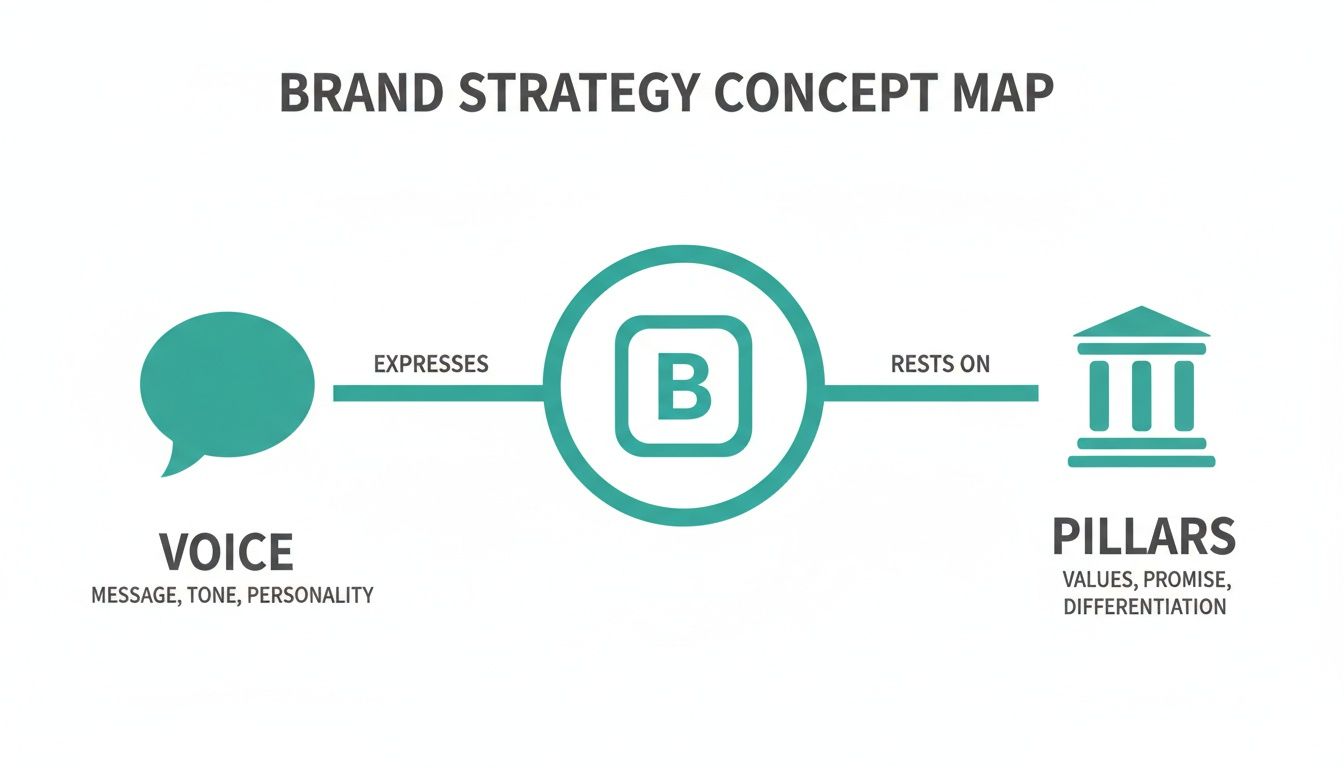
As shown, the voice is the unique personality presented to the world. The pillars are the core topics the brand aims to own, connecting its promise to every blog post, video, and social media update.
Let's examine the specifics for different business models.
The B2B Lead Generation Playbook
In the B2B sector, the audience consists of busy professionals seeking solutions to complex, high-stakes problems. Content must demonstrate expertise and build trust. The sales cycle is long, and establishing credibility is a primary objective.
The goal is to become an indispensable resource, the first name that comes to mind when a professional in the industry faces a challenge.
Content Recommendations:
- Deep-Dive Case Studies: Go beyond testimonials. Detail how a client was helped—the problem, the solution, and the quantitative results. This is a powerful form of social proof.
- Authoritative LinkedIn Articles: The target audience is active on LinkedIn. Provide them with long-form articles that analyze industry trends or offer fresh perspectives on common issues.
- Gated Whitepapers & Ebooks: Create a valuable, comprehensive guide that solves a major pain point. Request an email address in exchange for access. If the content is high-quality, users will provide their information.
A 2021 study found that 78% of the most successful content marketers had a documented strategy. For a B2B company, a clear playbook is a necessity for participation in the market.
The Ecommerce Sales Driver Playbook
In ecommerce, the goal is to capture attention in a fast-paced, visual environment. The mission is to convert a casual scroll into a purchase. Content in this space is about inspiration, desire, and simplifying the checkout process.
Move beyond sterile product shots. Content should evoke emotion and help customers envision the products in their own lives. Authenticity and community are key assets.
Content Recommendations:
- User-Generated Content (UGC) Campaigns: Customers can be effective photographers. Encourage them to share photos and videos with the products and feature this content on social media and product pages. This builds trust quickly.
- Influencer Marketing on TikTok and Instagram: Partner with creators who genuinely appreciate the products and whose followers are the ideal customers. Short, engaging videos from a trusted source can generate significant awareness and sales.
- SEO-Powered Product Guides: Think from the customer's perspective. Create helpful blog posts that answer their biggest questions, such as "How to Choose the Perfect Running Shoe for Your Foot Type." This will attract users who are ready to make a purchase.
The Local Service Business Playbook
For a local service business, such as a plumber, landscaper, or real estate agent, the market is the local area. Content needs to convey reliability, trustworthiness, and proximity. The goal is to be the first name a local resident sees when searching for the service provided.
The online presence should mirror a firm handshake and a five-star reputation. Be helpful, visible, and undeniably local.
Content Recommendations:
- Optimize Your Google Business Profile: This is the digital storefront. Post regular updates, including project photos, special offers, and company news. Each post signals to Google that the business is active and relevant, which boosts local ranking.
- Community-Focused Facebook Posts: Get involved in the community. Share news about local events the business is sponsoring, promote other local businesses, or offer tips specific to the area (e.g., "Frost warning for our area this week! Here's how to protect your pipes.").
- Hyper-Local Blog Content: Write articles with information only a local would know. A landscaper in Houston could write, "What to Know About Houston's Gumbo Soil Before Planting a Garden." This positions the business as the neighborhood expert.
Selecting the right content format and distribution channel is a major part of the strategy. This table outlines recommendations by business type to help focus efforts where they will have the greatest impact.
Content and Distribution Playbook by Business Type
A comparative guide showing recommended content types and primary distribution channels for different business models to maximize impact.
| Business Type | Recommended Content Formats | Primary Distribution Channels |
|---|---|---|
| B2B | Case Studies, Whitepapers, Webinars, LinkedIn Articles, Data-Driven Reports | LinkedIn, Industry-Specific Forums, Email Marketing, SEO |
| Ecommerce | UGC, Product Guides, Influencer Videos, Lookbooks, How-To Tutorials | Instagram, TikTok, Pinterest, Facebook, YouTube, Email Marketing |
| Local Service | Before/After Photos, Customer Testimonials, Local SEO Blogs, Google Profile Posts | Google Business Profile, Facebook, Nextdoor, Local Directories (Yelp) |
By selecting the appropriate plays from this table, content creation becomes a strategic asset designed to connect with the right people in the right place, ultimately driving business growth.