

A digital marketing audit is a top-to-bottom assessment of every single one of your online marketing efforts. It gives you a clear, data-driven picture of what’s crushing it, what’s failing, and where your biggest growth opportunities are hiding in plain sight.
Think of it as a strategic health check for your entire online presence.
Why an Audit is Your Most Powerful Growth Tool

Trying to grow your business without a regular marketing audit is like driving across the country without a map. Sure, you’re moving, but you have no idea if you’re headed in the right direction, how much fuel you’re wasting, or if there’s a much faster route. In today’s market, guessing is just a recipe for stalled growth and wasted money.
An audit forces you to step back and take an honest, unflinching look at your current marketing operations. You’ll move past vanity metrics and dig into the data that actually impacts your bottom line. This isn’t just about spotting a few broken links; it’s about uncovering the deep strategic gaps that are holding your business back.
Uncovering Hidden Opportunities
A proper audit gives you a 360-degree view of your marketing, revealing insights you’d almost certainly miss otherwise. The process systematically combs through every channel and tactic to find areas for quick wins and long-term strategic shifts.
Here are just a few things an audit brings to light:
- Wasted Spend: Find those underperforming ad campaigns or entire channels that are eating up your budget without delivering a clear return.
- Conversion Bottlenecks: Pinpoint the exact pages or steps in your funnel where potential customers are dropping off, so you can make targeted fixes.
- Competitive Gaps: See exactly what your competitors are doing well (and where they’re weak), giving you a clear path to start stealing market share.
- Untapped Potential: Discover new keywords, audience segments, or content ideas that align perfectly with your goals but are currently being ignored.
Ultimately, a key goal here is to find ways to improve marketing efficiency and make sure every dollar and hour spent is pushing your business forward.
The Foundation for a Strategic Roadmap
The digital marketing industry is exploding—it’s projected to hit $807 billion by 2026, a massive jump from $531 billion in 2022. This kind of rapid growth means that strategies that worked last year might be totally obsolete today.
This is why an audit is so critical. It’s not just about finding problems; it’s about building the solution.
An audit is more than a report; it’s the blueprint for your future success. It transforms subjective opinions into an objective, data-backed action plan that aligns your entire team and focuses resources on what truly drives results.
This process allows businesses of all sizes—from local B2B firms to national e-commerce brands—to stop guessing and start making informed, strategic decisions. It provides the clarity needed to allocate your budget effectively, prioritize high-impact initiatives, and build a sustainable engine for growth.
Auditing Your Search Engine Visibility

Let’s be blunt: if your customers can’t find you on Google, you’re practically invisible. Search visibility is the absolute bedrock of a solid digital presence, which is why it’s a critical starting point for any audit. Here, we’re dissecting both your organic (SEO) and paid (PPC) search efforts to see if they’re actually working together to bring qualified traffic through the door.
A real SEO audit goes way beyond a simple keyword ranking report. It’s a deep dive into your site’s technical health, the relevance of your on-page content, and the authority your site commands online. On the flip side, a PPC audit isn’t just about click-through rates; it’s about finding and plugging the holes where your ad spend is leaking out.
Ever wonder why some brands seem to pop up everywhere overnight while others just… don’t? It often comes down to this kind of rigorous analysis. With SEO projected to drive 93% of all web traffic by 2026, treating it as an afterthought is no longer an option.
Diagnosing Your Technical and On-Page SEO Health
Think of your website’s technical foundation like the foundation of a house. If it’s cracked and unstable, it doesn’t matter how great the rest of the house is. If Google’s crawlers run into roadblocks like slow-loading pages or broken links, even the most brilliant content won’t stand a chance of ranking.
Your first checkpoint should always be a technical review. I’m talking about the nuts and bolts:
- Site Speed: How fast do your pages load? Use a tool like Google’s PageSpeed Insights. A slow site is a one-way ticket to a high bounce rate and tanking rankings.
- Mobile-Friendliness: Can people easily use your site on a phone? With most searches happening on mobile devices, this isn’t just a “nice-to-have” anymore; it’s a dealbreaker for Google.
- Crawlability & Indexability: Are you accidentally telling search engines to ignore your best content? Look for errors in your
robots.txtfile ornoindextags on pages you want to rank.
Once the technicals are sorted, we can turn our attention to on-page elements. This is all about making sure your content aligns perfectly with what people are searching for. Are your page titles, meta descriptions, and headers actually optimized for the keywords you’re targeting? More importantly, is your content genuinely helpful and better than what your competitors are putting out there?
Evaluating Your Off-Page Authority and Backlink Profile
Your off-page SEO, which is mostly your backlink profile, is like your website’s reputation. When other high-quality, authoritative sites link to you, they’re essentially vouching for your content, telling Google you’re trustworthy. But a profile cluttered with spammy, low-quality links? That can do some serious damage.
A crucial part of your audit is analyzing exactly where your links are coming from. Tools like SEMrush or Ahrefs can give you a full breakdown, allowing you to spot and disavow toxic links that could be dragging you down. And while you’re at it, reviewing an essential domain health check guide can help you uncover underlying issues that affect both your SEO and email deliverability.
For businesses that need a forensic-level analysis, our team offers specialized SEO audit services that dig deep to uncover those hidden problems and opportunities.
Auditing Your Paid Search Campaigns
While SEO is the long game, Pay-Per-Click (PPC) ads give you that instant visibility. A smart PPC audit is all about maximizing your return on ad spend (ROAS) by eliminating waste. The first thing to look at is your campaign structure. Is it logically organized around themes, products, or specific services? A messy structure is often the first sign of trouble.
Next, get ruthless with your keyword targeting. A classic mistake I see all the time is bidding on broad, vague keywords that get a lot of clicks but zero conversions. Dive into your search query reports to find irrelevant terms and add them to your negative keywords list. This one tweak alone can save you a fortune.
The goal of a PPC audit is simple: ensure every click has the highest possible chance of turning into a customer. This means aligning your ad copy, keywords, and landing pages into a seamless, persuasive user journey.
Finally, check the connection between your ads and your landing pages. Does the promise you make in the ad copy perfectly match what users see when they land on the page? Any disconnect here will kill your conversion rates and hurt your Quality Score, which ultimately just makes your clicks more expensive. Make sure that alignment is flawless.
Gauging Your Content and Social Media Footprint

It’s easy to feel productive when you’re pushing out new blog posts and keeping social media channels active. But is any of it actually moving the needle? A proper digital marketing audit forces you to stop guessing and start digging into the data to see what’s building your brand versus what’s just adding to the internet’s noise.
For your content, this is about taking a full inventory to see what you have, which pieces are working hard for you, and which ones are just collecting digital dust. On the social media side, we need to look past vanity metrics like follower counts and focus on what drives real business value—think engagement, audience quality, and referral traffic.
Kicking Off a Strategic Content Inventory
First things first: you need to catalog every single piece of content you own. Yes, it sounds tedious, but it’s the only way to get a truly objective look at your assets. Fire up a spreadsheet and start listing out your blog posts, landing pages, case studies, videos, and white papers.
For each item on that list, you’ll want to pull in some key performance data. We’re looking for metrics that tell a story about how users are actually interacting with what you’ve made:
- Traffic: How many unique eyeballs are landing on this content?
- Time on Page: Are people sticking around to read or watch, or are they bouncing immediately?
- Conversions: Does this content drive newsletter sign-ups, demo requests, or actual sales?
- Backlinks: Has this piece been valuable enough to earn links from other reputable sites?
This process is incredibly revealing. It quickly separates your high-performing “workhorse” content from the assets that are doing nothing. You’ll also start to see glaring gaps. Maybe you have a dozen top-of-funnel blog posts but almost nothing designed to help a lead in the middle or bottom of the sales funnel.
A content audit isn’t about judging past work; it’s about making informed decisions for the future. It gives you a clear roadmap to update high-potential articles, consolidate weak ones, and create new content that directly addresses gaps in your customer’s journey.
Once you have this data, you can start categorizing each piece. Is it a high-traffic blog post that just needs a refresh? A low-performing article that should be 301-redirected? Or a killer case study that’s just not getting the promotion it deserves? This inventory becomes your playbook for every content decision you make going forward.
Auditing Social Media Beyond the Follower Count
With over 5 billion active users across the globe, social media is a force you can’t ignore. But a massive follower count is meaningless if those followers aren’t engaging with you or, better yet, becoming customers. A real social media audit cuts through the fluff to measure what actually grows a business.
You need to look at each platform on its own to see what it’s bringing to the table. Instead of obsessing over follower growth, shift your focus to KPIs that matter:
- Engagement Rate: What percentage of your audience actually interacts with your posts (likes, comments, shares)? A high rate means your content is hitting the mark.
- Audience Demographics: Do your followers on Instagram actually match your ideal customer profile?
- Referral Traffic: How many visitors are coming to your website from each social channel? You can track this right in Google Analytics.
- Conversions from Social: Of that referral traffic, how many people are actually taking action on your site?
This deeper dive shows you the true ROI of your time and effort. A B2B company might discover that while Instagram racks up more “likes,” LinkedIn is generating 100% of its qualified leads from social. That’s the kind of insight that tells you exactly where to double down and which platforms are just a time sink. Understanding your audience is foundational to building a successful social media marketing strategy that delivers tangible results.
By systematically picking apart both your content library and your social channels, your audit will give you the clarity you need to sharpen your message, focus your resources, and build a more effective online presence that’s truly driven by results.
Analyzing Your Path to Conversion
Getting traffic is only half the battle. Seriously. The most brilliant SEO and paid media campaigns in the world won’t move the needle if that hard-won traffic never actually becomes a customer.
This is where the audit pivots from bringing people to your site to figuring out what they do once they get there. We’re going to dissect the entire journey a user takes, from the moment they land on a page to the second they click “buy now” or “submit.” More often than not, this is where you’ll find small, overlooked issues causing massive leaks in your revenue funnel—specifically in your website’s user experience (UX) and email marketing.
Uncovering User Frustration with a UX Audit
You can’t fix problems you can’t see. A user experience audit is your way of stepping into your customer’s shoes and seeing your website through their eyes, pinpointing all the little friction points that make them give up and leave. Instead of just guessing, we use data to diagnose exactly where and why people are getting stuck.
This is where tools like Hotjar or Crazy Egg are absolute game-changers. They give you a visual layer that standard analytics just can’t provide.
- Heatmaps: These show you exactly where people are clicking, how they’re moving their mouse, and—crucially—how far down the page they scroll. You might find out dozens of people are clicking on an image that isn’t even a link, which points to a design flaw. Or you might realize your main call-to-action is below the fold where 75% of your visitors never even see it.
- Session Recordings: There is nothing more powerful than watching an anonymized recording of a real person trying to use your website. Seeing someone rage-click a broken button or get lost in your checkout process provides an “aha!” moment that numbers on a spreadsheet never will.
The goal here is to find the “why” behind your bounce and exit rates. A high exit rate on a form page isn’t just a number. A session recording might reveal that the “Submit” button is completely unresponsive on mobile. That’s a direct, actionable insight that’s costing you money every single day.
I once worked with an e-commerce store that saw a huge drop-off on their product pages. After digging into their heatmaps, we saw that users were consistently ignoring the “Add to Cart” button. Why? Because a huge, distracting banner ad was placed right above it, drawing all the attention. This wasn’t a grand strategic failure; it was a simple design flaw that was killing their sales.
Evaluating Your Email Marketing Engine
Email is still one of the highest-ROI channels out there, but only if you’re running a tight ship. An audit of your email program has to go way beyond just glancing at open rates. It’s a full-blown assessment of your list health, automation performance, and how much it’s actually contributing to your bottom line.
First, look at the health of your list. High bounce rates or consistently low engagement will torpedo your sender reputation, which hurts the deliverability of all your campaigns. Are you regularly cleaning out inactive subscribers? A clean list is a profitable list. Period.
Next, turn your attention to your automated flows. Think of these as your 24/7 sales reps—they need to be performing at their best.
- Welcome Series: Does it actually welcome new subscribers, introduce the brand, and guide them toward that crucial first purchase?
- Cart Abandonment Flows: Are these emails firing off promptly? Do they clearly show what the user left behind and provide a dead-simple path back to their cart?
- Post-Purchase Follow-ups: Are you using this golden opportunity to build loyalty, ask for reviews, or tee up a repeat purchase?
Each of these automations needs to be tracked with clear KPIs to prove they’re working. Nailing your email strategy is also a critical part of getting the most out of your broader search engine marketing service efforts, as it’s your primary tool for nurturing all those leads you acquire.
Key Audit Metrics for Conversion and Retention
To truly understand what’s happening on your site and in your inbox, you need to look at the metrics that tie directly to user behavior and revenue. This table breaks down the essential KPIs for auditing your conversion funnels.
| Audit Area | Primary KPI | Secondary Metrics | Common Tools |
|---|---|---|---|
| Website UX/CRO | Conversion Rate | Bounce Rate, Exit Rate, Avg. Session Duration | Google Analytics, Hotjar, VWO |
| Lead Generation | Cost Per Lead (CPL) | Form Abandonment Rate, Leads to MQL Ratio | Google Analytics, CRM data |
| Email Marketing | Revenue Per Subscriber | Open Rate, Click-Through Rate, Unsubscribe Rate | Klaviyo, Mailchimp, HubSpot |
| E-commerce | Cart Abandonment Rate | Average Order Value (AOV), Customer Lifetime Value (CLV) | Shopify Analytics, GA4 |
Tracking these numbers helps you move from “I think we have a problem” to “Here is the problem, and here’s how we’ll fix it.”
A real-world example I’ve seen play out multiple times is the impact of form length. One B2B client had a “Request a Demo” form with seven required fields. We watched session recordings and saw user after user hesitate, get frustrated, and drop off. We ran a simple A/B test pitting the old form against a new version with just three fields: name, email, and company.
The result? A 28% increase in qualified demo requests in the first month alone. That simple change, uncovered during an audit, directly translated to a major revenue lift.
Turning Audit Findings Into an Action Plan
You’ve done the heavy lifting. You’ve waded through analytics, benchmarked performance, and pinpointed what’s driving growth and what’s holding you back. But here’s the hard truth: a digital marketing audit stuffed with findings is just an interesting report. It’s not a strategy.
The final, and most important, step is to forge those insights into a clear, prioritized roadmap that your team can actually execute.
This is the exact point where most businesses stumble. They’re staring at a laundry list of potential fixes and have no idea where to even start. The secret isn’t trying to fix everything at once. It’s about methodically tackling the items that will deliver the biggest bang for your buck.
A truly powerful audit doesn’t just highlight problems; it architects the solution. It gives you a structured plan that turns raw data into clear direction, showing your team precisely what to do next to move the needle.
Prioritizing Your Next Moves
So, you have a list of dozens of tasks, ranging from fixing a typo on a key landing page to a complete overhaul of your SEO strategy. How on earth do you decide what comes first?
You need a simple, objective framework to cut through the noise. This is crucial for preventing personal bias or the “loudest voice in the room” from dictating the game plan.
One of the most effective methods I’ve used is the Impact, Confidence, and Ease (ICE) scoring model. It’s a refreshingly straightforward system that forces you to look at each potential task from a few different angles.
- Impact: How much will this actually move the needle on our core goals (e.g., revenue, qualified leads, conversions)?
- Confidence: How certain are we that this specific action will produce the impact we’re hoping for?
- Ease: How much time, money, and manpower will this realistically take to get done?
For every finding, you give a score from 1-10 for each of these three categories. Multiply them together, and you get a total ICE score. Suddenly, prioritization becomes clear and data-driven. A broken “Buy Now” button would score sky-high on Impact and Confidence, making it a top priority. A full visual rebrand, on the other hand, would likely score low on Ease, pushing it further down the list for later consideration.
Building Your Action-Oriented Report
With your prioritized list in hand, it’s time to assemble it into a report that anyone in the company—from the marketing intern to the CEO—can understand and act on. Think of this document as your strategic blueprint. It translates technical jargon into plain business language.
A solid report clearly lays out three key things for each priority item:
- The Problem: State the issue you uncovered in simple terms. For example: “Our welcome email series sees a 70% drop-off after the first email.”
- The Proposed Solution: Detail the specific, actionable steps needed to fix it. For example: “We will rewrite the second email with a stronger CTA, A/B test new subject lines, and simplify the copy.”
- The Expected Outcome: Tie the solution directly to a measurable business result. For example: “We project this will lift our new subscriber purchase rate by 15% within 30 days.”
This structure does more than just list tasks; it builds a compelling business case for making a change.
The flow below shows how auditing the entire customer journey, from where traffic comes from to how users behave on your site, leads directly to revenue growth.
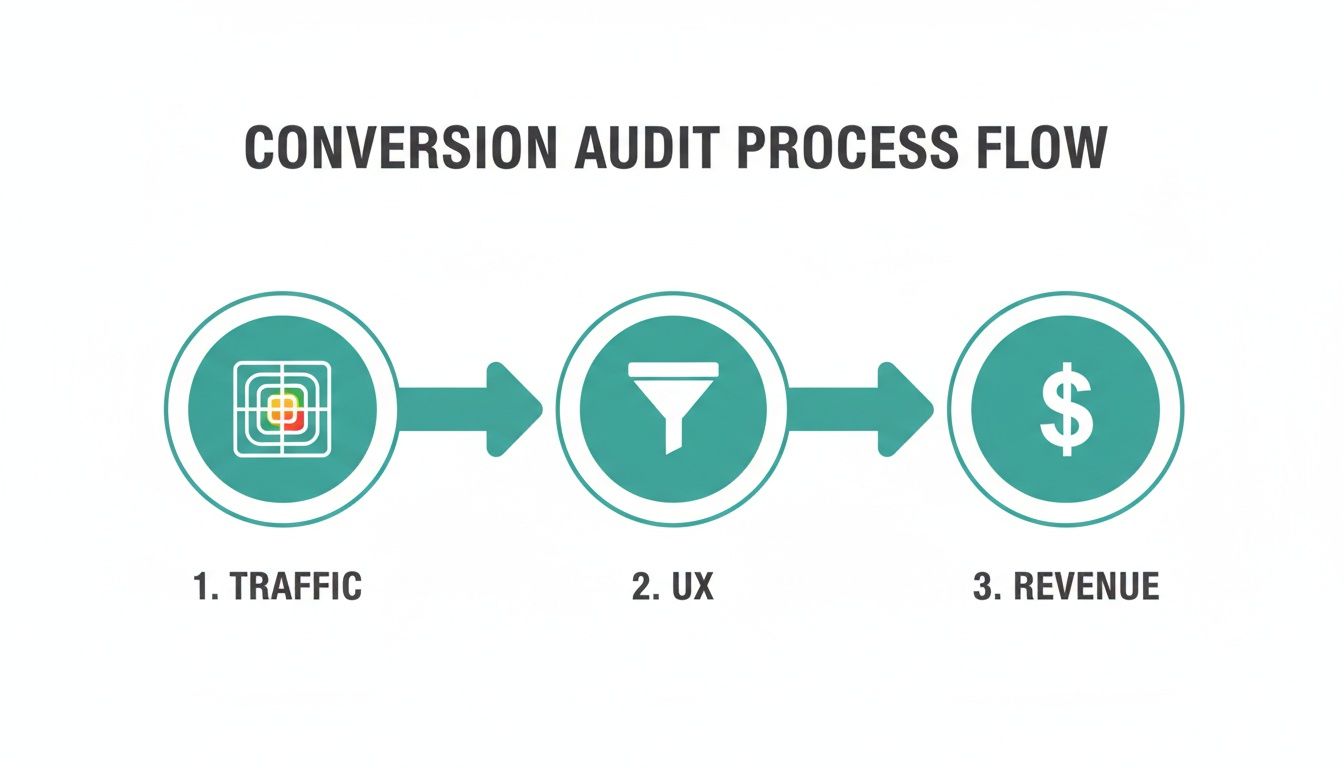
This just goes to show that every single stage of the buyer’s journey is an opportunity for improvement that a good audit will bring to light.
An audit is a survival tool. It’s a recurring process, not a one-and-done project. Think of it like rotating the tires on your car. Regular checks are essential for adapting to market shifts and making sure your strategy doesn’t become a ‘flat tire’ holding you back.
This proactive approach is critical. The digital market is projected to swell from a $531 billion baseline in 2022 to over $807 billion by 2026, and the cost of standing still is massive. Auditing helps you get ahead of rising ad costs and embrace continuous improvement. In fact, we often see that channels optimized through this process deliver up to 25% better returns. For a deeper dive, you can explore the ultimate digital marketing audit checklist from Smargasy.
Still Have Questions About Your Digital Marketing Audit?
It’s completely normal. Even with a full roadmap laid out, tackling a comprehensive digital marketing audit can feel like a massive project. But a few key clarifications can make the whole thing feel much less intimidating.
Let’s clear up some of the most common questions that pop up when business owners and marketers start digging into their own performance data. Think of this as the final piece of the puzzle, giving you the confidence to get started and turn your audit findings into real, measurable growth.
How Often Should I Actually Do One of These?
This is, without a doubt, the question I hear most often. And the honest answer is, it depends. The right frequency is tied to your industry, how fast your market moves, and the size of your business. But there’s a general rhythm that works for almost everyone.
You absolutely need to perform a deep-dive, comprehensive audit—like the one we’ve covered—at least once a year. This is your big-picture strategic check-in. It’s where you validate your long-term goals, make sure the entire marketing engine is running smoothly, and make major pivots for the year ahead.
But don’t just set it and forget it for 365 days. To stay agile, you should also plan for smaller, more focused “mini-audits” on a regular basis. For example:
- Quarterly PPC Check-in: A quick but thorough review of your ad spend, campaign results, and keyword efficiency.
- Monthly SEO Health Check: A scan for technical SEO red flags, a look at keyword ranking shifts, and a check on new backlinks.
- Bi-annual Content Review: A look at your top-performing content to find pieces that need a refresh or update.
An audit isn’t a one-and-done event; it’s a recurring health check. These smaller, consistent reviews stop minor issues from turning into catastrophic problems and help you stay ahead of the curve.
What Tools Do I Absolutely Need for a DIY Audit?
Good news: you don’t need a huge, expensive software subscription to get this done right. But there are a few non-negotiable tools for pulling the data you need. Many of them have free versions or trials that are perfect for getting started.
At a minimum, your foundational toolkit should include:
- Google Analytics 4 (GA4): This is your undisputed source of truth for all things website traffic, user behavior, conversion tracking, and audience insights. It’s free and essential.
- Google Search Console: Another free powerhouse from Google. It’s critical for understanding your organic search performance, spotting indexing errors, and seeing the exact keywords people use to find you.
- An SEO Platform: You’ll want a tool like Ahrefs or SEMrush in your corner. They’re invaluable for digging into competitor strategies, auditing your backlink profile, and running technical SEO crawls. Their site audit features alone can find critical problems in minutes.
- A Site Speed Tester: A free tool like Google PageSpeed Insights is perfect for diagnosing performance bottlenecks that hurt both user experience and your SEO rankings.
Sure, there are dozens of other specialized tools out there, but this core four will give you everything you need to audit your SEO, website performance, and conversion funnels.
I Have My Findings… Now What? How Do I Avoid Getting Overwhelmed?
Staring at a long list of problems, weaknesses, and to-dos can be paralyzing. The final audit report often looks incredibly intimidating. The key to breaking through this “analysis paralysis” is ruthless prioritization.
Not every finding is created equal.
The simplest way to handle this is to sort every single item into one of three buckets:
- Critical Fixes: These are the “house is on fire” problems. I’m talking about a broken checkout process, a major indexing error that’s blocking Google from seeing your site, or ad campaigns burning cash with zero conversions. These need to be fixed now.
- High-Impact Opportunities: These are the changes that will give you the biggest bang for your buck. Think optimizing your top 10 landing pages, plugging a major leak in your conversion funnel, or targeting a new set of high-intent keywords.
- Strategic Enhancements: These are the important, but less urgent, improvements. This bucket is for things like a long-term content refresh project, exploring a new social media channel, or building out a comprehensive backlink strategy.
When you categorize your findings this way, an action plan almost writes itself. You tackle the critical stuff immediately. Then, you build your next quarterly marketing plan around the high-impact opportunities. Suddenly, that overwhelming list becomes a clear, step-by-step roadmap.
A great digital marketing audit delivers the clarity you need to stop guessing, stop wasting money, and start accelerating growth. At Ascendly Marketing, we live for turning these data-driven insights into powerful, results-focused strategies that help businesses win in their markets.
If you’re ready for an audit that uncovers your biggest growth opportunities, schedule your free consultation with Ascendly Marketing today.