

Digital marketing includes SEO, social media, email, and paid ads. For a small business owner, this can be overwhelming. An effective approach does not require activity on every channel.
Growth comes from being in the correct places and executing specific actions. This means building a system that attracts customers and builds trust without excessive spending.
How Digital Marketing Functions as a Growth Engine
Many business owners are uncertain about which digital marketing road to take. A focused approach on a few strategies that convert online browsers into paying customers can yield results.
This guide focuses on functional methods. It is about making calculated moves. For a broader overview, you can review information on what digital marketing is and how it helps small businesses grow.
Start With the Fundamentals
Instead of distributing energy across a dozen different channels, focus on three foundational pillars. These tactics work together to create a system for attracting customers.
- Local Search Optimization: This action puts your business on the digital map. When someone nearby searches for what you offer, your business appears.
- Content Creation: This action involves sharing your knowledge. By answering customer questions and solving their problems, you become a resource.
- Community Engagement: This action means participating in conversations on social media. It is a place to listen, connect, and build relationships with people who use your products or services.
Focusing on these organic channels first is a method for long-term growth. According to industry data, leads generated from SEO and other inbound methods have a 14.6% close rate. This compares to a 1.7% close rate from outbound methods like cold calling.
When these three areas are executed correctly, they reinforce each other. Your content improves your search rank with Google. You can share that same content on social media to engage your community, which directs more people to your business. This creates a self-sustaining loop.
To provide a clear starting point, the following table outlines where to focus initial energy.
Your Initial Digital Marketing Focus
| Strategy | Primary Goal | Ideal For | Initial Effort |
|---|---|---|---|
| Local Search (Google Business Profile) | Get found by local customers | Businesses with a physical location or service area | Low |
| Simple Content Creation (Blog/FAQ) | Build trust and answer questions | Businesses with expertise to share | Medium |
| Community Engagement (1-2 Social Platforms) | Connect with your audience | Businesses where community and relationships matter | Low-to-Medium |
These are your first three actions. Once they are in motion, they will initiate subsequent, larger effects.
When you are ready to look further ahead, these 10 actionable small business growth strategies for 2026 offer insights for future planning. By adopting a focused set of digital marketing strategies, you are building a system for growth.
Winning Locally With Local SEO
Local Search Engine Optimization (SEO) makes your business visible in the digital world. The objective is to be the first business people find when they are in your area and actively searching for your offerings.
When someone nearby uses their phone to search for “coffee shop near me” or “plumber in Springfield,” you want to appear at the top of the results. Local SEO makes that happen, turning online searches into foot traffic, phone calls, and new customers.
The center of this strategy is your Google Business Profile (GBP). It is your command center on Google Search and Maps. It is a free tool that attracts customers from your neighborhood.
Your Digital Welcome Mat: The Google Business Profile
Your Google Business Profile is an interactive first impression. For many potential customers, it is their first view of your business. A well-constructed profile gives them reasons to choose you without needing to visit your website.
Properly managing this starts with claiming and setting up your profile. This step proves you are the owner and gives you control over what people see. This is a high-impact, low-cost marketing action.
Data indicates that 60% of searches are now “zero-click” due to AI-powered search results. A complete and active Google Business Profile provides an advantage. Small businesses that keep their profiles updated can gain visibility over competitors with larger ad budgets because AI search rewards this activity with prominent placement.
Turning Your Profile Into a Customer Acquisition Tool
An incomplete profile is like a closed shop. You must fill it with helpful information to draw people in. Here is how to make your profile work:
- Fill Out Everything: Do not skip any fields. Your business name, address, phone number, hours, and website are the minimum requirements. The more complete it is, the more Google understands what you do.
- Pick the Right Categories: Select a primary category that is specific to your main offering (e.g., “Italian Restaurant,” not just “Restaurant”). Then add relevant secondary categories.
- Show Off with Photos & Videos: Upload high-quality photos of your space, your products, your team, and customers. A steady stream of new visuals indicates to Google that you are active.
Your Google Business Profile functions as a mini-website on Google. The goal is to provide enough information directly in the search results that a user feels confident enough to call or visit.
Fueling Your Local SEO Engine
Once set up, the profile requires ongoing activity. This is what separates businesses at the top from others. Two actions need to be done consistently to maintain visibility.
First, get and respond to customer reviews. Reviews build trust with potential customers and send ranking signals to Google’s algorithm. New, positive reviews show you are credible.
Second, use Google Posts. These are updates that appear on your profile. You can share special offers, announce new services, or highlight an event. This keeps your profile fresh and gives people a reason to check it. To learn more about these tactics, check out our guide on what is local SEO and how it can transform your business. This consistent effort is a component of any digital marketing strategy for a small business.
Build Trust and Authority with Content

An effective way to win customers online is to become a helpful expert in your field. This is the core of content marketing. It is about building trust so that when someone is ready to buy, your business is their first choice.
The goal is to answer your customers’ questions and solve their problems. When you consistently provide useful information, you transition from a vendor to a trusted advisor.
How to Uncover Your Best Content Ideas
Effective content ideas are not found in expensive marketing tools. They are in your everyday conversations with customers. Your most frequently asked questions are a source of content.
What questions do you and your team answer repeatedly? Each one is a potential blog post, video, or social media update. As a starting point, write down a list of the top 10 questions people ask before they buy from you.
This approach creates content that solves real-world problems for your ideal customers, meeting them with the information they need. This action builds credibility.
Imagine a local plumber publishing a guide on “Fixing a Leaky Faucet in 5 Steps.” A business consultant could create a checklist titled “How to Choose the Right Software for Your Team.” This content is practical, findable on Google, and positions you as an expert.
Crafting Content That Connects
Once you have a list of topics, it is time to create the content. Different formats appeal to different people, so vary your approach.
Here are a few content formats to start with:
- “How-To” Guides: These are step-by-step articles or videos that walk someone through a task. They are often shared and attract search engine traffic.
- Checklists and Cheat Sheets: People appreciate downloadable resources that simplify tasks. A one-page PDF can be a tool for collecting email addresses.
- FAQ Blog Posts: Take a common customer question and explore it in depth. This creates a comprehensive resource that helps both your customers and your search rankings.
Quality is more impactful than quantity. One helpful article has more value than ten generic posts. Aim to create content so useful that people bookmark and share it. When companies do this, they become known for their expertise. You can see examples of thought leadership to observe how others build authority this way.
Your Content is the Fuel for Everything Else
Content is not just another task; it powers your entire marketing system. It works with all the other strategies discussed.
Consider how the pieces connect. A helpful blog post does more than exist on your website.
- It enhances your SEO. Creating content around the phrases your customers use in Google searches increases your chances of appearing in search results. This means more organic traffic.
- It supplies your social media. You now have a library of content to share. A link to your new guide gives your followers something useful.
- It improves your Google Business Profile. You can use the Google Posts feature to share snippets and links to your latest content, keeping your profile fresh for local searchers.
This creates a self-perpetuating cycle. Your content attracts traffic, your social media spreads it further, and your improved search visibility brings in more potential customers. This is how you build sustainable growth that compounds over time.
Engage in the Conversation: Social Media
Think of social media as a place where conversations are already happening. Your role is not to interrupt with advertisements but to participate and build connections.
Being active on every platform can lead to burnout. A more effective strategy for a small business is to select one or two platforms where your ideal customers spend their time and focus your efforts there. This approach shifts from “posting” to “connecting.” Social media becomes a direct line to understanding customer needs and showing the human side of your business.
Create Content People Want to See
People use social media to be entertained, learn something, or connect with others, not to see sales pitches. The content that performs best provides these experiences. It involves showing the passion behind your business.
Instead of “selling,” think about “sharing.” Here are some ideas that encourage interaction:
- Show the “How It’s Made”: Provide a look behind the scenes. Show how an order is packed, a view of your workspace, or your team preparing for an event. This content adds personality and makes your business feel more human.
- Spotlight Your Customers: If you have a customer who is satisfied with your service, feature them. A photo and a quote about their experience serve as social proof. This is more persuasive coming from a peer than from your business.
- Ask Simple Questions: This is a straightforward method. A coffee shop could ask, “What’s your go-to morning brew?” or “Espresso or drip?” This starts a conversation and provides market research.
When you use these methods, you build a community. That community becomes a marketing asset.
Use Visuals to Create Interest
For many businesses, especially those with visually appealing products or services, platforms like Instagram and Pinterest are discovery zones. Users browse these platforms for inspiration, new ideas, and products to buy. More than 80% of Instagram users state that the platform helps them discover new products and services.
Consider your feed as your digital shop window. Your task is to make users stop scrolling.
An image or video must be compelling enough to make them pause, read the caption, and feel a sense of interest. You create this desire with strong visuals and a good story.
An effective Instagram feed or Pinterest board does more than look good; it can drive sales. For an e-commerce brand, this means lifestyle shots of products in use. For a service business like an interior designer, it involves before-and-after photos. This is how a passive scroller can become an interested customer.
A 180-Day Action Plan
You have a list of digital marketing strategies. The next step is to turn them into an action plan. This 180-day roadmap breaks the process down.
This plan is about methodical implementation. Each phase builds on the previous one, creating a growth engine for your business without causing overwhelm.
Days 1-30: Laying the Foundation
Your first month is about establishing your digital presence. Focus on setting up your home base before launching campaigns.
Your two goals for this phase are:
Complete your Google Business Profile. This is your digital introduction to local customers. Claim it and fill out every section. Upload high-quality photos, and verify that your hours, address, and phone number are correct.
Pick ONE social media channel. Do not try to be on every platform. Determine where your ideal customers are online—Facebook, Instagram, LinkedIn—and commit to that platform.
This foundation is a prerequisite for what comes next. As you attract interest, you need a system to manage it. Using a Lead Management Software for Small Business early on helps organize and nurture potential customers.
Days 31-90: Content and Connection
Your digital storefront is now operational. The next 60 days are for stocking it with content and starting conversations. The goal is to demonstrate your expertise and begin building a community.
It is time to publish content and gather social proof.
Your key actions for this period:
- Publish your first two cornerstone articles. These are not just blog posts; they are in-depth resources that answer your customers’ biggest questions. Examples include a comprehensive “how-to” guide or an ultimate FAQ. These become long-term assets that generate traffic.
- Start a review-gathering system. Actively ask your satisfied customers to leave feedback on your Google Business Profile. A follow-up email or a card included with a purchase can be effective.
This is also when you will implement your social media plan, following this three-step process.
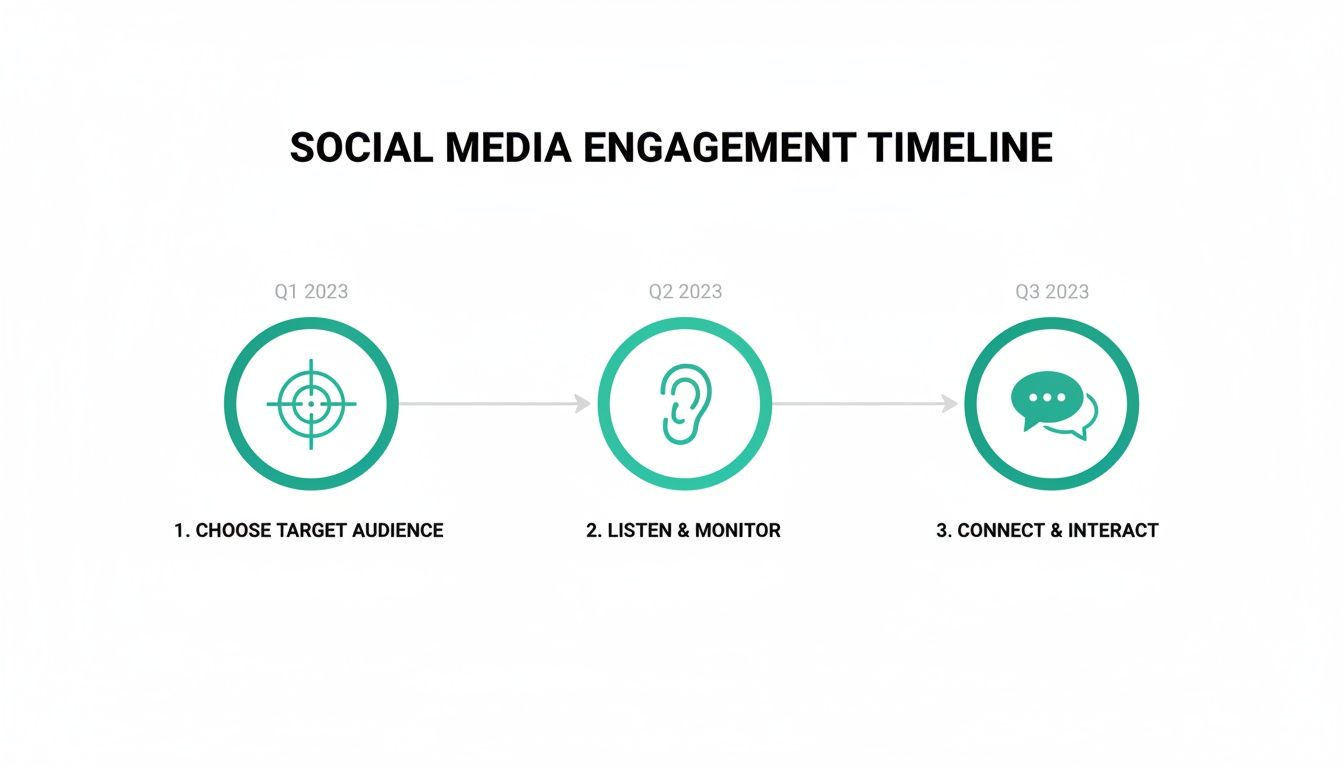
The process is: know who you are talking to, listen to what they are saying, and then join the conversation.
Days 91-180: Analyze, Refine, and Amplify
At the six-month mark, you will have data. This means you can stop guessing and start making informed decisions. This phase is about identifying what is working, concentrating on it, and finding ways to expand its reach.
You are moving from executing marketing tasks to strategically improving them.
The goal is to create a feedback loop where results from one channel inform your actions on another. For example, insights from your top-performing blog post can inspire a series of social media updates, driving more traffic back to your site.
Here’s how to do that:
- Analyze your results. Review your Google Business Profile insights. Which photos get the most views? How many people called you directly from your profile? On social media, which posts generated the most comments or shares? The answers provide your direction.
- Let data drive your content. If a guide on a specific topic performed well, create more content around that theme. If “behind-the-scenes” photos on Instagram are receiving high engagement, produce more of that content.
- Test paid ads. If a piece of content is a proven performer, it may be time to allocate a small, targeted budget to it. Promoting that post on your chosen social platform can help you reach a wider audience.
To help you visualize the journey, here is a roadmap you can follow.
Sample 180-Day Digital Marketing Roadmap
This table breaks down the process into an actionable timeline. It is a checklist for building a marketing system from the ground up.
| Phase | Focus Area | Key Actions | Success Metric |
|---|---|---|---|
| Days 1-30 | Foundational Setup | Claim/optimize Google Business Profile; select one social channel. | 100% complete GBP; social profile fully set up. |
| Days 31-90 | Content & Engagement | Publish 2 cornerstone articles; implement a review request system. | 2 pillar posts live; 5-10 new Google reviews. |
| Days 91-180 | Optimization & Growth | Analyze platform data; refine content strategy; test a small ad campaign. | Increased traffic from top content; higher social engagement rate. |
Following this path provides a structured way to build momentum. You will move from basic setup to optimization, creating a sustainable system for growth.
Measuring the Metrics That Matter
Reviewing marketing analytics can be confusing. There are charts, graphs, and numbers, but it is not always clear what they mean for your business. It is easy to feel overwhelmed by data.
The solution is not to understand every metric, but to focus on the few that signal business growth. This does not refer to vanity metrics like social media likes or follower counts, but to data showing a customer is taking a specific action. This approach turns analytics from a confusing task into a decision-making tool.
Key Metrics for Local Service Businesses
If you are a roofer, plumber, electrician, or any business serving a local area, your focus is on getting the next job. Your marketing metrics should align with that goal.
Concentrate on these two numbers:
- Phone Calls from Your Google Business Profile: This is a primary indicator. A person had a problem, searched on Google, found you, and called.
- Contact Form Submissions: This is another valuable lead. A potential customer visited your website, decided you were a good fit, and filled out your form.
These are not abstract figures; they are business opportunities. You can find this data in your Google Business Profile and your website’s backend. When these numbers increase, your business is growing.
The goal is to connect your marketing efforts to a phone call or a new email. When you can draw a direct line from an optimized profile or a new blog post to a customer inquiry, you have identified a successful formula.
Core Metrics for Online Stores
For an e-commerce brand, your website is your store. Success is about getting people to the site and guiding them to checkout. While there are many things to track, focusing on three can support business growth.
These are the three legs of the stool that support your online store.
- Website Traffic: How many people are visiting your digital shop? Where are they coming from? Knowing if your visitors are finding you through social media, Google, or email tells you which marketing channels are working.
- Conversion Rate: This is the percentage of visitors who make a purchase. A low conversion rate can indicate an issue with your product pages, pricing, or checkout process. A typical e-commerce conversion rate is around 2-3%.
- Average Order Value (AOV): This is the average amount a customer spends in a single transaction. Encouraging customers to add one more item to their cart with bundles or upsells is a way to increase revenue without needing more traffic.
You can track all of this for free using Google Analytics 4. Monitoring your traffic, conversion rate, and AOV will give you a clear picture of your business’s performance and what actions to take next.
Your Digital Marketing Questions Answered
Let’s address common questions about starting with digital marketing.
How Much Should I Budget for Digital Marketing?
There is no single number, but a general guideline is to allocate 5-10% of your total revenue to marketing.
When starting, your time is your most valuable asset. Before spending money on ads, focus on “free” activities. Maximize your Google Business Profile, implement a system for collecting reviews, and create helpful content. This is “sweat equity.” Once these efforts produce results, you can reinvest some of the new profit to accelerate growth.
How Long Does It Take to See Results?
Digital marketing is a long-term effort. While an ad can provide a quick result, sustainable growth comes from consistency over time.
- Local SEO: After optimizing your Google Business Profile and getting new reviews, you can expect to see changes in local search results within 30-90 days.
- Content Marketing: Getting a new blog post to rank in search results and generate steady traffic takes longer. It typically takes 6-9 months for content to start producing consistent results.
It is useful to watch for small indicators of progress. Are you getting more calls from your Google profile? Are people spending more time on your website? These are signs that you are on the correct path.
Do I Really Need a Website if I Have Social Media?
Yes. Your social media profiles are rented spaces. The platform owner can change the rules or even remove your account.
Your website is an asset you own. It is your digital headquarters, the one online space you completely control. It is where you establish your expertise, collect leads, and convert visitors into customers on your own terms.
The team at Ascendly Marketing builds customized marketing plans that drive traffic, generate leads, and increase revenue. Get your free consultation today!