

A successful digital marketing strategy for B2B does not begin with an ad campaign or a series of social media posts. It starts with understanding the customer.
This initial work separates campaigns that generate high-value leads from those that do not.
Building Your B2B Marketing Foundation

Starting a strategy without defining your audience is directionless. The first step is to focus on the customer, not the product.
This action requires defining the companies you serve and identifying the decision-makers within those companies.
From Broad Strokes to a Razor-Sharp ICP
Your Ideal Customer Profile (ICP) is a detailed description of the company type that fits your product or service. This profile extends beyond industry and employee count.
To build your ICP, analyze your existing clients. Identify the common characteristics among your most profitable clients.
- Company Size: Are your top clients companies with 50-200 employees, or are they enterprises with over 1,000? Be specific.
- Industry & Niche: Do they operate in a specific sector like SaaS, logistics, or healthcare? Specify the niche.
- Revenue: Is there an annual revenue range where companies find your solution most effective?
- Tech Stack: Do they use a common set of tools or platforms? Perhaps they have moved from a competitor’s system.
Your CRM contains this data. A well-managed system functions as the central hub for your marketing operations, tracking every interaction. The relationship between CRM and digital marketing is symbiotic; analyzing this data provides the evidence needed to construct an ICP based on facts.
Focusing your digital marketing strategy for B2B on a well-defined ICP stops resource allocation to companies that will not convert. This precision is the initial move toward an efficient and profitable marketing operation.
Giving Your ICP a Human Face with Buyer Personas
You know the company type. Who are the individuals you need to convince? This is the function of buyer personas. In B2B sales, you often sell to a committee, where each member has different objectives.
A typical software sale might involve these roles:
- The User: This is the Marketing Manager. They use the tool daily and are concerned with features, workflow, and usability.
- The Decision Maker: This could be the VP of Marketing. They focus on ROI, team productivity, and the solution’s impact on the bottom line.
- The Blocker (or Influencer): This is the Head of IT. They are concerned with security, data privacy, and integration challenges, not features.
Each of these personas has different problems, goals, and questions. Your marketing must address all of them.
How to Uncover Persona Insights
Creating these personas is investigative work. It combines data with human intelligence.
Your sales and customer success teams are valuable sources of information. They interact with customers daily. Ask them pointed questions:
- Common Objections: What are the top three reasons a deal stalls or a prospect declines?
- Trigger Events: What event typically causes a company to seek a solution like yours? For example, a new funding round, a key hire, or a failed audit.
- Success Metrics: How does this person measure their success? What KPIs are they responsible for?
- Watering Holes: Where do these individuals spend time online? Which blogs do they read, what podcasts do they listen to, and which LinkedIn influencers do they follow?
When you combine this field intelligence with data from tools like LinkedIn Sales Navigator, you create a multi-dimensional picture of your buyers. You will understand their challenges, their goals, and how to position your product as the solution. This forms the foundation of a functional B2B digital marketing strategy.
Picking Your B2B Marketing Battlegrounds

You know who to reach. Where will you find them? A successful digital marketing strategy for B2B involves selecting channels where your ideal customers are active.
Consider it a coordinated effort. Each channel has a role, and they must work together. Insights from one channel will improve the others, increasing your return on investment.
The Core of B2B Lead Generation
In the B2B sector, lead generation typically relies on SEO, content, and paid advertising. This combination drives most lead generation systems. Each element serves a different function, but they are interconnected.
Search Engine Optimization (SEO) is a long-term strategy that builds a foundation for organic traffic. When a potential client searches for a problem your business solves, SEO positions your website as the answer. It is about earning trust from both users and search engines over time.
Pay-Per-Click (PPC) advertising provides immediate results. While SEO builds momentum, PPC places you in front of active buyers now. Platforms like Google Ads or LinkedIn allow you to target specific job titles who are searching for a solution.
SEO and PPC work together. When a keyword performs well in PPC campaigns, it signals an opportunity to build an SEO content strategy around that term. This eliminates guesswork by using proven data.
Content as Fuel, Social as Amplifier
Content marketing empowers your SEO and PPC campaigns. It provides the “why” behind the click, allowing you to demonstrate expertise and convert a visitor into a lead. For B2B, this means creating genuinely useful resources.
Effective formats include:
- In-depth blog posts that address specific customer problems.
- Whitepapers and eBooks that offer data-backed insights in exchange for an email address.
- Case studies that narrate a story and show real-world results for similar companies.
- Webinars that allow direct connection with your audience and establish brand authority.
To improve your search presence and attract organic traffic, you need to build authority. Exploring SEO link-building strategies, such as guest posting and identifying broken links on other sites, is an effective method. The more quality links you acquire, the more credible Google perceives your site to be.
Integrating with LinkedIn and Email
For B2B professionals, LinkedIn is the digital meeting place. It is a platform for sharing expert content, participating in industry discussions, and running highly specific ad campaigns targeting the companies and job titles on your list. With over 60% of buyers researching new vendors on social media, its presence is necessary.
Finally, email marketing connects all these elements. It is the method for following up with leads generated from your content, SEO, and PPC efforts.
With email automations, you can:
- Welcome new subscribers with a series of your most educational content.
- Segment your list to send relevant information to each group.
- Guide prospects through a long sales cycle, building trust with each email.
When all these components are integrated, they create a seamless customer journey. A CTO might discover you through a blog post found on Google, see a LinkedIn ad for your webinar a few days later, and then receive a series of emails that lead to booking a demo. This indicates your marketing system is operating effectively.
Weaving AI and Tech into Your B2B Game Plan
The future of B2B marketing is occurring now, driven by artificial intelligence. Integrating AI into your digital marketing strategy for B2B provides a competitive advantage by enabling smarter work.
AI tools are transforming the B2B approach. They handle tasks from creating personalized content at scale to predicting which leads are ready for contact. This is not about replacing your team but about freeing them from repetitive tasks to focus on strategy and creative problem-solving.
Let AI Handle the Heavy Lifting with Automation and Personalization
Marketing automation is the core of modern B2B campaigns, and AI enhances its capabilities. AI can analyze large datasets to identify behavioral patterns, enabling a high level of personalization.
Consider the possibilities. Your system could automatically send a prospect a case study that addresses an objection they raised during a demo. Your website could dynamically change its content based on a visitor’s industry or browsing history.
Here is how AI can assist with daily marketing tasks:
- Content Creation: Tools can brainstorm blog topics, draft outlines, write social media posts, and create video scripts. This allows you to produce more content and maintain your pipeline without sacrificing quality.
- Lead Scoring: AI analyzes numerous signals, such as website visits, email opens, and firmographic data, to create a dynamic lead score that learns and improves over time. This provides your sales team with a clear signal on who to contact immediately.
- PPC Campaign Management: AI algorithms can manage ad bids, A/B test copy, and reallocate budget between campaigns in real-time, ensuring every dollar spent is maximized for return.
AI-powered personalization is more than inserting a first name into an email. It is about delivering the right message on the right channel at the right time, all orchestrated by an intelligent system.
Implementing these systems creates an efficient and effective workflow. You can learn more about building these flows in our guide on marketing automation for B2B.
Getting Ahead in the New World of GEO
As AI tools like ChatGPT become more common, the way B2B buyers search for information is changing. They are asking complex questions, not just searching for keywords. This shift has created a new field: Generative Engine Optimization (GEO).
GEO involves optimizing your digital presence so that AI models cite your brand, content, and products as the primary answer. The objective is to become the trusted source the AI recommends.
To succeed at GEO, a multi-faceted approach is needed:
- Top-Tier, Expert Content: Double down on creating comprehensive, well-researched content that thoroughly answers your audience’s questions.
- Structured Data: Use schema markup on your site to provide AI engines with the context needed to understand your content, including product specifications, author bios, and company information.
- Brand Authority: Build a solid online reputation. This involves obtaining mentions in credible publications, accumulating positive reviews, and being an active participant in your industry’s online communities.
You Need an AI Rulebook
Using generative AI without a plan introduces risks. An ungoverned approach can lead to legal issues, brand damage, and security breaches.
The data is clear. By 2026, 45% of B2B content marketers are projected to increase their spending on AI tools. Forrester warns that without proper guidelines, chaotic generative AI use could result in over $10 billion in losses for B2B companies. With 94% of B2B buyers having used large language models for research in 2025, GEO is no longer optional. More data can be found in a comprehensive B2B marketing statistics report from Originality.ai.
Establishing a clear AI governance policy is a business necessity. This framework should define:
- Acceptable Use: What AI tools are approved, and for what specific purposes?
- Data Privacy: What company or customer data is prohibited from use in third-party AI platforms?
- Fact-Checking and Oversight: All AI-generated content must be reviewed by a human for accuracy and brand voice before publication.
By establishing these rules, you can use the efficiency of AI without compromising your company’s integrity or security. It is a balanced approach that allows you to scale growth while delivering a trustworthy customer experience.
Executing Your Lead Generation and Nurturing Plays
Attracting website visitors is only the beginning. B2B marketing succeeds when that traffic is converted into a predictable pipeline of opportunities for your sales team. This is where the focus shifts from attracting to converting.
We will build the system to capture leads and guide them from initial interest to purchase readiness. It starts with creating lead magnets so valuable that your Ideal Customer Profile will exchange their email for them.
Consider their perspective. Someone in the early stages of problem awareness will be interested in a broad industry report. A prospect actively comparing solutions will look for a detailed case study or a product comparison. The key is to match the lead magnet to their stage in the buying journey.
Designing High-Converting Lead Magnets
You need to offer something genuinely useful to obtain an email address.
Here are a few formats that work well in B2B:
- In-depth Whitepapers and eBooks: This is an opportunity to establish thought leadership. Go deep on an industry problem with original research or a new perspective.
- Exclusive Webinars: A live webinar can be effective for demonstrating your product or hosting an expert panel. This builds authority and provides a list of engaged attendees.
- Data-Rich Case Studies: Proof is important. A case study tells a story: “Here is a problem you may have, and here is how we solved it for a similar company, with real numbers to support it.”
- Templates and Checklists: Provide something for immediate use. An SEO audit checklist or a content calendar template offers practical value without a sales pitch.
Building Automated Nurturing Sequences
You have the email. Now the relationship-building process begins. This is not about sending sales messages but about building trust through a series of automated emails. The goal is to educate and guide them forward.
Imagine a new lead has downloaded your latest whitepaper. Your automated sequence could be:
First, an email arrives immediately with the download link. This demonstrates reliability.
A few days later, a follow-up email provides a link to a related blog post or a short video. You are adding value and continuing the conversation.
Then, you might share a case study that connects the problem discussed in the whitepaper to how your product solves it. This introduces your solution in a helpful context.
Finally, instead of a direct “Book a Demo!” call to action, you offer a softer next step, like an invitation to your next webinar.
The key to effective nurturing is relevance. Segment your audience based on what they downloaded or which pages they visited. This makes every email feel like a personal recommendation, not a generic marketing message.
Here is how AI can help streamline the entire process, from content creation to ensuring it gets found.
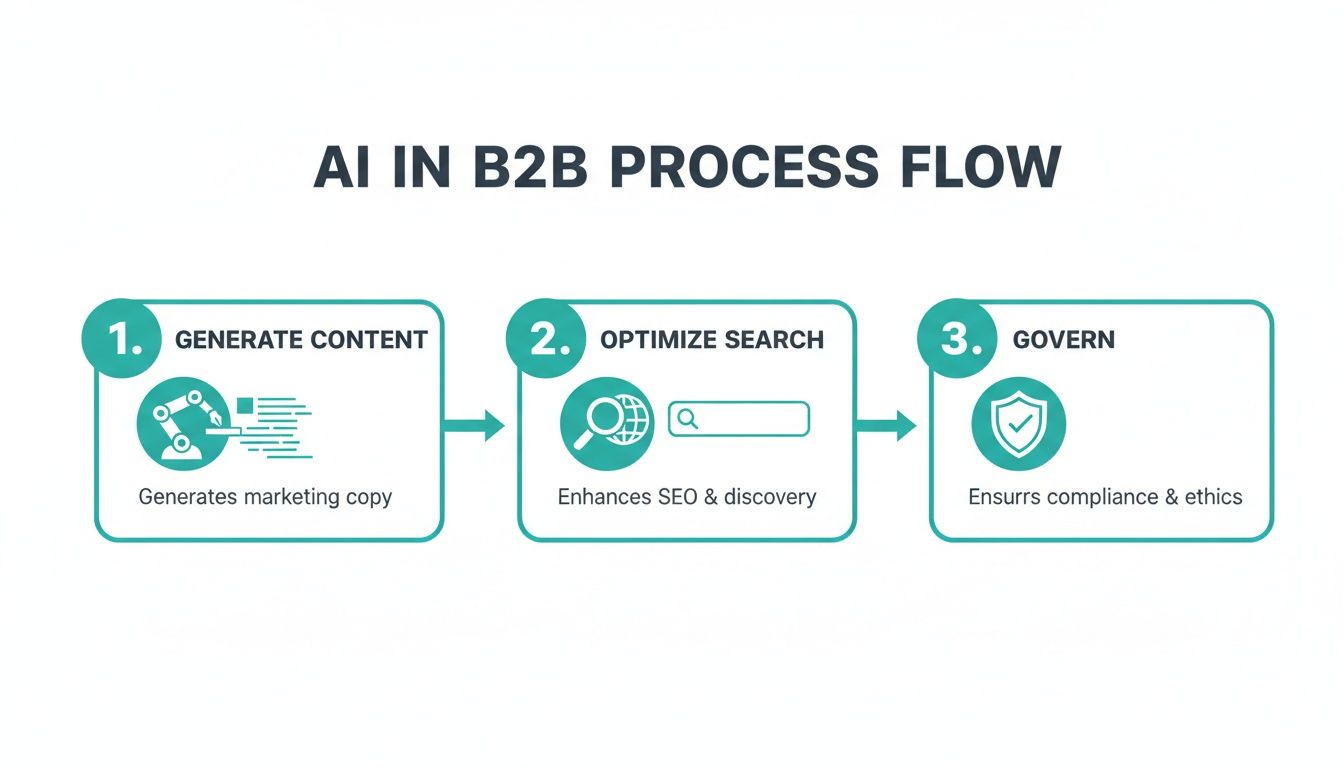
This workflow demonstrates how AI can assist with creating the right content, optimizing it for search engines, and maintaining brand consistency and accuracy. It is a modern approach to scaling these efforts.
Pinpointing Sales-Ready Leads with Scoring
How do you differentiate window shoppers from leads ready to talk to sales? Lead scoring is the method. It is a point system that tracks a prospect’s every action.
You will assign points based on who they are and what they do:
- Demographics: A “VP of Marketing” at a 500-employee tech company is a high-value profile. An intern from a non-target industry is not.
- Engagement: Actions indicate interest. Visiting your pricing page might be +15 points. Watching an entire webinar could be worth +25 points. Opening an email earns a few points (+2 points).
Once a lead’s score reaches a certain threshold, for example, 100 points, they become a Marketing Qualified Lead (MQL).
At that point, an alert is automatically sent to your sales team with a complete history of that lead’s activity. This data-driven handoff changes the process. It means sales is not contacting cold leads; they are calling educated, engaged prospects who are already close to a “yes.”
Measuring Success and Optimizing for Revenue
A B2B digital marketing strategy requires constant fine-tuning based on real-world data. Success is measured by revenue, not by metrics like likes or impressions.
This is where marketing is demonstrated as a revenue-driving machine, not a cost center. We will focus on the numbers that gain the attention of your CFO.
Key Metrics that Matter
To justify your budget and demonstrate value, you need to track metrics that directly relate to the company’s bottom line. These three metrics reveal the financial impact of your efforts.
- Customer Lifetime Value (CLV): This is the total profit you expect from a single customer over their entire relationship with you. Knowing your CLV determines how much you can spend to acquire a new customer while remaining profitable.
- Customer Acquisition Cost (CAC): This is the total cost of marketing and sales to acquire one new customer. A primary rule is to keep your CAC significantly below your CLV. Spending $5,000 to acquire a customer worth $50,000 is a positive result.
- MQL to SQL Conversion Rate: This percentage indicates how many of your “Marketing Qualified Leads” are accepted by the sales team as “Sales Qualified Leads.” A high rate signals that marketing and sales are aligned and targeting the right audience.
When you manage these three numbers, you have a clear picture of your marketing’s financial health. They show efficiency, profitability, and the effectiveness of your lead-generation system.
Building Your B2B Marketing Dashboard
A marketing dashboard should be your single source of truth, consolidating all important data into one command center. It provides an at-a-glance view of all activities, enabling faster, smarter decisions.
Dashboards should be tailored to your specific goals, but organizing them by the marketing funnel is an effective structure.
Top of Funnel (Awareness)
- Website Traffic by Source (Organic, Paid, Social, etc.)
- Keyword Rankings for high-value terms
- Social Media Reach and Engagement
Middle of Funnel (Consideration)
- Gated Content Downloads (whitepapers, webinars)
- Cost Per Lead (CPL) for each channel
- Email Open and Click-Through Rates
Bottom of Funnel (Decision)
- Marketing Qualified Leads (MQLs) Generated
- SQLs Accepted by the sales team
- Demo Requests and “Contact Us” form submissions
A good dashboard does more than display numbers; it tells a story. It helps you identify where the customer journey is failing. A large drop-off between website visits and lead sign-ups is a signal to investigate the cause.
Tying It All Back to Revenue
Which marketing touchpoint gets credit for a sale? Was it the blog post read six months ago, the LinkedIn ad clicked last week, or the webinar attended yesterday? Answering this question is revenue attribution, and it is how you identify your most effective channels.
For example, your data might show that while PPC ads generate many leads, those from organic search have a higher closing rate and a larger average deal size. This insight is valuable. To fully understand this, you need to know how to calculate marketing ROI.
This creates a feedback loop for continuous improvement.
You measure your performance against your KPIs in the dashboard. Then, you analyze the results to see what is working and what is not. Finally, you optimize by reallocating your budget from underperforming channels to successful ones.
This cycle ensures your B2B marketing remains agile, effective, and focused on driving profitable growth. Your marketing department becomes a predictable, scalable source of revenue.
Answering Your B2B Marketing Questions
You have a strategy document. But real questions arise during implementation. “How much will this cost?” “What if it does not work?” “How long until we see results?”
These are common concerns for marketers. Let’s address some of the main ones.
How Do I Figure Out a Realistic B2B Marketing Budget?
A common benchmark is to allocate 7-10% of your projected annual revenue for marketing. For startups or smaller companies, this figure may not be feasible.
A practical approach is to work backward from your goals. Determine what a customer is worth over their entire relationship with your company (their Lifetime Value, or LTV). That figure informs how much you can reasonably spend to acquire them (your Customer Acquisition Cost, or CAC).
If you are still unsure, start with a pilot program.
- Allocate a modest, controlled budget to one or two channels you are confident in, such as targeted LinkedIn Ads or foundational SEO content.
- Track every dollar and measure the return carefully.
- Use this hard data to build a case for a larger budget with your finance team.
Always frame your budget requests around business outcomes. Do not ask for money for “marketing.” Ask for the funds needed to “generate 50 qualified leads” or “influence $200,000 in the sales pipeline.”
This approach transforms marketing from a cost center into a growth engine.
What is the Single Biggest Mistake B2B Companies Make?
A significant mistake is a disconnect between the sales and marketing teams. Marketing generates leads and passes them to sales, only to be told they are poor quality. This wastes effort, time, and money.
This problem often starts with an unclear Ideal Customer Profile (ICP) and no shared definition of a quality lead. If marketing and sales are not aligned, your efforts are ineffective.
To fix this, involve sales in strategy planning from the beginning. Document and agree on a lead handoff process. Use a shared CRM for full transparency. Schedule regular meetings to review lead quality and campaign results. This keeps both teams aligned.
How Long Until B2B Content and SEO Work?
Patience is required. Unlike PPC ads that can generate traffic immediately, content and SEO are long-term strategies. You are building a permanent brand asset.
Realistically, initial progress should be visible in about 3 to 6 months. This will appear as improved keyword rankings and a slight increase in organic traffic. It is a sign you are on the right path.
The full benefit, a consistent flow of high-quality inbound leads, usually takes 6 to 12 months to materialize, sometimes longer. The timeline depends on your industry’s competitiveness, your website’s current authority, and how consistently you publish valuable content.
Ready to stop guessing and start growing? The team at Ascendly Marketing builds data-driven digital marketing strategies that deliver measurable results. Let’s talk about how we can accelerate your revenue. Get your free consultation.