

A digital marketing strategy for startups is a plan to find product-market fit by testing, learning, and focusing on effective tactics while managing budget.
Laying the Groundwork: The Discovery Phase

Executing marketing tactics without a plan can lead to inefficient spending. The initial discovery phase establishes a foundation by replacing assumptions with facts about customers and the market. An E-commerce Brand Strategy can align all marketing communications, including tweets, blog posts, and emails, to convey a consistent message.
Nail Your Product-Market Fit
The main goal for an early-stage startup is to achieve product-market fit (PMF). PMF occurs when a specific group of people needs a product and is willing to pay for it. PMF does not require a feature-complete product. It requires solving a problem so effectively that early users see it as indispensable.
How do you find it? You listen.
Your first users provide valuable feedback. Every comment, complaint, and feature request offers a clue about market demand.
A startup’s marketing focus should be on solving a customer’s problem. The marketing then communicates that solution.
Conduct calls and send personal emails to these early users. Ask open-ended questions like, “What were you using before our product?” or “If this product were unavailable tomorrow, what would you miss?” This process uncovers the “job” they hired your product to do.
Go Deep on Your Customer Profiles
After understanding the problem, you must understand the people who have it. Basic demographics like age and location are starting points. To connect with your audience, build customer profiles, also known as buyer personas, that represent real people.
A useful persona answers questions such as:
- Motivations: What are they trying to achieve in their life or career?
- Frustrations: What issues cause them regular annoyance?
- Behaviors: Which online platforms do they use, such as LinkedIn, Reddit, or TikTok? What blogs, podcasts, or influencers do they follow?
- Watering Holes: Identify the specific subreddits, Slack communities, or Facebook groups where they discuss topics and seek advice.
This information informs what message will resonate, which channels to use, and how to create content that captures their attention. A content marketing plan template can help organize these insights.
To gather this information, conduct research. Below is a comparison of common customer research methods for startups.
Customer Research Methods Comparison
| Method | Pros | Cons | Best For |
|---|---|---|---|
| 1-on-1 Interviews | Deep qualitative insights; builds relationships. | Time-consuming; not scalable. | Early-stage validation; understanding “why.” |
| Surveys | Scalable; provides quantitative data. | Low response rates; can lack nuance. | Gauging sentiment; prioritizing features. |
| Community Mining | Unfiltered, honest opinions; often free. | Can be a time sink; context is needed. | Finding customer language; identifying pain points. |
| User Testing | Observe how users interact with your product. | Requires a functional product/prototype. | Uncovering usability issues; validating workflows. |
Each method provides a different piece of information. Combining interviews for qualitative understanding and surveys for quantitative data can be effective for startups.
Scope Out the Competition
No startup operates without competitors. You need to identify your competition, understand their strategies, and find their weaknesses. This is not about imitation; it is about finding a market opening.
Use tools to analyze their SEO, examine their ad campaigns, and read their customer reviews. Focus on the complaints. A competitor’s negative review can present an opportunity for your startup.
By identifying what the competition overlooks, you can define a niche and position your startup as the solution for a specific, underserved audience. This initial work directs time and money toward areas with the highest potential impact.
Stop Chasing Vanity Metrics: Set Goals That Build Your Business

Vague objectives like “getting more traffic” or “going viral” are not strategies and can deplete a startup’s resources without tangible results. A digital marketing strategy for startups requires defining measurable success metrics. This process turns business ambitions into specific targets that guide your actions.
From Vague Hopes to SMART Goals
The SMART framework helps ensure marketing goals are well-defined.
Consider this comparison:
- The Vague Hope: “We need more leads this quarter.”
- The SMART Goal: “Generate 200 marketing-qualified leads (MQLs) from our organic blog content in Q3. This will be achieved by publishing eight new search-optimized articles and promoting them through our weekly email newsletter.”
The second goal is Specific (200 MQLs from the blog), Measurable (trackable in a CRM), Achievable (eight articles is a manageable workload), Relevant (MQLs contribute to the sales pipeline), and Time-bound (by the end of Q3). The team now has a clear objective.
Pick KPIs That Tell the Real Story
After setting a goal, select Key Performance Indicators (KPIs) to monitor progress. Tracking too many metrics can lead to “analysis paralysis,” where data overload prevents clear decision-making.
Focus is a key asset. The right KPIs depend on your startup’s current stage.
Your KPIs are your startup’s vital signs. Tracking the right ones shows if your marketing engine is healthy or needs adjustment.
Consider your startup’s stage:
- Early-Stage (Getting Noticed): At this point, your brand is unknown. Metrics revolve around social media reach, website traffic, brand search volume, and the number of quality backlinks earned.
- Growth-Stage (Getting Customers): You have some visibility; now the focus is converting attention into revenue. Obsess over your lead-to-customer conversion rate, cost per lead (CPL), and your overall customer acquisition cost (CAC).
- Scale-Stage (Getting Efficient): Growth is occurring, but is it profitable? The focus shifts to efficiency. Monitor your customer lifetime value (LTV) and ensure a healthy LTV: CAC ratio (a 3:1 ratio is a good benchmark).
The final measure of marketing success is its contribution to company revenue. A guide on how to calculate marketing ROI provides more detail on this topic.
Your At-a-Glance Dashboard (Keep It Simple)
You do not need a complex business intelligence platform to start. An organized Google Sheets file or a basic Google Analytics dashboard is sufficient.
The dashboard should answer these questions weekly:
- Where is our traffic coming from?
- What are people doing on the site?
- Are we generating leads or sales?
- What is our customer acquisition cost?
Focusing on a few metrics directly linked to your SMART goals creates a feedback loop. This allows you to see what is working, stop what is not, and guide your startup’s marketing efforts.
Choosing Your Channels From The Startup Marketing Arsenal
A startup’s budget must be managed carefully. Spreading it across many marketing channels can be inefficient. This “spray-and-pray” approach is a way to deplete cash quickly.
Instead, be surgical. Select one or two channels where your target audience is active and concentrate your efforts there. This approach builds the momentum needed to scale later.
SEO vs. PPC: The Startup Dilemma
Founders often face a choice between Search Engine Optimization (SEO) and Pay-Per-Click (PPC) advertising. Both target users on search engines like Google, but their methods differ.
- PPC offers speed. A campaign can be launched in the morning and generate traffic and data by the afternoon. This is a fast way to test messaging, gauge product interest, and identify which keywords convert users into customers.
- SEO is a long-term strategy. Building a site’s authority and improving organic rankings takes months. Once your site ranks on the first page, it provides a sustainable source of traffic, which can reduce customer acquisition costs over time.
For many startups, a combined approach is effective. Use PPC for immediate feedback and early wins, while simultaneously investing in foundational SEO to build a long-term asset.
The question is not “SEO or PPC?” It is “How can they work together?” Use data from paid ads to identify high-performing keywords, then focus SEO and content efforts on ranking for those terms.
Content and Email: The Heart of Your Customer Relationship
If SEO and PPC are about getting found, content and email are about building the relationship that follows. This is how you convert a curious visitor into a loyal customer.
Content marketing demonstrates your expertise. By creating helpful blog posts, guides, or videos that address your audience’s problems, you build trust and establish yourself as an authority.
Email is your direct line to your most valuable audience. It is used to nurture leads, share product news, and encourage repeat purchases. Your email list is a marketing asset you own, unaffected by algorithm changes.
Social Media and Niche Communities
Social media is a significant channel. The global social ad market is projected to increase by another 12% in 2026. A 2024 study by Sprout Social shows that 76% of users report social content has directly influenced a purchase, a figure that rises to 90% for Gen Z. This trend also impacts influencer marketing, with a 2024 Influencer Marketing Hub survey indicating 59% of brands plan to increase their influencer budgets this year.
Beyond large platforms like TikTok or Instagram, small, passionate online communities are valuable. Exploring Reddit marketing strategies can connect you with specific groups where your ideal customers seek advice and provide honest feedback. These are your watering holes.
To understand all the options, our guide on the types of digital marketing for SMB growth breaks down the different channels available.
The strategy is to go deep, not wide. Choose one or two channels where your ideal customers are active. Master them. Become a recognized presence in your niche on that platform. Once you have built a predictable, scalable engine, you can expand.
Time to Roll Up Your Sleeves: Putting Your Marketing Plan into Action
A marketing strategy is only valuable when implemented. Results come when plans are put into action. Many startups get stuck in “analysis paralysis,” attempting to create a perfect long-term plan. Instead, enter the market and start learning what resonates with your audience now.
Map Out Your First 90 Days
Think in 90-day sprints instead of year-long roadmaps. This timeframe is long enough to execute meaningful projects yet short enough to force focus on what matters. Your goal is to create a simple, dynamic document that tracks activities, timelines, and success metrics.
Here is a practical example:
- Month 1 (Foundation & Quick Wins): Launch your first Google Ads campaign targeting high-intent, “ready-to-buy” keywords. Concurrently, publish your first two foundational blog posts targeting valuable long-tail SEO questions.
- Month 2 (Content & Engagement): Identify which ads are performing well. Double down on the messaging from your successful ads. Begin distributing your blog content through a new email newsletter and engage in two or three niche Reddit communities where you can contribute insights.
- Month 3 (Analysis & Scaling): Analyze the data. Which channels generated the best leads, not just the most clicks? Use these learnings to adjust your budget for the next 90-day sprint. You might pause underperforming ads to fund another in-depth article.
This process is a continuous feedback loop. What you learn from one channel informs the strategy for another.
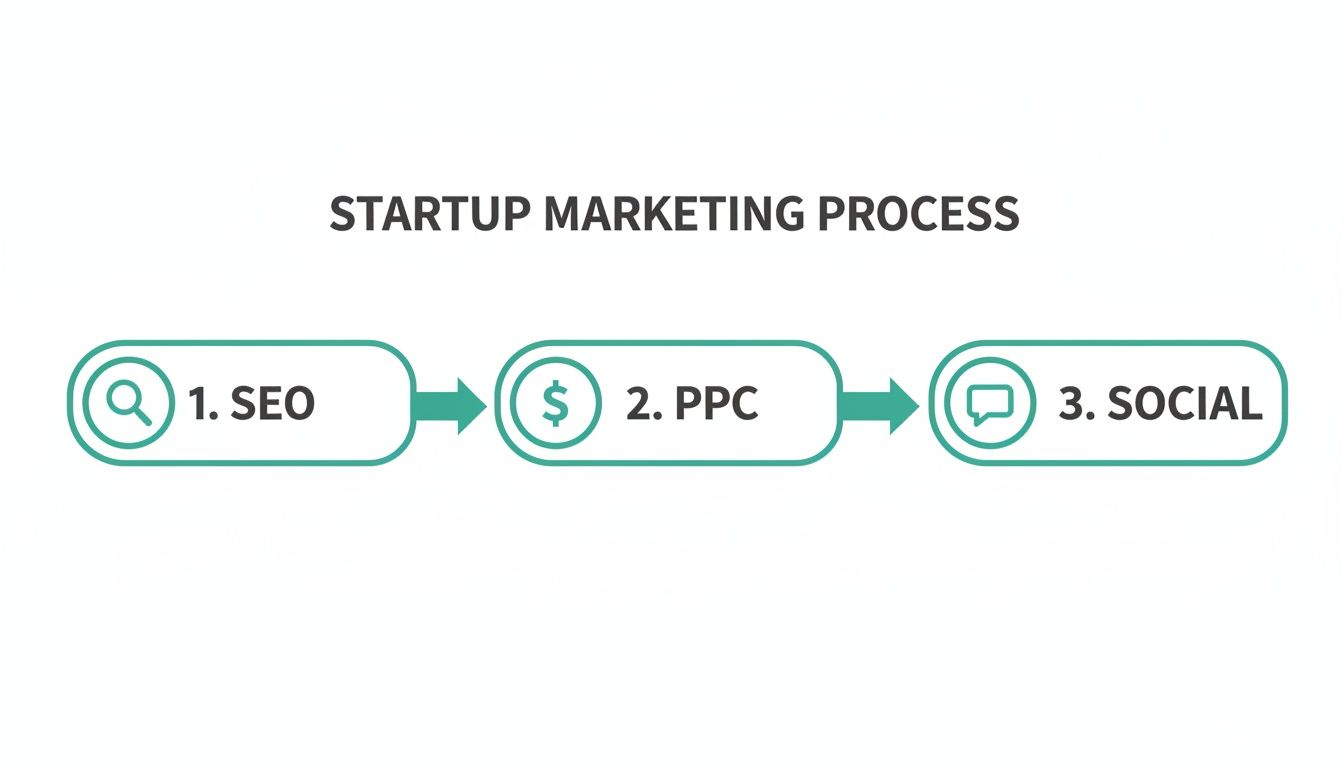
The keywords that convert effectively in your PPC campaigns indicate which topics to focus on for your SEO strategy.
Small Bets and Agile Experiments
Before committing the entire marketing budget to a single large campaign, test your assumptions. Startup success is often built on validated learning, and your marketing should follow the same principle. Small, controlled experiments help de-risk your strategy.
If you are unsure which headline will be more effective, run a simple A/B test with a small ad budget or a segment of your email list.
If you are wondering which call-to-action button will generate more demo bookings, test two versions on your main landing page. A 2023 HubSpot survey found that 88% of marketers use analytics tools to make data-driven decisions.
The purpose of your initial campaigns is not just to succeed, but to learn. Each dollar spent should yield data.
Live by the Build-Measure-Learn Feedback Loop
This concept from the lean startup methodology is an engine for continuous improvement. It is a simple cycle that keeps your marketing grounded in real-world results.
Here is how to apply it:
- Build: You take action. Launch an ad campaign, publish a blog post, or send an email sequence. You have a hypothesis, for example: “This ad will achieve a 2% CTR.”
- Measure: You track the real-world performance—click-through rates, conversion rates, cost per lead. What actually happened? Did you get a 2% CTR, or was it 0.5%?
- Learn: This is the analytical part. You investigate the “why.” Why did one ad perform better than others? Why was a post on a seemingly niche topic widely shared? The gap between your hypothesis and the actual result is where valuable insights are found.
The insights from the “learn” phase inform the “build” phase of your next experiment. This turns marketing from guesswork into a methodical process of continuous improvement. This disciplined loop is what can separate growing startups from those that remain stagnant.
Scaling Smart With Advanced Tactics And AI

You have found early adopters and generated initial interest. The next challenge is scaling your marketing without a corresponding explosion in your budget. This involves moving from manual execution to building efficient systems.
First, move beyond manual processes. Marketing automation helps nurture leads from initial interest to purchase without manual intervention for every email. This frees your team to focus on strategy instead of repetitive tasks.
At the same time, build a content engine, not just occasional blog posts. This means creating a system where each piece of content builds upon the last, generating increasing organic traffic and establishing your authority.
Embracing AI in Your Startup Marketing
Artificial intelligence is a core part of a startup’s marketing toolkit in 2026. It allows a small team to achieve results disproportionate to its size. AI is a tool for personalizing experiences, improving team efficiency, and making data-driven decisions.
AI has reshaped marketing and is becoming a differentiator between companies that scale and those that do not. According to a 2024 Salesforce report, 42% of marketing professionals are already using AI to create more personalized content. This aligns with customer expectations, as a 2023 McKinsey study found that 73% of customers expect personalized interactions.
The benefits extend to internal operations. A 2024 IBM survey reports that 64% of companies use AI to improve workflow efficiency. With 71% of marketers planning to increase their AI investment, as noted by Gartner in 2024, the trend is clear. You can find more on these trends by learning more about the 2025 digital marketing landscape on brandpipal.com.
This technology allows a small team to accomplish tasks that once required a larger group of specialists.
The value of AI for a startup is not just in speed, but in enabling smarter actions that were previously impractical, such as predicting which leads are most likely to convert or tailoring a website to each visitor in real time.
Consider using AI for a few high-impact tasks:
- Predictive Lead Scoring: AI models can analyze past customer data to identify the characteristics of your best leads. They then score new leads on their likelihood to convert, allowing your sales team to focus on the most promising prospects.
- AI-Powered Content Generation: AI can serve as a powerful assistant. Use it to brainstorm topics, generate first drafts for social media posts, or handle tasks like writing meta descriptions. This can significantly accelerate your content production.
- Dynamic Personalization: AI can modify your website, emails, and product recommendations in real-time based on a user’s behavior. This creates a one-to-one interaction that can improve conversion rates.
How to Start With AI Without Getting Overwhelmed
The number of available AI tools can be paralyzing. The secret is to start small. Do not try to implement multiple AI systems at once.
First, identify your single biggest bottleneck. Is it a lack of quality leads, a slow content process, or poor engagement? Once you have defined the problem, find a specific AI tool designed to solve it.
For instance, if your team is overwhelmed with customer support tickets, an AI-powered chatbot could handle common questions 24/7, freeing up human agents for more complex issues.
Treat it as an experiment. Select one tool, measure its impact on your key metrics, and determine if it delivers value. Once its worth is proven and it is integrated into your workflow, you can look for the next opportunity to expand your AI toolkit. Scale your AI implementation one step at a time.
Your Burning Startup Marketing Questions, Answered
You have a plan, but the reality of startup marketing is complex. It involves difficult questions where every dollar and decision matters.
Let’s address some common questions from founders.
How Much Should We Be Spending on Marketing?
A common guideline is to allocate 10% to 20% of projected revenue for marketing. This is a general rule, not a strict requirement.
The focus is more on the allocation than the amount. In the early stages, you are not trying to be everywhere. You are trying to prove you can win somewhere. Your initial marketing budget should be concentrated on one or two channels where you know your ideal customers are present.
Spreading a small budget across five different platforms will likely result in zero impact everywhere. Dominating a single channel to prove your model is more effective before scaling your spend.
Once you see a clear, repeatable return from that channel, you can increase investment or begin testing a new one.
What’s the One Metric That Matters for a New Startup?
It is easy to focus on vanity metrics like social media likes, website visitors, or newsletter subscribers. These metrics can feel good, but they do not directly contribute to revenue.
Your focus should evolve with your startup.
In the very beginning, look for signs of life—metrics that prove you are connecting with the right people.
- Targeted website traffic: Are potential customers finding you?
- Email sign-ups: Is anyone interested enough to request more information?
- Real social media engagement: Are people asking questions and starting conversations?
Once you have this initial engagement, your focus must shift to metrics that sustain the business. This means Customer Acquisition Cost (CAC) and your lead-to-customer conversion rate. These numbers show how much it costs to acquire a paying customer. Mastering this equation is part of building a viable business.
SEO vs. Paid Ads: Where Do We Start?
The choice between the long-term strategy of SEO and the immediate results of paid ads depends on your financial runway and your need for speed.
Paid advertising, through platforms like Google Ads or social media ads, provides immediate traffic and data. For a new startup, this is valuable. You can launch a campaign and, within days, have data on which messages, landing pages, and audiences perform well. It is the fastest way to learn.
Search Engine Optimization (SEO) is a long-term process of building a website that attracts high-intent customers organically. The payoff can be significant, but it requires patience and consistent effort.
So, what is the best approach? For many startups, it is not an either/or decision. You do both.
- Use PPC for quick feedback and early leads: Acquire your first customers and use the data to understand their motivations.
- Build your SEO foundation from day one: Start publishing helpful content around your core keywords and work on earning initial backlinks.
This two-track strategy combines immediate results with long-term growth. Paid ads deliver the short-term results needed for survival, while SEO efforts build a foundation for sustainable growth.
Ascendly Marketing works with startups to build marketing strategies that generate results. Let’s discuss achieving your goals. https://ascendlymarketing.com