

How do certain brands become the first name you think of in their industry? This outcome results from a deliberate strategy. They have moved beyond simply selling a product or service to become a source for expertise and forward-thinking ideas. This is thought leadership, and it is more attainable for your business than you might imagine. It involves sharing what you know in a way that helps your audience, building trust and authority that advertising alone cannot.
This article provides a blueprint. We will look into concrete examples of thought leadership from brands that have mastered influence. You will see how they did it, what it achieved, and how you can replicate their methods for your own business. Effective content marketing is at the heart of building a thought leadership strategy, serving as the vehicle for your expertise.
Each example is a mini-masterclass, broken down into an actionable format. We will analyze:
- The Strategy: What was the core idea and the specific goal?
- The Execution: Which channels and formats did they use?
- The Results: What measurable impact did it have on their business?
- Your Action Plan: How can you apply these tactics?
From strategic blog posts and podcasts to industry research reports, this curated list provides the tactical inspiration you need. Prepare to not just participate in your industry, but to lead it.
1. In-Depth Case Studies & ROI Documentation
In-depth case studies are a form of showing your work, transforming abstract promises into concrete, verifiable results. They are detailed, data-driven narratives that walk a potential customer from a real client's problem to your implemented solution and the measurable success that followed. This method is one of the effective examples of thought leadership because it demonstrates expertise through action, not just words.
Why It Works & How to Replicate It
Consulting firms like McKinsey & Company built reputations on exhaustive reports, but any business can adopt this strategy. The method lies in the storytelling structure: The Challenge, The Solution, The Results. This framework provides a clear and persuasive argument. For instance, a marketing agency might show a client's 250% traffic increase and 45% conversion rate improvement, detailing the exact SEO and content strategies used.
Strategic Insight: Case studies connect your actions directly to a client's bottom line, using specific dollar figures and Return on Investment (ROI) calculations when possible.
Actionable Takeaways for Your Business:
To get started, identify clients who represent your ideal customer profile.
- Focus Your Narrative: Develop industry-specific stories. A case study for a SaaS client should use different language than one for a local retail shop.
- Standardize Your Metrics: Use consistent KPIs across your case studies. This allows prospects to compare outcomes and see a pattern of success. You can explore these digital marketing agency case studies for inspiration.
- Create Multiple Formats: A comprehensive document is useful for deep dives, but also create one-page summaries. These short-form versions can be used as quick-reference handouts during meetings.
2. Industry Research Reports & Trend Analysis
While case studies prove past success, original research reports define future conversations. By publishing proprietary data, industry benchmarks, and forward-looking trend analysis, a company shifts from a participant in the market to an authority that shapes it. These reports are deep dives that provide new, exclusive data the audience cannot find elsewhere. This approach is one of the respected examples of thought leadership because it establishes you as a primary source of information.

Why It Works & How to Replicate It
Companies like HubSpot with their annual "State of Marketing" report or Backlinko with its SEO ranking factor studies have become go-to resources. They achieve this by surveying professionals and analyzing datasets to uncover actionable insights. The key is transforming raw data into a compelling narrative about where the industry is heading. For example, an agency could survey its client base to create a "State of Digital Marketing in Texas" report, providing unique local benchmarks.
Strategic Insight: A report can be a lead generation tool. Gating the full PDF report behind an email capture form is a standard and effective practice for building a qualified lead database.
Actionable Takeaways for Your Business:
Start by identifying a knowledge gap in your niche that your unique data or perspective can fill.
- Survey Your Network: Use your existing client base, email list, or social media following as a panel for proprietary survey data.
- Repurpose Aggressively: One major report can fuel an entire quarter's worth of content. Break it down into multiple blog posts, social media infographics, a webinar series, and presentation slides.
- Coordinate a Launch: Treat your report launch like a product release. Develop a PR and outreach strategy to get it in front of industry journalists and influencers for impact.
3. Long-Form Educational Content & Pillar Pages
A definitive, exhaustive guide on a topic for your audience can cement your authority. These long-form educational pieces, often called "pillar pages" or "cornerstone content," are deep-dives (3,000+ words) that cover a subject from every angle. By creating the resource on a complex topic like SEO or lead generation, you are not just answering a question; you are becoming the answer. This is one of the most effective examples of thought leadership because it systematically proves your expertise and generosity.

Why It Works & How to Replicate It
This model, used by digital marketing entities like Moz, HubSpot, and Neil Patel, works by creating a central hub of knowledge that attracts backlinks and can rank well in search engine results for high-value keywords. A pillar page like Moz’s "The Beginner's Guide to SEO" becomes a perennial resource that other sites link to, establishing topical authority. The content is structured with a clear hierarchy (H2s, H3s) and is internally linked to a "cluster" of smaller, related articles that explore subtopics in more detail, further strengthening your SEO footprint.
Strategic Insight: The goal isn't just to be long; it's to be the most complete and practical resource available. Integrate real-world examples, downloadable templates, and checklists to move the reader from learning to doing.
Actionable Takeaways for Your Business:
Begin by identifying a broad topic that aligns directly with your core services and your clients' challenges.
- Structure for Skimming & SEO: Use a clear H2/H3 hierarchy and a table of contents. Optimize for featured snippets by directly answering common questions in a concise format.
- Develop a Cluster Strategy: Your pillar page is the hub. Plan and create 10-15 related blog posts (the spokes) that dive deeper into specific elements of the main topic and link back to the pillar.
- Keep It Fresh: This is not a "set it and forget it" task. Schedule quarterly reviews to update statistics, add new insights, and replace outdated examples to maintain its ranking position.
4. Executive Webinars & Interactive Training Sessions
Hosting a live or on-demand webinar is like inviting prospects into your digital conference room to showcase your expertise in real time. These 45-to-60-minute video presentations, complete with Q&A, position the hosts as authorities on a subject. They go beyond a simple blog post by creating a direct, interactive dialogue with a captive audience. This format is a prime example of thought leadership because it educates first and sells second, building trust and capturing qualified leads who have actively raised their hands to learn from you.
Why It Works & How to Replicate It
Companies like HubSpot and SEMrush have turned educational webinars into a core part of their marketing engine. The format allows you to address specific, high-stakes customer pain points in a detailed, accessible way. For instance, a webinar titled 'How to Double Your Ecommerce Conversion Rate in 90 Days' directly targets a clear business goal and promises an actionable roadmap. The live interaction during a Q&A session further solidifies your authority as you handle unscripted questions.
Strategic Insight: Successful webinars deliver upfront value. Focus 90% of your time on pure education, providing a framework or tool they can use immediately, and only dedicate the final 10% to a soft pitch about your services.
Actionable Takeaways for Your Business:
To begin, brainstorm topics that answer the most common and urgent questions your sales team hears from prospects.
- Promote Strategically: Announce your webinar 3-4 weeks in advance through email lists, social media channels, and blog posts. Create a dedicated landing page with a clear value proposition and registration form.
- Repurpose Your Content: Your work doesn't end when the webinar does. Record the session and slice it into smaller pieces. A single webinar can become several short YouTube videos, dozens of social media clips, a detailed blog post, and an audio-only podcast episode. You can find inspiration by checking out the wide variety of topics covered in SEMrush's webinar library.
- Automate Your Follow-Up: Prepare an email sequence for attendees. This should include a "thank you" email with a link to the recording, a second email with additional resources, and a final, carefully crafted message that introduces your relevant service or product.
5. Podcast Series & Audio Content Leadership
In the battle for attention, audio offers an intimate and convenient medium. A branded podcast allows you to communicate with your audience during their commute, workout, or daily chores. By featuring interviews with industry experts, successful clients, or your own in-house leaders, you position your brand not just as a service provider but as a central hub for industry conversation and knowledge. This is one of the effective examples of thought leadership because it builds a loyal, subscribed audience and establishes you as a curator of insights.
Why It Works & How to Replicate It
Brands like HubSpot with its podcast network and personalities like Neil Patel built followings by consistently delivering audio value. The format fosters a personal connection that is difficult to achieve with text alone. Listeners feel like they're part of an exclusive conversation, gaining insights from leaders they admire. The key is to find a specific niche; instead of a general "marketing" podcast, focus on a topic like "Scaling Ecommerce Growth" to attract a dedicated and relevant audience.
Strategic Insight: The power of a podcast isn't just the live listen; it's the repurposing potential. A single episode can be transcribed for SEO, turned into a blog post, clipped into short-form videos for social media, and quoted in your email newsletter.
Actionable Takeaways for Your Business:
To launch your own thought leadership podcast, start by defining a clear, narrow focus that aligns with your expertise.
- Secure Credible Guests: Invite respected industry leaders, partners, and successful clients to share their stories. This provides fresh content and allows you to tap into their audience when they promote the episode.
- Maintain a Consistent Schedule: Publishing on a reliable schedule, such as weekly, helps in building audience habits and loyalty. Consistency signals commitment and professionalism.
- Optimize for Discovery: Create compelling, keyword-rich episode titles and descriptions. This helps new listeners find your show through podcast apps and search engines. Also, transcribe every episode to make the content accessible and fully indexable by Google.
6. Strategic Blog Posts & SEO-Optimized Articles
A well-maintained blog is a strategic asset for establishing authority. By consistently publishing long-form, SEO-optimized articles, businesses can directly answer their audience's most pressing questions. These are not quick updates but deep dives (1,500+ words) that address specific pain points, demonstrate expertise, and attract organic search traffic. This method is one of the most effective examples of thought leadership because it systematically builds a library of proof that you understand your customers' world.
Why It Works & How to Replicate It
Entities like HubSpot and Backlinko built their presence on this exact strategy, showing that giving away high-value knowledge leads to audience trust and business growth. The approach is straightforward: identify the problems your audience searches for on Google and create a comprehensive answer. A B2B firm might publish a detailed guide on lead generation, packed with original data and screenshots, to attract marketing managers looking for solutions.
Strategic Insight: The goal is to create topic clusters. Instead of writing random articles, build a "pillar" page on a core topic (like SEO) and surround it with "cluster" articles that cover related subtopics in detail. This signals deep expertise to both search engines and human readers.
Actionable Takeaways for Your Business:
To begin, focus your content efforts on topics where you have true expertise and that align with your business goals.
- Prioritize Keyword Research: Use tools to find low-competition, high-intent keywords. These are the queries that signal a user may need a service like yours.
- Optimize for Search Intent: Write for humans first, but structure your content for search engines. Use clear headings, bullet points, and answer questions directly to target Featured Snippets and "People Also Ask" sections. For a deeper understanding, explore these tips on how to increase organic traffic.
- Refresh and Repurpose: Your work isn't done after you hit "publish." Update your top-performing posts quarterly with new information and statistics. Repurpose the content into social media threads, email newsletters, or short videos to maximize its reach.
7. LinkedIn Thought Leadership & Professional Network Engagement
LinkedIn is no longer just a resume repository; it's a modern public square for professionals. Establishing a strategic presence there through regular posts, articles, and active engagement positions you as an accessible authority in your field. It's a direct channel for building professional networks, nurturing relationships, and driving B2B lead generation. This method is one of the most effective examples of thought leadership because it builds trust and credibility in the very space your target clients are already active.
Why It Works & How to Replicate It
Marketing influencers like Neil Patel and executives from companies like HubSpot and Wistia have demonstrated how consistent, valuable content on LinkedIn creates a powerful personal brand. The platform rewards authentic interaction and content that addresses the real-world pain points of a specific audience. For B2B agencies, it serves as a primary channel for prospect engagement by showcasing expertise directly. Instead of a cold pitch, you are providing solutions before a conversation even starts.
Strategic Insight: The key is to build relationships before you build a sales pipeline. Engage with your prospects' content and share insights freely. This warms up the connection, making any future outreach feel like a natural continuation of an existing professional dialogue.
Actionable Takeaways for Your Business:
To get started, treat your LinkedIn profile and company page as dynamic content hubs, not static brochures.
- Mix Your Content: Post 2-3 times per week with a blend of educational content (how-to guides, industry analysis), inspirational stories (client successes, team wins), and service-related insights that tie back to your offerings.
- Use Native Features: Take advantage of LinkedIn's features like carousel posts and polls. These formats often receive higher engagement because they are interactive and easy to consume within the feed.
- Encourage Employee Advocacy: Your team is a powerful amplifier. Encourage them to share company content and post their own insights, which expands your reach and adds authentic voices to your brand. Host a LinkedIn Live Q&A session to interact with your audience in real-time.
8. Video Content & YouTube Channel Strategy
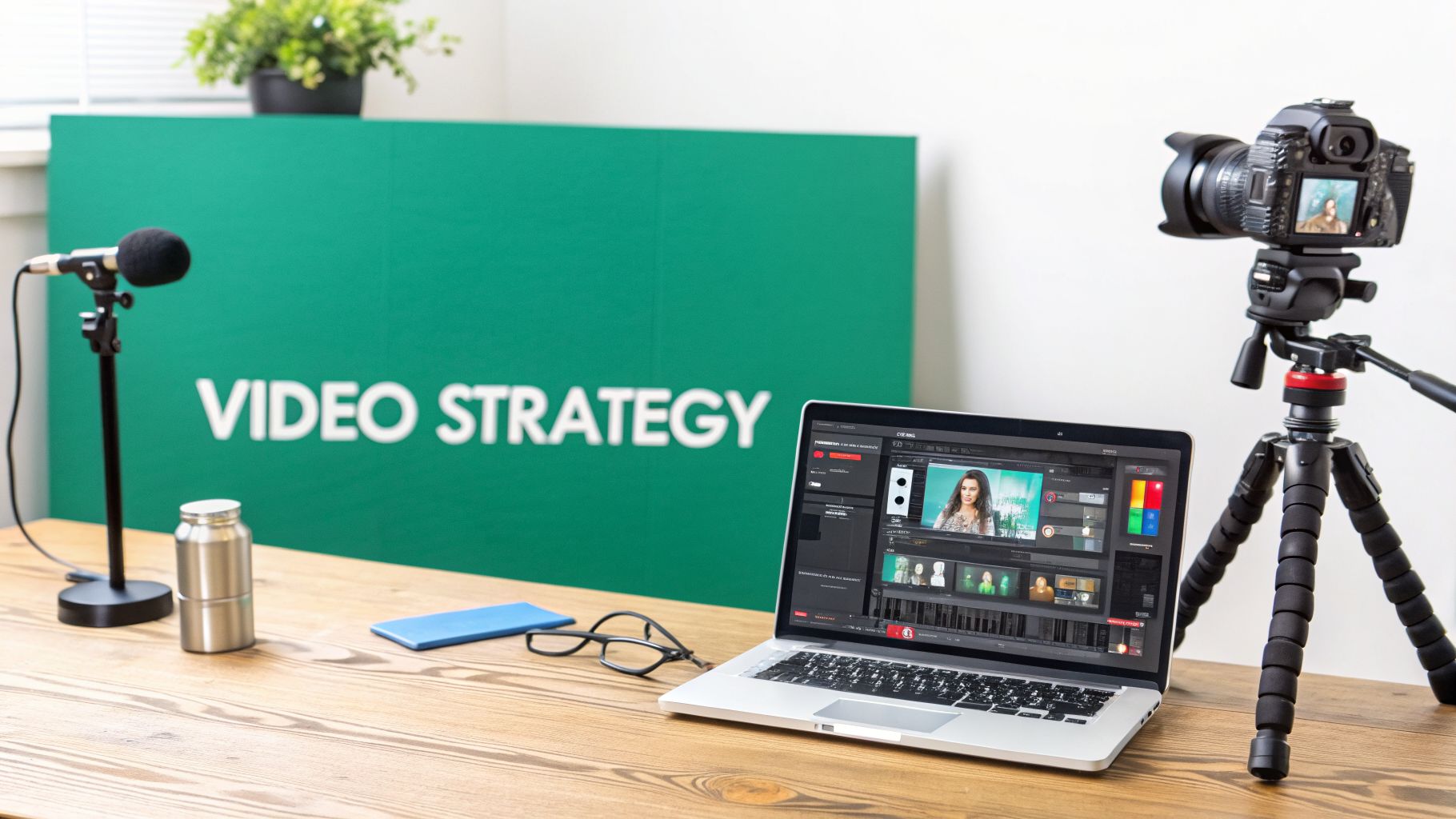
If a picture is worth a thousand words, a well-executed video is worth a million. Strategic video content positions you not just as an expert, but as an accessible and trustworthy guide. By creating a library of tutorials, industry commentary, and case studies, you meet your audience on YouTube, the world's second-largest search engine. This approach builds a direct line of communication, demonstrating both your expertise and, for agencies, your production capabilities. It's a prime example of thought leadership because it builds trust through face-to-face interaction at scale.
Why It Works & How to Replicate It
Industry leaders like Backlinko and HubSpot Academy prove that educational video content attracts and retains a dedicated audience. The key is to provide immense value upfront without asking for anything in return, building a community that views you as the go-to source. You can replicate this by creating helpful, problem-solving content that directly addresses the pain points of your ideal customer. For instance, a web design firm could create a video walking through the top five mistakes businesses make on their homepage, offering clear solutions for each.
Strategic Insight: Your YouTube channel is a long-term asset. Optimize every video title, description, and tag for relevant keywords to ensure your content is discoverable for months and even years after publication.
Actionable Takeaways for Your Business:
Start by brainstorming the top 10 questions you get from prospects and clients. Those questions are your first 10 video ideas.
- Publish Consistently: A regular publishing schedule, like one video per week, signals to YouTube's algorithm and your audience that your channel is active and reliable.
- Organize with Playlists: Group your videos into playlists by topic, such as "SEO Tips," "E-commerce Growth," or "B2B Marketing." This encourages binge-watching and makes it easier for viewers to find relevant content. You can see how this works by checking out Wistia's channel for inspiration on creating series.
- Repurpose for Maximum Reach: Don't let your video live only on YouTube. Extract short, impactful clips and share them on platforms like TikTok, Instagram Reels, and LinkedIn to drive traffic back to your main channel.
9. Speaking Engagements & Conference Participation
Stepping onto a stage with a microphone places you in an immediate position of authority. Speaking engagements and conference participation are classic methods for establishing credibility, transforming you from just another name on a website into a visible, recognized expert. Whether addressing a local chamber of commerce or a major industry conference like HubSpot's INBOUND, public speaking provides a direct line to your target audience. It is one of the most effective examples of thought leadership because it demonstrates confidence and mastery of a subject in a live, interactive setting.
Why It Works & How to Replicate It
This method works by building personal connection and trust at scale. An audience that hears your insights directly is more likely to view you and your company as a go-to resource. For example, a marketing agency founder speaking at an e-commerce expo can directly address the lead generation and conversion pain points of hundreds of potential clients at once. The key is to deliver genuine value, not a sales pitch.
Strategic Insight: The goal of the talk is not to sell but to teach. Frame your presentation around a common, difficult problem your audience faces and provide them with a clear, actionable framework to solve it. This generosity builds trust and positions you as an ally.
Actionable Takeaways for Your Business:
To secure speaking opportunities, start by identifying conferences and local events your ideal clients attend.
- Pitch with Precision: Develop session topics that solve a specific, nagging problem. Instead of a generic title like "Marketing Tips," try something like "Three Overlooked Analytics to Triple Your B2B Leads This Quarter."
- Create Supporting Assets: Design a simple one-page handout, a downloadable resource, or a special assessment that attendees can access by providing their contact information. This extends the conversation beyond the event.
- Repurpose Your Performance: Always record your session if permitted. The video can be cut into social media clips, the audio can become a podcast episode, and the transcript can be adapted into a detailed blog post, multiplying the impact of a single event.
10. Email Newsletters & Subscriber Community Building
An email newsletter is far more than a simple sales tool; it’s a direct line of communication to a curated audience eager for your insights. By consistently delivering valuable content, original research, and industry news directly to a subscriber's inbox, you build a powerful relationship. This method stands out among examples of thought leadership because it establishes authority and maintains top-of-mind awareness in a personal, direct-to-consumer channel you own.
Why It Works & How to Replicate It
Industry leaders like HubSpot and Neil Patel demonstrate that a well-crafted newsletter can become a primary driver of engagement and authority. The core principle is value-first. For example, Ascendly’s 'Marketing Insights' newsletter delivers weekly tips specifically for SMB and ecommerce audiences, positioning them as a go-to resource. The format is a mix of original blog content, curated external resources, and actionable tips, providing a comprehensive update without a hard sell.
Strategic Insight: The true power of a newsletter is community building. By segmenting your audience and sending targeted content, you create a personalized experience that makes subscribers feel understood, transforming a mailing list into an engaged community.
Actionable Takeaways for Your Business:
To launch an effective newsletter, start by aggressively building your subscriber list through every available channel.
- Lead with Value: Structure each newsletter with 3-5 content pieces. A strong formula includes one of your own blog posts, a helpful external article, a piece of industry news, and a quick, actionable tip.
- Segment for Relevance: Group your subscribers by interest or business type (e.g., ecommerce, B2B, local service). This allows you to send more relevant content, which boosts engagement and reduces unsubscribes. You can explore a variety of methods for how to build an email list from scratch.
- Establish a Rhythm: Consistency is key. Send your newsletter on the same day and at the same time each week or bi-weekly. This trains your audience to expect and look forward to your content, significantly improving open rates.
Top 10 Thought Leadership Examples Compared
| Content Type | Implementation Complexity | Resource Requirements | Expected Outcomes | Ideal Use Cases | Key Advantages |
|---|---|---|---|---|---|
| In-Depth Case Studies & ROI Documentation | High — needs client access and interviews | High — research, design, analytics, legal sign-off | Strong credibility, improved conversion and sales enablement | Sales proposals, proof-of-performance for prospect evaluation | Tangible proof of impact; high trust and shareability |
| Industry Research Reports & Trend Analysis | Very high — methodological design and analysis | Very high — surveys, data tools, PR and distribution | Authority, backlinks, media coverage (long-term) | Positioning as market leader; enterprise and partner outreach | Proprietary data and differentiation; high perceived authority |
| Long-Form Educational Content & Pillar Pages | High — deep research and architecture | Medium–High — writers, SEO, ongoing updates | Sustained organic traffic and topical authority | SEO-driven lead generation; cornerstone content for clusters | Evergreen resource; strong E-E-A-T and repurposing potential |
| Executive Webinars & Interactive Training Sessions | Medium — slide + presentation prep; live logistics | Medium — platform, presenter, promotion, follow-up | Qualified leads, direct engagement, content for repurposing | Lead capture, product/service demonstrations, nurturing | Real-time interaction; high-intent audience and recordings |
| Podcast Series & Audio Content Leadership | Medium — planning and consistent production | Medium — recording, editing, guests, distribution | Audience growth and relationship building over time | Brand awareness, guest networking, B2B thought leadership | Builds loyal audience; strong relationship and guest reach |
| Strategic Blog Posts & SEO-Optimized Articles | Medium — keyword research and quality writing | Low–Medium — writers, SEO tools, editorial process | Steady organic traffic and keyword-driven leads | Demonstrating capability; targeting commercial search intent | Cost-effective, scalable, and supports internal linking |
| LinkedIn Thought Leadership & Professional Network Engagement | Low–Medium — consistent posting and engagement | Low — time investment, employee advocacy | Direct B2B leads and professional relationships | Executive visibility, B2B prospecting, recruiting | Direct access to decision-makers; organic B2B reach |
| Video Content & YouTube Channel Strategy | High — scripting, filming, post-production | High — equipment, talent, editors, SEO for video | High engagement, improved trust and conversions | Explaining complex services, tutorials, case study showcases | Strong engagement and repurposable short-form clips |
| Speaking Engagements & Conference Participation | High — proposal, preparation, travel logistics | High — travel, materials, time away from office | Third-party credibility, networking, PR opportunities | Regional authority, enterprise outreach, brand visibility | Third-party validation; concentrated qualified audiences |
| Email Newsletters & Subscriber Community Building | Medium — content planning and segmentation | Medium — email platform, copy, analytics | High ROI, predictable traffic, long-term nurture | Nurturing leads, driving repeat visits, launching content | Owned audience, direct communication channel, measurable ROI |
Putting Thought Leadership into Practice
We have journeyed through a landscape rich with powerful examples of thought leadership, from detailed research reports to engaging podcast series. The central lesson is clear: authentic authority isn't built by shouting the loudest. It's cultivated by consistently delivering genuine value, offering original perspectives, and solving real problems for your audience.
The examples we explored, spanning video series, in-depth articles, and professional network engagement, all share a common DNA. They don't just state expertise; they demonstrate it through action. They answer the questions your audience is already asking and, more importantly, the ones they haven't thought of yet. This proactive approach to education and insight is what separates true thought leaders from the rest of the noise.
Distilling the Core Principles
So, what are the golden threads connecting these successful initiatives? If you peel back the layers of each case study, from the B2B webinar to the subscriber-only newsletter, you find a few foundational truths.
- Originality is Non-Negotiable: Successful thought leadership requires a unique point of view. This doesn't mean you must invent a new theory from scratch. It can be a new analysis of existing data, a contrarian take on a popular trend, or a unique framework for solving a common problem.
- Consistency Builds Momentum: A single great blog post or one viral video does not make a thought leader. The examples demonstrate that authority is a result of sustained effort over time. Committing to a regular publishing cadence, whether it's a weekly newsletter or a monthly research report, trains your audience to look to you for guidance.
- Value Precedes the Sale: Notice how none of the effective examples led with a hard sales pitch. They focused on educating, informing, or entertaining their audience first. This builds trust and positions the brand as a credible resource, making the eventual sales conversation feel like a natural next step, not an unwanted interruption.
To understand how thought leadership translates into real-world impact, consider these practical applications and insights from others, such as these 8 Examples Of Thought Leadership You Should Know. Seeing how different brands tackle this challenge can provide further inspiration for your own strategy. The goal is to absorb these lessons and find the unique angle that only your business can provide.
Your Actionable Blueprint for Authority
Feeling inspired is one thing; taking action is another. The path from reading about great examples of thought leadership to becoming one yourself starts with a single, deliberate step. Forget trying to do everything at once.
Instead, ask yourself these questions:
- Where does my expertise truly shine? Identify the one or two topics where you can offer unparalleled depth and a fresh perspective.
- What format fits my strengths and my audience's preferences? If you're a great speaker, a podcast or webinar series might be perfect. If your team excels at data analysis, a signature annual report could be your cornerstone.
- What is a realistic commitment I can make today? Can you commit to one in-depth blog post a month? A bi-weekly LinkedIn article? Start small, prove the concept, and build from there.
The journey to becoming a recognized authority is a marathon, not a sprint. It requires patience, a genuine desire to help your audience, and a strategic plan for execution. By choosing your channel, defining your unique angle, and committing to consistency, you can start building an asset that pays dividends in credibility, trust, and ultimately, business growth. The time to start is now.
Ready to turn your expertise into a powerful marketing asset but not sure where to start? At Ascendly Marketing, we specialize in helping businesses develop and execute thought leadership strategies that drive measurable results, from lead generation to increased sales. Let's build your authority together; visit Ascendly Marketing to see how we can help.