

Building an email list is a trade. You offer something useful, such as a discount, a guide, or early access, and in return, a person provides their email address. This action opens a direct communication channel that you control, allowing you to nurture leads and drive sales away from the influence of social media algorithms.
Why An Email List Is A Key Marketing Channel

Before explaining the methods, it is useful to understand the reasons. A social media following can be compared to renting an apartment, whereas an email list is akin to owning the building. You have a direct, unfiltered line to people who have actively expressed interest in hearing from you.
This ownership is significant. Social media platforms can and do change their algorithms, which can reduce organic reach. For example, the organic reach for many Facebook pages has dropped below 5%. This means for every 100 followers, approximately five might see a given post.
The ROI of Email
For every dollar invested in email marketing, the return can range from $36 to $45. This represents a profitable marketing activity. As a result, 82% of marketers globally use email as a primary component of their strategy. For further details, you can review the latest email marketing ROI findings on WSIWorld.com.
This concept is connected to consumer behavior and engagement.
- Customer Acquisition: Email is 40 times more effective for acquiring new customers than Facebook and Twitter combined.
- Sales Driver: Shoppers who receive marketing emails spend 138% more than those who do not.
- Direct Impact: An engaged email list becomes a predictable system for both acquiring new customers and retaining existing ones.
Your email list is a community of fans and future customers who are interested in what you offer. Nurturing this community builds trust and loyalty.
Building a Sustainable Business Asset
Each new subscriber gives you explicit permission to contact them via their inbox. With increasing privacy concerns and regulations like GDPR, that permission holds value. It is an asset that appreciates over time.
For an ecommerce store, this could mean sending a timely offer for a product a person was viewing. For a B2B service, it involves sharing insights over several months until a lead is ready to schedule a call.
When you are ready to launch a new product, you will not have to rely on algorithms or pay to boost a post to reach your own followers. You can simply send an email. This control makes your email list a foundational element of a resilient business.
What will you send to your first 100 subscribers?
Creating Lead Magnets and Opt-Ins
An email list grows because you offer a trade that is valuable to your ideal customer. This valuable offer is your lead magnet. It is the mechanism that can turn a casual visitor into a potential customer. To build an email list that supports business growth, your lead magnet needs to solve a problem or offer a shortcut. This is your first opportunity to demonstrate your value.
What Makes a Lead Magnet Effective?
An effective lead magnet is specific, provides immediate gratification, and delivers on its promise upon receipt. A visitor should see your offer and feel an immediate need for it.
Imagine someone on your ecommerce site selling running shoes. They are looking to run faster or resolve knee pain. A "10% discount" offer is functional but generic.
What if you offered "The 5-Minute Daily Stretching Routine to Prevent Runner's Knee"? You have now addressed a specific problem with a quick, actionable solution. This is an offer worth exchanging an email for. You can find more information on this topic in a guide on how to create lead magnets that actually convert.
Building a list this way is standard practice. The practice of buying email lists is outdated. Emails sent to purchased lists have a 40% lower deliverability rate compared to organically built lists. Marketers who segment their organically grown lists have reported revenue increases of up to 760%.
A smaller, engaged list built on value will outperform a large, disengaged one.
Designing Opt-In Forms That Work
Once you have a lead magnet, you need a method to present it. The design, placement, and wording of your opt-in form can influence your strategy's success. Correct implementation can lead to conversion rates of 10% or higher.
The goal is to make signing up simple.
Placement: Do not place your form only in the footer. Use a mix of embedded forms within blog posts, slide-in boxes that appear as a user scrolls, and timed pop-ups.
Copywriting: Avoid the word "Subscribe." Instead, use action-oriented copy that focuses on the benefit. "Get My Free Guide" or "Unlock My 20% Discount" are more direct.
Simplicity: Ask only for necessary information. For most lead magnets, a first name and email address are sufficient. Each additional field can be a barrier to completion.
A well-designed opt-in form is a helpful suggestion offered at a moment of high engagement, not an interruption.
Matching Your Offer to Your Business
The most effective lead magnets are tailored to your audience and business model. A generic freebie is less likely to be effective. Considering your offer as a piece of content can generate ideas, and exploring the benefits of content marketing can provide inspiration.
Here are examples of what works for different business types.
Lead Magnet Ideas for Different Business Models
| Business Type | High-Impact Lead Magnet Idea | Why It Works |
|---|---|---|
| Ecommerce | Exclusive Access to a "Secret Menu" or Limited-Edition Product Drop | It creates urgency and exclusivity. Subscribers feel like insiders, which is a stronger emotional connection than a simple discount. |
| B2B Service | A Data-Backed Industry Benchmark Report or an ROI Calculator | This positions your brand as an authority. It provides value that helps a prospect perform their job better or build a business case for your service. |
| Local Business | A Free "First-Time Customer" Service Voucher or a Local Neighborhood Guide | This gives a local resident a direct reason to visit. It lowers the initial barrier and encourages their first interaction. |
When you align your lead magnet with customer desires and business objectives, you are building a system that attracts qualified, interested subscribers.
Now that you have an offer, where will the email addresses be stored? It is time to select your Email Service Provider (ESP).
The ESP is the software that serves as the command center for your email operations. Choosing the right one is like hiring an efficient assistant. Choosing the wrong one can lead to technical issues and missed opportunities. For most growing businesses, the decision comes down to a few core features.
Selecting Your First Email Service Provider
When starting, focus on features that generate revenue and build relationships, not on advanced functionalities you may not use. Can you automatically tag a subscriber based on a downloaded checklist? Can you build a welcome email series easily?
Your business type will dictate what features are most important. An ecommerce store needs an ESP that integrates with platforms like Shopify or WooCommerce, allowing for segmentation based on purchase history or abandoned carts. A B2B company might prioritize analytics and lead scoring to identify promising prospects.
Look for these features:
- Automation Workflows: This feature allows you to create "if this, then that" rules to welcome new subscribers and nurture leads automatically.
- Segmentation and Tagging: You will need a system to organize your list. A flexible tagging system lets you send targeted messages to specific groups.
- Ease of Use: You have a business to run. A clean, drag-and-drop editor is a useful tool.
- Deliverability and Reputation: The ESP must have a good reputation for getting emails into the inbox.
Choosing an ESP is like hiring a digital employee. Select one that is reliable, intelligent, and capable of handling repetitive tasks so you can focus on strategy and content creation.
The Technical Setup That Protects Your Reputation
After selecting your ESP, there are a few technical steps to complete. This setup helps to avoid the spam folder. For B2B-focused businesses, an external guide on building a B2B email database can offer specialized insights.
This diagram illustrates the process in three parts: connecting your offer to a form to secure the signup.
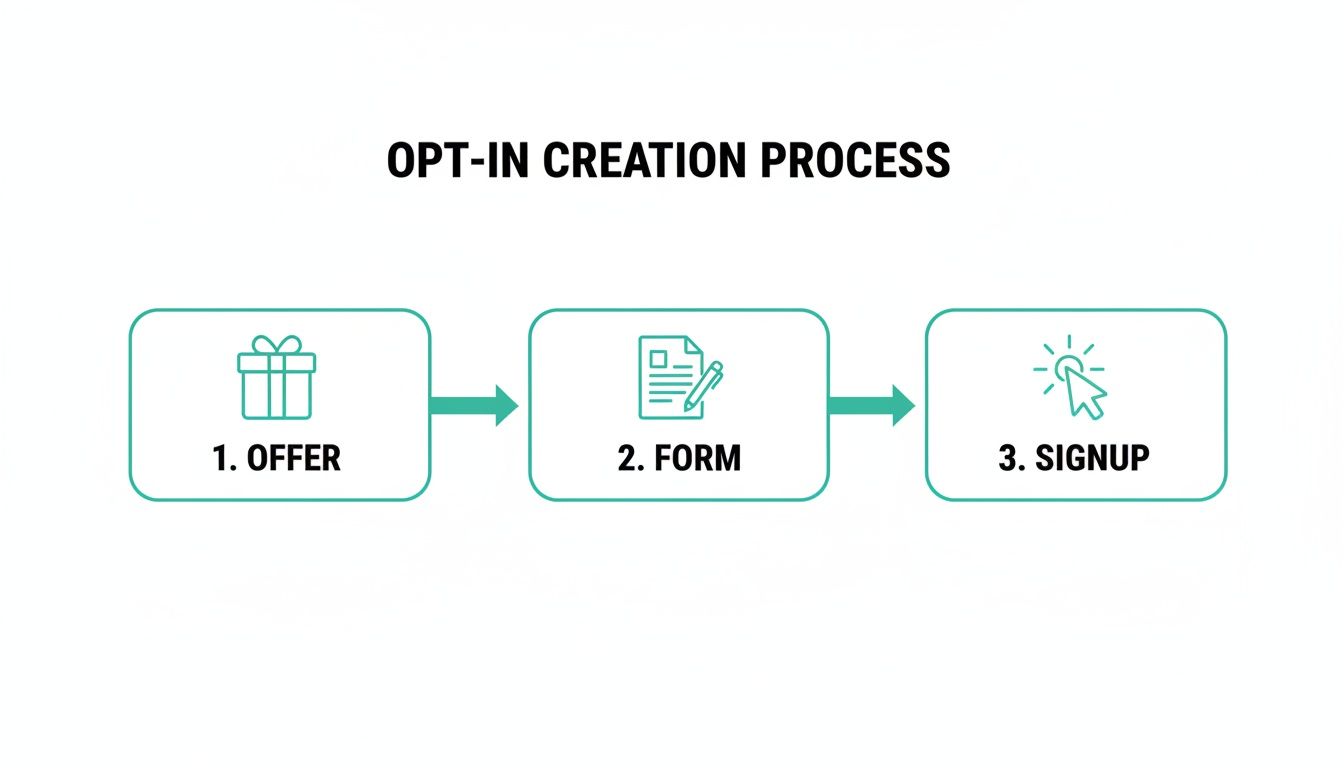
A compelling offer, a clear form, and a new subscriber form the core loop.
Embracing the Double Opt-In
One of the initial settings in your ESP will be the choice between "single opt-in" and "double opt-in." Choose double opt-in.
A double opt-in requires that after someone signs up on your form, they receive an email with a link to click to confirm their subscription. This extra step helps to filter out fake emails, typos, and uninterested individuals, resulting in a list of genuine, engaged people. A smaller, healthier list built with double opt-in will perform better than a larger, low-quality one.
Authenticating Your Domain
The final technical step is to set up sender authentication. Your ESP will provide text snippets called SPF and DKIM records to add to your website's domain settings.
This process gives your ESP permission to send emails from your domain, like showing identification to Gmail and Outlook. This step signals to email providers that you are a legitimate sender. Neglecting this is a common reason new email marketers end up in the junk folder.
Your ESP will provide a step-by-step guide for this one-time task, which helps ensure your emails are seen. For more on efficiency, you might be interested in learning more about marketing automation for B2B in our detailed guide.
From New Subscriber to Fan: Your Welcome Sequence Playbook

Someone has just given you their email address. Their interest in your brand is at a peak. Your next action can either turn them into a loyal fan or cause them to question their decision.
This is the time to implement a welcome sequence. This is a series of automated emails designed to make a strong first impression, build trust, and demonstrate your value.
What a Great Welcome Sequence Does
A welcome sequence functions as an orientation, not a sales pitch. It is your opportunity to deliver on the promise made on your signup form, showcase your brand's personality, and begin building a relationship.
An ecommerce store might begin by sending the promised 15% discount. A day later, they could share the founder's story. By day four, they could feature best-selling products with customer reviews. This layered approach builds familiarity and trust. You can see a detailed breakdown of this strategy in this email drip campaign example.
With global email users projected to reach 4.73 billion by 2026 and 376.4 billion emails sent daily, standing out is necessary. Automated emails like a welcome sequence have 48.57% open rates, which is higher than a typical newsletter. Since most people read emails on their phones, your emails must be optimized for small screens. You can find more data at Porch Group Media's latest email statistics.
Here is a framework for a 3-part welcome series:
Email 1 (Immediately): Deliver the promised item. This could be a discount code or a PDF guide. Make it the main focus.
Email 2 (1-2 Days Later): Share your story, introduce your team, or explain your brand's purpose. This is for human connection.
Email 3 (3-5 Days Later): Guide them to your most popular blog post, invite them to follow you on social media, or highlight a flagship product. Show them the next step.
Your welcome sequence sets the tone for your relationship with a subscriber. A successful execution will increase long-term engagement.
Next Level: Smart Segmentation
After your welcome sequence is running, the next step is to avoid sending the same message to everyone on your list. This can lead to unsubscribes.
The solution is segmentation, which involves grouping subscribers based on what you know about them.
You can start with simple segments. For instance, someone who downloaded your "Checklist for First-Time Homebuyers" belongs in a different category than someone who downloaded your guide on "Refinancing Your Mortgage." This allows you to send them more relevant content.
Simple Segmentation Ideas for Any Business
Your segmentation strategy should reflect your business goals. Creating these simple groups makes your messages more personal and effective.
| Business Type | Simple Segmentation Tactic | Why It's Effective |
|---|---|---|
| Ecommerce | Purchase History. Group people as "First-Time Buyers," "VIPs" (repeat customers), and "Window Shoppers" (hasn't purchased). | You can send a thank-you offer to a new buyer, an exclusive perk to a VIP, or a reminder to someone who has not yet purchased. |
| B2B | Company Size or Industry. Use information from your signup form to sort contacts into "Startup," "Mid-Market," and "Enterprise." | This allows you to send case studies and service information relevant to their context. A startup has different needs than a large corporation. |
| Local Service | Geographic Location. Group subscribers by city, zip code, or neighborhood. | This is useful for announcing local events, offering neighborhood-specific discounts, or informing them of service area expansions. |
By combining a welcome sequence with basic segmentation, you begin to have targeted conversations. You are building a community, not just a list. What will your first segment be?
Tactics to Grow Your Email List

You have a solid foundation, a well-crafted welcome sequence, and an effective lead magnet. Now it is time to actively acquire subscribers.
The goal is to place your offer in front of the right people repeatedly. These tactics are proven methods for list growth, starting with your website and expanding to other online platforms.
Maximize Leads from Your Website
Your website is a constant sales tool. A single sign-up form in the footer is insufficient. You need to capture visitors' attention at their peak interest.
The content upgrade is a powerful tool for this purpose. This is a hyper-specific bonus offered within a blog post. For example, in a post about "10 Ways to Declutter Your Home Office," the content upgrade could be a one-page "Ultimate Desk Organization Checklist." This is a logical next step for the reader.
For visitors who are about to leave, an exit-intent pop-up can be effective. As their cursor moves toward the 'back' button, a pop-up appears with a final offer. The approach should be helpful, such as "Before you go, grab our free guide to a more productive workday." This can turn a potential bounce into a new subscriber.
The objective is to enhance the user's journey, not interrupt it. A well-timed offer feels like a helpful suggestion.
Promote Your List Off-Site
Your lead magnet needs visibility. Social media is a platform for promotion. Avoid generic posts like "Sign up for my newsletter." Instead, promote the value of your lead magnet.
Treat your freebie like a product launch.
- Go Live on Social: Share a piece of information from your e-book or a statistic from your research. Use graphics or a short video. Then, provide the link to your landing page with a clear call-to-action.
- Run Social Ads: Platforms like Facebook and LinkedIn allow you to target people based on their job, interests, and online behavior. You can place your lead magnet directly in front of your target audience for a modest daily budget.
This shifts your strategy from passive waiting to active lead generation.
Tap into New Audiences with Partnerships
Collaborating with other businesses or creators in your field can be a fast way to grow your list, providing instant trust and credibility.
Here are a few collaboration ideas:
- Co-host a Webinar: Partner with a non-competing business that serves a similar audience to host a joint training session. Both parties promote it to their lists, and all registrants are added to both email lists (with their consent specified on the registration page).
- Guest Posting with a Content Upgrade: Write a valuable article for a popular blog in your industry. In your author bio, link directly to your lead magnet's landing page instead of your homepage. This provides value to their audience and generates targeted subscribers for you.
- Create a Resource Bundle: Collaborate with 5-10 other businesses to create a bundle of freebies. Each business contributes one lead magnet, and everyone promotes the bundle to their audience. The cross-promotion can result in a significant, rapid increase in subscribers.
Staying Compliant and Measuring What Matters
Building an email list involves being a responsible steward of subscriber trust. Regulations like GDPR and CAN-SPAM should not be intimidating.
These regulations are based on a simple agreement: you are transparent, and in return, you get a place in their inbox. This involves a few key principles.
You need clear permission to email someone. Your emails should identify you and include a valid physical mailing address. Your unsubscribe link must be easy to find and use. A single click should be sufficient. Hiding it can get you flagged as spam and damage your reputation.
Tracking Metrics That Indicate Progress
With compliance addressed, you can focus on measuring what works. It is easy to get lost in data, so concentrate on the metrics that reflect your list's health and business growth.
Here are the numbers to monitor:
- List Growth Rate: Is your list growing, shrinking, or static? This indicates if your lead magnets and sign-up forms are effective.
- Open Rate: This percentage shows if your subject lines are compelling enough to earn a click in a crowded inbox. It is a good initial indicator.
- Click-Through Rate (CTR): This shows how many people were interested enough in your email to click a link. It is a strong signal that your content is relevant.
- Conversion Rate: This tracks how many subscribers took the desired action, such as buying a product or scheduling a demo. This is your direct line to ROI.
Monitoring these numbers is about making informed decisions. A low open rate might suggest testing new subject lines, while a low conversion rate could mean your offer is not resonating with your audience.
By monitoring this data, you move from guessing to making informed decisions. You can identify problems early, reinforce what is working, and turn your contact list into a predictable growth engine.
Your Top Email List Questions, Answered
You have the roadmap, but some questions may remain. Let's address some common ones.
"How Fast Should My Email List Be Growing?"
There is no single answer; it depends on the context. A new blog owner might be satisfied with 100 subscribers in the first month. An established ecommerce store with consistent traffic might aim for 1,000 new subscribers in the same period.
The rate of growth is more important than the absolute number. Focus on achieving a steady list growth rate. Aiming to grow your list by a consistent percentage each month is a more sustainable goal.
"Do I Need to 'Clean' My Email List?"
Yes, cleaning your list is a best practice. It may seem counterintuitive to delete subscribers, but it is beneficial. List cleaning involves removing people who never open your emails, known as inactive or "cold" subscribers.
Sending emails to an unengaged audience can harm your sender reputation. When this happens, email clients like Gmail may classify your emails as spam, making it harder for your messages to reach engaged subscribers.
Most email platforms provide tools to identify these subscribers. A good starting point is to segment anyone who has not opened your last 10-15 emails. You can attempt a re-engagement campaign or simply remove them.
"My Open Rates Are Low. What Am I Doing Wrong?"
Low open rates can be discouraging, but the solution is often straightforward. Before making major changes, examine these two factors:
- Your Subject Lines: Are they uninteresting? The subject line is your chance to earn the click. Try asking a question, teasing a benefit, or creating curiosity.
- Your Sender Name: Do people recognize you? An email from "Jen from The Cool Biz" is more likely to be opened than one from "[email protected]." Use a personal or brand name that your subscribers will recognize.
If these are optimized and you still have low open rates, experiment with your send times and frequency. You might be sending emails at a busy time for your audience. A/B testing different days and times can help you find an optimal schedule.
The team at Ascendly Marketing builds data-driven strategies that turn website visitors into loyal subscribers and customers. Get your free consultation today and see how we accelerate growth.