

Every marketer has invested in campaigns and eventually faced the question: “Is this working?” This question does not have to be a source of anxiety. Proving the value of marketing is a matter of calculation.
A Guide to Proving Marketing Works

The standard way to calculate marketing return on investment (ROI) begins with one formula: (Net Marketing Revenue – Marketing Investment) / Marketing Investment x 100. This equation translates marketing activities into financial outcomes.
Consider a scenario. An account-based marketing campaign was run on LinkedIn. The total investment was $50,000, which included ad spend, freelance design services, and analytics tools. Several months later, $200,000 in new deals were directly traced to this effort.
Plug the numbers into the formula:
($200,000 – $50,000) / $50,000 x 100 = 300% ROI
This result means that for every dollar put into the campaign, $4 was generated. This is a type of result that will interest a CFO. More examples of campaign ROI breakdowns are available from Demandbase.
The Components for Your Calculation
Before arriving at a percentage, the correct components must be gathered. Accurate data for these two numbers is the foundation of the calculation; inaccurate inputs produce inaccurate outputs.
To begin, several pieces of data are required. The table below details what is needed.
| Component | Description | Example |
|---|---|---|
| Net Marketing Revenue | The sales revenue directly attributable to a marketing campaign. A reliable attribution model is necessary to obtain a trustworthy figure. | A customer clicks a Facebook ad and makes a $500 purchase. |
| Marketing Investment | The total cost of the campaign. This includes ad spend, software, agency fees, contractor costs, and a portion of team salaries. | $10,000 in ad spend + $2,000 for a landing page tool + $3,000 for a freelance copywriter. |
Defining these inputs is the most intensive part of the process. Once they are established, the impact can be demonstrated.
From Numbers to a Story of Success
After the inputs are determined, the calculation is simple arithmetic. The result is a percentage that can be understood by anyone in the organization, from an intern to the CEO.
A positive ROI indicates a profit. A negative ROI indicates a loss. The calculation transforms a marketing report from a list of expenses into an account of profit generation.
For instance, a 150% ROI communicates that for every $1 spent, the business received $1.50 in profit. This is a financial language that is universally understood in business.
This basic calculation serves as a starting point. It is the first step toward building a data-driven marketing function and prepares the groundwork for more advanced methods discussed later.
Gathering the Right Data for Accurate ROI
Any ROI calculation is inaccurate without reliable data. The work involves not just using a formula, but also the process of finding the correct numbers. Errors in this stage will result in vanity metrics.
Your data is likely spread across different platforms. You will need to obtain reports from your CRM, use web analytics like Google Analytics, and access accounting software. Each platform contains a piece of the puzzle.
Nailing Down Your Real Marketing Costs
One way to get an inaccurate ROI is to omit some costs. It is common to only consider ad spend and stop there, but the true investment is broader.
To get a realistic figure, separate direct costs from indirect costs.
- Direct Costs: These are expenses linked to a specific campaign. This category includes ad spend on Google or Facebook, an invoice from a PPC agency, or a one-time software purchase for a specific launch. They are clearly defined.
- Indirect Costs: These are the ongoing operational costs that support marketing activities. This includes the monthly fee for a marketing automation platform, a portion of the marketing team’s salaries, and general office overhead.
Correctly sorting expenses is required for a trustworthy ROI. If there is difficulty in categorizing costs, an effective expense categorization guide can provide assistance. Taking the time for this step means the presented ROI will be defensible.
Setting Up Your Tracking Fundamentals
After managing costs, the next step is to connect spending to its earnings. Without proper tracking, identifying which marketing efforts generate revenue is speculative. Two tools for tracking are UTM parameters and conversion goals.
UTM parameters are tags added to the end of a URL. When someone clicks the link, these tags send detailed information to the analytics platform, identifying where the visitor came from.
A well-structured UTM link should answer three questions: Where did they come from (source, like Google)? How did they get here (medium, like email)? What specific campaign sent them (campaign name)? This creates a clear path from click to conversion.
For example, a link from a promotional email might be: yourwebsite.com?utm_source=newsletter&utm_medium=email&utm_campaign=july_promo. This shows that any sale from this link originated from the July email promotion.
Conversion goals are specific actions you want users to complete on your site. These are set up within your analytics platform. A purchase is a common goal, but other actions are also valuable:
- Filling out a contact form
- Signing up for a webinar
- Downloading a whitepaper
- Starting a free trial
Tracking these “micro-conversions” helps demonstrate the value of campaigns that do not result in an immediate sale but contribute to the sales pipeline. To increase the completion of these actions, ideas to improve website conversions are available in our guide.
This foundational work on both the cost and revenue side is what distinguishes a reliable business insight from a guess. This process moves from guessing to knowing.
Going Pro: Advanced ROI Formulas That Tell the Real Story
The basic ROI formula is a good start. It provides a quick, high-level number. Modern marketing, however, is complex, and that simple formula can miss the larger context.
To analyze financial performance more deeply, more sophisticated methods are necessary. These advanced formulas help answer difficult questions. Are campaigns producing short-term results or building lasting customer relationships? Let’s explore a few ways to get these insights.
Pinpointing Marketing’s Profit with ROMI
The first is Return on Marketing Investment (ROMI). This metric focuses specifically on the profitability of marketing by incorporating the Cost of Goods Sold (COGS).
The formula is: (Gross Profit – Marketing Investment) / Marketing Investment
Suppose an email campaign generated $80,000 in sales. The cost of the products sold (COGS) was $30,000, resulting in $50,000 in gross profit. The campaign itself cost $10,000.
Plugging that into the formula:
($50,000 – $10,000) / $10,000 = 4, or a 400% ROMI.
This means for every $1 invested in the campaign, $4 was returned in actual profit, not just revenue. For e-commerce or retail businesses where margins are a primary concern, this is a more accurate measure of success.
Playing the Long Game with LTV-Based ROI
For businesses that rely on repeat customers, subscriptions, or have a long sales cycle, measuring only the first sale is incomplete. This is where Customer Lifetime Value (LTV) is useful. LTV estimates the total value a customer will bring to a business over their entire relationship.
Incorporating LTV into the ROI calculation changes the perspective. The formula is: (Customer Lifetime Value – Marketing Investment) / Marketing Investment
Imagine a B2B SaaS company spends $25,000 on a content marketing initiative that acquires 10 new clients. In their first year, they generate $30,000 in revenue. A simple ROI calculation would show a 20% return, which might be viewed as a failure.
However, if the average customer LTV is $15,000, the total projected value of those 10 new customers is $150,000. Let’s run the numbers again:
($150,000 – $25,000) / $25,000 = 5, or a 500% ROI.
This is a different way of thinking. It allows for confident investment in strategies that build long-term value, even if they do not deliver an immediate large return. For B2B companies, using tools like marketing automation for B2B is an effective way to nurture these long-term relationships and maximize LTV.
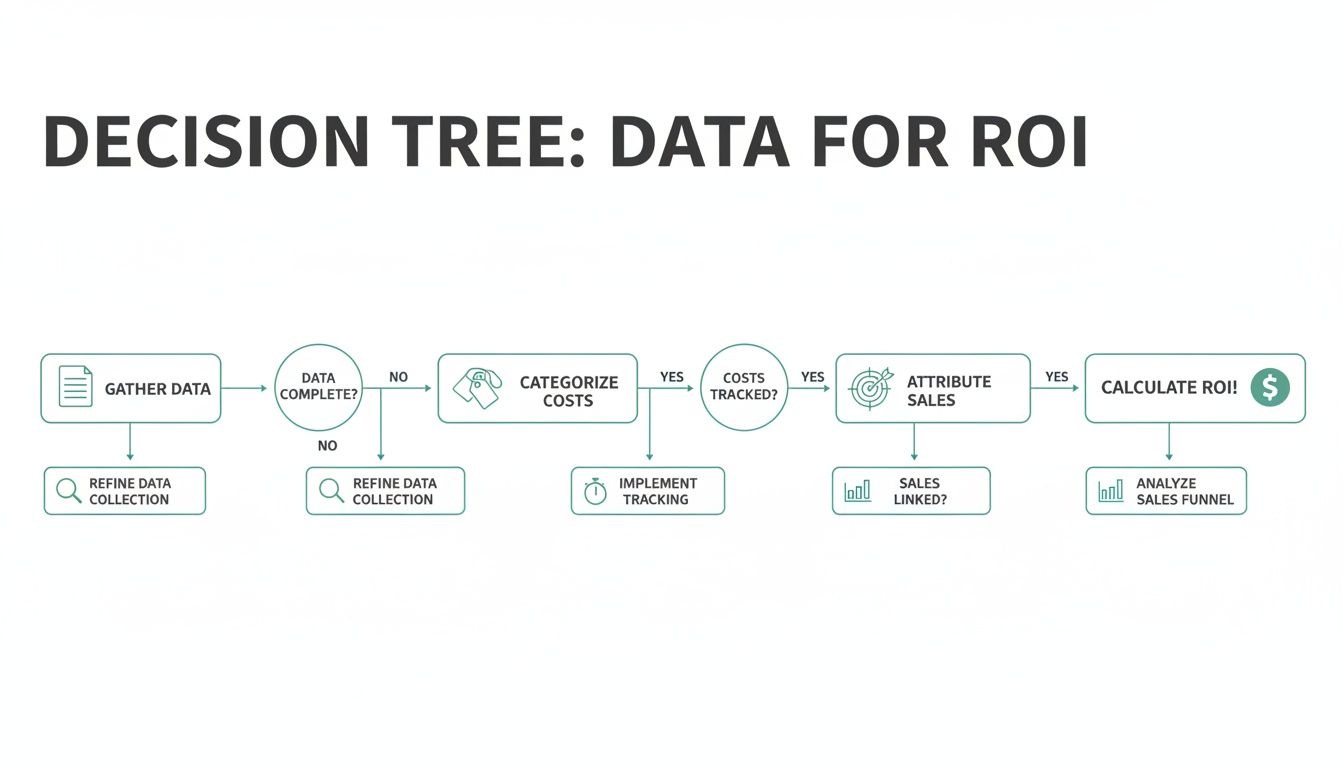
Arriving at any of these numbers begins with a solid process. You have to gather the right data, organize costs, and correctly attribute sales before using a formula.
Simple ROI vs ROMI vs LTV-Based ROI
Choosing the right formula depends on the objective and the type of business. Each one provides a different part of the performance story. This comparison can help in deciding which one to use.
| Method | Focus | Best For | Potential Drawback |
|---|---|---|---|
| Simple ROI | Gross revenue from a single campaign. | Quick, high-level assessment of direct-response marketing. | Ignores product margins and long-term customer value. |
| ROMI | Profitability of marketing spend. | Businesses with significant COGS, like retail or e-commerce. | Can be short-sighted if it ignores customer loyalty. |
| LTV-Based ROI | Long-term value of acquiring customers. | Subscription businesses, B2B, and companies focused on retention. | Relies on predictive LTV models, which can be complex to create. |
By becoming comfortable with these more advanced formulas, you are gaining a deeper understanding of your marketing’s real impact. This allows you to make smarter budget decisions and prove that you are building a marketing engine for sustainable, long-term growth.
Calculating ROI for Specific Marketing Channels
Knowing the overall marketing ROI is a starting point, but breakthroughs occur when you analyze the details.
This is where you ask more specific questions. Is the SEO strategy outperforming the PPC campaigns? Is email still the most valuable part of the marketing budget?
Answering these questions involves calculating ROI for each channel. This turns the budget from a blunt instrument into a precise tool. By seeing exactly how each channel performs, you can double down on the winners and reduce investment in underperformers.
The Clear-Cut Case of Paid Advertising ROI
Let’s begin with paid ads. Channels like Google Ads and Meta Ads are designed for ROI calculations. They provide clear numbers on spending and earnings, which makes the calculation straightforward.
The standard metric here is Return on Ad Spend (ROAS). For example, if you spend $5,000 on a Google Ads campaign and analytics show it generated $25,000 in direct sales.
The calculation is: $25,000 (Revenue) / $5,000 (Ad Spend) = 5x ROAS.
For every $1 invested, $5 was returned in revenue. On platforms like Amazon, driving traffic is not sufficient; it must be converted profitably. As a guide on Amazon CRO Strategy for profitable scale indicates, high traffic with no sales is an inefficient use of funds.
Tackling the ROI of SEO and Content Marketing
Now for SEO and content. This is where many marketers encounter difficulty. It is a long-term strategy, and results are not always immediate. A blog post published today might not generate a lead for six months, but it could still be driving sales years later.
Because of this delay, a simple last-click attribution model will make SEO efforts seem ineffective. A broader perspective is required.
- Look at Organic Traffic Growth: In Google Analytics, track the increase in non-branded organic traffic. Calculate what that traffic would have cost if paid for through ads. This assigns it a value.
- Hunt for “Assisted Conversions”: Analytics can show how many sales included a visit to the blog or an organic search. These “assists” are contributions to the final sale.
- Value Your Leads: If content is generating leads through forms or downloads, assign each lead a dollar value. If 10% of content leads become customers and the average customer spends $1,000, then each lead is worth $100.
Suppose the total SEO spend for the year—salaries, tools, and other costs—is $60,000. Using the methods above, you trace $180,000 in revenue back to organic search.
Your SEO ROI is: ($180,000 – $60,000) / $60,000 = 200%. That is a $3 return for every $1 invested, which justifies the long-term approach.
Measuring Email Marketing’s Impressive ROI
Email marketing is a reliable channel that consistently delivers results. The ROI is usually cleaner to calculate than SEO because opens, clicks, and sales can be tracked from every email sent.
The calculation involves comparing the revenue from an email campaign against its cost.
An E-commerce Flash Sale Example
- The Haul: A flash sale email with UTM-tagged links is sent. Analytics confirm it directly generated $15,000 in sales.
- The Cost: The email platform is $200 per month, and a designer was paid $300 for the template. Total campaign cost: $500.
- The ROI: ($15,000 – $500) / $500 = a 2,900% ROI.
Numbers like these are why marketers value their email lists.
The Puzzle of Social Media ROI
Social media ROI can be difficult to measure. Its value is divided between direct sales and the less tangible goal of brand building. Sales from a shoppable post can be tracked, but much of social media’s power comes from creating a community that may purchase later.
To understand social media’s value, a mixed approach is needed. Track direct sales. Also monitor “soft” metrics like engagement, brand mentions, and follower growth. These are indicators of a brand’s long-term health.
To understand social performance, a deeper analysis is required. Our guide on how to run a social media audit can walk you through analyzing data to find what is working. By combining hard sales numbers with softer engagement metrics, you can build a stronger case for your social media budget.
Common ROI Calculation Pitfalls and How to Avoid Them

Calculating marketing ROI may appear straightforward. In practice, it is full of common traps that can make clean-looking numbers inaccurate. Well-intentioned teams can make poor budget decisions based on these mistakes.
Let’s examine these pitfalls so you can build a measurement system that accurately reflects marketing performance.
Getting Trapped by the Last Click
The most common mistake is over-reliance on last-click attribution. It is the default because it is easy. It assigns 100% of the credit for a sale to the last thing a customer clicked. This is simple, tidy, and often incorrect.
The problem with last-click attribution is its blindness to preceding interactions. It ignores the blog post read a month ago, the social ad seen last week, and the newsletter opened this morning. All these touchpoints contributed to the final sale but receive no credit.
This narrow view makes top-of-funnel efforts like content or social media appear as expensive failures, while bottom-of-funnel channels like branded search seem exceptionally effective. This can lead to cutting activities that are filling the sales pipeline.
The solution is to explore multi-touch attribution. Instead of a winner-takes-all approach, credit is distributed across the customer journey.
A few common ways to do this include:
- Linear: Every touchpoint receives an equal share of the credit. This method is fair and acknowledges that every step played a role.
- Time-Decay: This model assigns more weight to interactions that occur closer to the sale. The click from yesterday is likely more influential than one from three months ago, and this model reflects that.
- Position-Based (or U-Shaped): This approach gives 40% of the credit to the first touch (the introduction) and 40% to the last touch (the closer), then divides the remaining 20% among the steps in between.
Adopting one of these models provides a more balanced view of how channels work together, leading to smarter budget decisions.
Forgetting About the Time Lag
Another common error is judging a campaign’s success too soon. This is a significant issue for B2B companies or any business selling high-ticket items with a long sales cycle.
If a campaign runs in January but the average sales cycle is four months, measuring ROI on February 1st will produce poor results. It is like removing a cake from the oven after five minutes and questioning why it is not baked.
You cannot expect the full value from a campaign before customers have had a chance to move through the sales funnel. Patience is a measurement necessity.
The solution is to align the measurement window with the sales cycle. If a deal typically takes 90 days to close, the ROI report should not be finalized until at least 90 days after the campaign ends. This allows leads the necessary time to mature into revenue.
The Danger of Ignoring “Soft” Metrics
Do not fall into the trap of only measuring what is easy. It is tempting to focus exclusively on hard numbers like sales and leads, but ignoring “soft” metrics like brand awareness, social engagement, and customer sentiment is short-sighted.
These metrics are leading indicators of future success. A surge in brand mentions on social media or a jump in organic search traffic might not appear in this month’s sales report, but they build momentum for next quarter’s revenue.
The most effective marketers use a balanced scorecard. Track hard ROI. Also, track these vital signs of brand health. This combination provides a holistic and truthful picture of marketing’s total impact.
Frequently Asked Questions About Marketing ROI
Once you begin to analyze marketing ROI, it may feel as though you have uncovered more questions than answers. It is a notoriously complex area, so let’s address some of the most common questions marketers have.
What is a “Good” Marketing ROI?
The only honest answer to this question is: it depends.
A 5:1 ratio (500% ROI) is often cited as a standard. Making $5 for every $1 spent is a positive outcome. But that number is meaningless without context. What is considered “good” is entirely dependent on your business model, profit margins, and industry.
For example, an e-commerce store with very thin margins might need a 10:1 return just to be profitable after accounting for product costs. In contrast, a high-margin B2B software company could be satisfied with a 3:1 ratio, knowing the lifetime value of that customer will make the acquisition very profitable over time.
The benchmark that truly matters is not an industry average; it is your own performance. The goal should be to improve upon your last quarter. Consistent improvement is a sign of success.
How Do I Calculate ROI for Brand Awareness Campaigns?
Assigning a hard ROI to a brand awareness campaign can be like trying to measure the financial value of a handshake. It is difficult, but not impossible. Since there is no direct sale to track, you must rely on proxy metrics.
Think of these as clues that show your efforts are having an impact, even if they do not lead directly to a purchase.
- Branded Search Volume: Are more people searching for your company’s name on Google this month compared to last month? This is a strong indication that your brand is gaining recognition.
- Share of Voice: How often is your brand mentioned in your industry compared to your competitors? Tools that track web and social mentions can quantify this.
- Website Direct Traffic: An increase in visitors who type your URL directly into their browser is a classic indicator of strong brand recall.
- Engagement Metrics: A high number of likes, shares, and comments does not directly result in revenue, but it demonstrates that your message is resonating with people.
From there, you can use creative methods to assign value. One simple method is to calculate what that new organic and direct traffic would have cost if you had paid for it with ads. It is not a perfect method, but it provides a solid, defensible number.
Which Marketing ROI Tools are Best for Beginners?
When starting, it is not necessary to purchase an expensive, complex analytics suite. The best tools are likely the ones you are already using. Focus on mastering these three.
First, Google Analytics 4 (GA4). This is your central hub for data. It is free, powerful, and shows where your visitors are coming from and what they do on your site. Ensure you set up conversion goals to track actions that are important to your business, from filling out a form to making a purchase.
Next is your CRM. Whether you use HubSpot, Salesforce, or another platform, this is your source of truth for sales data. By connecting it to your marketing efforts, you can see which campaigns are generating leads that become paying customers.
Finally, do not underestimate the utility of a spreadsheet. Google Sheets or Excel is an excellent tool for your first ROI calculations. It allows you to consolidate marketing costs from one source and sales data from another, giving you a hands-on understanding of how the numbers connect. Master this simple trio first, and you will have everything you need to begin.
Ready to stop guessing and start knowing what your marketing is truly worth? The team at Ascendly Marketing specializes in creating data-driven strategies that deliver measurable results. Let us help you track your ROI and dominate your market. Find out how we can help at https://ascendlymarketing.com.