

Creating a content calendar that functions effectively begins with analyzing past performance before planning future actions.
The initial step is a content audit. This process involves reviewing all content published over the last 6 to 12 months to identify what resonated with your audience and what did not. This approach replaces assumptions with data-driven planning.
Build the Foundation for a Results-Driven Calendar
Beginning a content plan without an audit is like constructing a building on an unstable foundation. This phase requires a detailed examination of performance data.

This involves a comprehensive review of your blog analytics, social media insights, and email marketing reports. The objective is to distinguish successful content from underperforming content.
Pinpoint Your Wins and Losses
Start by compiling your data into a spreadsheet. For each platform, identify your top-performing and lowest-performing content. What patterns do you notice?
Consider the common elements of your most successful pieces.
- Format: Did your audience engage more with video clips than static images? Did long-form guides generate more shares than short tip-based posts? For example, your analytics might show that video drove higher engagement than other formats.
- Topic: Are there specific themes that consistently generate conversation or drive traffic to your website? Do “how-to” articles perform better than behind-the-scenes stories?
- Timing: Examine the days and times when you posted. Note which schedules consistently produced the best results.
Identifying what does not work is equally useful. Each piece of underperforming content provides a lesson on what your audience does not want from you. This information helps prevent wasted resources in the future.
Analyzing your content history creates a foundation based on evidence rather than intuition. This process uncovers the specific approaches that lead to increased traffic, better leads, and business growth.
Digging Into the Data
An organized audit is an effective one. A table can help you interpret the data and convert it into actionable insights. Understanding what a content calendar is is not just about scheduling; it is about using this type of data to make every post effective.
Here is a sample structure for organizing your findings:
Sample Content Audit Findings
This exercise clarifies where you should invest your time and energy, promoting a more efficient workflow.
From Audit to Action
Now, use what you have learned. Your audit findings will become the building blocks for your new content calendar.
If you discovered that “how-to” guides are your primary source of organic traffic, schedule more of them. If your Instagram audience engages with behind-the-scenes Stories, allocate a dedicated spot for them each week. Some teams find that batching content, like shooting all videos in one day, can reduce production time.
This process establishes a direct link between your content efforts and your business goals. You will move from a trial-and-error approach to making strategic decisions that yield results. This foundational work is what realizes the benefits of content marketing and prepares you for sustained success.
If you are constantly struggling to decide what to post next, it is time to shift from planning individual posts to developing a content strategy. This process begins with your content pillars.
Think of these as the 3 to 5 primary topics your brand will focus on. These are not random subjects; they are the core themes you will consistently address.

These pillars function as the main categories in a library you curate for your audience. Each pillar should be broad enough to generate numerous ideas but specific enough to establish your authority on the subject.
Finding Your Pillar Sweet Spot
How do you identify these pillars? They exist at the intersection of your business’s strengths and your audience’s needs. What knowledge do you possess that is unique? What challenges do your customers face? The answers to these questions will reveal your content pillars.
For instance, if you run an e-commerce store selling sustainable home goods, your pillars might be:
- Eco-Friendly Living: This covers topics from zero-waste kitchen tips to bathroom product alternatives.
- A Non-Toxic Home: Here, you can discuss natural cleaning recipes, the advantages of organic cotton, and creating a healthier living environment.
- Ethical Consumerism: This pillar allows you to discuss fair-trade practices, product origins, and conscious shopping.
If you are a B2B software company targeting sales teams, your pillars could be “Sales Productivity,” “Lead Nurturing,” and “CRM Mastery.” Each one addresses a specific pain point for your ideal customer. This focused approach helps build authority. You can find examples of thought leadership to see this in practice.
Once you define these pillars, you have a framework for all your content. Every blog post, video, and social media update will have a clear purpose and reinforce your brand’s identity.
This structure also simplifies brainstorming. Instead of facing a blank calendar, you have pre-defined categories to fill with content ideas.
Connecting Pillars to Your People
After defining your pillars, match them to your target audience segments. Most businesses serve multiple customer types, each with unique characteristics and needs.
Let’s continue with the sustainable e-commerce brand example. Its audience may include:
- The Budget-Conscious Beginner: New to eco-friendly practices and looking for simple, affordable starting points.
- The Health-Focused Parent: Primarily motivated by creating a safe, non-toxic home for their children.
- The Eco-Warrior: An expert seeking in-depth information, advanced tips, and full transparency on ethical production.
Now, you can align your pillars with these audience segments.
<figure class="wp-block-table"><table><tr>
<th align="left">Content Format</th>
<th align="left">Platform</th>
<th align="left">Key Metric</th>
<th align="left">Finding/Insight</th>
<th align="left">Action for Calendar</th>
</tr>
<tr>
<td align="left">Video Tutorial</td>
<td align="left">YouTube</td>
<td align="left">Watch Time</td>
<td align="left">5-minute "how-to" videos have a 70% completion rate.</td>
<td align="left">Produce one 5-minute tutorial video every two weeks.</td>
</tr>
<tr>
<td align="left">Blog Post</td>
<td align="left">Website</td>
<td align="left">Organic Traffic</td>
<td align="left">"Beginner's Guide" posts from 9 months ago still attract over 500 new users per month.</td>
<td align="left">Plan a "Beginner's Guide" series targeting new keywords.</td>
</tr>
<tr>
<td align="left">Image Carousel</td>
<td align="left">Instagram</td>
<td align="left">Saves & Shares</td>
<td align="left">Carousels with checklists get 4x more saves than single images.</td>
<td align="left">Create a weekly "Checklist Carousel" for Tuesday afternoons.</td>
</tr>
<tr>
<td align="left">Case Study</td>
<td align="left">LinkedIn</td>
<td align="left">Clicks to Site</td>
<td align="left">Case studies published as text-only posts had low engagement.</td>
<td align="left">Repurpose top case studies into short video summaries for LinkedIn.</td>
</tr>
</table></figure>| Content Pillar | Audience Segment | Content Example |
|---|---|---|
| Eco-Friendly Living | The Budget-Conscious Beginner | A blog post on “10 Zero-Waste Swaps That Cost Less Than $20.” |
| A Non-Toxic Home | The Health-Focused Parent | An Instagram Reel showing how to make a child-safe all-purpose cleaner. |
| Ethical Consumerism | The Eco-Warrior | A detailed report on the lifecycle of the recycled materials in your products. |
This is a strategic action, not just an organizational one. By mapping content this way, you ensure every piece you create has a specific function and a specific audience. This transforms a simple calendar into a powerful tool for growth.
Design a Balanced and Engaging Content Mix
With your goals and pillars established, the next step is to fill your calendar with engaging content ideas.
Many businesses make the mistake of using their social media as a digital billboard, broadcasting only sales messages. This approach often leads to being ignored or unfollowed.
To build a loyal audience, you must provide more value than you ask for in return. This can be achieved by following the 80/20 rule.
The 80/20 Rule of Content
The rule is straightforward. 80% of your content should provide value to your audience. The remaining 20% can be used for promotional purposes.
The 80% is your opportunity to educate, entertain, and inspire. This is where you solve problems, share insider tips, and express your brand's personality. This type of content builds trust and encourages people to follow you.
After earning that attention and goodwill, your audience will be more receptive to the 20% of promotional content, such as new product announcements, sale alerts, and direct calls to action.
Think of it as a conversation. You would not talk only about yourself. You build a relationship by listening and offering something useful first. Your content calendar should reflect this balance.
This approach delivers tangible results. Calendars built on this balance can increase engagement because value-first posts often receive more interaction. This principle is explored further in this guide to building a social media content calendar.
Content Mix Examples in Action
What does this look like in practice?
An e-commerce brand posting 3 to 5 times a week on Instagram will not rely solely on product shots. They will incorporate Reels and carousels, which can generate higher shares and click-through rates than static images.
To illustrate, here is how different businesses can apply the 80/20 rule.
Content Mix Ratio by Business Type
| Business Type | 80% Value Content Examples | 20% Promotional Content Examples |
|---|---|---|
| E-commerce Store | Reels showing 3 ways to style a scarf, a user-generated content roundup, a behind-the-scenes look at product design. | A carousel post announcing a new collection, a story with a swipe-up link for a flash sale, a post highlighting a specific product’s features. |
| B2B SaaS Company | A text-only LinkedIn post sharing a surprising industry statistic, a video interview with a customer about their success, a blog post breaking down a complex topic. | A post announcing a new feature with a link to a demo, a case study download, an invitation to an upcoming webinar. |
| Local Service Business | A quick tip video on DIY home maintenance, a post introducing a team member, a checklist for seasonal prep. | A special offer for new customers, a post showcasing a recently completed project, a direct call to book a consultation. |
Variety is a key element. Experiment with different types of content for social media to discover what resonates with your audience. What works for one segment may not work for another, so continuous testing is advised.
The Essential Columns of Your Calendar Template
To maintain organization, your calendar template needs a solid structure. Whether you use a tool like Airtable or a spreadsheet, these columns are necessary.
- Date: When will the content be published? Be specific, including the time.
- Platform: Where will it be published? (e.g., Instagram, Blog, LinkedIn, Email).
- Content Title/Topic: A short, clear description of the post.
- Content Pillar: Which core theme does this post support?
- Content Type/Format: Is it a blog post, video, carousel, or story?
- Call-to-Action (CTA): What is the one action you want the audience to take? (e.g., “Comment below,” “Visit our site,” “Save this post”).
- Status: Where is the content in the production pipeline? (e.g., Idea, In Progress, Ready for Review, Scheduled, Published).
- Owner: Who is the person responsible for this post?
These columns create a central hub for your content. You can see your 80/20 balance, identify gaps, and ensure your team is aligned. This is how you build a calendar that not only organizes your content but also drives your strategy.
Now, let’s discuss how to transform your content ideas into a systematic process. An idea remains a concept until you establish a system to execute it. This involves moving from list-making to content creation.
Your editorial workflow is the assembly line for your marketing. It is the step-by-step process that converts a raw concept into a polished, published piece.
Without a defined workflow, you may encounter missed deadlines, lost approvals in email chains, and a team constantly addressing urgent issues. A clear process prevents this by providing a map of tasks and timelines.
Map Out Your Content Production Stages
Every piece of content, whether a blog post, video, or social update, follows a path from idea to publication. Your task is to formalize this journey. Most content production processes include these key stages:
- Ideation: The concept is generated and added to your “idea bank” or content backlog.
- Drafting: A writer or creator produces the first version of the content.
- Design: Visual elements are created. This includes making graphics, selecting photos, or editing videos.
- Review: A second person checks the content for accuracy, spelling, and brand voice. This step should not be skipped.
- Approval: The final stakeholder gives their approval.
- Scheduling: The finished piece is loaded into your publishing tool for its scheduled release.
Once this is mapped out, ambiguity is eliminated. There will be no need for follow-up emails about the status of a blog post.
The objective is to build a predictable system that turns brainstorms into published content efficiently. This structure allows your team to focus on creativity rather than project management.
Find Your Publishing Rhythm
With your assembly line designed, the next question is how fast it should operate. This is your publishing cadence, and there is no universal answer. The right frequency depends on your team’s capacity and your audience’s preferences.
A useful guideline is the 80/20 balance. Aim for 80% of your content to be valuable and helpful, with only 20% being directly promotional.
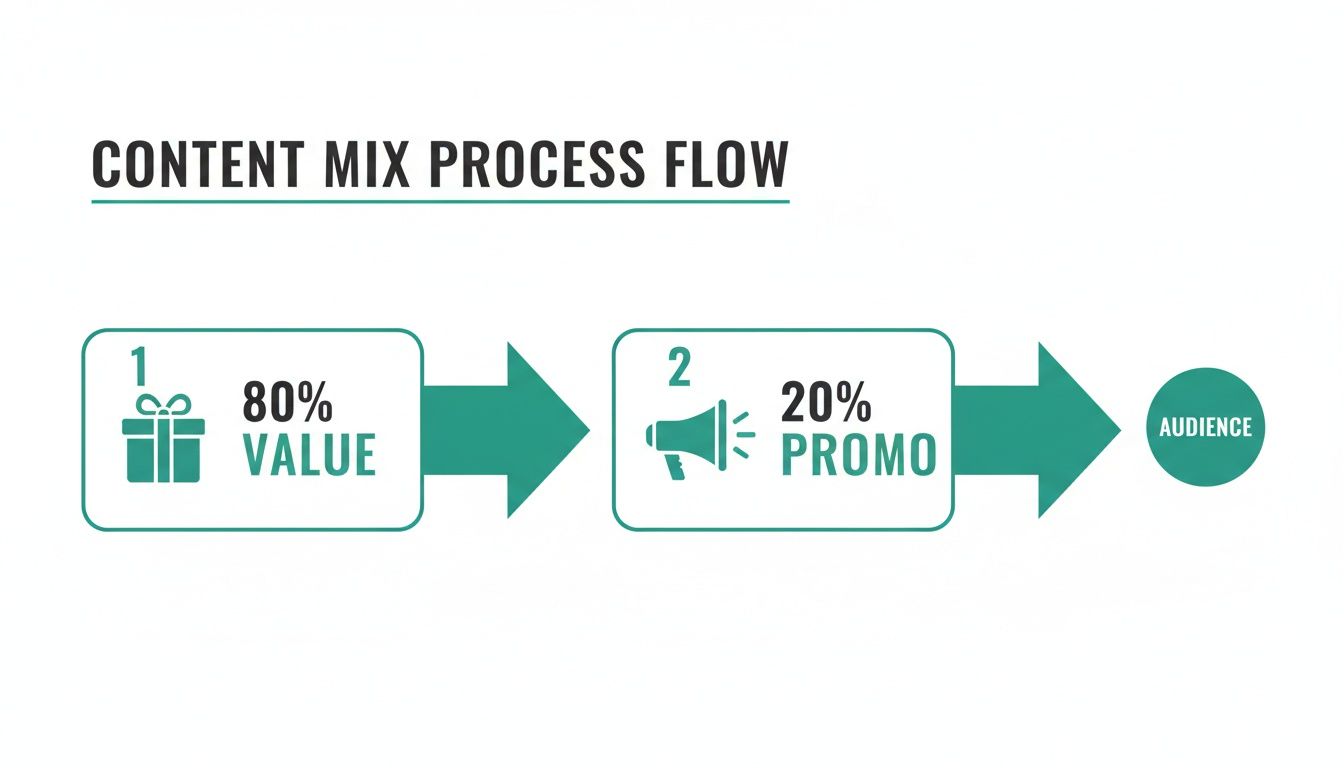
This visual serves as a reminder that your main goal is to build a relationship, not just to promote products or services.
Remember that consistency is more effective than intensity. Publishing two high-quality blog posts every week is better than publishing five in one week and then none for the next three. Be realistic about what your team can handle without compromising quality or causing burnout.
For a small e-commerce brand, a sustainable cadence might look like this:
- Instagram: 4 to 5 posts per week, mixing Reels, carousels, and stories.
- Email Newsletter: One valuable email sent weekly.
- Blog: One in-depth article every two weeks.
The Ultimate Workflow Hack: Content Batching
To make your cadence more manageable, consider content batching. This is the practice of performing similar tasks all at once. Instead of writing a post one day and shooting a video the next, you block out a day to write all of the month’s posts or film all of the videos.
This method can significantly improve efficiency. Focusing on a single task type allows you to enter a state of flow and complete work more quickly. It also helps maintain consistency in quality and tone of voice.
Here is how you could structure a batching schedule:
- First Monday of the month: Brainstorm and outline all blog posts.
- First Tuesday of the month: Write all the first drafts.
- Second Monday of the month: Film all video clips for social media.
- Second Tuesday of the month: Create all graphics for the blog and social media.
This approach changes content creation from a daily task into a structured project. It frees up mental energy for the rest of the month, allowing your team to focus on broader strategic goals.
Pick Your Gear and Know the Score
You have a content plan and a workflow in place. But where will this plan be managed? And more pointedly, how will you know if it is effective?
This is where you select your command center, the tool that will house your calendar, and determine how to track the metrics that connect your daily activities to business growth.
Finding the Right Home for Your Content Calendar
There is no single “best” tool. The most suitable tool is the one your team will consistently use. The choice depends on your team size, budget, and the complexity of your process.
Many marketers begin with a spreadsheet.
Spreadsheets (Google Sheets, Excel): A spreadsheet can be a powerful tool. They are free, widely understood, and highly customizable. You can create columns for all the necessary elements, use color-coding to indicate status, and build a robust system at no cost.
Project Management Tools (Trello, Asana): When a spreadsheet becomes too limiting, it may be time to upgrade. These tools offer visual Kanban boards, allowing you to move content through stages like “Ideas,” “Writing,” and “Published.” This visual representation makes it easy to identify bottlenecks.
Dedicated Content Platforms (Airtable, etc.): For teams with more complex needs, these platforms provide advanced features. They combine calendar views with database functionalities, allowing you to link individual posts to campaigns, import performance data, and create a central source of truth for your content.
Start with a simple tool. Avoid “analysis paralysis” when choosing software. A Google Sheet that is used daily is more valuable than a sophisticated tool that is not.
Your tool is merely the vehicle. The engine is the strategy you implement and the data you track. Choose a system that integrates naturally into your team’s daily workflow.
What to Measure (and What to Ignore)
A content calendar provides organization, but Key Performance Indicators (KPIs) tell you if your efforts are making an impact. Without tracking, you are operating without feedback. Your KPIs must be directly linked to the business goals you established at the beginning.
So, what should you actually track?
Moving Past Vanity and Toward Real Impact
It is easy to focus on “vanity metrics” like likes, new followers, or page views. While they may feel good, they do not directly contribute to revenue. To understand what is working, focus on metrics that show your content is influencing audience behavior.
Here is a breakdown of how to connect your goals to tangible KPIs:
| If Your Goal Is… | …Then These KPIs Are Your North Star |
|---|---|
| Increase Brand Awareness | Reach: How many unique individuals saw your content? Impressions: How many times was your content displayed? (Good for gauging algorithmic favorability). |
| Boost Engagement | Comments & Shares: Is your content starting conversations? Saves: This indicates that someone found your content useful enough to revisit. Time on Page: Are people reading your blog posts thoroughly or leaving after the first paragraph? |
| Generate Leads | Click-Through Rate (CTR): Are people clicking the links you want them to click? Form Submissions: How many people are downloading your e-book or signing up for a webinar? |
| Drive Sales (E-commerce) | Conversion Rate: What percentage of people who interact with your content end up making a purchase? Add to Carts: A strong indicator of purchase intent driven by a specific product video or post. |
Your calendar is the ideal place to track these metrics. Add columns for your main KPIs next to each content item. At the end of the month, you can sort the sheet by “Conversion Rate” or “Shares” to instantly identify your most and least successful content.
This review process transforms your calendar from a static schedule into a dynamic strategic document. It tells you what to do more of and what to discontinue. This cycle of plan, execute, measure, and refine is how you build a content system that not only keeps you organized but also accelerates your growth.
Content Calendar FAQs (The Stuff No One Tells You)
You have created what appears to be a perfect content calendar. It is color-coded, organized, and ready for implementation. But then you encounter a creative block, a deadline is missed, or a new trend emerges that makes your plan seem outdated.
Let’s address the real-world challenges that can disrupt even the most well-organized content strategy. Understanding these now will prevent future complications.
How Far Out Should I Actually Plan This Thing?
This is a common question. The answer is that you need to operate on two different timelines simultaneously.
For your day-to-day content—blog posts, social media updates, newsletters—a good practice is to plan one month. This provides your team with enough time for writing, design, and approvals without creating undue pressure. Rushing often compromises quality.
For larger initiatives, such as major marketing campaigns, new product launches, or a Black Friday sale, you should be planning 3 to 6 months. This long-term view allows for alignment across all departments, from paid advertising to email marketing.
Consider this approach:
- Quarterly Planning: This is for your high-level strategy. You will map out major themes and campaigns, not individual posts. This serves as your strategic roadmap.
- Monthly Planning: This is where you focus on tactics. You will fill in the details for the coming weeks with specific topics and deadlines. This keeps the process running smoothly.
This dual-horizon approach provides both the flexibility to adapt and the structure to build something substantial.
What if I Run Out of Content Ideas?
Experiencing a lack of ideas is a common challenge. When you feel you are out of ideas, it is often a signal to shift from brainstorming to listening. The best ideas are frequently found outside your own thoughts.
Return to your primary sources.
- Consult your sales team: Ask them, “What are the top three questions you receive on every sales call?” The answers can become the basis for three blog posts.
- Analyze customer support tickets: What are the recurring problems and questions your customers have? Every ticket represents a need for helpful content.
- Use Google for research: Use a keyword tool or Google’s “People also ask” section for your main topics. Google provides a list of what your audience wants to know.
- Revisit your top-performing content: Analyze your analytics. What was your most popular piece of content last year? Consider how you can update it, expand on the topic, or repurpose it into a video or infographic.
A shortage of ideas often indicates a disconnect from your audience’s daily challenges. By re-engaging with their world, you will find an abundant source of relevant topics.
How Often Should I Mess With My Calendar?
A content calendar is not a static document. It should be a living document. You should review it daily, but also schedule dedicated time for review and adaptation.
Schedule these two meetings:
- The Weekly Huddle (30 minutes maximum): Gather the team for a brief sync. Review the upcoming week, confirm responsibilities, and make any necessary last-minute adjustments. This promotes accountability and helps identify problems early.
- The Monthly Performance Review (60 minutes): At the end of each month, conduct an honest review. What content was successful? Which pieces drove traffic, leads, or sales? Which ones underperformed? Use this data to inform your strategy for the next month.
If a major trend emerges in your industry, you need the flexibility to adjust your calendar and respond. A rigid plan that cannot adapt is likely to fail.
Should I Use a Spreadsheet or a Fancy Tool?
This is a classic debate. The answer is simple: the best tool is the one your team will consistently use.
An expensive, feature-rich platform like Asana or Trello is useless if your team dislikes it and does not use it. Conversely, a simple Google Sheet can be highly effective if everyone treats it as the single source of truth.
Start with a spreadsheet. It is free, familiar to most people, and can be customized with columns and color-coding for status updates.
You will know it is time to upgrade to a more advanced tool when the spreadsheet becomes cumbersome. This usually occurs when you need better workflow automation, visual boards (like a Kanban layout), or integrations with other software. Do not invest in a complex tool until you have outgrown a simple one.
Ready to stop guessing and start building a content strategy that drives real growth? Ascendly Marketing helps businesses create and execute high-performance content plans. We build the systems that attract more visitors and convert them into loyal customers.