

You already know the pattern. The team publishes when there’s time, everyone wants more leads, and the content calendar turns into a list of disconnected blog ideas. A few posts do well, most drift, and nobody can say which pieces helped sales.
That isn’t a content problem. It’s an operations problem.
If you want to learn how to scale content marketing, stop thinking in terms of output alone. More posts won’t fix weak planning, unclear ownership, or bad measurement. A scalable program behaves like a system. It has goals tied to revenue, a production model that doesn’t collapse under workload, workflows that reduce waste, and reporting that shows what to keep, what to cut, and what to improve.
For ambitious SMBs, B2B firms, and e-commerce brands, that’s the difference between content as a recurring expense and content as a reliable growth channel.
The Blueprint for Scalable Content Strategy
The common approach to scaling content involves asking how often to publish. The better question is simpler. What business result should this program produce?
That shift matters because content can perform extremely well when it’s managed with discipline. According to Genesys Growth’s content marketing ROI data, content marketing delivers a median 4.33:1 revenue return for successful brands, yet only 29% of organizations with documented strategies report high effectiveness. The same research notes that, for SMBs, investing over $2,000 per content piece correlates with 54% reporting high strategy success. Cheap volume looks efficient on paper. In practice, it usually creates a backlog of weak assets nobody wants to promote.

A documented strategy isn’t a deck that sits in a shared drive. It’s a set of operating decisions. Which audiences matter most? Which offers deserve support? Which topics connect to pipeline, sales, retention, or repeat purchase? Which channels earn attention over time instead of requiring constant spend?
Start with business targets, not content ideas
If you’re in e-commerce, your content should support product discovery, comparison, and conversion. If you’re in B2B, your content should move buyers from problem awareness to solution evaluation and then into sales conversations. Those are different buying motions, so they need different content maps.
A practical strategy document should answer a short list of questions:
- What is the commercial goal: More qualified leads, higher trial intent, stronger product page traffic, or better conversion from existing demand.
- Who is the audience: One clear segment first. Broad targeting produces generic content.
- What role does content play: Acquisition, education, objection handling, or retention.
- Which topics deserve depth: Areas where your business can build repeated coverage instead of scattered commentary.
- How will success be judged: Revenue, lead quality, opportunity creation, or assisted conversions.
Practical rule: If a proposed article can’t be tied to a buyer stage and a business outcome, it doesn’t belong in a scaling plan.
Many teams get stuck. They confuse relevance with usefulness. A topic may be related to your industry and still be a poor investment because it doesn’t help a buyer move.
Map content to the funnel before production starts
One-off publishing creates content gaps. Funnel mapping fixes that. You build assets on purpose.
A simple approach works well:
| Funnel stage | Content job | Example asset type |
|---|---|---|
| Awareness | Frame the problem and attract search demand | Educational blog post, glossary, trend explainer |
| Consideration | Compare options and answer objections | Comparison page, use-case guide, webinar recap |
| Decision | Reduce friction and support sales | Case-led landing page, FAQ page, implementation guide |
| Retention | Expand value and improve repeat action | Email series, knowledge content, feature education |
The point isn’t to force every asset into a rigid template. The point is to make sure the program serves the full buying journey instead of overproducing top-of-funnel traffic pieces.
Useful planning frameworks can help sharpen that process. I like Fame’s content marketing insights because they reinforce the difference between content volume and a real operating model.
If your team needs a working document instead of a blank page, use a structured content marketing plan template and fill in decisions before assigning drafts. That order matters. Planning first removes a surprising amount of wasted writing, editing, and publishing effort.
Quality is a scaling decision
Teams often treat quality as an editorial preference. It isn’t. It’s a growth constraint.
Low-quality content creates hidden costs. It ranks poorly, earns weak engagement, forces rewrites, and gives distribution teams little confidence in promotion. Strong content takes longer and costs more upfront, but it creates more options later. You can repurpose it, link to it, use it in sales enablement, and build related pieces around it.
That’s the blueprint. Clear goals, a narrow audience, funnel alignment, and quality standards are set before production begins.
Assembling Your Content Marketing Powerhouse
Once the strategy is clear, the next decision is resourcing. Who builds and runs the machine?
SMBs often make expensive mistakes. Some hire too early and lock themselves into overhead before the process is stable. Others rely on low-cost freelancers for everything and end up with fragmented quality, weak briefs, and no accountability. A few outsource all of it without retaining strategic control, then wonder why the content sounds polished but detached from sales reality.
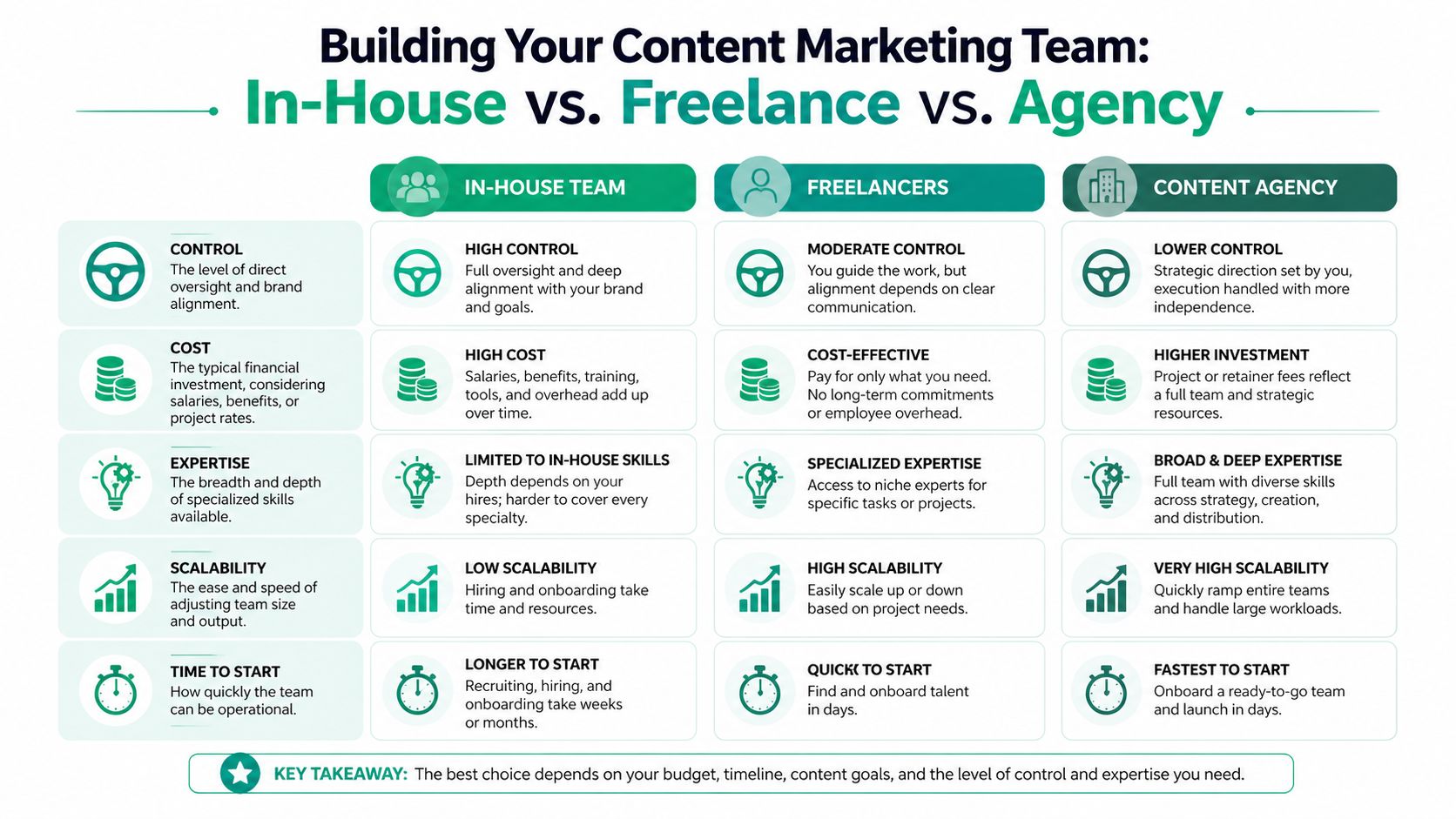
The right answer depends on budget, growth stage, internal expertise, and how much coordination your team can realistically handle.
The three common team models
An in-house team gives you direct access and close brand alignment. It also requires hiring, management, editorial direction, and enough work to justify specialist roles.
A freelance model gives flexibility. You can bring in a writer, designer, editor, or video specialist as needed. The trade-off is coordination. Freelancers rarely build the system for you. They execute pieces of it.
An agency partner brings strategy, process, and multi-skill execution together. The trade-off is that your internal team still needs to provide context, approvals, and business priorities. Agency support works best when the client side isn’t absent. It works when the client and partner each own a defined part of the workflow.
Here is the clean comparison.
Content Team Resourcing Models Compared
| Criteria | In-House Team | Freelance Model | Agency Partner |
|---|---|---|---|
| Control | Highest day-to-day oversight | Moderate, depends on briefing and management | Shared control with structured process |
| Cost | Ongoing salary and management commitment | Variable by project or retainer | Ongoing investment, but bundled expertise |
| Expertise | Strong in owned specialties | Narrow by individual contributor | Broad across strategy, SEO, writing, design, distribution |
| Scalability | Slower to expand | Fast to add contributors, harder to coordinate | Fastest when systems already exist |
| Time to start | Slowest because of hiring and onboarding | Fast for isolated tasks | Fast when the agency has a working delivery model |
Why hybrid teams usually win for SMBs
For most SMBs, the cleanest model is hybrid. Keep strategy, messaging, and commercial priorities close to the business. Use external specialists for production, design, editing, and repurposing.
That approach is supported by Within’s guidance on scaling content teams, which notes that hybrid models combining a core strategy team with freelancers for modular asset production can boost velocity by 40% with 25% cost savings, while 70% of scaled SMBs report quality drops from purely in-house expansion.
That finding matches what many operators see in practice. Hiring more people doesn’t automatically create a better system. It can create more meetings, more handoffs, and more inconsistency unless the workflow is already clear.
Build the core close to the business. Outsource the repeatable parts. Keep one owner accountable for quality.
A practical hybrid setup often looks like this:
- Internal lead: Owns positioning, product context, approvals, and funnel priorities.
- External strategist or editor: Turns business goals into briefs, calendars, and quality standards.
- Specialist creators: Writers, designers, video editors, and technical SEO support.
- Operations support: Project management, publishing, formatting, and repurposing.
That structure gives you an advantage without forcing full-time hiring across every role.
What doesn’t work
Some models look lean but fail under pressure.
- Founder-led everything: Fast at first, then blocked by the founder’s calendar.
- Writer-only resourcing: Produces drafts without a distribution or SEO plan.
- Freelancer patchwork with no editor: Every piece has a different voice, structure, and quality bar.
- Agency with no internal owner: Feedback arrives late, priorities shift, and momentum dies.
If you’re weighing whether to build internally or outsource, this breakdown of in-house marketing vs agency support helps frame the trade-offs more clearly.
Choose based on bottlenecks, not preference
A lot of team decisions are emotional. Leaders hire because they want more control, or outsource because they want less management. Better decisions come from asking where work gets stuck.
If strategy is weak, hiring more writers won’t help. If drafts are strong but publishing is delayed, the problem isn’t ideation. If content goes live and nobody distributes it, your issue isn’t production capacity.
Find the bottleneck first. Then match the model to that constraint.
Building Your Unstoppable Content Engine
A good team without a clear system produces uneven output. One month is busy, the next month stalls, and nobody can explain why. The fix is operational. You need a repeatable engine that moves work from idea to publication without relying on memory or last-minute effort.

The strongest teams treat content production like a managed pipeline. Topics are researched. Briefs are standardized. Drafts move through review in a known order. Distribution is built into the workflow instead of being added as an afterthought.
StoryChief’s framework for scaling content marketing captures this well. Their guidance notes that standardizing briefs can cut production time by 40%, Kanban boards can lead to 25% faster throughput, and automating workflows plus repurposing content reduces manual effort by 50-70%.
Build the workflow before you chase volume
If you’re trying to figure out how to scale content marketing, start with the production path itself.
A practical workflow usually has these stages:
- Topic selection based on audience pain points, keyword intent, and business relevance.
- Content brief creation with angle, structure, target action, internal links, and source guidance.
- Drafting by the assigned writer or subject matter contributor.
- Editorial review for clarity, claims, positioning, and consistency.
- SEO and formatting pass before upload.
- Design and media prep for graphics, screenshots, or video cutdowns.
- Publishing and QA in the CMS.
- Distribution and repurposing across email, social, sales, and outreach channels.
- Performance review after publication.
- Update cycle for pieces worth expanding or refreshing.
Most bottlenecks show up in two places. Weak briefs create slow drafts. Missing ownership creates review delays.
Standardize the brief or expect rework
A content brief should remove ambiguity. If a writer has to guess the audience, angle, or offer, the draft will drift.
Your brief doesn’t need to be long. It needs to be complete. Include:
- Audience and buying stage: Who this is for and what they need to understand next.
- Primary topic and search intent: What problem the piece solves and why someone would search for it.
- Commercial role: What action should the article support.
- Required proof and inputs: Internal data, examples, product notes, or approved claims.
- Structure guidance: H2s, FAQs, examples, links, and call-to-action direction.
- Distribution notes: Where this piece will be reused after launch.
A strong brief compresses review time because fewer assumptions survive into the draft.
The easiest way to speed up content is to remove guesswork before writing starts.
Use Kanban to expose bottlenecks
Teams often say content feels slow. Kanban boards show why.
Whether you use Trello, Asana, ClickUp, Notion, or Jira, the point is visibility. Every asset should sit in one lane at a time. Ideas, briefs, drafting, editing, design, uploading, scheduling, live, repurposing, and update queue. Once the board is visible, recurring delays become obvious. Maybe legal review takes too long. Maybe SMEs don’t return comments. Maybe publishing is blocked by image prep.
Later in the workflow, a short visual walkthrough helps:
Repurpose from the start, not after the fact
Repurposing works best when the original asset is designed for it. A strong article can feed email copy, LinkedIn posts, short video scripts, sales follow-up content, FAQ snippets, and internal enablement material.
Don’t wait until publication to ask what else can be made from the piece. Add repurposing instructions inside the brief. For example:
- Turn the core argument into an email to send
- Pull three objection-handling excerpts for sales
- Extract short-form social points
- Convert the framework into a checklist
- Record a short talking-head summary for the video
That approach is how content stops acting like isolated output and starts working like an engine.
From Keywords to Kingdom Building: Topical Authority
Publishing around random keywords creates random results. One article may rank, another may not, and the program never compounds. Topical authority fixes that because it turns content into a connected system of expertise instead of a pile of standalone pages.

The structure is straightforward. You choose a small number of pillar topics that matter to your business, then build spoke content around each one. Pillars cover the broad subject. Spokes answer specific questions, objections, comparisons, and subtopics. Internal links connect them.
Think in clusters, not isolated posts
If your company sells to B2B buyers, a pillar might center on lead generation, sales enablement, onboarding, or a problem your buyers repeatedly face. If you run e-commerce, pillars might focus on product education, category buying guides, fit or use advice, and post-purchase support content.
Each spoke should do one job well. It should answer a narrow question with enough depth to satisfy search intent and support the broader topic cluster.
A healthy cluster often includes:
- Foundational guides that define the topic clearly
- Use-case articles tied to real buying situations
- Comparison pages for decision-stage readers
- FAQ content that handles objections and edge cases
- Supporting assets such as videos, checklists, or email follow-ups
This model improves relevance because every new article strengthens the context around the others. It also improves editorial focus. Writers know what belongs in the cluster and what doesn’t.
Publish fewer orphan pages. Build more connected coverage.
Topical authority also changes internal linking
Internal links are often treated as an SEO cleanup task. They should be planned as part of the content architecture. Pillar pages should route readers deeper into the cluster. Spokes should point back to the pillar and to neighboring articles where that helps the user continue.
That creates two useful outcomes. Search engines get clearer signals about subject coverage, and readers get a smoother path from learning to evaluating.
When teams skip this structure, they usually end up with duplicate posts competing for similar terms, thin articles that don’t add much, and archives full of content that no one revisits.
Add AI visibility to the authority model
Search behavior is shifting, and topical authority now has another layer. Your brand also needs to appear in AI-driven discovery environments.
According to Sight AI’s analysis of scaling content marketing challenges, AI search is projected to surpass 50% of queries by 2026; brands that ignore AI-powered discovery can face 30-40% less visibility, and fewer than 20% of marketers currently track it. That creates a real opening for early adopters.
This doesn’t require a separate content strategy. It requires better formatting, clearer entity signals, stronger factual coverage, and pages that answer the kinds of direct questions AI systems summarize.
A practical audit looks like this:
- Search your core topics in major AI platforms and note whether your brand appears.
- Record which competitor domains are cited or mentioned.
- Identify missing topic coverage, weak definitions, and thin comparison content.
- Update pillar pages so they answer broad questions cleanly and directly.
- Add spoke pages for specific questions your audience asks in sales calls, support threads, and demos.
What AI-friendly content usually gets right
Pages that show up consistently in AI answers tend to share a few traits. They are clear, tightly structured, and specific. They define terms, answer obvious follow-up questions, and avoid vague filler. They also make relationships between topics easy to interpret through headings, internal linking, and direct explanations.
That means the old SEO playbook of chasing disconnected keywords is too narrow now. The better move is broader subject ownership. Build clusters that help human readers first, then make those clusters easy for search engines and AI systems to understand.
Mastering Content Distribution and Amplification
A published article without distribution is unfinished work. Teams spend days researching, writing, editing, and formatting, then hit publish and move on. That’s where a lot of content ROI disappears.
Distribution needs its own checklist, owner, and timing. The first push matters because it gives the asset early visibility, sends traffic signals, and gives sales, email, and social channels something useful to work with.
Build a launch routine for every asset
The cleanest approach is a repeatable distribution package attached to each major piece.
A standard launch checklist might include:
- Email sent: Share the asset with the segment most likely to care about it.
- Sales enablement: Give account reps a summary and a reason to use it in conversations.
- Social publishing: Turn the main argument into native posts for the platforms you use.
- Partner outreach: Send relevant content to collaborators, associations, or referral partners.
- Internal linking updates: Add the new piece to related pages so it starts with context.
- Retargeting eligibility: Flag high-value assets that may deserve paid support later.
The exact channels depend on your business. B2B teams usually get strong value from sales follow-up, founder-led posts, and email. E-commerce teams often gain more from category page support, lifecycle email, and creator or partner distribution.
Email remains one of the strongest distribution levers
Email works because you control the audience and timing. It also forces discipline. If the article isn’t worth sending to your list, it may not be strong enough to publish.
That said, weak packaging kills strong content. Subject lines matter. Preview text matters. The opening line matters. If your team debates formatting, this guide to subject line capitalization best practices is a useful reference because it helps clean up one of the easiest ways to make newsletters look inconsistent.
A good content email is short. It gives one reason to click. It doesn’t try to summarize the entire article.
Send the point, not the whole post. Curiosity drives the click better than a compressed essay.
Organic first, paid when the asset has real leverage
Not every post deserves paid amplification. Most don’t.
Put budget behind content when one of these conditions is true:
- The asset supports a high-value offer such as a demo, consultation, or strategic product category
- The topic has clear buyer intent and helps move prospects closer to action
- The content already shows traction organically through engagement, clicks, replies, or assisted conversions
- Sales can use the traffic and follow up effectively
Paid amplification should increase reach for proven assets, not rescue weak ones. If the page doesn’t hold attention or support the next step, paid traffic just reveals the weakness faster.
Connect content distribution with PR and authority building
Many SMBs separate content promotion from reputation building. That’s a missed opportunity.
Good content can support media outreach, founder visibility, partner co-marketing, and quote placements. A strong guide, original point of view, or useful resource gives outreach teams something concrete to pitch. If that’s part of your growth mix, these digital public relations services show how visibility work can complement a content program rather than compete with it.
Distribution works best when assigned, not implied
A common failure pattern looks like this. Marketing assumes social will share it. Social assumes email will include it. Sales never hears about it. The article sits on the site; its effectiveness is limited.
Ownership solves that.
Assign one person to publish. Another to package for email. Another is to turn it into channel-native posts. Another is to route it to sales or outreach. Once those roles are named, content stops disappearing after launch.
Measuring What Matters from Traffic to Revenue
Traffic can be useful. So can rankings, impressions, time on page, and social reach. None of them answers the only question leadership cares about for long. Did the content help generate business?
That is where many scaled programs fail. They produce a lot, report a lot, and still can’t prove much. The issue usually isn’t the absence of data. It’s the absence of a measurement model tied to commercial outcomes.
The cleanest framework comes from Content Marketing Institute’s measurement process, which notes that 75% of top performers use KPIs tied directly to revenue, making them 2.9x more likely to achieve high growth. The same guidance warns that tracking only total traffic can inflate perceived success by 40% while revenue stagnates. Their benchmark logic also connects content KPIs such as more than 20% month-over-month traffic growth with business outcomes like a 15% increase in high-quality leads.
Step one is objective setting
Start with one business objective. Not five.
For a B2B company, that may be more qualified leads from organic content. For e-commerce, it may be stronger revenue from non-branded informational pages that assist product discovery. For a service business, it may be more consultation requests tied to educational pages.
The objective needs a direct commercial outcome because every downstream KPI depends on it. If the team says the goal is “brand awareness,” reporting will drift toward vanity metrics almost immediately.
A better setup uses a statement like this:
Content should generate more qualified opportunities by attracting the right visitors, moving them into conversion paths, and supporting sales conversations.
That gives every metric a job.
Step two is defining key results that actually matter
Key results translate the objective into trackable outcomes. Teams often overcomplicate the definition of these. You don’t need a dashboard full of noise. You need a small set of indicators that show whether content is helping the business.
Useful key results usually live in a few groups:
- Acquisition quality: Organic sessions to target pages, traffic growth on priority clusters, new users by intent-focused page groups
- Engagement quality: Scroll depth, engaged sessions, dwell signals, bounce trend, shares or saves where relevant
- Lead behavior: Form fills, demo requests, email signups, trial starts, quote requests
- Pipeline influence: Opportunities touched by content, sales usage, assisted conversions, closed-won influence where attribution is available
Some benchmarks from the CMI framework are useful guardrails. They point to engagement rates above 4%, bounce rates below 50%, and share rates above 10% as practical targets in performance design. Those aren’t universal truths. They are operating reference points that help a team decide whether an asset deserves more investment or a rewrite.
Step three is separating the signal from the noise
A lot of content reports are filled with totals. Total pageviews. Total users. Total impressions. Those numbers can rise while lead quality stays flat.
What matters more is segmented performance.
Look at content by cluster, buyer stage, intent type, and conversion path. Compare educational pages to comparison pages. Compare articles linked from sales emails to articles that only receive search traffic. Compare new content to refreshed content. Once content is grouped this way, useful patterns show up fast.
A simple reporting view can include:
| Metric group | What to review | Why it matters |
|---|---|---|
| Visibility | Organic traffic trend, rankings by cluster, indexed pages | Shows whether topic coverage is gaining traction |
| Engagement | Bounce trend, dwell signals, click depth, share activity | Shows whether visitors find the content useful |
| Conversion | CTA clicks, forms, trials, quote requests | Shows whether the page moves readers to action |
| Revenue impact | Assisted conversions, opportunity influence, sales usage | Connects content to business outcomes |
Step four is review cadence and iteration
Measurement only helps if it changes behavior. A monthly review usually works well for active production teams, with a deeper quarterly review for cluster-level decisions and major updates.
In those reviews, ask direct questions:
- Which topics brought qualified traffic, not just traffic?
- Which assets generated conversion actions?
- Which pages attracted visitors but failed to move them deeper?
- Which articles are strong enough to refresh, expand, or repurpose?
- Which topics looked promising but produced weak business impact?
A good dashboard doesn’t just prove performance. It creates editing decisions.
That last part matters. Measurement should shape the calendar. Winning topics deserve follow-up content, stronger internal links, and broader distribution. Weak assets deserve revision or retirement. Middling assets often need better calls to action, sharper positioning, or cleaner search intent alignment.
Build attribution that your sales team can actually use
Attribution gets messy fast if marketing and sales use different languages. Keep it practical.
If a prospect lands on a guide, returns later through branded search, and then books a demo, content likely assisted the path even if it didn’t get the final click. Your reporting should reflect that reality as clearly as your tools allow. GA4, CRM tagging, campaign parameters, lead source fields, and sales feedback all help. None are perfect on their own.
The better approach is triangulation. Use analytics for traffic and engagement patterns. Use conversion tracking for direct actions. Use CRM notes and sales feedback to understand which content buyers mention or consume before conversations move forward.
The final filter is business discipline
A scalable content program doesn’t keep every asset alive out of sentiment. It keeps what performs, improves what has potential, and stops funding what doesn’t support the model.
That discipline is what turns content into a revenue engine. Not because every article wins. Most won’t. But the system learns, compounds, and gets more efficient over time because the team measures the right things and acts on them.
If you want a content system that ties strategy, production, SEO, distribution, and reporting together, Ascendly Marketing can help you build and run it. Their team supports SMB, B2B, and e-commerce brands with practical growth programs designed around measurable outcomes, not just output.