

A website redesign is a strategic process to address functional shortcomings in a company’s digital presence. For industrial companies, this involves correcting issues that lead to lost leads and revenue. This action re-engineers a digital asset to generate revenue and appeal to technical buyers.
If a website functions like a static brochure instead of a sales tool, it indicates an underlying problem that extends beyond its visual design.
Why Your Industrial Website is not Delivering
A website should be a primary business development tool. If it fails to generate leads or support sales activities, it is not functioning correctly. The issues are often invisible to the business but apparent to the engineers, procurement managers, and MRO specialists who use the site.
Consider a component manufacturer experiencing a decline in conversion rates. Their sales representatives cannot efficiently access specification sheets on a tablet for a client because the pages load slowly and the navigation is difficult on mobile devices. This circumstance can hinder sales conversations and reflect poorly on the company’s technical capabilities.
Understanding the causes of a website’s poor performance is a preliminary step before implementing solutions. These issues have a direct impact on financial outcomes.
Redesign Triggers and Their Business Impact
The table below outlines common indicators for a website redesign and the business consequences of not addressing them.
| Problem Area | Common Symptom | Business Impact |
|---|---|---|
| User Experience (UX) | High bounce rates, low time on page, confusing navigation. | Users may leave for competitors due to frustration. |
| Lead Generation | Few or no form submissions, low-quality inquiries. | The sales pipeline may contract, limiting company growth. |
| Mobile Performance | The site is slow or unusable on phones and tablets. | Field sales teams are hindered; opportunities may be lost. |
| Outdated Technology | Slow load speeds, security vulnerabilities, difficult to update. | SEO rankings can decline and brand reputation may be at risk. |
Recognizing these symptoms is the first step. A redesign addresses these failures to turn a website from a non-performing asset into a revenue-generating one.
The Financial Effect of a Poor User Experience
When a procurement manager visits your site to find a specific part number, they require an efficient process. They need specifications, datasheets, and a clear path to request a quote. A website with a dysfunctional search bar can cause them to seek alternatives, potentially leading them to a competitor. Each instance of user frustration represents a potential loss of business.
Data indicates that negative digital experiences affect business decisions.
A study shows that 80.8% of businesses overhaul their websites because of low conversion rates. The primary cause, cited in 61.5% of redesign projects, is a poor user experience, where the site navigation is confusing and mobile performance is inadequate.
In the industrial sector, a single qualified lead can have significant value. User experience failures can accumulate into substantial revenue loss. Visitors who have a negative experience may share their feedback, which can affect brand reputation. Focusing on user experience can mitigate these losses. A starting point is to learn how to reduce bounce rate on your website and keep prospects engaged.
Your Site Needs to Work on the Factory Floor, Not Just the Desktop
The modern industrial buyer is not confined to a desk. They operate on factory floors, at job sites, or at trade shows. In 2026, mobile devices account for over 60% of all web traffic, which has altered B2B sales dynamics. If a website is not functional on a phone, the sales team’s effectiveness is reduced.
A site not optimized for mobile devices presents a liability. For an industrial business, this translates to:
- Lost Deals: A potential customer cannot access a critical data sheet during a project meeting and seeks other options.
- A Frustrated Sales Team: Sales personnel may avoid using the company website because it is slow and unreliable in the field.
- A Stale Brand Image: The company may appear technologically outdated compared to more agile competitors.
A comprehensive website redesign addresses these issues. It ensures that whether an engineer is on a desktop planning a custom fabrication project or a technician is on a smartphone checking a part number, the experience is fast, seamless, and productive. This action transforms the website into an effective sales tool.
Laying the Groundwork: Your Data-Driven Redesign Blueprint
Initiating a website redesign by focusing on visual elements like mockups, colors, and fonts overlooks the foundational aspects. A successful industrial website, one that generates leads and supports business growth, is built on data, not on subjective preferences.
Vague goals such as “we need more leads” are insufficient. The initial phase requires converting general objectives into a specific, data-backed plan.
Become a Digital Archaeologist on Your Own Site
Before planning new features, you must understand the existing site’s flaws. This involves conducting a forensic audit of the current site from the user’s perspective.
Tools like heatmaps provide a visual representation of user behavior, showing where people click, how far they scroll, and where they encounter difficulties. For example, a “Request a Quote” button might be overlooked, or users might click on a non-interactive product diagram. These are indicators of user frustration.
A confusing experience can cause users to leave the site.
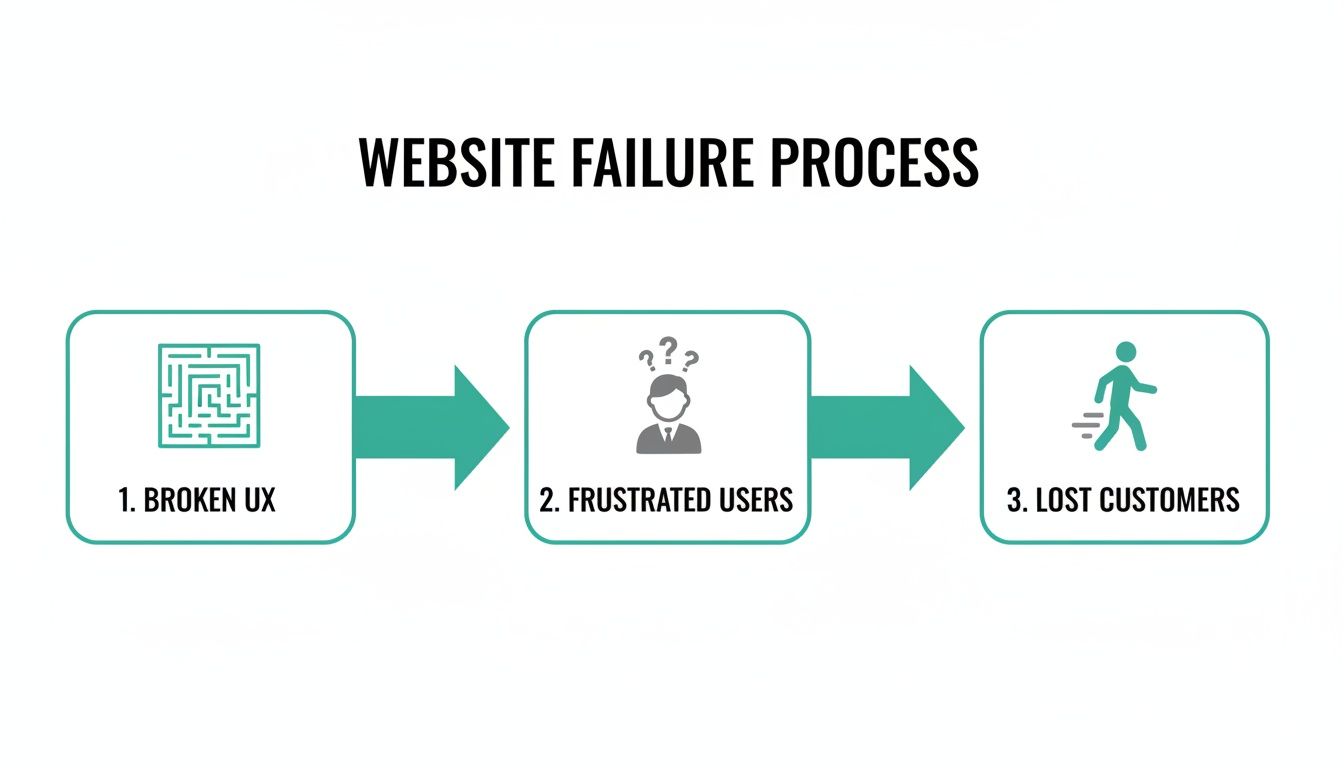
When a potential customer cannot find what they need, they are likely to abandon the search on that site.
Digging for Gold in Your Analytics
Heatmaps show what users are doing, while analytics explain why. Using tools like Google Analytics allows you to connect user behavior to quantitative data.
- High-Exit Pages: Identify where users are leaving the site. If prospects land on a technical spec sheet and then exit, the page may lack a clear next step.
- Bounce Rate on Key Pages: A high bounce rate, such as 80%, on a landing page receiving paid traffic indicates a mismatch between the ad’s promise and the page’s content.
- Conversion Paths: Trace the user journey from the first click to a submitted contact form. A significant drop-off on a specific page indicates a problem in the sales funnel.
Combining this quantitative data with qualitative heatmap findings builds a case for change. For instance, data showing that pages without video demos have a 30% higher exit rate makes the inclusion of videos a data-driven requirement.
This process shifts the focus from “I think our users want…” to “I know they’re struggling with…” Data showing that 45% of users abandon your quote form at the second field identifies a tangible problem that can be fixed.
Your Website Doesn’t Exist in a Vacuum
A redesign project confined to the marketing department will lack crucial input. It is necessary to communicate with individuals who interact with customers daily.
Start with your sales representatives. They can provide insights on which spec sheets customers cannot find, which competitor features are influencing deals, and what questions prospects frequently ask. This information links website flaws directly to lost revenue. For more on this, a specialized manufacturing digital marketing agency can offer further perspective on these challenges.
Interview other key personnel as well:
- Customer Service: What are the top five questions they receive weekly? Answering these on the site can reduce their workload and improve customer satisfaction.
- Engineering/Product Teams: What technical details are indispensable for a serious buyer? This information must be clear and easy to find.
- The CEO/Leadership: What is the company’s five-year vision? The new site must support future goals, such as market expansion or new product lines.
Each conversation contributes to the project brief. This document serves as the blueprint for the redesign, translating data and stakeholder interviews into a concrete plan with clear objectives, target audiences, required features, and success metrics.
A well-defined project brief helps prevent scope creep and ensures the final product is a strategic asset. To execute this effectively, familiarity with current B2B e-commerce best practices is beneficial.
Time to Architect Your Content (The Right Way)
A visually appealing design is insufficient if the website’s content is not structured effectively. The process involves creating a digital blueprint that addresses the needs of every visitor, from a procurement officer to an engineer.
This is not simply about creating a sitemap. It is about engineering an experience where complex technical information is easily accessible.

The objective is to map clear paths for the individuals who make purchasing decisions. This requires understanding their mindset, anticipating their questions, and guiding their journey. A maintenance manager seeking a replacement part has different needs than a design engineer evaluating custom fabrication capabilities. The content strategy must accommodate both.
Map the Journeys of Your Technical Buyers
First, define your main user personas. What is their job title? What are their professional challenges? What do they want to accomplish on your site?
- The Procurement Officer: This user is focused on price, lead times, and order placement efficiency. Their ideal journey is a direct path from a product search to a spec sheet and a prominent “Request a Quote” button.
- The Design Engineer: This user validates technical information. They require data such as CAD files, material specifications, performance charts, and case studies. Their path might begin on a technical blog post, proceed to a detailed white paper, and conclude on a page about custom capabilities.
- The Maintenance Manager: This user often needs to solve an immediate problem. They require quick access to support documents, parts catalogs, and contact information for the technical service team.
Sketching the ideal path for each persona will highlight dead ends, frustrating loops, and content gaps on the current site.
Build Your Site Like a Fortress with the Hub and Spoke Model
The hub and spoke model is an effective way to structure an industrial site, benefiting both users and SEO.
The “hub” is a main pillar page for a core service, such as “Precision CNC Machining.” This page provides a high-level overview and targets broad keywords. The “spokes” are supporting content pieces that delve into specific details and link back to the main hub.
This structure establishes authority. Surrounding a core service page with a network of specific, helpful resources signals to search engines and customers that your company is an expert in the field.
These spokes can take various forms, as long as they answer a specific question:
- Case Studies: “How We Achieved 0.001″ Tolerance for an Aerospace Client”
- Application Notes: “Choosing the Right Material for High-Wear Components”
- White Papers: “The Future of 5-Axis Machining in Medical Devices”
- Blog Posts: “Common Causes of Part Failure in Hydraulic Systems”
This model creates an intuitive user flow. An engineer can land on a blog post, click through to the main “Custom Fabrication” hub, and then explore a specific case study without feeling lost.
Audit Your Content and Fill the Gaps
With user journeys mapped and the hub-and-spoke structure planned, it is time to conduct a content audit. This involves mapping every page, PDF, and video on the old site to its new location.
Content will fall into three categories:
- Content to Keep & Optimize: These are high-performing assets that align with the new strategy and require minor updates, such as fresh data and improved internal links.
- Content to Consolidate or Kill: Outdated spec sheets, thin blog posts, and low-value pages should be addressed. Consolidate where possible and remove the rest.
- Content Gaps: This analysis will reveal missing content, such as information for a key customer industry or application notes for a flagship product line.
These gaps form your new content creation roadmap. Each new piece of content will have a specific purpose, supporting your target customers and fleshing out your hub-and-spoke models.
As you develop this new content, consider future search trends. It is valuable to start optimizing your content for AI search ranking to ensure it is discoverable by next-generation search technologies. This approach builds a lead-generating system, not just a new website.
Time to Build: Weaving Together Design, Development, and SEO

With planning and blueprints complete, the next phase is to transform wireframes and strategies into a functional website. This involves three parallel projects: design, development, and SEO migration.
These three elements must be integrated. A well-designed site is ineffective if it loads slowly. Fast code is meaningless if users cannot find necessary information. Success requires executing all three components effectively.
Designing for Engineers, Not Art Critics
For industrial and B2B companies, web design should build trust and facilitate access to information. The audience, consisting of engineers, procurement managers, and technicians, values clarity and substance.
This context does not call for trendy animations or abstract layouts. Clarity is paramount. Calls-to-action, such as “Request a Quote” or “Download Spec Sheet,” should be prominent and easy to identify. Navigation must be logical, allowing a first-time visitor to find technical data with minimal clicks.
The purpose of the design is to simplify the process for a serious buyer to engage with the company. They should land on the site, understand the company’s offerings, and see a clear path to the information they need.
A poor user experience is a common reason for redesigns. Data shows that 61.5% of redesigns are initiated to fix UX problems. With 52% of customers stating they would abandon a brand after one bad online experience, getting this right is a priority. For more detailed guidance, our article on the best website design practices offers tips for creating effective interfaces.
The Non-Negotiables of Development
The design is now translated into functional code. For an industrial website, several factors are non-negotiable: clean code, fast loading speed, and a mobile-first build.
First, clean code serves as the site’s foundation. A well-structured codebase is easier to update, more stable, and more accessible to search engine crawlers. This technical foundation determines the site’s long-term health.
Next, speed is a prerequisite. A busy engineer on a deadline will not wait for a slow-loading page. They will move to a competitor’s site that functions efficiently. This involves image optimization, streamlined code, and modern hosting to ensure a responsive experience.
Finally, all sites built in 2026 are mobile-first. An engineer on a factory floor with a tablet or a sales representative visiting a client needs full access on the go. A non-responsive mobile site is a significant issue, responsible for 53.8% of redesigns. It directly contributes to problems leading to 80.8% of low conversion rates and 65.4% of high bounce rates. More data on these issues can be found in the latest web design statistics and their impact.
Don’t Wreck Your SEO: The Technical Migration
This is a high-risk phase of any industrial website redesign. Errors here can erase years of search engine rankings. The objective of a technical SEO migration is to launch the new site without losing existing organic traffic.
The primary tool for this task is the 301 redirect map.
This is a spreadsheet that maps every URL from the old site to its new location on the redesigned site. A 301 redirect is a permanent “change of address” notice for search engines. It informs Google that a page has moved.
This serves two purposes:
- It preserves your authority. It transfers the majority of the old page’s ranking power to the new one, protecting your search result positions.
- It keeps users happy. Anyone clicking an old link from a search result, email, or another website is directed to the correct new page instead of a “404 Not Found” error.
Creating this map is a detailed but necessary process. It involves crawling the entire old site, listing every URL, and matching each one to its new counterpart. Skipping this step is a fast way to lose traffic and undermine the launch. It is the connection between the technical build and post-launch success.
Launch and Post-Launch Performance Optimization
After the planning, design, and coding phases, it is time to launch the new website. The launch day is the start of the process to turn the new site into a lead-generating asset.
The launch should be a controlled and methodical event, a result of thorough pre-launch preparations.
This preparation involves more than a cursory review of a few pages. It is a comprehensive inspection using a detailed checklist.
- Final QA Takedown: A complete review of every page, form, and interactive element. Test on multiple browsers (Chrome, Firefox, Safari, Edge) and devices (iPhones, Androids, tablets).
- Analytics Check: Confirm that your Google Analytics code is active and that goals are set for every “Request a Quote” form and PDF download. Measurement is key.
- Redirect Verification: Personally verify that the 301 redirect map is functioning correctly. A single mistake can have a significant negative impact on SEO.
- Backup Plan: Before going live, confirm you have a complete, restorable backup of the new site.
Once all checklist items are complete, you can deploy the site. What follows is what differentiates an aesthetic website from a functional business tool.
The Critical First 90 Days
The first three months post-launch are when theories are tested against real-world user behavior. The focus should be on key performance indicators (KPIs) that measure financial impact, not on vanity metrics like total visits.
Your analytics dashboard becomes your command center. Monitor these numbers closely, comparing them to benchmarks from the old site. The objective is to understand the reasons behind any changes in the data.
KPIs You Need to Obsess Over
During this initial period, a few key metrics will provide most of the necessary information.
Organic Traffic and Keyword Rankings
This is the test of your SEO migration. A sudden drop in organic traffic requires immediate attention, as it may indicate a problem with the redirect map or an incorrect noindex tag. Traffic should remain steady and then begin to increase. Monitor your primary keywords to ensure their rankings are stable.
Bounce Rate
A high bounce rate indicates that the page is not meeting user expectations. If this occurs on a critical landing page, there may be a disconnect between the ad copy and the page content, or the next step may be unclear. Investigate high-bounce pages to identify the cause.
Lead Conversion Rates
This is a primary metric. Are you receiving more and better-quality leads? Focus on the conversion rates of your “Request a Quote” and “Contact Us” forms. If this number has not improved, there is a problem that could be related to the form, the call-to-action, or the offer itself.
User Engagement Metrics
Analyze metrics like pages per session and average session duration. If users are staying on the site, visiting multiple pages, and engaging with your content, it suggests that the new information architecture and content strategy are effective. They are finding the information they need.
Treat your website as a high-performance engine. The data collected provides real-time feedback, indicating where adjustments are needed.
If a key landing page has a low conversion rate, use a tool like Optimizely or VWO to run an A/B test. Test a new headline, change a button color, or reduce the number of form fields.
Let data, not opinions, guide your decisions.
This continuous cycle of measuring, testing, and refining transforms your website from a one-time project into an evolving company asset.
Answering Your Top Questions About Industrial Website Redesigns
This section addresses common questions about industrial website redesigns.
How Long Does This Actually Take?
The timeline depends on the project’s scope. A smaller site of 20 to 50 pages, with a direct refresh and no extensive custom features, will likely take 3 to 4 months from the initial conversation to launch.
For larger, more complex projects involving extensive product catalogs, ERP integrations, or e-commerce, the timeline is typically 6 to 9 months. The initial discovery and strategy phase alone can take 4 to 6 weeks and should not be rushed.
Inadequate time for upfront strategy is a common mistake. Attempting to save a few weeks at the beginning often leads to months of delays and change orders later.
How Do I Keep My SEO Rankings From Tanking?
The answer is a meticulous technical SEO migration plan. This is a core part of the technical process.
It begins with mapping every URL on your current site. Then, a permanent 301 redirect is created for every old page, directing it to its new location. This tells Google to transfer the page’s authority. This process is the difference between a smooth transition and a significant loss of traffic.
A full content audit is also conducted to protect top-performing pages, and current keyword rankings are benchmarked. After launch, a final technical audit is run to identify any issues. This is a process designed to protect your existing SEO equity.
What’s a Realistic Budget for This?
For a professional, strategy-driven redesign, a small to mid-sized industrial company should plan for a budget between $15,000 and $50,000.
If you have a large site with hundreds of pages, require e-commerce functionality, or need complex integrations with your CRM or ERP system, the cost can be $75,000 or more.
This budget covers more than just a visual design:
- Deep-Dive Discovery: Interviews with your sales team, engineers, and leadership to align the website with business goals.
- Actual UX Research: Understanding how your specific customers use a website to make buying decisions.
- A Real Content Strategy: Planning what to say, how to say it, and how to structure it to generate leads.
- The SEO Migration: The critical work that protects your traffic.
This is an investment in building a 24/7 business development tool, not just a marketing brochure.
Should We Redesign Our Old Site or Start From Scratch?
In 99% of cases, “redesign” means building a new website from the ground up on a modern platform.
Attempting to apply a new design to a site with old, inefficient code or an outdated CMS is ineffective. It results in a slow, insecure site that is difficult for your team to update.
Starting fresh provides a clean, fast, and mobile-friendly foundation. The “redesign” aspect involves migrating your brand, best content, and SEO authority to a framework built for success in 2026 and beyond.
Ready to turn your industrial website from an online catalog into a sales tool? The team at Ascendly Marketing builds high-performance websites backed by data-driven strategies that deliver measurable results. Schedule your free consultation today, and let’s talk about what’s possible.