

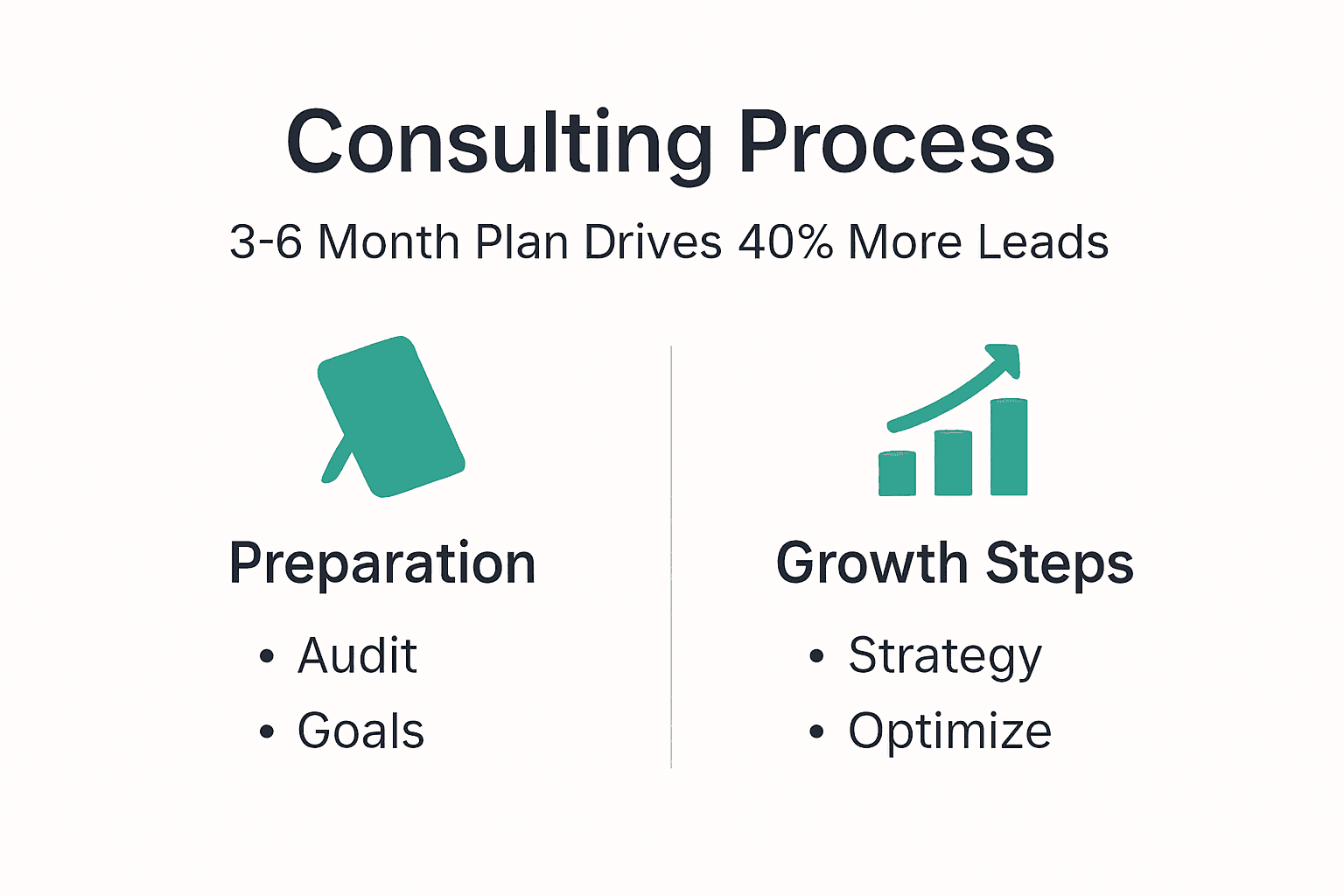
Many small to medium-sized business owners struggle with ineffective marketing consulting because of poor processes and unclear communication. Research shows 40% of consulting projects fail due to unclear communication of goals and deliverables. This guide presents a clear, step-by-step marketing consulting process designed specifically for SMBs looking to boost lead generation and online growth systematically. You’ll learn how to engage consultants effectively and achieve measurable results.
Table of Contents
- Prerequisites: What You Need Before Starting Marketing Consulting
- Step 1: Initial Business and Market Assessment
- Step 2: Strategy Development and Validation
- Step 3: Implementation Planning and Execution
- Step 4: Performance Monitoring and Continuous Optimization
- Common Mistakes and How to Avoid Them
- Expected Results and Success Metrics
- Alternative Consulting Approaches and Tradeoffs
- Explore Customized Marketing Consulting Services with Ascendly Marketing
- Frequently Asked Questions About the Marketing Consulting Process
Key takeaways
| Point | Details |
|---|---|
| Clear process drives results | A structured consulting approach improves lead generation by up to 40% within 6 months. |
| Foundation matters | Initial assessment and market analysis create the solid groundwork needed for effective strategy. |
| Continuous refinement wins | Phased implementation with regular optimization cycles ensures sustained business success. |
| Avoid critical errors | Skipping competitor analysis wastes budget and delays projects by 20% to 40%. |
| Choose your model wisely | Project-based or retainer consulting models each offer distinct tradeoffs for SMB budgets and goals. |
Prerequisites: What you need before starting marketing consulting
Before you engage a marketing consultant, prepare essential groundwork to ensure your consulting project succeeds. Starting without proper preparation wastes time and budget.
First, conduct a detailed audit of your existing digital marketing channels and campaigns. Review your website analytics, social media performance, email marketing metrics, and any paid advertising results. This baseline data helps consultants identify what’s working and what needs fixing.
Next, gather and organize your customer and sales data. Compile information about your target audience demographics, purchasing patterns, and customer journey touchpoints. Clean data accelerates the assessment phase and improves strategy accuracy.
Set SMART marketing goals aligned with your overall business objectives. Businesses that clearly define marketing objectives before consulting see up to 30% higher lead generation success rates. Vague goals like “get more customers” won’t cut it. Instead, aim for specific targets like “increase qualified leads by 35% in Q2 2026” or “boost website conversion rate from 2% to 3.5% by June 2026.”
Define realistic budgets and timelines to set proper consulting expectations. Understand that meaningful results typically require 3 to 6 months and sufficient investment in both consulting fees and campaign execution. Choosing the right agency partner who fits your budget and timeline is crucial.
Finally, develop basic familiarity with key digital marketing channels. You don’t need to become an expert, but understanding the fundamentals of SEO, PPC, content marketing, and social media helps you communicate effectively with consultants and make informed decisions.
Pro Tip: Create a shared folder with all marketing assets, analytics reports, and brand guidelines before your first consultant meeting. This saves valuable time and demonstrates your commitment to the process.
Step 1: Initial business and market assessment
The first consulting phase focuses on understanding your business context and competitive environment. Your consultant conducts comprehensive SWOT analysis and competitive research to identify growth opportunities and align realistic expectations.
This assessment phase typically lasts 2 to 4 weeks, grounding strategy in data-driven insights rather than guesswork. Rushing this stage leads to misaligned strategies that waste budget on ineffective tactics.
Here’s what happens during initial assessment:
- Internal analysis: Consultant evaluates your current marketing assets, brand positioning, messaging consistency, and digital presence across all channels.
- Competitive landscape review: Detailed analysis of 5 to 10 direct competitors examines their SEO rankings, content strategies, paid advertising approaches, and social media engagement.
- Market opportunity identification: Data analysis reveals untapped customer segments, underutilized channels, and content gaps your competitors haven’t filled.
- Stakeholder alignment sessions: Structured interviews with key team members validate business objectives and surface any conflicting priorities early.
- Preliminary recommendations: Consultant presents high-level findings and strategic direction before diving into detailed planning.
This systematic approach ensures your marketing consulting services engagement starts with a solid foundation. You’ll have clear visibility into where you stand, where competitors excel, and which opportunities offer the best ROI potential.
Expect regular check-ins during this phase. Transparent communication prevents surprises and keeps assessment on track. Your active participation accelerates the process and improves accuracy.
Step 2: Strategy development and validation
Once assessment reveals opportunities, you’ll co-create a tailored marketing strategy with measurable KPIs. This phase transforms insights into actionable plans that align with your business goals and budget realities.
Integrated marketing strategies combining SEO, PPC, and content with measurable KPIs must be set before implementation begins. Skipping validation leads to misaligned execution and disappointing results.
Your consultant will develop a comprehensive strategy incorporating:
- Channel mix recommendations: Prioritized list of marketing channels (SEO, PPC, content marketing, social media, email) based on your audience behavior and competitive gaps.
- Budget allocation framework: Specific investment levels for each channel with expected ROI ranges and timeline to results.
- Content strategy blueprint: Topics, formats, and publication frequency designed to attract and convert your target audience.
- Technical optimization roadmap: Website improvements, conversion rate optimization tactics, and user experience enhancements.
Stakeholder engagement during strategy development is critical. Share draft strategies with your team, gather feedback, and validate assumptions with customer data. This collaborative approach catches potential issues before you invest in execution.
Define crystal-clear, measurable KPIs before moving forward. Generic metrics like “increase traffic” aren’t sufficient. Instead, specify targets such as “generate 150 qualified leads monthly by month 4” or “achieve 35% increase in organic search visibility for 20 target keywords by month 5.”
Your marketing consulting strategy should include a phased implementation plan. Breaking execution into manageable stages (typically 30- to 45-day sprints) enables efficient resource allocation and allows for course corrections based on early results.
Pro Tip: Request a one-page strategy summary with your top 3 priorities, target KPIs, and success criteria. This document keeps everyone aligned and provides a reference point for measuring progress.
Step 3: Implementation planning and execution
With a validated strategy in hand, you’ll organize and launch your marketing initiatives. Clear timelines, defined roles, and consistent communication protocols minimize delays and maximize team collaboration.

Create detailed project timelines with specific milestones for each initiative. Break larger projects into weekly deliverables to maintain momentum. For example, a content marketing campaign might include milestones like keyword research completion (week 1), content calendar approval (week 2), first 5 articles published (week 4), and performance review (week 6).
Assign clear roles and responsibilities:
- Consultant team: Strategy guidance, campaign setup, optimization recommendations, and performance reporting.
- Your internal team: Content approvals, brand guideline adherence, customer insights, and implementation support.
- External vendors: Specialized services like graphic design, video production, or development work as needed.
Establish consistent communication protocols that work for your business. Weekly status calls, biweekly progress reports, and monthly strategy reviews create accountability without micromanagement. Use project management tools to track tasks, share documents, and maintain transparency.
Begin execution with your highest-priority initiatives first. Quick wins build momentum and demonstrate value while longer-term projects develop. For instance, launch PPC campaigns for immediate lead generation while simultaneously building your SEO foundation for sustained growth.
Your digital marketing implementation should include:
- Campaign launches: Set up and activate paid advertising, email sequences, and social media programs according to your timeline.
- Content production: Create and publish blog posts, videos, infographics, and other assets per your content calendar.
- Technical deployments: Implement website optimizations, tracking systems, and conversion tools.
- Testing protocols: Run A/B tests on ad copy, landing pages, and email subject lines to identify top performers.
Regular problem-solving collaboration keeps projects moving forward. When obstacles arise (and they will), scheduled check-ins provide forums to address issues quickly rather than letting them derail progress.
Step 4: Performance monitoring and continuous optimization
Ongoing data tracking and iterative improvements sustain lead generation performance after initial implementation. The difference between good and great results lies in systematic optimization based on real performance data.
Regularly track your priority KPIs including qualified leads generated, conversion rates by channel, cost per acquisition, and website engagement metrics. Set up automated dashboards that update daily so you can spot trends and anomalies quickly.
Optimization cycles every 4 to 8 weeks help adjust campaigns based on the latest data and market trends. These structured review periods prevent reactive changes while ensuring you capitalize on winning tactics and cut losing ones.
Your ongoing marketing optimization process should include:
- Performance analysis: Deep dive into what’s working and what’s underperforming across all channels.
- Hypothesis development: Identify specific changes likely to improve results based on data patterns.
- Testing implementation: Roll out optimizations systematically to measure impact accurately.
- Budget reallocation: Shift investment from low-performing to high-performing channels and tactics.
Maintain transparent reporting and open communication with all stakeholders. Monthly performance reviews should celebrate wins, acknowledge challenges honestly, and outline next steps clearly. Data-driven discussions replace subjective opinions and keep everyone focused on results.
Use insights from your campaigns to refine messaging, expand successful channels, and eliminate ineffective tactics. For example, if LinkedIn ads generate qualified leads at half the cost of Facebook ads, reallocate budget accordingly. If blog posts about specific topics drive 3x more conversions than others, double down on that content theme.
| Metric | Month 1 | Month 3 | Month 6 | Target |
|---|---|---|---|---|
| Qualified Leads | 45 | 78 | 126 | 120 |
| Conversion Rate | 2.1% | 2.8% | 3.6% | 3.5% |
| Cost Per Lead | $87 | $72 | $58 | $60 |
| Organic Traffic | 3,200 | 5,100 | 8,400 | 8,000 |
Continuous optimization transforms initial success into sustained growth. Markets shift, competitors adapt, and customer preferences evolve. Your marketing must evolve too, and regular optimization cycles ensure you stay ahead.
Common mistakes and how to avoid them
Recognizing and preventing frequent consulting pitfalls protects your investment and accelerates results. Many SMBs make predictable errors that significantly reduce marketing project success.
Skipping comprehensive competitor analysis early in the process is the most costly mistake. Skipping competitive analysis delays projects by 20% to 40% and reduces ROI by 18%. Without understanding what competitors do well, you waste budget reinventing the wheel or competing in oversaturated spaces. Always invest time upfront in thorough competitive research.
Unclear communication of goals and deliverables causes 40% of consulting projects to underperform. Vague objectives like “improve marketing” or “get more visibility” give consultants no clear target. Instead, specify exactly what success looks like with measurable criteria and realistic timelines.
Other critical mistakes to avoid:
- Skipping SMART goal setting: Immeasurable objectives make it impossible to track progress or demonstrate ROI.
- Inadequate budget allocation: Underfunding execution after paying for strategy leaves plans gathering dust.
- Ignoring ongoing optimization: Launch-and-forget approaches lose momentum as markets change and competitors adapt.
- Micromanaging tactical details: Questioning every keyword choice or ad variation undermines consultant expertise and slows progress.
- Changing priorities mid-project: Frequent strategy pivots prevent any initiative from reaching maturity and demonstrating results.
Pro Tip: Schedule a formal mid-project review at the 6 to 8 week mark to assess progress, address concerns, and realign priorities if needed. This structured checkpoint prevents small issues from becoming major problems.
Protect your consulting investment by establishing clear success criteria upfront, maintaining consistent communication, and trusting the process long enough to see results. Quick wins are possible, but meaningful transformation requires patience and sustained effort.
Expected results and success metrics
Setting realistic benchmarks for project duration and performance improvements helps you objectively measure marketing success. Understanding typical timelines and results prevents unrealistic expectations while keeping your team motivated.
Typical marketing consulting projects last 3 to 6 months, with lead generation gains between 25% and 40% within 6 months of engagement. Your specific results depend on starting position, competitive intensity, budget investment, and execution quality.
Projects typically unfold in these phases:
- Weeks 1 to 4: Assessment, competitive analysis, and stakeholder alignment.
- Weeks 4 to 6: Strategy development, validation, and implementation planning.
- Weeks 7 to 12: Initial campaign launches, content production, and technical optimizations.
- Weeks 13 to 24: Ongoing execution, optimization cycles, and performance scaling.
Lead generation improvements realistically range from 25% to 40% within 6 months post-engagement for most SMBs. Businesses starting with minimal digital presence may see higher percentage gains, while those with mature programs might see smaller but still meaningful improvements.
Monitor these key performance indicators throughout your engagement:
- Qualified leads generated: Total number of prospects meeting your ideal customer criteria.
- Conversion rates: Percentage of visitors taking desired actions at each funnel stage.
- Cost per acquisition: Total marketing investment divided by new customers acquired.
- Organic search visibility: Rankings and traffic for target keywords.
- Website engagement: Time on site, pages per session, and bounce rates.
| Timeframe | Expected Outcomes | Key Milestones |
|---|---|---|
| Month 1-2 | Foundation and quick wins | Strategy finalized, campaigns launched, first optimization |
| Month 3-4 | Momentum building | 15-25% lead increase, content gaining traction, refinements active |
| Month 5-6 | Sustained results | 25-40% lead increase, predictable pipeline, scalable systems |
Sustained growth beyond initial engagement depends on regular optimization cycles and continued investment. Marketing isn’t a one-time fix but an ongoing process that compounds results over time. The systems and processes established during consulting create foundations for long-term success.
Alternative consulting approaches and tradeoffs
Different engagement models offer distinct benefits and limitations. Understanding project-based versus retainer consulting helps you choose the approach that best fits your growth goals and budget constraints.
Project-based consulting provides focused deliverables with clearer upfront costs. You engage a consultant for a specific initiative like “develop SEO strategy and implement technical optimizations” with defined scope, timeline, and budget. This model works well for SMBs with limited budgets or specific challenges to solve.
Benefits of project-based consulting include cost predictability, clear deliverables, and finite commitment. You know exactly what you’re paying and what you’ll receive. However, limitations include limited ongoing support after project completion and potential gaps between engagements that lose momentum.
Retainer-based consulting provides continuous optimization and strategic guidance through ongoing monthly engagements. Your consultant becomes an extension of your team, available for regular strategy sessions, campaign optimizations, and market opportunity identification. This model delivers better long-term ROI through compounding improvements but requires higher sustained investment.
| Factor | Project-Based | Retainer-Based |
|---|---|---|
| Cost Structure | Fixed project fee | Monthly recurring fee |
| Best For | Specific challenges, limited budgets | Sustained growth, mature programs |
| Typical Duration | 1-3 months | 6-12+ months |
| Optimization Frequency | End of project only | Every 4-8 weeks |
| Strategic Support | Limited to project scope | Ongoing and adaptive |
| ROI Timeline | Immediate to 3 months | 6-12 months for full impact |
Tradeoffs center on budget predictability versus flexibility and sustained growth needs. Project-based consulting offers lower entry costs but may require multiple engagements to achieve meaningful results. Retainer models cost more monthly but deliver compounding improvements through continuous refinement.
Choose your engagement model based on your marketing maturity, available budget, and growth timeline. Early-stage SMBs often start with project-based consulting to establish foundations, then transition to retainers once they see initial results and commit to sustained growth.
Some consultants offer hybrid models combining project deliverables with limited ongoing support. These middle-ground options can provide good value for SMBs not ready for full retainers but needing more than one-time projects.
Explore customized marketing consulting services with Ascendly Marketing
Ready to implement a proven consulting process that drives measurable growth for your SMB? Ascendly Marketing specializes in transparent, results-oriented marketing consulting services tailored to small and medium-sized businesses since 2013.
Our experienced team combines strategic SEO services in Dallas with data-driven PPC advertising services to create integrated campaigns that boost your online visibility and generate qualified leads. We follow the same systematic process outlined in this guide, ensuring clear communication, measurable KPIs, and continuous optimization throughout your engagement. Our diverse team of designers, SEO specialists, and content creators brings big-brand expertise to SMB budgets, building long-term partnerships focused on your success. Book a consultation today to discover how our customized approach can transform your marketing results.
Frequently Asked Questions About the Marketing Consulting Process
What is the typical duration of a marketing consulting project?
Most marketing consulting engagements run 3 to 6 months from initial assessment through optimized execution. The first 4 to 6 weeks focus on assessment and strategy development, while the remaining time covers implementation and optimization cycles. Sustained growth often requires ongoing engagements beyond initial projects.
How do I measure if my marketing consulting is successful?
Track qualified leads generated, conversion rates, cost per acquisition, and organic search visibility against the SMART goals you set before engagement. Successful consulting typically delivers 25% to 40% improvement in lead generation within 6 months. Regular performance reviews every 4 to 8 weeks keep you informed of progress.
Can I customize the consulting process to my business size and goals?
Absolutely. The best consultants tailor their approach to your specific situation, budget, and objectives. Share your constraints and priorities upfront so your consultant can adjust timelines, deliverables, and channel focus accordingly. Smaller SMBs might start with fewer channels and scale over time.
What happens if there are delays during implementation?
Establish clear communication protocols at project start to address obstacles quickly. Regular check-ins provide forums to troubleshoot issues before they cause major delays. Most consultants build some buffer time into timelines for unexpected challenges. Transparent discussion of delays and adjusted timelines keeps projects on track.
How often should I revisit and optimize my marketing strategy?
Plan formal optimization cycles every 4 to 8 weeks to review performance data and adjust tactics. Quarterly strategic reviews assess whether your overall approach still aligns with business goals and market conditions. Marketing requires ongoing refinement because customer behavior, competitive dynamics, and platform algorithms constantly evolve.