

A treatment center director usually knows the clinical side cold. The hard part is getting found by the right person at the right moment, then guiding that person from panic to a real conversation without sounding exploitative, careless, or generic.
That tension sits at the center of marketing for addiction treatment. Families are searching in crisis. Patients are often scared, private, and unsure who to trust. Meanwhile, the market keeps getting more crowded, ad costs stay high, and compliance mistakes can shut down campaigns or damage credibility fast.
A workable system has to do two jobs at once. It has to create visibility today, and it has to build trust that compounds over time. That means search, paid media, content, intake operations, attribution, and compliance all need to work together.
The Mission and the Market of Addiction Treatment
The market is large, crowded, and still growing. The addiction treatment market is projected to reach $11.71 billion by 2030, and the U.S. has more than 13,000 addiction treatment facilities, according to Vix Media Group’s roundup of addiction treatment marketing trends.
That creates a difficult operating environment. A center may offer excellent care and still struggle to reach families who need help today. Clinical quality alone doesn’t create discoverability. The centers that stay visible usually combine digital channels with conventional outreach, with a strong focus on SEO, paid search, and social media.
What people are actually looking for
Most searches aren’t academic. They’re urgent.
A spouse searches late at night. A parent compares detox options on a phone. An adult child wants to understand whether a loved one needs treatment at all. Educational content matters because many people don’t begin with program names. They begin with confusion.
A plain-language resource like what is rehab works because it meets people where they are. That same principle should shape your own site. Start with the questions people ask before they’re ready to call.
Marketing in this category works best when it reduces fear and confusion. Hard-sell messaging usually drives the right people away.
The real job of marketing
Treatment marketing isn’t about forcing demand. Demand already exists.
The job is narrower and more serious than that:
- Be discoverable: Show up when someone searches for help nearby or for a specific level of care.
- Be understandable: Explain programs, costs, process, and first steps in plain English.
- Be believable: Use accurate language, consistent messaging, and a site that feels stable and trustworthy.
- Be reachable: Make the next action obvious, whether that’s a call, form, or chat.
Many centers waste time chasing tactics before they build that base. They launch ads to a weak site. They publish blog posts that don’t answer patient questions. They track clicks but not admissions.
A better approach is to build an integrated engine. One part brings in high-intent traffic. Another part earns trust over months. The rest of the system makes sure inquiries are handled properly and measured all the way to intake.
Building Your Ethical and Compliant Foundation
Before traffic, before media spend, before content calendars, there has to be a foundation. In this space, weak messaging isn’t just ineffective. It creates risk.

Start with real patient language
Teams often define an audience too loosely. “Men 25 to 50” or “parents looking for treatment” doesn’t help a writer, media buyer, or intake coordinator make better decisions.
Build profiles around lived concerns:
- What fear is driving the search
- Who is making the inquiry
- What language do they use
- What could stop them from calling
- What proof do they need before taking the next step
A family member might ask about safety, detox, or insurance. A patient may care more about privacy, job disruption, or whether treatment means disappearing for a month. Those are different conversations. Your pages, ads, and intake scripts should reflect that.
Ethical messaging rules that keep you out of trouble
In addiction treatment, trust is fragile. Centers lose it when they overpromise, use vague clinical claims, or hide basic details.
Use messaging that is:
| Do this | Avoid this |
|---|---|
| Describe programs clearly | Claim guaranteed outcomes |
| Explain the first step | Use pressure-heavy calls to action |
| Use compassionate, direct wording | Use shame-based language |
| State what the center treats | Blur clinical scope or capabilities |
| Review everything before launch | Publish first and fix later |
For teams working with AI chat, forms, or automated qualification flows, privacy review should happen before deployment. If your team is evaluating conversational tools, this guide on GDPR guidelines for AI chatbots is a useful reference for thinking through consent, data use, and bot behavior in sensitive categories.
Compliance has to be operational
Compliance isn't a note in the brand guide. It has to live in workflow.
The strongest setup usually includes:
- Pre-publication review for ads, landing pages, forms, and testimonial use.
- Platform policy checks before campaigns go live.
- Data handling standards for forms, chat, call recordings, and CRM access.
- Regular review cycles as platform rules and privacy expectations change.
For teams in regulated healthcare categories, the workflow issues overlap with adjacent industries. This page on digital marketing for pharmaceutical companies is useful because it shows how much campaign success depends on review discipline, not just creative quality.
Practical rule: If the intake team would feel uncomfortable saying the claim out loud on a recorded call, it shouldn't appear in your ad copy.
Build one message framework and use it everywhere
A center sounds more credible when the website, Google Ads, social profiles, and admissions team all describe care in the same way.
That framework should define:
- the center's plain-language value proposition
- the approved phrasing for each program
- what can and can't be said about outcomes
- how to speak to patients versus families
- the exact next-step language used across channels
When this work is skipped, everything downstream gets harder. SEO content sounds disconnected from ads. Intake calls don't match landing pages. Reporting gets messy because campaigns target the wrong audience in the first place.
Engineering Your Digital Front Door for Discovery
A treatment center website shouldn't read like a brochure. It should work like a staffed front desk that never closes.
When someone lands on your site from a search result, they need orientation right away. What do you treat? Where are you located? What kind of care do you offer? Who is this program for? What happens after the call? If those answers are buried, the visit ends quickly.
Build pages around services, not internal jargon
Many sites make a common mistake. They organize navigation around how the organization thinks, not how people search.
A strong structure usually includes dedicated pages for each program or treatment need, written in plain language. For example:
- Outpatient alcohol treatment
- Detox support
- Dual diagnosis treatment
- Veteran-focused addiction care
- Family support resources
- Aftercare and ongoing recovery planning
Each page should answer a distinct question. A person looking for outpatient help shouldn't have to sift through a generic “services” page and guess whether they're in the right place.
Local intent should shape the architecture
In this category, search behavior is often local. The site has to support that reality.
That means your local signals need to be consistent across title tags, headings, service pages, metadata, and business listings. Location pages can work well when they're specific and useful. Thin, duplicated city pages usually don't.
If your local visibility is weak, this guide on how to rank higher on Google Maps is a practical starting point for improving map presence and location-based discovery.
What the homepage must do fast
The homepage doesn't need to say everything. It needs to direct people to the right next step.
A homepage for marketing for addiction treatment should quickly establish:
| Element | What it should do |
|---|---|
| Clear headline | State who the center helps and what kind of care is offered |
| Primary CTA | Make calling or contacting admissions obvious |
| Program paths | Send users to service-specific pages |
| Trust signals | Show stable, professional information without hype |
| Local cues | Reinforce where care is available |
| Mobile usability | Keep buttons, forms, and navigation easy to use on phones |
Most visits happen under stress. Reduce choices. Make navigation simple. Put phone access where users can find it without scrolling forever.
Content should mirror real search behavior
Good keyword work in this field starts with real language from admissions calls, contact forms, and patient questions.
A useful editorial mix covers three layers:
Decision content
These are bottom-of-funnel pages. They help people compare providers or search for immediate care.
Examples include:
- rehab near me
- outpatient addiction treatment near me
- alcohol treatment program in [city]
Consideration content
This content helps people understand what kind of care they may need.
Examples include:
- what is outpatient rehab
- does dual diagnosis treatment include therapy
- how long does detox take
Early trust content
Many centers underinvest in educating potential clients. Families often need education before they choose a provider.
Examples include:
- signs a loved one needs treatment
- how to talk to someone about going to rehab
- what happens on the first day of treatment
A page should exist because it answers a real search or intake question. If it doesn’t help a patient or family decide, clarify, or act, it probably doesn’t need to be there.
Technical details still decide whether content gets seen
Even strong content can underperform when the site is slow, awkward on mobile, or difficult for search engines to interpret.
Focus on the basics first:
- Mobile experience: Calls, forms, and navigation have to work cleanly on phones.
- Page speed: Slow pages increase friction during high-stress visits.
- Internal links: Connect blog posts to service pages and service pages to contact paths.
- Schema markup: Use healthcare-relevant structured data where appropriate.
- Clean page hierarchy: One clear topic per page beats broad, unfocused copy.
The best treatment sites don’t feel “optimized.” They feel easy to use. That’s the point.
Deploying Strategic Paid Media and Targeted Outreach
Paid media can bring calls quickly. It can also burn budget faster than almost any other channel in this category.
The economics are brutal. In addiction treatment PPC, keywords such as “alcohol rehab near me” can reach up to $185 per click in 2024, and paid search acquisitions can run from $6,660 to $12,500 per admission according to Circle Social’s analysis of PPC for drug rehabs. The same source says centers should keep PPC to no more than 10% of total admissions, and that the minimum viable monthly budget for statistically valid campaigns is $10,000.
That changes how you should use paid search. It is not the foundation of a stable program. It is a selective, high-intent channel inside a broader system.
Treat PPC like a precision tool
The centers that waste the least money usually make three decisions early.
First, they narrow keyword targeting to terms that indicate genuine treatment intent.
Second, they route traffic to landing pages that match the query exactly.
Third, they accept that some keywords are too expensive or too broad to justify aggressive bidding.
A practical paid search structure often separates campaigns by:
- core treatment terms
- branded search
- local “near me” intent
- specialty program terms
- family-focused search themes
This keeps budgets visible and makes it easier to pause poor performers without shutting down the whole account.
What usually fails in rehab PPC
The failure patterns are predictable.
A center bids broadly on expensive terms. Ads send traffic to the homepage. The page asks users to “learn more” without explaining what happens next. Intake misses calls, and the team blames Google Ads.
The channel wasn’t the only problem. The system around it failed too.
Common mistakes include:
- Broad keyword match without filters: Irrelevant queries drain budget.
- Weak negative keyword lists: Jobs, free services, and unrelated searches slip in.
- Generic landing pages: Users don’t see a clear path from click to call.
- No intake coordination: Expensive leads die after hours or in voicemail.
- No source-level tracking: Teams can’t separate search quality from response issues.
Paid social works differently
Meta and similar platforms generally aren’t replacements for high-intent search. They’re better used for awareness, retargeting, and family-oriented messaging that introduces the center before a crisis search happens.
That means the offer should match the channel. Educational guides, program overview videos, and gentle family-focused messaging often fit better than direct-response language that feels too aggressive for a social feed.
A short comparison helps:
| Channel | Best use | Main trade-off |
|---|---|---|
| Google Ads | Capture immediate treatment intent | Extremely high cost |
| Meta Ads | Build awareness and retarget interested users | Lower intent at first touch |
| YouTube video | Explain process and reduce fear | Longer path to inquiry |
| Local display or directories | Reinforce visibility | Mixed lead quality |
Outreach still matters
Some of the most durable admissions pipelines don't come from ad platforms alone. They come from referral relationships.
That work is slower and less glamorous. It also tends to produce stronger trust. Outreach to therapists, physicians, case managers, hospitals, and community organizations can create a steady stream of qualified introductions when the process is disciplined and useful.
Cold outreach can work if it sounds like a competent human wrote it. Keep it specific. Explain who the program serves, what intake looks like, and when referrals are appropriate. Skip the inflated promises and broad claims.
If a PPC campaign doesn't have a matching landing page, tracked phone number, and trained response path, don't launch it yet.
Paid media earns its place when it fills short-term gaps, validates demand, and captures urgent searches. It becomes dangerous when leadership expects it to carry the whole census.
Fostering Trust Through Content and Community Engagement
A center can buy visibility for a while. It can't buy a reputation that way.
Content and community engagement are what make a program feel known before the call ever happens. This part of marketing for addiction treatment often looks slower on a dashboard, but it creates the material that families remember, share, and return to.

Publish the answers people hesitate to ask
The best treatment content usually doesn't start from SEO software. It starts from uncomfortable conversations.
Think about the questions admissions hears that people ask softly, indirectly, or only after reassurance. Those topics often become the strongest articles and videos.
Examples include:
- what medical detox feels like
- how family contact works during treatment
- whether someone can keep working while in outpatient care
- how to speak to a loved one who refuses help
- what to expect during an assessment
These aren't filler topics. They're trust assets. When written clearly, they lower anxiety and help the right people self-select into the next step.
Show the process, not just the promise
Many treatment websites talk in abstractions. They mention healing, transformation, and support, but don't explain logistics. Families want logistics.
A stronger content mix includes practical pieces such as:
| Content type | What it does |
|---|---|
| Program explainer article | Clarifies level of care and who it’s for |
| Short facility video | Reduces fear of the unknown |
| FAQ page | Handles objections before the call |
| Family guide | Supports the actual decision-maker in many cases |
| Alumni story used properly | Builds credibility through lived experience |
One useful format is video. A calm walkthrough of the admissions process or daily schedule often does more than a polished brand reel because it answers direct concerns.
A simple example of how video can support understanding sits below.
Community reputation is built offline and online
A center’s reputation strengthens when its digital presence matches what professionals and families hear in the community.
That means content should be paired with local relationship work:
- Therapist outreach: Provide clear referral criteria and fast contact paths.
- Physician education: Offer concise program information and intake availability.
- Hospital and behavioral health contacts: Keep communication practical and consistent.
- Community participation: Support events, education, or recovery-focused initiatives where appropriate.
- Local PR: Share credible stories, expert commentary, or educational resources without hype.
This isn’t brand theater. It’s repeated exposure to useful information from a stable organization.
Testimonials need discipline
Stories can build trust. Mishandled stories can do the opposite.
Use testimonials and alumni narratives carefully. Keep consent process tight. Stay factual. Focus on experience rather than exaggerated claims. If a story sounds too polished or too absolute, readers notice.
A useful content program doesn’t try to impress everyone. It helps the right person feel less alone and more ready to talk.
Over time, this work makes other channels perform better. Paid search converts more efficiently when people have already seen your center in organic search, local discussions, or professional referrals. Intake conversations also improve because callers arrive with fewer unknowns.
Connecting Clicks to Admissions with Optimized Operations
Traffic is only potential. Admissions come from operations.
At this point, many treatment centers lose the plot. Marketing reports show clicks, form fills, and call volume. Leadership assumes growth is coming. Then the census doesn’t move because attribution is weak, response times are slow, and the intake path leaks at every step.
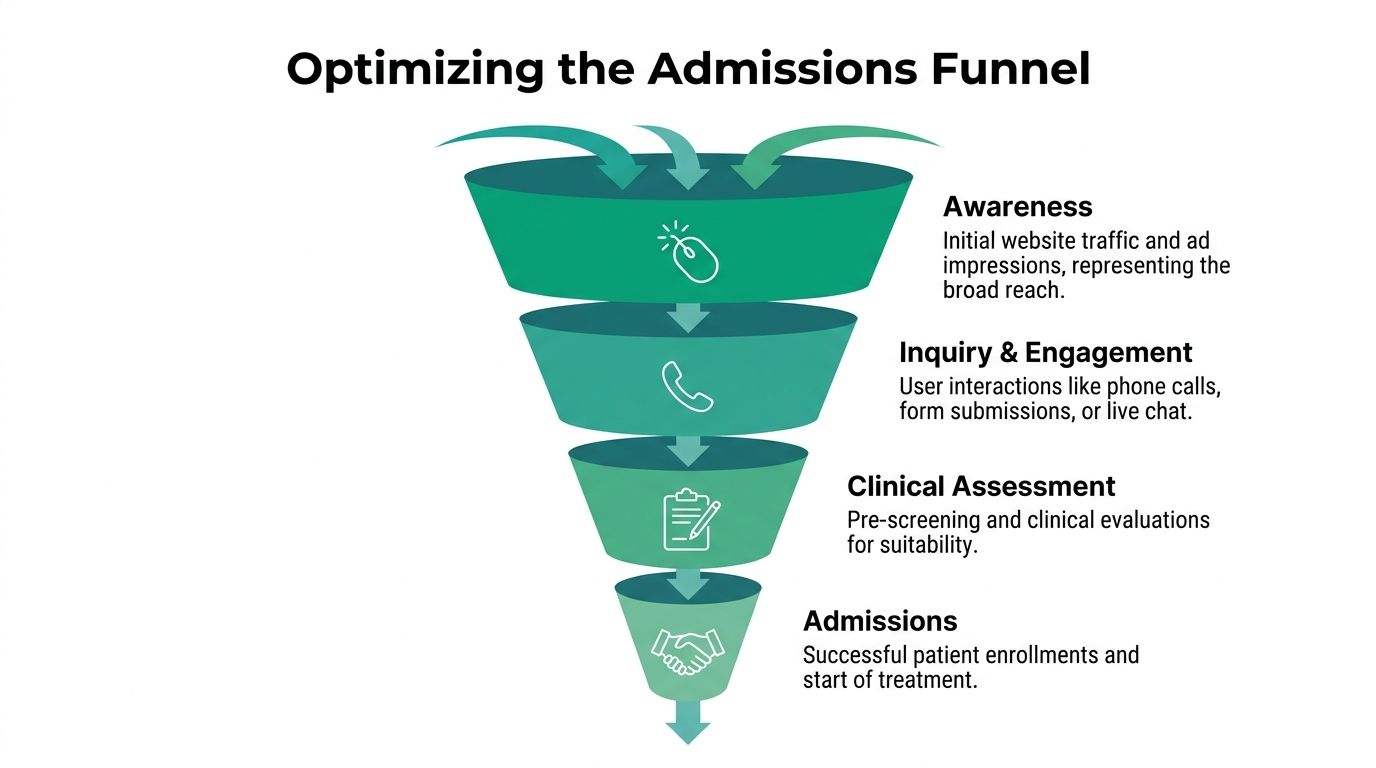
The funnel has to be measurable
A basic admissions funnel sounds simple. Someone discovers the center, makes contact, completes assessment, and admits. In practice, each stage needs instrumentation.
The most useful setup connects:
- source and campaign data
- call tracking
- form submissions
- CRM records
- intake outcomes
- admissions status
Without that chain, teams argue about channel performance using partial data.
A data-driven attribution system can change the economics materially. According to Active Marketing’s guidance on rehab marketing strategy, centers achieve 40% to 60% reductions in cost-per-acquisition by tying every marketing dollar to admissions through call tracking, UTM parameters, and conversion pixels. The same source notes that 42% of leads receive no callback, and that responding within 5 minutes can increase conversions by 400%.
Build the tracking stack first
The order matters. Tracking shouldn’t be added after campaigns launch.
A workable setup usually includes three layers.
Call attribution
Use unique tracking numbers by source, campaign, or landing page where possible. Tools like CallRail are commonly used because they tie calls back to marketing inputs and let teams review conversation quality.
Form attribution
Every form should capture source information through UTM parameters and pass that data into the CRM or admissions workflow. If the source disappears after the form submit, reporting breaks.
Pixel and event tracking
Conversion pixels help confirm what users did before they contacted you. They don’t replace call and CRM data, but they add context for optimization.
Intake speed changes outcomes
The intake team isn’t adjacent to marketing. In this category, intake is part of marketing performance.
If calls ring too long, if forms sit untouched, or if follow-up lacks empathy, the acquisition cost rises even when campaigns are well managed.
Simple discipline often beats fancy tactics:
- Route inquiries immediately to someone trained to respond.
- Use phone, text, and email as part of one coordinated follow-up path.
- Review missed calls daily and resolve handoff failures fast.
- Listen to call recordings for friction, confusion, and tone.
- Update scripts from real objections instead of writing them in isolation.
A fast response matters, but tone matters too. The person answering can’t sound like a sales rep chasing quota. They need to sound calm, informed, and ready to help.
Optimize the site for inquiry, not applause
Some websites look polished but create too much work for anxious visitors.
Conversion rate optimization in this space is usually about removing friction:
- shorter forms
- clearer calls to action
- stronger page-to-page pathways
- more visible phone access
- fewer dead-end pages
- better alignment between ad copy and landing page headline
If your site generates traffic but weak inquiry rates, this resource on how to improve conversion rates gives a useful framework for tightening the user path.
What to report every month
Dashboards should support decisions, not decoration.
Track metrics that connect to admissions:
| Metric | Why it matters |
|---|---|
| Cost per admission | Shows whether acquisition is financially sustainable |
| Lead-to-admission rate | Separates lead volume from lead quality |
| Calls by source | Reveals which channels generate conversations |
| Form submissions by source | Helps identify useful content and campaigns |
| Response time | Exposes operational delays |
| Referral source quality | Highlights non-paid channels worth expanding |
Vanity metrics can still be observed, but they shouldn’t drive budget shifts. A spike in impressions or social engagement doesn’t mean much if admissions stay flat.
Strong reporting answers one question clearly: which channels produced qualified admissions, and what broke for the ones that didn’t?
When this system is working, decisions get cleaner. Budgets move toward channels that produce actual enrollments. Low-quality campaigns get cut faster. Intake training becomes specific because call data shows where confusion starts.
Frequently Asked Questions About Modern Rehab Marketing
A treatment center can be doing a lot right and still feel stuck. The phones ring, paid search keeps spending, the website gets traffic, yet leadership still cannot answer a basic operating question. Which parts of the system are creating qualified admissions, and which parts are just creating activity?

That is where modern rehab marketing gets harder and more useful. Strong programs do not treat PPC, SEO, content, outreach, intake, and reporting as separate jobs. They run them as one connected engine with clear rules, clear handoffs, and close oversight.
Should treatment centers use AI for targeting and personalization
Yes, with narrow use cases, documented consent practices, and human review.
AI is useful when it helps the team process information faster without making sensitive decisions on its own. For example, use AI to review call transcripts and group common logistical questions such as “What is the daily schedule?” or “Can family visit?” Then have a human strategist decide how those answers should appear on the website, in admissions scripts, and in follow-up emails so the language builds trust and stays compliant.
According to Rehabs.com’s discussion of rehab center marketing, AI-driven personalization in this category intersects with tighter privacy regulation, and non-consented profiling can expose centers to fines of up to $50,000 per violation.
Good uses usually stay operational:
- routing inquiries to the right service line
- spotting repeated questions in transcripts or chats
- drafting FAQ outlines for staff review
- identifying landing pages with weak next-step clarity
- helping admissions teams respond faster with approved language
Poor uses involve hidden profiling, broad health inferences, or automated messaging that sounds personal without valid consent.
Is lead volume still the right north-star metric
Lead volume is an input, not the scorecard.
A center can increase form fills and phone calls while lowering admission quality, straining the intake team, and wasting budget on the wrong audience. Leadership needs a layered measurement model that reflects how treatment marketing works. Some channels create immediate inquiries. Others build trust, support referral relationships, or improve close rates over time.
A practical model tracks performance in three layers:
- Demand generation: Inquiries, calls, form fills, booked assessments
- Admission quality: Lead-to-admission rate, payer mix fit, program fit, show rate
- Longer-term value: Retained relationships, referral contribution, alumni re-engagement, local brand trust
This approach keeps a center from overfunding expensive short-term channels while starving the trust-building assets that make paid media work better over time.
How should leaders measure ROI beyond direct admissions
Use channel reporting and operational reporting together.
Channel ROI shows where demand starts. Operational ROI shows whether the center can convert that demand once it arrives. I have seen campaigns blamed for poor performance when the underlying issue was missed after-hours calls, weak insurance verification, or slow follow-up on web inquiries.
This table gives leaders a cleaner way to review ROI:
| ROI layer | What to examine |
|---|---|
| Direct acquisition | Channel cost, inquiry quality, admission outcomes by source |
| Trust-building assets | Organic search growth, returning visitors, branded search, local visibility |
| Relationship development | Professional outreach response, alumni touchpoints, family re-engagement |
| Operational friction | Missed calls, response time, transfer failures, intake-to-clinical handoff issues |
That structure helps teams make better budget decisions. It also keeps the conversation honest. A high-cost PPC campaign may still deserve budget if it fills beds efficiently. A content program may deserve patience if it improves local rankings, lowers paid dependence, and increases close rates from better-informed callers.
Will AI replace content teams and intake strategy
No. It can speed up production and analysis, but the judgment still belongs to people.
AI can summarize transcripts, cluster search topics, draft a first-pass FAQ, or flag language that may be too vague. A human content lead still needs to decide what claims can be made, what proof is strong enough to publish, and how to speak to a frightened family member without sounding generic or manipulative.
The same rule applies in admissions. AI can help organize information. It should not decide how to respond to clinical nuance, objections about safety, or a caller's fear about leaving work or family responsibilities.
What's the most common strategic mistake in modern rehab marketing
Running each channel as its own project.
That creates predictable problems. Paid search teams optimize for lead volume while SEO teams write content with no intake feedback. Outreach happens without a clear follow-up path. Admissions staff answer calls without context on the campaign promise that drove the inquiry. Reporting then turns into a list of activities instead of a record of what produced admissions.
The stronger approach is operational. Set one message framework, one intake feedback loop, one source-tracking system, and one monthly review process. Then assign each channel a job inside that system. PPC captures high-intent demand. Local SEO and content build discoverability and trust. Outreach supports referral relationships. Admissions closes the loop by showing marketing where confusion, resistance, and drop-off happen.
That is how centers build a marketing engine that can hold up under high click costs, compliance pressure, and real scrutiny from families who need clear answers fast.
Ascendly Marketing helps organizations build measurable digital growth systems that connect traffic, lead generation, conversion, and reporting. If your team needs a clearer operating model for SEO, paid media, website performance, or attribution, talk with Ascendly Marketing about building a marketing program that is easier to measure and easier to scale.