

Marketing for a roofing company often involves chasing storms. This approach can bring in jobs, but it is a reactive and unpredictable way to operate a business. A system that brings a steady stream of leads to you, regardless of the weather, creates a predictable machine that turns marketing dollars into signed contracts. This involves showing up where homeowners look and earning their trust before you visit their property.
The Modern Playbook For Roofing Marketing
A structured marketing system distinguishes companies that are consistently booked from those waiting for calls. This is not about following trends; it is a method for building a lead-generating engine.
The strategy combines a website designed to convert visitors, local search engine optimization (SEO) that places you at the top of Google, and targeted paid ads. Integrating offline methods, such as understanding how TV advertising for roofing companies works, can also be effective. When these components function together, your brand can become a prominent choice in your market.
Blending Digital Dominance With Traditional Trust
The U.S. roofing market in 2026 is valued at $31.38 billion, with an annual growth rate of 6.17%. Online channels drive 58% of new roofing projects. Referrals account for 68% of business. SEO delivers an average return on investment (ROI) of 300% in this industry. This data shows that combining modern digital visibility with a solid reputation is an effective formula.
A digital marketing presence can enhance a real-world reputation, and a strong reputation can make digital marketing more effective. Online reviews should reflect what people are already saying about the business locally.
A strong online presence attracts homeowners who are searching at that moment. A positive reputation brings in referral leads that have a higher closing rate.
This flowchart illustrates the connections.
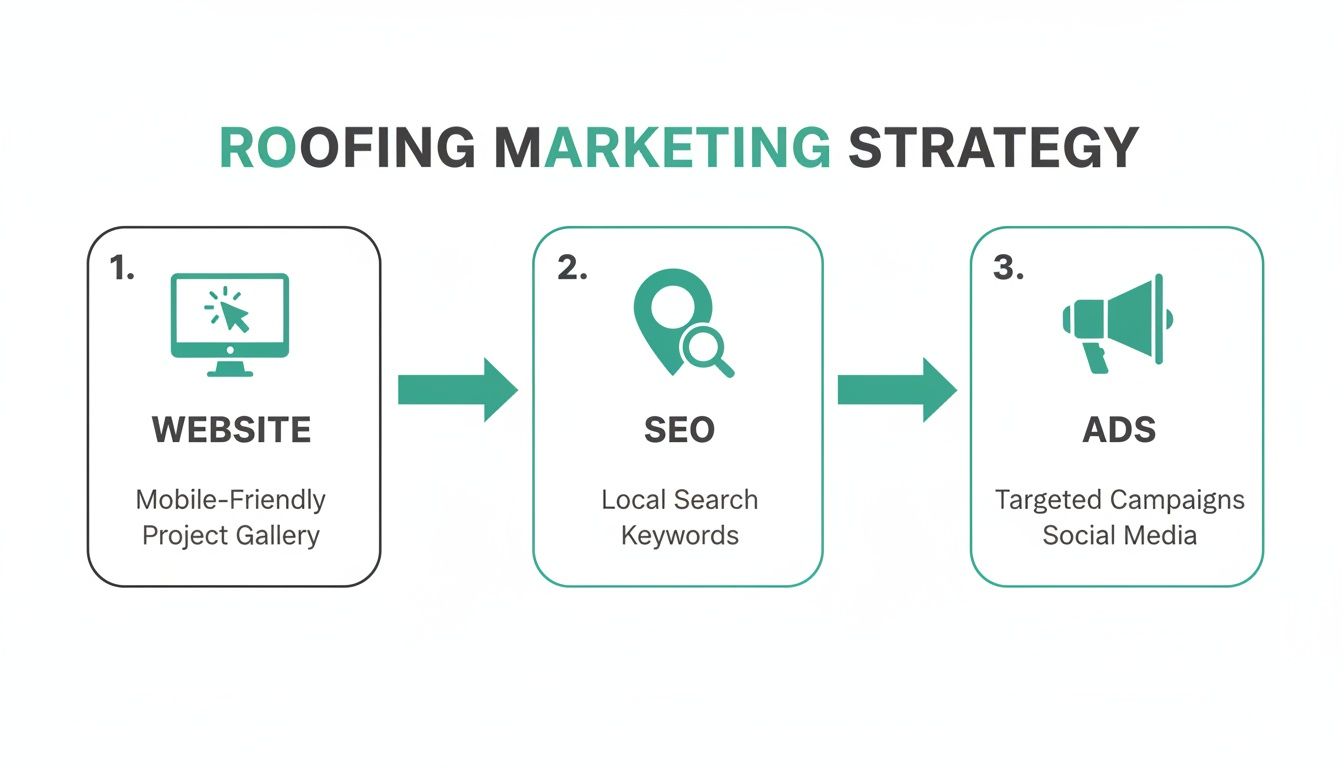
The customer journey often begins with a search. Your objective is to ensure your website, supported by SEO and ads, is what they find first.
The following table provides a breakdown of the core marketing channels and their functions.
Core Roofing Marketing Channels And Their Function
| Marketing Channel | Primary Role | Expected Outcome |
|---|---|---|
| High-Converting Website | Your 24/7 digital salesperson and central hub for all marketing. | Turn traffic into qualified leads through clear calls-to-action. |
| Local SEO & Google Business Profile | Dominate local search results when homeowners need a roofer. | Top rankings on Google Maps and organic search for your city. |
| Paid Ads (PPC & LSA) | Generate immediate, high-intent leads from active searchers. | A consistent, controllable flow of inbound calls and form fills. |
| Reputation & Content Marketing | Build trust, answer questions, and showcase your expertise. | More 5-star reviews, higher trust, and better SEO performance. |
| Referral & Partnership Programs | Encourage word-of-mouth and generate high-quality leads. | A reliable stream of warm leads from past clients and partners. |
Each part has a distinct but connected role in building a marketing system that supports company growth.
The Four Pillars Of Your Marketing Foundation
A lead-generating system needs to be built on a solid foundation. These are four interconnected pillars that support the entire marketing structure.
- A High-Converting Website: This is your digital storefront. It must be fast, mobile-friendly, and focused on turning visitors into leads.
- Dominant Local SEO: When a hailstorm hits, people search for "roofer in [Your Town]." You must appear at the top of Google Maps and local search results.
- Targeted Paid Advertising: SEO is a long-term strategy. For immediate results, paid ads on Google place you in front of customers at the moment they identify a problem.
- An Unshakable Reputation: Online reviews are the new form of word-of-mouth. A system to get a steady stream of 5-star reviews is necessary for building trust.
These elements work together. Paid ads are more effective when they direct people to a website with positive reviews. SEO is enhanced by helpful content. This integrated approach is what differentiates professional roofing marketing from amateur efforts.
Your Website: The 24/7 Digital Salesperson
Your website is a hard-working asset. It operates 24/7 and can interact with many potential customers daily. Is it functioning to sell roofs, or is it merely a digital business card? An effective website is the engine of your marketing operation, designed to convert homeowners into clients.
It cannot be a passive brochure. It needs to be an active tool built to generate leads. Every element, from the headline to the footer, should guide visitors to call or fill out a form.
Designing For Action, Not Just Aesthetics
A visually appealing website that does not generate phone calls is an expensive art piece. Design should be about a layout that drives action. This begins the moment a homeowner lands on your page.
They need to know who you are, what you do, and how you will fix their roof. Your phone number should be large, bold, and at the top of every page. A clear call-to-action (CTA) button, such as "Get My Free Inspection," must be impossible to miss.
A proven formula for roofers starts with a powerful "hero" section: a strong headline, a prominent phone number, and a CTA. Below that, display trust badges, such as logos from the BBB, GAF, or your local Chamber of Commerce if you have those affiliations. This combination builds credibility and guides them to the next step.
Building Instant Trust
Homeowners can be cautious, especially with a significant investment. Your website's role is to overcome skepticism and build trust from the first click. The tool for this is social proof.
Here are ways to use it effectively:
- Video Testimonials: A video of a satisfied customer discussing their experience in front of their new roof provides authentic, visual proof of your work.
- Project Galleries: Show the entire process—the "before," the "during" with your crew at work, and the "after." This transparency demonstrates professionalism.
- "Meet the Crew" Page: Putting faces to the company name is effective. A brief bio and a photo of the owner and key team members show you are a local team, not a faceless corporation.
These are tools for converting uncertain prospects. They prove you deliver on your promises. For more detail, our guide on the best website design practices explains how these principles produce results.
Mobile First, Lightning Fast
Imagine a hailstorm has just passed. A homeowner is in their driveway, looking at a damaged roof. They will use their smartphone. If your site is difficult to use on their phone, you have likely lost the business. A mobile-first design is a requirement.
This means designing for the small screen first, then adapting for a desktop. Buttons must be large enough for a thumb to tap, forms should be easy to fill out, and your phone number must be "click-to-call."
A good mobile design is useless if it is slow. Page speed affects leads. Studies show that a delay of a few seconds increases your bounce rate. Homeowners will not wait for a slow site to load when a competitor is one click away. Your website’s load time is directly linked to your revenue.
Own Your Backyard With Local SEO
When a hailstorm occurs or a homeowner finds a water stain, they do not use a phone book. They search on their phone for a "roofer near me." In that moment, your business either gains or loses the job.
This is the essence of local Search Engine Optimization (SEO). It is a plan to show Google that you are the most relevant, trustworthy, and authoritative roofer in your service area. The objective is simple: when a local homeowner needs a roof, your company’s name is the first one they see.
This is an area where you need to compete. With over 55% of people searching online before booking a home service, your visibility is critical. If you want to own your territory and attract local customers, boosting your local presence with effective SEO is not optional.
Your Google Business Profile Is The Ultimate Lead Magnet
Your Google Business Profile (GBP) is your company’s digital storefront. For many potential customers, it is their first interaction with your brand. An unmaintained profile is like a closed shop. A fully optimized profile is a lead-generation tool.
Stop treating your GBP as a static listing. It is an active marketing channel that requires constant attention and updates to stay ahead of the competition.
Here is how you can optimize your profile:
- Service Descriptions That Sell: Be specific. Instead of just listing "Roof Repair," for a service like "Storm Damage Repair," describe your process: explain emergency tarping, how you assist with insurance claims, and your expertise in matching shingles.
- Geo-Tagged Job Photos: You complete jobs weekly; showcase them. Regularly upload high-quality photos from recent projects. Geo-tag those photos with the job site's coordinates. This signals to Google the exact neighborhoods you serve.
- Use The Q&A Feature Proactively: Homeowners frequently have the same questions. Pre-load your GBP's Q&A section with common queries like, "Do you offer financing?" or "How long does a total roof replacement take?" Then, post clear, helpful answers yourself.
Building Authority With Citations And Reviews
A strong GBP is a good start, but it is one part of the strategy. To solidify your local authority, you need two other elements: a steady flow of positive reviews and a solid foundation of local citations. This is how you build trust with both Google and homeowners.
A continuous stream of five-star reviews is powerful social proof. You need a system to obtain them. It can be as simple as sending a text or email with a review link after the job is completed, when the customer is most satisfied.
Responding to every review—good and bad—is necessary. A thoughtful, professional response to a negative review can win more business than ten positive ones. It shows you stand behind your work.
Local citations are mentions of your business's Name, Address, and Phone number (NAP) on other sites, like Yelp, Angi, or the Better Business Bureau. Consistency is key here. Your NAP information must be 100% identical everywhere. Any variation confuses Google and can harm your ranking. Our guide on local SEO ranking factors provides more detail on how these signals build your authority.
On-Page SEO For Hyper-Local Targeting
Your website must be optimized to attract local traffic. This involves creating content that speaks directly to the towns and neighborhoods you want to serve. Generic content is not effective.
The strategy is to create dedicated "city pages" on your website. For each key service area, create a unique "Roofer in [Town Name]" page. This page should not be a copy-and-paste job. It should feel local, featuring testimonials from customers in that town and photos of jobs you have completed there.
This strategy makes your website highly relevant when someone in that specific location is searching, which increases your chances of appearing at the top of search results. The reality of marketing for roofing companies is that 98% of roofing content gets zero traffic. This hyper-local approach is how you avoid that outcome.
Flipping The Switch For Immediate Leads
While Local SEO is a long-term strategy, sometimes you need immediate phone calls. Paid advertising provides an on-demand source of leads.
Specifically, we are discussing Pay-Per-Click (PPC) and Google's Local Services Ads (LSAs). These tools place your company in front of homeowners who are actively searching for a roofer. This approach involves surgical strikes, targeting homeowners using high-intent keywords like "emergency roof tarping" or "asphalt shingle replacement cost."
You only pay when someone takes action.
Google Ads PPC For Roofers
Traditional Google Ads function like an auction for a homeowner's attention. You bid on specific keywords and create ads designed to appear at the top of the search results.
Success requires a precise strategy, beginning with your keywords. You need to understand the customer's mindset and target "money" keywords that indicate they are ready to hire.
Consider phrases like:
- "hail damage roof repair"
- "local roofer for leak"
- "metal roofing contractors near me"
- "new roof estimate"
Your ad copy must be effective. It requires a powerful headline, a clear benefit, and a strong call to action. For a post-storm scenario, an ad could be: "Storm Damage? Fast Tarping & Free Inspections. Call Us Now!" It addresses the pain point and provides an immediate, easy next step.
When they click, do not send them to your homepage. Direct them to a dedicated landing page about storm damage, complete with relevant testimonials and a simple contact form. This continuation of the message is what converts clicks into customers. For more detail, our paid advertising guide shows how to boost sales with proven strategies.
The Power Of Local Services Ads
Local Services Ads (LSAs) are a different type of ad and a significant opportunity in marketing for roofing companies. Instead of paying for clicks, with LSAs, you pay per qualified lead—a phone call from a potential customer in your service area.
This "pay-per-lead" model reduces risk. If you receive a call from a telemarketer or someone outside your service area, you can dispute the charge and get a refund. Your budget is spent only on real opportunities.
The key feature of LSAs is the Google Guaranteed badge. This badge builds trust. It indicates to a homeowner that Google backs your business, which sets you apart from the competition.
Obtaining the badge requires passing background checks and providing proof of your license and insurance. This upfront work provides significant credibility. You earn trust before the first phone call.
Managing The Money And Measuring What Matters
A common mistake is a "set it and forget it" approach to ad budgets. You cannot just give money to Google and hope for results. Paid ads require active management and constant measurement.
First, you need to know what a lead is worth to your business. Once you know your numbers, you can create a sensible budget. Start small, identify which keywords and ads generate the best leads, and then increase spending on what is working.
Your primary metric is Return on Ad Spend (ROAS).
To monitor your campaigns, you must track these metrics:
- Cost Per Lead (CPL): How much does each phone call or form submission from your ads cost? Monitor this number closely.
- Lead-to-Sale Rate: What percentage of those leads are your team converting into paying customers?
- ROAS: This is the most important metric. Calculate the total revenue from your ads and compare it to your spending. For every $1 you invest, how much revenue are you generating?
This is about data, not guesswork. When you know your numbers, you can invest your advertising dollars with confidence that they are working to grow your business.
Building A Brand That Homeowners Trust
In the roofing industry, your reputation is critical. Building credibility is not about slogans or ad budgets. It is about becoming the local expert and proving your reliability.
First, establish yourself as the go-to authority with smart content. Then, systematize how you collect and display your five-star reviews. This is how you transition from being just another roofer to the one homeowners recommend.
Become The Go-To Expert With Content Marketing
When a hailstorm occurs, homeowners search online. Your goal is to be the answer they find. This is not about writing sales pitches; it is about being helpful and demonstrating your expertise.
By creating blog posts and videos that answer the questions people are searching for, you attract free traffic from Google and build trust before they request a quote.
Every question you receive can become a piece of content that works for you 24/7.
- "How to Spot Hail Damage on Your Own Roof": A blog post with clear photos is a valuable resource after a storm.
- "Is a Metal Roof Worth the Investment in [City]?": A video explaining the pros and cons positions you as an honest advisor, not a salesperson.
- "What to Ask a Roofer Before You Hire Them": A downloadable checklist presents you as a transparent partner who wants the homeowner to make an informed decision.
This type of content does more than just generate clicks. It pre-sells your company by proving your expertise. When it is time to hire someone, you are not just a name on a list; you are the expert who has already helped them.
This transforms your website from a brochure into a library of resources that attracts qualified homeowners.
Master Your Reputation And Win The Job
Your online reviews are the new word-of-mouth. Before a homeowner calls, they will check your Google reviews. A system for managing your reputation is a requirement to compete in 2026.
People trust other people. 29% of consumers always read reviews, and 76% are annoyed when a company does not seem to understand their needs. Additionally, 62% of users start their search for a roofer online after extreme weather. A strong reputation is your best sales tool. You can find more details in these roofing marketing trends.
Getting your satisfied customers to leave a review is the first step. You need a simple, repeatable process.
A Simple System for 5-Star Reviews
- Timing is Everything: The best time to ask is after the final walkthrough. The homeowner is happy with their new roof and satisfied with their decision. This is the peak moment of satisfaction.
- Make It Easy: Do not just say, "Leave us a review sometime." Send a direct text or email with one link that takes them straight to your Google Business Profile review page.
- Ask Politely: A simple, polite request is effective. "It was a pleasure working with you. If you're happy with your new roof, would you mind taking 30 seconds to share your experience online? It makes a huge difference for our local business."
This system turns your satisfied clients into a powerful marketing tool, systematically building the social proof your next customer needs to see.
Turn Negative Feedback Into A Marketing Win
Sooner or later, every company receives a bad review. Do not panic. Your response says more about your character than a hundred five-star reviews. A calm, professional response can win over future customers who are observing how you handle problems.
Do not be defensive. Your response should be quick, professional, and aim to take the conversation offline. Try something like this: "Thank you for your feedback, and we're sorry to hear your experience wasn't up to our standards. We stand by our work and want to make this right. Please call me directly at [Your Phone Number] so we can resolve this for you."
This shows you are accountable, responsive, and committed to customer satisfaction. That is how you build a brand people trust.
Answering Your Questions About Roofing Marketing
You are a roofer, not a marketing expert, and you likely have questions. Here are straightforward answers to the most common questions we receive from roofing contractors.