

So, what exactly is a marketing request for proposal (RFP)? Think of it as a formal document your company puts together to get bids from marketing agencies for a specific project or a long-term partnership. But don't mistake it for a simple procurement tool—it's the foundational document that spells out your goals, scope, and requirements, acting as a magnet for the best-fit agencies.
Why a Great Marketing RFP Matters More Than Ever

Let's be honest—writing a marketing RFP can feel like another administrative chore to check off the list. But treating it that way is a massive missed opportunity. A vague or poorly constructed RFP is a surefire way to get a stack of generic, copy-paste proposals from agencies.
This leaves you trying to compare apples to oranges, dealing with mismatched expectations, and ultimately, wasting a ton of time for everyone involved.
The modern RFP is your first real, strategic conversation with a potential partner. It’s your chance to articulate your vision and challenges so clearly that the best agencies get genuinely excited to jump in and solve your unique problems.
The Real Cost of a Vague RFP
When an RFP is short on details, agencies are left to fill in the blanks themselves. They have to make assumptions, and that leads to proposals that miss the mark on your core needs and don't really show off what an agency can do strategically. The fallout from this is pretty significant:
- Mismatched Solutions: You end up with proposals for services you don’t actually need or strategies that are completely out of sync with your goals.
- Inaccurate Pricing: Without a clear scope, budget estimates are just guesswork. This opens the door to scope creep and surprise costs later on.
- Wasted Resources: Your team will burn hours sifting through irrelevant proposals and sitting in meetings with agencies that were never the right fit.
Attracting Top-Tier Agency Talent
On the flip side, a thoughtful and detailed marketing RFP acts like a filter. It pulls in the high-quality agencies you want to work with and gently weeds out the ones just looking for a quick win. Top agencies are selective; they want to partner with clients who have a clear vision and respect the strategic process.
A well-crafted RFP signals that you are a serious, organized client worth investing time in. It challenges agencies to move beyond generic pitches and present customized, innovative solutions tailored specifically to your business.
This dynamic is more critical now than ever. The proposal game has changed, with automation allowing agencies to respond at lightning speed. It now takes about 25 hours on average to draft an RFP response, and the top teams are firing off 14-15 proposals per month. That kind of pressure means agencies have to be picky, prioritizing RFPs that show real partnership potential.
By giving them clarity, you empower them to dedicate their best strategic minds to your project instead of just rushing through another template. If you want to get inside their heads, learning more about the latest RFP response benchmarks can give you the agency's perspective.
Ultimately, a great RFP doesn’t just help you pick an agency—it lays the groundwork for a successful, results-driven partnership right from day one.
Building the Foundation with Your Company Story and Goals

Before any agency can even begin to think about strategy, they need to know who you are. This is the part of your marketing request for proposal where you lay the groundwork. It's not just a history lesson; it's the critical context that shapes every single marketing decision that follows.
Think of it as the orientation for your future partner. A good agency doesn’t just check boxes—they get invested. They need to understand your brand, your market, and what makes you tick. The details you share here are the raw materials they'll use to build a plan that actually works.
Painting the Picture of Your Business
First, set the scene. Tell them who you are, what you do, and why it matters. Don't make the mistake of assuming agencies will spend hours piecing together your story from your website. You need to hand it to them on a silver platter, clear and concise.
This is your chance to convey the passion behind your business and what makes you unique. A compelling background story helps an agency connect with your brand on a human level, which almost always leads to more inspired and dedicated work.
Make sure your story includes these key pieces:
- Your Mission and Vision: What’s the core purpose of your business? What future are you trying to build?
- A Brief History: Hit the high points. What key milestones shaped your company and brought you to where you are today?
- Your Unique Selling Proposition (USP): What really sets you apart? Is it your tech, your customer service, your pricing? Get specific.
This narrative gives them the "why" behind the project. For instance, knowing a company was founded to fix a specific industry pain point gives an agency powerful storytelling ammo for future campaigns.
Defining Your Target Audience and Competitors
Next, map out the battlefield. Who are you trying to reach, and who are you up against? Vague descriptions like "we target small businesses" just won't cut it. The more detail you provide, the more strategic and targeted the proposals you get back will be.
If you have detailed buyer personas, include them. If not, describe your ideal customer with as much clarity as you can muster.
- Audience Demographics: Think age, location, job titles, and income levels.
- Audience Psychographics: Go deeper. What are their goals, challenges, and pain points? Where do they hang out online?
- Key Competitors: Name your top three to five rivals, both direct and indirect. What are they doing well? Where are their blind spots?
This level of detail shows you've done your homework and lets agencies start brainstorming about channel selection, messaging, and competitive angles right away. It's also a great moment to reflect on whether this is something to handle in-house or if you need outside expertise. For a deeper look, our guide on choosing between in-house marketing vs. an agency can offer some valuable perspective.
From Vague Wishes to Concrete Marketing Goals
This might be the most important part of your entire marketing RFP. Vague goals like "increase brand awareness" or "get more sales" will only get you vague, uninspired proposals. You have to translate your high-level business objectives into specific, measurable marketing goals.
A goal without a number is just a wish. Every objective you list should be quantifiable and tied to a timeline, giving agencies a clear finish line to race toward.
Instead of just stating a need, frame it as a tangible outcome. To really nail this, it helps to have a solid grasp of what a robust content marketing strategy looks like and how it connects to your bigger objectives.
Here are a couple of real-world examples that turn ambiguity into action:
- For a B2B Tech Company: Don't say "generate more leads." Instead, aim for "Generate 50 marketing qualified leads (MQLs) per month from organic search within six months."
- For an Ecommerce Brand: "Improve website performance" is weak. A much stronger goal is "Increase organic search traffic by 40% and improve the ecommerce conversion rate from 1.2% to 1.5% over the next 12 months."
This quick-reference table should help connect the dots between what your business needs and what you ask for in your RFP.
Translating Business Objectives into Marketing KPIs
| Business Objective | Example Marketing Goal | Primary KPIs to Include in RFP |
|---|---|---|
| Increase Market Share | Capture a larger portion of organic search traffic from top competitors. | Share of Voice (SOV) growth, SERP position for target keywords. |
| Grow Revenue by 20% | Increase online sales from new customers by 20% year-over-year. | Customer Acquisition Cost (CAC), Conversion Rate, Average Order Value (AOV). |
| Improve Customer Loyalty | Increase repeat purchases from existing customers. | Customer Lifetime Value (CLV), Repeat Purchase Rate, Churn Rate. |
| Generate Higher Quality Leads | Increase the number of sales-accepted leads from inbound marketing. | Marketing Qualified Leads (MQLs), MQL-to-SQL Conversion Rate, Lead-to-Close Rate. |
| Expand into a New Market | Establish brand presence and generate initial leads in a new geographic region. | Geo-targeted traffic, local keyword rankings, inbound leads from the target region. |
By setting clear benchmarks like these, you force every proposal to be grounded in your reality. It ensures agencies are focused on delivering the specific results your business actually needs to grow.
Defining Your Project Scope and Key Deliverables
Alright, this is where the rubber meets the road. After you’ve told your company’s story and laid out your big-picture goals, it's time to get brutally specific. This section translates those ambitions into a concrete to-do list for your future agency partner.
Vague requests get vague proposals. It’s a simple truth. If you want agencies to give you sharp, realistic, and comparable bids, you have to give them a crystal-clear picture of the work. Absolute clarity here is non-negotiable.
Think of the scope as the project's blueprint. It tells agencies exactly what you expect them to do. This precision empowers them to assign the right people, accurately estimate their time, and give you a price tag that isn't just a wild guess.
Outlining Specific Marketing Services
Resist the urge to write something like, "We need digital marketing help." That's a recipe for proposals that are all over the map. Instead, break your needs down into the actual service lines you're looking to hire. This helps an agency know in about five seconds whether they're even a good fit for the job.
For instance, don’t just say you need SEO. What kind of SEO? This level of detail shows you've done your homework and helps agencies give you a response that’s actually useful.
Here’s how you can get specific for a few common services:
- Search Engine Optimization (SEO): Are you looking for a one-off project or an ongoing retainer? You might list activities like "a comprehensive technical SEO audit with an implementation roadmap," "ongoing on-page optimization for our top 10 service pages," or "monthly link building focused on acquiring backlinks from industry-relevant publications."
- Pay-Per-Click (PPC) Management: Name the platforms. Is this just for Google, or are you looking to run ads on LinkedIn and Meta, too? A good example would be, "Full management of Google Ads and LinkedIn Ads campaigns with a focus on B2B lead generation," maybe adding, "Includes landing page creation and A/B testing to improve CPL."
- Content Marketing: How much content, and how often? Try something like, "Development of a quarterly content strategy, execution of four long-form blog posts per month, and creation of one downloadable asset (like a whitepaper or ebook) each quarter."
- Website Design/Development: Be clear about the scale. For a total rebuild, you could say, "Complete redesign and development of our corporate website on Webflow, including a new sitemap, UX/UI design, and migration of our existing 50+ blog articles."
When every proposal is based on the same set of assumptions, comparing them becomes infinitely easier. If you're building a scope that covers multiple areas, it can be helpful to review the full range of potential digital marketing services to make sure you haven't missed anything.
From Activities to Tangible Deliverables
Defining the services is half the battle. Now you need to list the tangible outputs—the deliverables—you expect to get for your money. The scope covers the actions the agency will take; deliverables are the results of those actions. They are the concrete things you can hold, review, and sign off on.
A well-defined deliverable turns a service into a promise. It’s the proof of work that holds both you and the agency accountable, giving you clear markers of progress along the way.
Listing these items out forces an agency to think through its process. It makes them consider what they can realistically produce within your budget and timeline, cutting through the fluff and setting clear expectations from day one.
Examples of Clear Marketing Deliverables
Let's make this practical. You need to connect the services you're asking for with the specific reports, documents, and assets you expect to receive. This is how you can frame it in your RFP.
| Service Area | Example Deliverables to Request |
|---|---|
| SEO | Monthly SEO performance report via a live dashboard, a quarterly keyword ranking report, and the completed technical audit document with prioritized recommendations. |
| PPC | A weekly campaign performance snapshot, a detailed monthly report with analysis and next steps, and access to a library of all ad copy and creative assets. |
| Content Marketing | A documented content calendar for approval, final drafts of all blog posts in Google Docs, and a live, published landing page for each lead magnet. |
| Social Media | A monthly content schedule for approval, a weekly report on key engagement and reach metrics, and a quarterly competitive analysis report. |
| Website Project | Approved wireframes and mockups in Figma, a staging link for site review before launch, and a final project hand-off document with CMS training videos. |
When you’re this explicit, you’re not just buying an agency’s time—you’re commissioning specific, valuable assets for your business. This clarity is the foundation of any great partnership. It ensures the work being done directly supports the goals you laid out earlier and shifts the entire dynamic from a vague service agreement to a results-focused collaboration.
Setting Clear Budget and Timeline Expectations
Let’s talk about the two things that can make or break an RFP before you even send it out: money and time. Getting these right isn’t just a formality; it sets the practical boundaries for the entire partnership. If you’re vague here, you’ll get proposals that are either wildly out of budget or based on a schedule that’s just not going to happen.
Being upfront about your budget and timeline shows agencies you’re a serious, organized partner. It lets them skip the guesswork and build a realistic strategy that fits your financial and operational reality. A little transparency now saves everyone from a lot of frustrating conversations later.
How to Frame Your Marketing Budget
I get it—the big question is always whether you should show your cards and disclose your budget. It can feel like you’re giving away negotiating leverage, but trust me, keeping it a secret is almost always a mistake. When you don’t provide a number, agencies are forced to guess, and you end up with a stack of proposals that have no connection to what you can actually spend.
You’ve got two solid options for sharing your budget:
- State a Specific Number: This is the way to go when you have a fixed, non-negotiable amount approved. It sends a clear message: “This is the exact investment we have. Show us the absolute best you can do with it.”
- Provide a Budget Range: This is often the most effective approach. A range (say, $60,000 to $80,000 for the first year) gives agencies some breathing room. It invites them to propose different service tiers, showing you what’s possible at the lower end versus the higher end of your investment.
To set realistic financial boundaries, it helps to understand how agencies structure their fees. Familiarizing yourself with different models for PPC management pricing, for example, will help you evaluate proposals and frame your budget in a way that encourages value-based solutions, not a race to the bottom on price.
Your budget isn’t just a number; it’s a strategic guide. It tells agencies the scale of the solution you’re looking for and helps them tailor a plan that maximizes your return on investment.
Creating an Achievable RFP Timeline
A detailed timeline is just as critical as a clear budget. It’s all about managing expectations—both for your internal team and for the agencies you’re inviting to the table. A well-structured timeline prevents those last-minute scrambles and gives everyone the time they need to do their best work.
Your timeline should map out every key milestone, from the day the RFP goes out to the day the project officially kicks off. Be honest with yourself about how long each stage will take, and don’t forget to factor in time for internal reviews and the inevitable unexpected delay.
Here’s a look at what a typical RFP process flow looks like, from submission to the final kickoff.
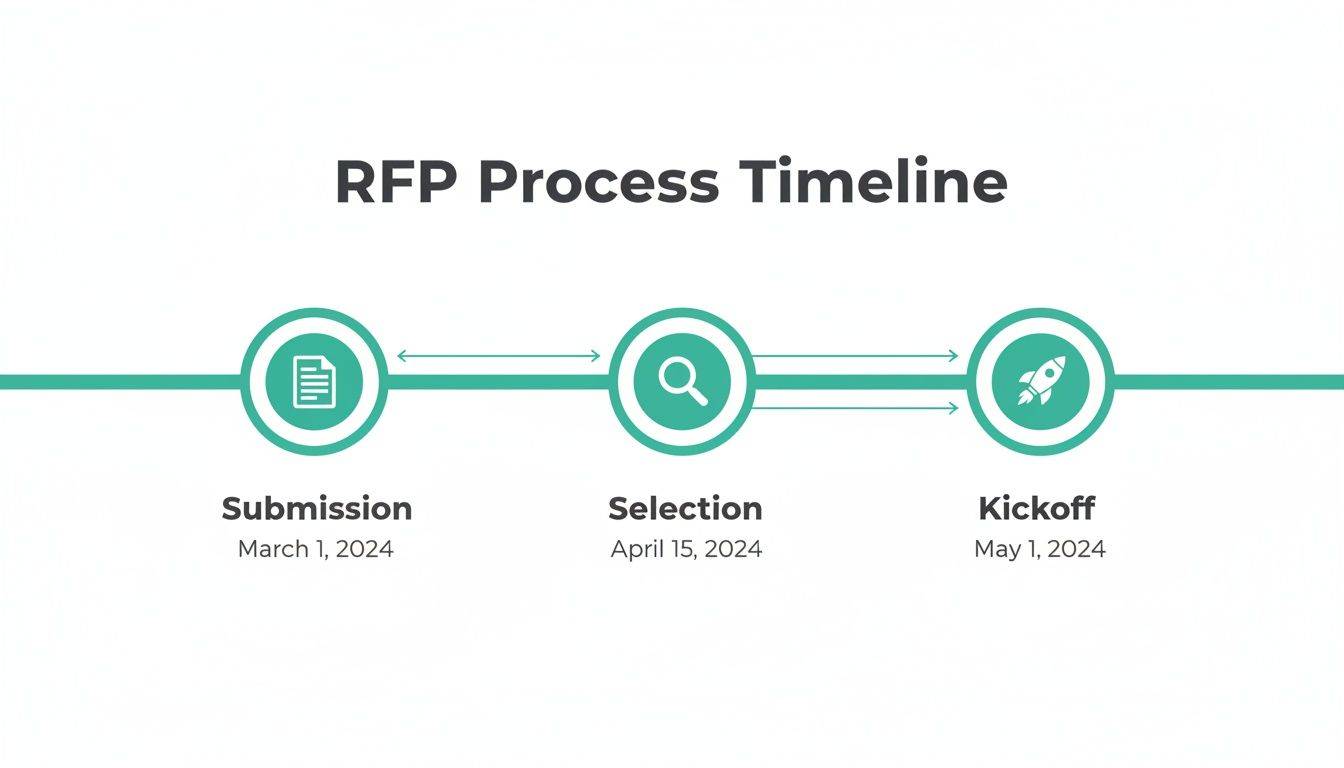
This visual shows why a thoughtful selection process needs dedicated time at each phase. Rushing it just leads to a bad decision.
Here’s a sample timeline you can adapt for your own marketing request for proposal:
- RFP Issued to Agencies: March 1, 2026
- Deadline for Agencies to Submit Questions: March 8, 2026
- Answers to All Questions Provided: March 12, 2026
- Proposal Submission Deadline: March 22, 2026 (5:00 PM EST)
- Finalists Notified for Presentations: March 29, 2026
- Finalist Presentations: April 8-10, 2026
- Final Agency Selection and Notification: April 15, 2026
- Contract Finalized and Signed: April 26, 2026
- Project Kickoff: May 1, 2026
Providing this level of detail creates a fair, transparent, and professional process. It’s exactly what high-quality agency partners look for when deciding if an opportunity is worth their time and effort.
Establishing Your Evaluation Criteria and Submission Rules
A fair and objective evaluation doesn’t just happen when the proposals start rolling in. It starts right now, by creating a clear, consistent framework for how you’ll judge each response and the ground rules every agency has to follow.
Without this structure, it’s far too easy to get swayed by a flashy presentation or a gut feeling instead of the strategic substance your business actually needs. A well-defined rubric makes sure every proposal is measured against the same yardstick, making your final choice logical, defensible, and tied directly to your business goals.
Building Your Proposal Scoring Rubric
The core of a fair process is a simple scoring rubric. This tool breaks your decision down into key components and assigns a weight to each one based on how important it is to your company. It’s a simple step that turns a complex, emotional decision into a manageable, data-driven one.
Your criteria should be a direct reflection of what you value most in a marketing partner. And trust me, it goes way beyond the price tag. The best partnerships are built on strategic alignment, deep industry expertise, and a team you genuinely trust.
Here are a few essential criteria I always recommend including in a scoring matrix:
- Relevant Industry Experience: Do they really get your specific market, audience, and challenges? Have they actually gotten results for businesses similar to yours?
- Strategic Approach: Did they just throw a list of tactics at you, or did they present a cohesive strategy that connects directly to the goals you laid out in the marketing request for proposal?
- Team Expertise and Chemistry: Who will be working on your account day-to-day? Does their team have the right mix of skills, and do they seem like a good cultural fit for your own team?
- Client Case Studies and Results: Look for real proof of performance. Do their case studies show tangible, measurable results that line up with the KPIs you care about?
By establishing a weighted scoring system before you review any proposals, you commit to an objective process. This prevents personal bias from creeping in and keeps your entire team focused on what truly matters for success.
Sample Scoring Matrix
To make this more practical, here’s a sample scoring matrix you can adapt. We score each proposal from 1 (Poor) to 5 (Excellent) for each criterion. That score is then multiplied by the assigned weight to get a final value, making it incredibly easy to rank your top contenders.
| Evaluation Criterion | Weight | Agency A Score (1-5) | Agency A Total | Agency B Score (1-5) | Agency B Total |
|---|---|---|---|---|---|
| Strategic Approach & Creativity | 30% | 4 | 1.2 | 5 | 1.5 |
| Industry Experience & Case Studies | 25% | 5 | 1.25 | 3 | 0.75 |
| Team Qualifications & Expertise | 20% | 4 | 0.8 | 4 | 0.8 |
| Understanding of Our Goals | 15% | 5 | 0.75 | 4 | 0.6 |
| Pricing and Overall Value | 10% | 3 | 0.3 | 4 | 0.4 |
| Total Score | 100% | 4.3 | 4.05 |
Setting Clear Submission Guidelines
If you want to be able to compare proposals easily, you have to enforce a consistent format and process. Submission rules eliminate confusion and level the playing field for every agency involved. Think of these as the non-negotiable administrative details that will make your life so much easier.
Your guidelines should be straightforward and impossible to misinterpret. Be sure to include:
- Proposal Format: Specify the required file type. PDF only is the standard for a reason—it prevents all sorts of formatting nightmares.
- Submission Method: Designate a single point of contact and one email address for all submissions. This stops proposals from getting lost in different inboxes.
- Deadline: Be explicit. Include the date, time, and time zone (e.g., Friday, April 26, 2024, by 5:00 PM EST). I always add a sentence stating that late submissions will not be considered. No exceptions.
- Question Protocol: Outline the process for asking questions and give a firm deadline for them. This ensures all agencies get the same clarifying information at the same time.
Asking Questions That Reveal True Partnership Potential
Finally, you need to go beyond the standard questions about agency size or founding date. The questions in your RFP should act as prompts, inviting agencies to showcase their strategic thinking and give you a peek into their working style. For more advice on this, our guide on how to choose a digital marketing agency offers additional insights.
These questions should challenge them to move past their templates and think specifically about your business.
- "Based on the information provided, what do you see as our single biggest marketing challenge, and how would you approach solving it in the first 90 days?"
- "Describe your process for reporting on performance and KPIs. Please provide a sample report or dashboard."
- "How would your team handle a situation where a campaign is underperforming against its goals?"
- "What do you need from us as a client to ensure this partnership is a success?"
Questions like these open a window into how an agency thinks, communicates, and handles adversity—the very qualities that define a great long-term partner.
Answering Your Lingering RFP Questions
Even after you've got the basics down, a few nagging questions always seem to pop up right when you’re trying to finalize your marketing RFP. Let's tackle those head-on so you can send your document out with complete confidence.
How Long Does This Thing Actually Need to Be?
Honestly, clarity beats length every single time. There's no magic page count, but a solid, well-thought-out RFP for a significant marketing partnership usually ends up somewhere between 10 to 20 pages. The goal isn't to hit a number; it's to give an agency enough meat to chew on so they can come back with a genuinely strategic proposal.
You want to paint the full picture without drowning them in fluff. Stick to the essentials we’ve talked about: who you are, what you need, your goals, the specific scope, your timeline, and how you’ll decide. A tight document that anticipates questions will always get better responses than a long one that leaves people guessing.
Should I Really Put My Budget in the RFP?
Yes, absolutely. It feels counterintuitive, I know. You're worried every proposal will come in at the top dollar, but keeping your budget a secret is one of the biggest time-wasters in this whole process. When you don't provide a number, you're asking agencies to play a guessing game.
The result? You’ll get proposals all over the map. Some will be so cheap you know they can't possibly deliver, and others will be so expensive you can't even consider them. It's a mess.
The best approach is to give a realistic budget range, like $50,000 to $75,000 annually. This lets agencies build a practical plan that fits what you can invest, and they can often show you what's possible at different levels within that range.
Being upfront shows you’re a serious buyer, not just window shopping, and it helps you get proposals that you can actually compare apples-to-apples.
How Many Agencies Should I Send This To?
The sweet spot is right around three to five agencies. Any fewer and you might not see a diverse enough range of ideas. Any more than five, and you’ll create a mountain of work for yourself trying to evaluate them all. This is a classic case of quality over quantity.
The real work happens before you send the RFP. Do your homework and shortlist a small group of agencies that already look like a great fit based on their case studies, industry experience, and overall approach. This ensures you’re spending your valuable time reviewing strong, relevant proposals, not weeding out dozens of duds.
What Are the Biggest Red Flags in an Agency's Response?
When the proposals start rolling in, you need to know what to look for—both the good and the bad. A great response feels like a conversation about your business. A bad one feels like junk mail.
Be on high alert for these warning signs:
- It Feels Like a Template: This is the most obvious red flag. If they barely mention your company name or gloss over your specific goals, they didn't put in the effort. It's a copy-paste job.
- They Guarantee Results: Run from any agency that guarantees a #1 ranking on Google or promises a certain number of leads. Marketing has too many variables for those kinds of absolutes. Real experts talk about projections and benchmarks, not guarantees.
- They Have Zero Questions: A sharp agency will almost always have clarifying questions after reading your RFP. Silence can mean they didn't dig deep enough to spot the nuances of your project.
- It's Full of Jargon and Fuzzy Pricing: If you can't understand their proposal or their pricing model seems intentionally confusing, that's a bad sign. The best partners communicate with clarity. They want you to understand the value you're getting.
At the end of the day, the best proposals are customized, strategic, and demonstrate a clear understanding of how to solve your problems. It should feel less like a sales pitch and more like the beginning of a true partnership.
Ready to stop guessing and start growing? At Ascendly Marketing, we build results-driven strategies that turn your business goals into reality. Whether you need a high-performing website, a powerful lead generation engine, or a comprehensive digital marketing plan, our team is ready to help. Schedule your free consultation today!