

Did you know that marketers who document their strategy are 331% more likely to report success than those who don’t? Yet most small to medium businesses operate without a clear strategic marketing plan, wondering why their digital efforts fail to deliver results. This article reveals exactly why a marketing strategy drives growth and ROI, and how you can create one that transforms your business visibility and sales.
Table of Contents
- Understanding Marketing Strategy
- Why Marketing Strategy Matters for Business Growth
- Key Elements of an Effective Marketing Strategy
- Common Misconceptions About Marketing Strategy
- Case Studies Illustrating Marketing Strategy Success
- Aligning Marketing Strategy with Business Goals
- Incorporating Emerging Trends in Marketing Strategy
- Summary and Next Steps for SMB Marketing Strategy
- Boost Your Business Growth with Expert Digital Marketing Support
- Frequently Asked Questions About Marketing Strategy
Key takeaways
| Point | Details |
|---|---|
| Document your strategy | Documenting your marketing strategy increases success by 331%, proving strategic planning directly impacts results. |
| Align with business goals | Marketing strategy connects every marketing action to your company vision, maximizing growth and resource efficiency. |
| Include essential elements | Effective strategies require market research, clear target audience definition, measurable KPIs, and continuous optimization. |
| Avoid common myths | Strategy defines what and why, while tactics are how; both small and large businesses need documented strategic plans. |
| Adapt to emerging trends | AI-powered tools, privacy regulations, and algorithm changes require flexible, forward-thinking marketing strategies. |
Understanding marketing strategy
A marketing strategy is your long-term guiding plan that aligns every marketing action with your business goals. Think of it as your roadmap: it defines what you want to achieve, who you’re targeting, and why these objectives matter to your bottom line. Too many SMB owners confuse strategy with tactics, jumping straight into social media posts or Google ads without understanding the foundational difference.
Strategy answers the what and why. Tactics answer the how. Your strategy might be to establish your brand as the trusted local expert in sustainable home renovations. Your tactics are the blog posts, email campaigns, and Facebook ads you use to execute that vision. A strategic marketing approach aligns every marketing action with the brand’s long-term vision, enabling flexibility to adapt to market changes while building deep customer loyalty.
For small businesses, adopting a strategic approach rather than fragmented tactics is critical. Without strategy, you waste budget on disconnected campaigns that don’t build momentum. With strategy, every dollar spent reinforces your business growth strategies and compounds results over time.
Pro Tip: Write down your marketing strategy in a single document. Revisit it quarterly to ensure it still reflects your business priorities and market realities.
“Strategic marketing isn’t about doing more. It’s about doing the right things consistently, with clear purpose and measurable outcomes.”
Key distinctions between strategy and tactics:
- Strategy focuses on long-term objectives and competitive positioning
- Tactics are specific actions like email blasts or paid ads
- Strategy guides decision-making; tactics execute the plan
- Changing tactics is easy; pivoting strategy requires careful analysis
Understanding this foundational difference sets you up to build marketing that actually drives sustainable growth. With this foundational understanding, we move next to why a marketing strategy is critical for driving real business growth and measurable results.
Why marketing strategy matters for business growth
The numbers tell a compelling story. Companies that put marketing at the core of their growth strategy are twice as likely to achieve revenue growth of 5% or more compared to those that treat marketing as an afterthought. For small and medium businesses competing against larger rivals, this difference between strategic and haphazard marketing can determine survival or success.
Marketing strategy directly impacts three critical growth areas: customer acquisition, engagement, and retention. Effective marketing strategies help small businesses create brand awareness, acquire and retain customers, and enhance engagement, which directly contributes to sustained business growth. When you operate with a clear strategy, you stop chasing every shiny new platform and start focusing resources where they deliver maximum ROI.
Consider what happens without strategy. You launch a Facebook campaign because competitors are doing it. You invest in SEO sporadically. You create content without understanding what your audience actually needs. Each effort exists in isolation, building no cumulative advantage. Strategic marketing flips this script entirely.
Proven benefits of strategic marketing for SMBs:
- Doubles the likelihood of consistent revenue growth year over year
- Increases customer lifetime value through targeted retention programs
- Reduces wasted ad spend by focusing on high-converting channels
- Builds brand recognition that compounds over time
- Creates competitive differentiation in crowded markets
Statistics proving strategy-centered marketing impact:
- 331% higher success rate for documented strategies
- 2x likelihood of achieving 5%+ annual revenue growth
- 73% of successful SMBs attribute growth to strategic marketing alignment
Implementing effective B2B SEO strategies within your overall marketing plan amplifies these results further. The key is viewing marketing not as an expense but as the core growth engine that powers customer acquisition and business expansion. Understanding why marketing strategy impacts growth, let’s explore the key elements and practical steps to build an effective strategy tailored for SMBs.
Key elements of an effective marketing strategy
Building a marketing strategy that actually works requires following a systematic process. Marketers who document their marketing strategy are 331% more likely to report success than those who don’t, highlighting the direct impact of strategic planning on marketing effectiveness. Here’s your step-by-step roadmap to create a documented, data-driven plan.
1. Conduct market research and situation analysis
Market research and situation analysis are the foundational first steps in building a marketing strategy that truly reflects customer needs and competitive dynamics. Analyze your competitors, understand industry trends, and identify gaps your business can fill. Survey existing customers to discover pain points and buying motivations.
2. Define clear marketing objectives
Set specific, measurable goals aligned with your business vision. Instead of “increase website traffic,” aim for “generate 50 qualified leads per month through organic search by Q3 2026.” Concrete objectives create accountability and enable accurate performance tracking.

3. Identify and segment your target audience
Go beyond basic demographics. Create detailed buyer personas that include motivations, challenges, preferred communication channels, and decision-making processes. The more precisely you understand who you’re reaching, the more effectively you can craft messages that resonate.
4. Develop your value proposition and brand positioning
Articulate exactly what makes your business different and why customers should choose you. Your value proposition must address specific customer needs better than competitors. Position your brand clearly in the market landscape.
5. Select appropriate marketing channels and tactics
Choose channels where your target audience actively spends time. For B2B companies, LinkedIn and email might dominate. For local services, Google My Business and Facebook could be primary. Match tactics to strategy, not the reverse.
6. Establish measurable KPIs and continuous tracking
Define key performance indicators that directly tie to your objectives. Track metrics like cost per lead, customer acquisition cost, conversion rates, and lifetime value. Set up dashboards that provide real-time visibility into campaign performance.
| Strategy Element | Key Action | Success Metric |
|---|---|---|
| Market Research | Analyze competitors and customer needs | Identify 3-5 competitive advantages |
| Objectives | Set SMART goals aligned with revenue targets | Achieve 90% of quarterly goals |
| Audience | Create detailed buyer personas | Increase targeting accuracy by 40% |
| Positioning | Craft unique value proposition | Improve brand recall by 50% |
| Channels | Select high-ROI platforms | Reduce CAC by 25% |
| KPIs | Implement tracking dashboards | Review metrics weekly |
Documenting your strategy in a living document ensures everyone on your team understands priorities and execution plans. This documentation becomes your reference point for evaluating new opportunities and maintaining focus when distractions arise. Refer back to your foundational growth strategies regularly to ensure marketing supports broader business aims.
Pro Tip: Schedule a quarterly strategy review session. Assess what’s working, what needs adjustment, and how market conditions have shifted. Update your documented strategy accordingly to stay relevant and effective.
With clear elements and steps outlined, it’s important to address common misconceptions that can prevent SMBs from fully benefiting from marketing strategy.
Common misconceptions about marketing strategy
Several myths prevent small business owners from developing effective marketing strategies. Clearing up these misconceptions is essential for building a plan that actually works.
Myth: Marketing strategy is just a list of tactics or campaigns
Common misconceptions include confusing marketing strategy with marketing tactics; strategy defines the “what and why” while tactics are the “how” to implement campaigns. Your strategy is the overarching vision and objectives. Tactics like Instagram ads or email newsletters are tools you use to execute that vision. Jumping straight to tactics without strategy guarantees wasted budget and inconsistent results.
Myth: Only large companies need a marketing strategy
Small and medium businesses benefit even more from strategic planning than large corporations. With limited budgets and resources, SMBs can’t afford to waste money on unfocused campaigns. A clear strategy helps you prioritize where to invest, compete effectively against bigger rivals, and punch above your weight in crowded markets.
Myth: Strategy is fixed and doesn’t change
Effective marketing strategy is dynamic and evolving. Market conditions shift. Customer preferences change. New competitors emerge. Technology transforms how people discover and buy products. Your strategy must adapt continuously while maintaining core positioning and objectives. Think of it as a living framework, not a static document gathering dust.
Myth: Strategy and branding are the same thing
Branding is one component of your marketing strategy. Your brand defines visual identity, voice, and personality. Strategy encompasses branding plus target audience, competitive positioning, channel selection, objectives, and performance measurement. Confusing the two limits your marketing effectiveness.
Common mistakes that stem from these misconceptions:
- Launching campaigns without clear objectives or success metrics
- Copying competitor tactics without understanding strategic context
- Treating marketing as a cost center rather than a growth investment
- Changing direction every quarter based on the latest trends
- Focusing on vanity metrics like followers instead of revenue impact
When you confuse strategy with tactics or assume strategy is only for big companies, you operate reactively instead of proactively. You chase every new platform and trend, building no sustainable advantage. Embrace strategy as your competitive edge, the framework that guides smart decisions and efficient resource allocation.
Pro Tip: When evaluating any marketing opportunity, ask: “Does this align with our documented strategy and support our core objectives?” If not, it’s a distraction, no matter how exciting it seems.
“The businesses that win aren’t those doing the most marketing activities. They’re doing the right activities, guided by clear strategy and measured against concrete goals.”
If you’re overwhelmed by strategic planning, consider professional guidance. Learning how to choose a digital marketing agency that understands strategic thinking can accelerate your progress significantly. Clearing up these misconceptions sets the stage to see real-world proof of how strategic marketing drives business success.
Case studies illustrating marketing strategy success
Real-world examples demonstrate how strategic marketing transforms companies and drives measurable growth. These case studies offer valuable lessons for SMB owners developing their own plans.
Netflix: Strategic pivot to streaming dominance
Digital marketing strategy success is evidenced by case studies such as Netflix’s use of consumer science and AI to transform its product offering and achieve substantial subscriber growth. Netflix didn’t just add streaming as another service. They strategically repositioned their entire business model based on deep consumer data analysis, predicting that streaming would dominate entertainment consumption. This strategic vision, supported by AI-powered personalization, grew their subscriber base from millions to over 230 million globally.
eBay: Market penetration through strategic repositioning
eBay faced declining engagement as competitors like Amazon gained market share. Their strategic response focused on improving user experience, emphasizing unique inventory like collectibles and vintage items, and targeting specific buyer segments with personalized campaigns. By strategically differentiating rather than competing head-to-head on price, eBay regained relevance and increased transaction volume.
Key lessons from these success stories:
- Data-driven insights inform strategic decisions that transform business models
- Personalization at scale requires strategic planning and technology investment
- Market positioning based on unique strengths beats generic competition
- Long-term strategic vision guides tactical execution across all channels
- Continuous adaptation within strategic framework responds to market evolution
For SMBs, these examples illustrate that strategic thinking drives growth regardless of company size. You don’t need Netflix’s budget to apply strategic principles. Start by deeply understanding your customers, identify your unique competitive advantage, and align every marketing action with that positioning.
Explore our marketing case studies to see how strategic approaches deliver measurable results for businesses similar to yours. These real-world examples prove that documented strategy consistently outperforms reactive, tactical marketing.
Pro Tip: Study one successful marketing strategy case study per quarter. Identify three specific strategic principles you can adapt for your business, then test them systematically.
Having seen these success stories, let’s explore how you can align your marketing strategy directly with your business goals for maximum ROI.
Aligning marketing strategy with business goals
Your marketing strategy only succeeds when it directly supports your broader business objectives. Aligning marketing strategy with business goals helps small business owners prioritize limited resources effectively, increasing the likelihood of marketing ROI and business success.
Start by clearly defining your company vision and financial targets for the next 12 to 36 months. Are you aiming to increase revenue by 30%? Expand into new geographic markets? Launch a new product line? Each business goal requires different marketing objectives and tactics.
Practical alignment framework:
- Match marketing objectives to specific revenue or growth targets
- Ensure marketing KPIs directly tie to business performance indicators
- Allocate marketing budget based on strategic priorities, not equal distribution
- Create accountability by assigning ownership for each objective
- Review alignment quarterly and adjust as business priorities evolve
For example, if your business goal is acquiring 100 new customers this year, your marketing objective might be generating 400 qualified leads at a 25% close rate. This clarity enables you to calculate required traffic, conversion rates, and budget allocation across channels.
Resource prioritization becomes straightforward when strategy aligns with business goals. You stop spreading budget thinly across every possible channel and concentrate investment where it delivers maximum impact toward your specific objectives. This focused approach particularly benefits SMBs with limited marketing budgets.
Track key performance indicators that bridge marketing activity and business outcomes. Monitor metrics like customer acquisition cost, marketing-influenced revenue, lead-to-customer conversion rate, and customer lifetime value. These KPIs reveal whether your marketing strategy genuinely drives business growth or just generates vanity metrics.
Pro Tip: Create a simple one-page document that maps each business goal to corresponding marketing objectives, tactics, KPIs, and budget allocation. Update it monthly and share with your entire team to maintain strategic focus.
Regularly reviewing how marketing performance impacts business results keeps your strategy relevant and effective. When you see clear connections between marketing investments and revenue growth, securing additional budget becomes easier. This alignment transforms marketing from a cost center into a recognized growth driver that leadership values and supports.
To stay ahead, SMBs must also adapt their strategies to emerging trends shaping marketing in 2026 and beyond.
Incorporating emerging trends in marketing strategy
The marketing landscape evolves rapidly. Emerging digital marketing trends such as AI-powered marketing and social media algorithm changes require adaptive and strategic planning to maintain and grow online visibility. SMBs that proactively integrate these trends into their strategies gain significant competitive advantages.
AI-powered marketing transformation
Artificial intelligence now enables sophisticated customer segmentation, predictive analytics, and personalization at scale previously available only to enterprise companies. Tools powered by AI analyze customer behavior patterns, optimize ad targeting in real time, and generate content insights that improve engagement. Strategic marketing plans in 2026 must incorporate AI tools to remain competitive.
Privacy regulations reshaping data collection
Stricter privacy laws and the deprecation of third-party cookies fundamentally change how businesses collect and use customer data. Your marketing strategy must emphasize first-party data collection through owned channels like email lists, customer accounts, and direct interactions. Building direct relationships becomes strategically essential, not just tactically useful.
Social media algorithm evolution
Platform algorithms constantly change how content reaches audiences. Organic reach continues declining on most networks, requiring either paid promotion or exceptional content quality to achieve visibility. Strategic planning accounts for these realities by diversifying channel mix and not over-relying on any single platform.
Key recommendations for adapting strategy:
- Invest in AI-powered analytics and automation tools appropriate for your budget
- Build first-party data assets through valuable content and direct engagement
- Diversify your channel mix to reduce dependence on algorithm changes
- Emphasize owned channels like email and websites over rented social platforms
- Stay informed about regulatory changes affecting your industry and marketing
| Aspect | Traditional Marketing Approach | Strategic Marketing in 2026 |
|---|---|---|
| Data Usage | Third-party cookies and purchased lists | First-party data and direct relationships |
| Personalization | Basic segmentation | AI-powered individual targeting |
| Channel Strategy | Focus on 1-2 primary channels | Diversified, integrated channel mix |
| Content Creation | Manual production | AI-assisted with human oversight |
| Privacy Compliance | Minimal consideration | Central strategic priority |
| Measurement | Platform-specific metrics | Unified cross-channel attribution |
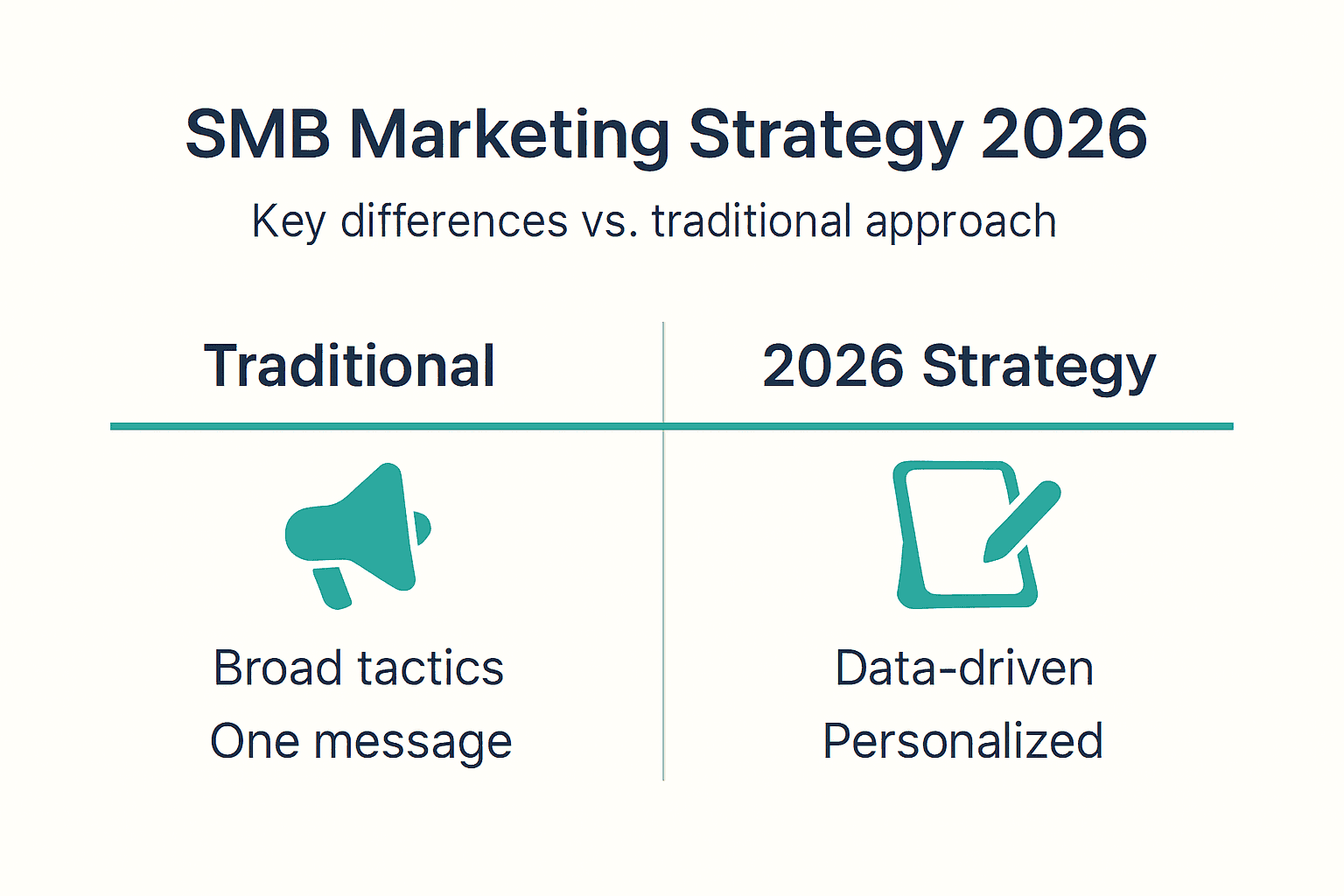
Staying current with 2026 marketing trends ensures your strategy remains effective as technology and consumer behavior evolve. Subscribe to industry publications, attend webinars, and network with other marketing professionals to identify emerging trends early.
The most successful strategies balance proven fundamentals with innovative adoption of emerging capabilities. Don’t chase every new trend, but do evaluate which innovations align with your objectives and offer genuine competitive advantage. Strategic thinking guides which trends to embrace and which to ignore.
Now that you know how to integrate trends into your strategy, let’s summarize key insights and outline next steps for implementing your marketing plan.
Summary and next steps for SMB marketing strategy
A documented marketing strategy increases your success likelihood by 331% compared to operating without one. This powerful statistic underscores why strategic planning must be your foundation, not an afterthought. Throughout this article, we’ve explored what marketing strategy truly means, why it drives business growth, and how to build one that delivers results.
Your marketing strategy aligns every action with your business vision, enabling you to compete effectively despite limited resources. It differentiates strategy from tactics, preventing the common mistake of jumping to execution without clear direction. When properly documented and regularly reviewed, your strategy becomes the framework for consistent growth and measurable ROI.
Essential takeaways to remember:
- Document your strategy in writing and revisit it quarterly
- Align marketing objectives directly with business goals and financial targets
- Focus on market research and audience understanding before selecting tactics
- Track KPIs that tie marketing activity to revenue and business outcomes
- Adapt continuously to emerging trends while maintaining strategic consistency
- Seek professional guidance when internal expertise or capacity limits progress
Your next steps to implement strategic marketing:
- Assess your current marketing efforts and identify gaps in strategic planning
- Conduct market research to understand customer needs and competitive landscape
- Define clear, measurable objectives that support your business goals
- Document your strategy in a single accessible document
- Select appropriate channels and tactics based on where your audience engages
- Implement tracking systems for key performance indicators
- Schedule quarterly reviews to evaluate progress and adjust strategy
Don’t let analysis paralysis prevent you from starting. Begin with a basic strategic framework and refine it as you learn. The competitive advantage comes from having any documented strategy rather than a perfect strategy. Improvement happens through consistent execution, measurement, and optimization.
If developing strategy feels overwhelming, partnering with experienced professionals accelerates your progress significantly. Marketing agencies bring strategic expertise, industry insights, and execution capabilities that transform your vision into results faster than going it alone.
With these takeaways in mind, you’re ready to explore specialized services that can help you execute a winning marketing strategy.
Boost your business growth with expert digital marketing support
Transforming marketing strategy into measurable business growth requires expertise, consistent execution, and ongoing optimization. That’s where Ascendly Marketing delivers exceptional value for small and medium businesses ready to scale.
Our team specializes in translating strategic vision into concrete results through comprehensive digital marketing services tailored to your unique business goals.
From search engine optimization that builds sustainable organic visibility to social media marketing that engages your target audience, we align every tactic with your strategic objectives. Our data-driven approach ensures your marketing investment delivers maximum ROI.
As a leading SEO company in Dallas, we’ve helped businesses across industries achieve breakthrough growth through strategic digital marketing. Whether you need comprehensive strategy development or specialized execution support, our experienced team brings the expertise to accelerate your success.
Ready to transform your marketing from scattered tactics into a powerful growth engine? Contact Ascendly Marketing today to schedule your consultation and discover how strategic digital marketing drives measurable business results.
Frequently Asked Questions About Marketing Strategy
What is the first step to creating a marketing strategy?
Start with comprehensive market research and situation analysis. Understand your customers’ needs, analyze competitor positioning, and identify market gaps your business can uniquely fill. This foundation informs every subsequent strategic decision.
How do I measure if my marketing strategy is working?
Track KPIs that directly tie to business outcomes like customer acquisition cost, marketing-influenced revenue, conversion rates, and customer lifetime value. Compare actual results against the specific objectives you set in your strategy document. Review these metrics monthly and conduct deeper quarterly analyses.
Can a small business benefit from marketing strategy?
Absolutely. Small businesses benefit even more than large corporations because limited budgets demand efficient resource allocation. A clear strategy helps you compete effectively, prioritize high-impact activities, and avoid wasting money on unfocused campaigns. The 331% success increase applies especially to SMBs.
How often should I update my marketing strategy?
Review your strategy quarterly to assess progress and adjust for market changes. Conduct a comprehensive strategy refresh annually or when significant business changes occur, like new product launches or market expansion. Your strategy should be a living document that evolves while maintaining core positioning.
When should I hire a marketing agency to help with strategy?
Consider professional help when you lack internal marketing expertise, your team is overwhelmed with execution, or growth has plateaued despite efforts. Agencies bring strategic insights, industry experience, and specialized skills that accelerate results. If marketing feels like guesswork rather than strategic execution, it’s time to seek expert guidance.