

Unifying paid search (PPC) and organic SEO creates a strategy more effective than its individual parts. This approach builds a feedback loop where the data from paid ads informs long-term SEO growth.
The Power Couple of Digital Marketing

A modern marketing approach views PPC and SEO as a dynamic duo. Each channel has distinct strengths, and they cover each other's weaknesses.
This is not just about running both campaigns simultaneously. It is about designing a system where outcomes from one channel directly improve the other.
To understand how this works, one must know the differences between Paid Search vs Organic Search. One channel provides immediate traffic with precise control, while the other builds a long-term asset that provides value for years.
The following sections explain how these two channels work together.
PPC vs SEO: A Quick Comparison
This table outlines the core differences and shows how PPC and SEO can function in tandem. One offers speed and control, and the other provides authority and trust over time.
| Attribute | Paid Search (PPC) | Organic Search (SEO) |
|---|---|---|
| Speed to Results | Immediate (minutes to hours) | Gradual (months to years) |
| Cost | Pay-per-click | Investment in time, content, and expertise |
| SERP Position | Top of the page (ad section) | Below ads, based on relevance and authority |
| Control | High (bids, ad copy, targeting) | Low (influenced by algorithms) |
| Longevity | Traffic stops when payment stops | Builds a long-term, compounding asset |
| Best For | Quick tests, promotions, high-intent keywords | Building brand trust and authority, long-term traffic |
Viewing them side-by-side clarifies that they are not competitors. They are two aspects of a unified approach to occupy the search results page.
The Symbiotic Feedback Loop
PPC campaigns function as a marketing laboratory. They allow for real-time testing of headlines, value propositions, and calls-to-action to determine what generates clicks.
An ad with a high click-through rate provides a proven blueprint for organic content. The high-performing language can be adapted for page titles and meta descriptions, which will increase organic click-through rates with tested messaging.
A strong SEO foundation makes ads less expensive. Google's Quality Score algorithm rewards ads that link to relevant, fast-loading landing pages. When SEO is well-executed, pages are naturally optimized. This results in a better Quality Score, which directly lowers cost-per-click (CPC).
This creates a continuous cycle of improvement:
- PPC data sharpens SEO: Paid search query reports contain long-tail keywords that customers use. These keywords can be fed directly into a content strategy.
- SEO makes PPC cheaper: High-quality landing pages boost Quality Score and reduce ad costs.
- Test before you invest: To evaluate a new keyword category, launch a small PPC campaign instead of spending months building content. If it converts, the SEO initiative is validated with minimal risk.
This integrated model of paid search engine optimization produces combined results greater than the sum of the individual parts. If you are new to paid search, this guide on what paid search is will provide more information.
The Financial Impact of Integration
Paid search delivers a fast, measurable return that complements the slower, compounding value of SEO. One analysis found that while SEO has a significant long-term ROI, PPC can generate a 4x return, which is double the return of some other digital channels.
With Google processing billions of searches daily, a combined strategy ensures visibility to motivated buyers, whether they click an ad or an organic result. This PPC statistics research provides more detailed numbers. This integrated approach helps secure both short-term revenue and long-term digital presence.
Forging a Unified Keyword Strategy That Actually Works
When SEO and PPC teams conduct keyword research in isolation, financial opportunities are missed. A unified strategy requires a single blueprint that maps user intent across the customer journey. This blueprint identifies which terms to target, how to target them, and which channel should lead for maximum impact.
Mine Your PPC Gold for SEO Wins
The first step is to analyze PPC campaign data. Identify keywords that are business-critical but have a high cost-per-click (CPC). These are the priority targets for a major organic content push.
High-cost PPC terms indicate what the audience values most. While paid ads offer immediate traffic, ranking organically for these same terms builds a long-term, "rent-free" asset that reduces dependency on ads.
For instance, if "emergency plumbing service" has a high ad budget, this is a signal. This is a classic paid search engine optimization play: use the expensive ad data to justify creating an authoritative guide on that topic. This will start earning "free" clicks for a term that was previously paid for at a premium.
By creating content around these themes, you capture valuable organic traffic. This content attracts users and builds site authority, which in turn can help PPC campaigns. To execute this, a solid foundation in what organic SEO is and why it's a priority is needed.
Use PPC as Your Keyword Crystal Ball
Use the paid search budget as a rapid testing ground for new keyword ideas. SEO is a long-term process. Spending months building a content cluster that does not convert is inefficient.
This feedback loop is simple and effective:
- Have a hunch? A new keyword group may relate to a product feature or a niche service.
- Launch a micro-campaign. Start a small, focused PPC campaign with a modest budget.
- Get fast answers. In a few days, real-world data on click-through rates (CTR), conversion rates, and traffic quality will be available.
If the numbers are positive, a data-backed green light is given for SEO efforts on that theme. If the campaign fails, months of wasted effort have been saved for the cost of a small ad experiment.
Map Your Keywords to the Customer Journey
An integrated strategy assigns keywords a job based on the customer's position in their buying journey. This ensures the right message is delivered through the right channel at the right time.
Top of Funnel (ToFu): The "What Is…?" Stage
- Keyword Clues: Informational queries like "how to," "what is," and problem-focused searches.
- Your Playbook: This is prime real estate for organic SEO. Dominate with comprehensive blog posts, ultimate guides, and educational articles. Display ads can be used for general brand awareness, but content is the primary focus.
Middle of Funnel (MoFu): The "Best Of" Stage
- Keyword Clues: Comparison searches are common. Examples include "best," "vs," "reviews," and "alternatives."
- Your Playbook: This requires a team effort. SEO provides in-depth comparison articles and review roundups. PPC uses remarketing to bring back users who have shown interest.
Bottom of Funnel (BoFu): The "Buy Now" Stage
- Keyword Clues: High-intent, commercial terms such as "buy," "price," "near me," and brand + product searches.
- Your Playbook: PPC is the closer. When purchase intent is at its peak, the immediate, top-of-page visibility that paid ads provide is necessary. Organic efforts support this with optimized, conversion-focused product and service pages.
Data indicates that while organic results are powerful, paid ads are useful for capturing high-intent users. 63% of people report they would click on a Google ad when looking to make a purchase. By pairing the channels, a flywheel effect is created that yields results.
Aligning Campaigns for a Seamless User Journey
A disconnect between an ad and its landing page will decrease conversion rates. When a user clicks an ad promising one thing and lands on a page that feels different, it wastes ad spend.
The goal is to create a smooth, logical path from the first ad impression to the final thank-you page. When this is done correctly, the user feels understood. Google receives the signal that the page is relevant to the search, which is a factor in Quality Score. A better score leads to better ad positions and lower costs.
A/B Testing for Cross-Channel Gains
Paid search campaigns function as a high-speed research and development lab for the entire marketing strategy. The ability to generate traffic quickly provides statistically significant data on what works. These learnings can then be applied to long-term organic efforts.
Where do you start?
- Headlines: Test headline ideas against each other in ads. The one with the highest click-through rate is a proven winner. This insight should be used as the new H1 on the matching SEO page.
- Calls-to-Action (CTAs): Determine if "Get a Free Quote" is better than "See Pricing Now." Paid ads provide the answer, backed by conversion data. The winning CTA can then be rolled out across organic pages.
- Form Layouts: Tweaking forms can increase lead flow. Use paid traffic to test a short, two-field form against a more detailed one. Once the optimal layout is found, apply it sitewide to lift the conversion rate.
You are using paid search to de-risk your SEO strategy. Instead of guessing what works, you make data-backed decisions that benefit both channels. Sending all traffic to the homepage is inefficient. The homepage is a general-purpose page and a poor destination for a user who clicked an ad for a specific need, which leads to high bounce rates.
The Power of Dedicated Landing Pages
Creating dedicated landing pages for ad groups is a fundamental tactic. If you run an ad group for "24/7 emergency AC repair," that traffic should land on a page that discusses only that topic.
This works because of message match.
First, it validates the user’s click. When their search for "Miami commercial roof repair" leads to an ad that says "Commercial Roof Repair in Miami" and then a landing page with the headline "Your Miami Commercial Roofing Experts," they know they are in the right place. The promise from the ad is instantly fulfilled, which keeps them engaged and moving toward the goal.
Second, message match improves Google's Quality Score. It proves relevance directly. Search engines reward this with lower cost-per-click (CPC) and better ad rankings. Building these dedicated pages creates a better user experience and makes the entire campaign cheaper and more effective.
Creating Your Cross-Channel Data Feedback Loop
Imagine paid search and SEO teams working as a single machine. Data from one channel instantly sharpens the other's strategy, creating a cycle of constant improvement. This is how paid search engine optimization is executed in 2026. It replaces guessing with decisions that boost immediate ad results and long-term organic presence.
PPC search query reports are a valuable resource. They contain the exact words customers type into Google. For an SEO team, this is a source of valuable long-tail keywords that broader research might miss. These phrases often indicate high intent.
For example, if several conversions occur on a paid ad for "hypoallergenic toddler mattress with organic cotton," it is a strong signal. The content team should then focus on creating a detailed guide or product page for "The Ultimate Guide to Hypoallergenic Toddler Mattresses" instead of just the generic term "toddler mattress."
Use PPC as an Agile Testing Ground
PPC's key advantage is speed. Building a large organic content pillar can take months with no guarantee of success. A small, targeted PPC campaign can validate a concept in days. This transforms paid search into a testing lab for the entire marketing strategy.
Before committing resources to a large new content initiative, run a small experiment.
- Test value propositions: Does "Free Shipping" perform better than a "5-Year Warranty"? Test them in ad copy and let the data decide.
- Test new offers: Wondering if a 20% Off coupon will outperform a "Buy One, Get One" deal? A quick PPC test will provide a clear winner based on conversion numbers.
- Test audience segments: Use paid campaigns to see if a new demographic or interest group responds before creating an organic content plan for them.
Once a winner is identified, those learnings can be confidently applied to organic content, landing pages, and core brand messaging. This reduces the risk of large content investments.
Let Organic Content Fuel Paid Campaigns
This data flow is not a one-way street. Top-performing organic content is a source of ideas for paid campaigns. Analyze analytics to find blog posts and guides with the highest engagement and longest time on page.
These popular pieces indicate what the audience cares about. If a blog post titled "10 Common DIY Plumbing Mistakes to Avoid" is the most popular, a major pain point has been identified.
You can act on that insight immediately. Create a new PPC campaign targeting keywords like "DIY plumbing help" or "fixing a leaky faucet." The ad can then point to a landing page offering a downloadable checklist or a free video tutorial in exchange for an email, capturing high-intent leads that organic content first uncovered.
This flow chart outlines the process: align the ad's promise with the landing page experience to guide users to conversion.
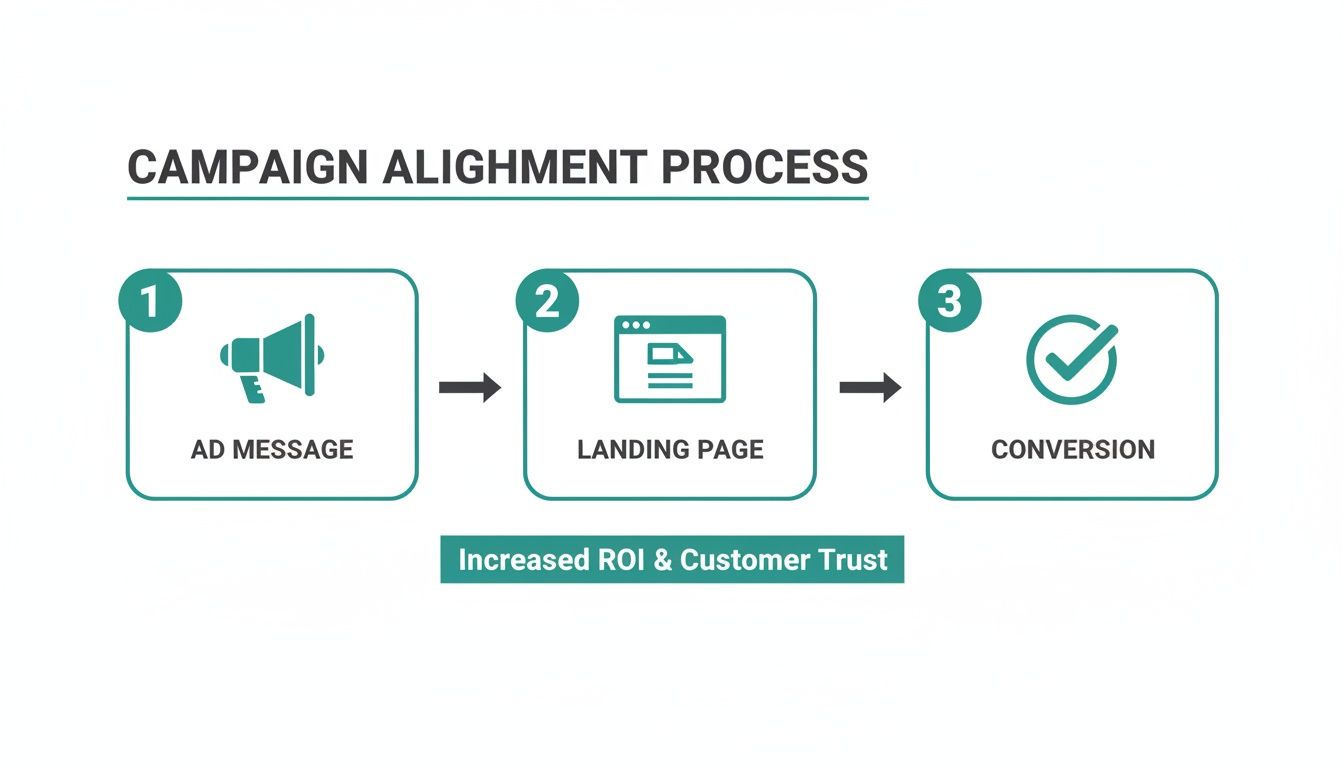
When the ad message flows seamlessly into the landing page, trust is built, and it is easy for the user to take the next step.
Paid search is an amplifier for SEO, especially for targeted campaigns. Research shows that intent-driven PPC traffic can have a 14.6% close rate, compared to 1.7% from outbound methods. With 63% of people willing to click on Google ads, a combined approach captures valuable bottom-of-funnel traffic that broad SEO might otherwise miss. More details on how AI and mobile strategies are shaping SEM statistics on fishbat.com are available.
Building this feedback loop creates a culture where every click and view makes the entire marketing engine smarter, faster, and more effective.