

You’ve seen the search results. A customer in Austin types the exact service you sell, and the first thing they see is a competitor with a Sponsored label sitting above the organic listings. That click goes to them. Your business gets whatever is left.
That’s why business owners start looking into PPC management in Austin, TX. Not because they want to learn a new ad platform. Because they’re tired of watching ready-to-buy traffic go somewhere else.
If this is your first serious PPC investment, skip the vague promises. You need a working decision framework. You need to know what competent management looks like, what kind of budget gives you a real shot in Austin, and whether you should hire an agency, a freelancer, or someone in-house.
Your Competitors are on Google, Why aren’t You
An Austin plumber, law firm, med spa, or home service company usually doesn’t lose business because demand disappeared. They lose because someone else showed up first when the buyer searched.
That’s what paid search does. It puts your offer in front of people who are already looking. The problem is that many owners treat PPC like a switch. Turn on ads, wait for leads, judge the whole thing in a week. That’s how budgets get burned.
PPC management isn’t the act of placing ads. It’s the discipline of deciding which searches matter, where your ads should appear, what page visitors should land on, and how your budget gets pushed toward actual lead quality instead of empty traffic.
If your competitors keep appearing on high-intent searches and you don’t, they’re building the habit of being chosen first.
Austin makes this more urgent. Buyers have options, and they don’t spend time digging through weak results. If your ad copy is sloppy, your targeting is broad, or your landing page doesn’t line up with the search, your campaign won’t fail slowly. It will waste money fast.
Here’s the practical way to view it:
- Search intent comes first. The person searching “emergency roofer Austin” is not the same as someone searching broad educational terms.
- Visibility without structure is expensive. Ads can run. That doesn’t mean they should.
- Clicks are not the win. Calls, form fills, booked consultations, and qualified leads are the win.
You don’t need to become a media buyer. You do need to know enough to tell the difference between management and mere ad setup.
What PPC Management Actually Includes
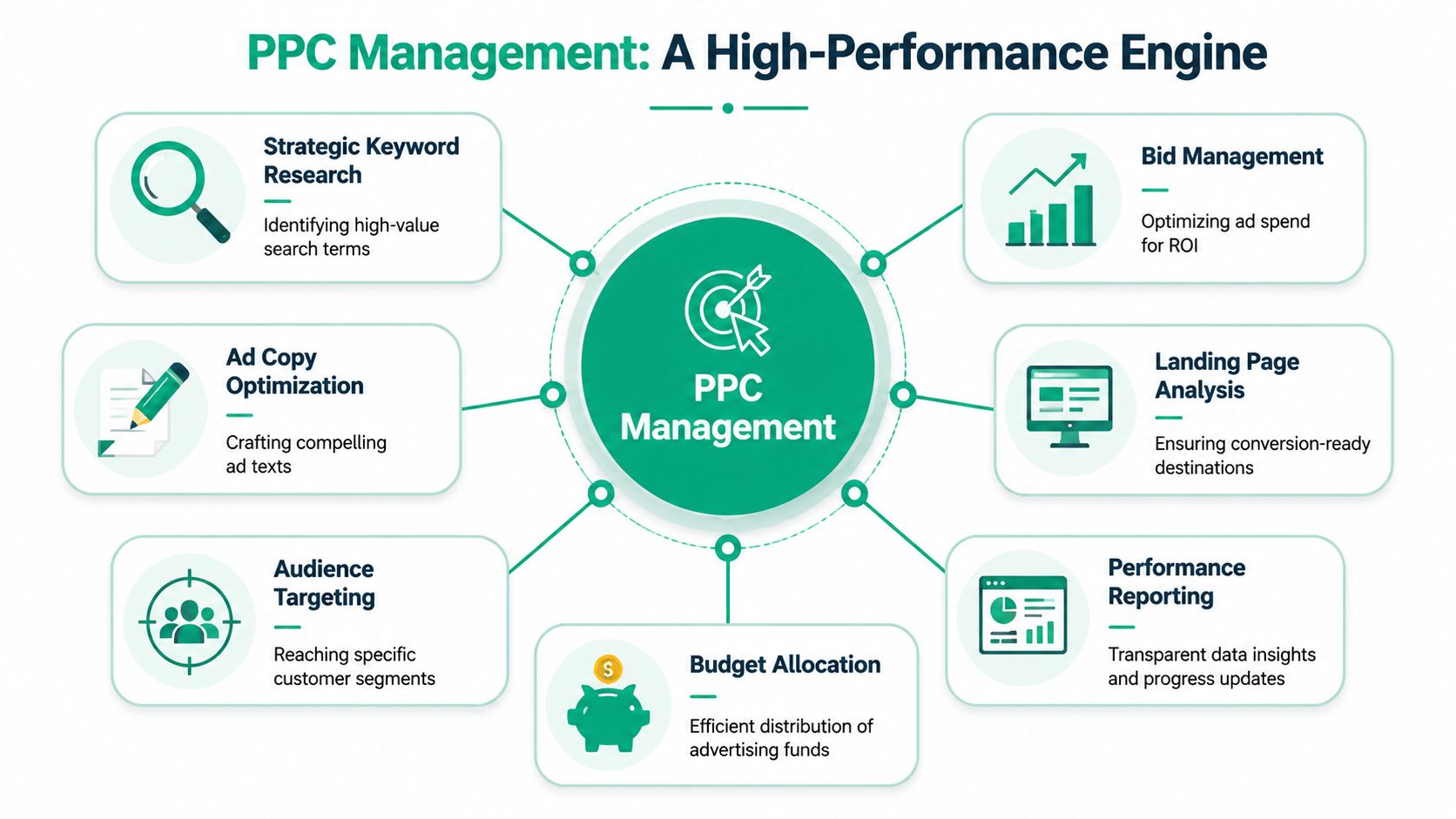
Most business owners think PPC management means writing ads and adjusting bids. That’s too narrow. Real management is a system. Every part affects every other part, and one weak link drags down the rest.
Start with the visual.
The account structure has to match buyer intent
Strong PPC accounts are built around how customers search. That means separating high-intent terms from research terms, branded queries from non-branded queries, and local searches from broader traffic.
A good manager will handle:
- Keyword research that filters for commercial intent, not vanity traffic
- Campaign structure that keeps unrelated searches from polluting each other
- Negative keywords that block irrelevant clicks
- Audience targeting that narrows reach to likely buyers
If you want examples of how paid campaigns are structured across different industries, review these PPC marketing examples. The patterns matter more than the surface-level creative.
Ad copy and landing pages work as one unit
Your ad doesn’t convert by itself. It earns the click. The landing page has to close the gap between search intent and action.
That’s where many campaigns break. A business bids on a solid keyword, writes a decent ad, then sends traffic to a generic page with weak message match, a clumsy layout, or too much form friction. The keyword gets blamed when the page is the problem.
A useful explanation of that relationship appears in Lengreo’s discussion of PPC agencies in Austin, which notes that effective PPC management pairs ad management with landing-page optimization and that the same keyword can produce very different acquisition costs depending on page factors.
Practical rule: If the ad promises one thing and the landing page delivers something broader, conversion rates drop and your cost per lead goes up.
Here’s the second media asset, and it reinforces the operational side of the work.
Ongoing optimization is the real job
The launch isn’t the work. It starts the work.
A competent PPC manager reviews search term reports, conversion paths, call and form tracking, device performance, ad variations, and budget allocation. That feedback loop decides what gets cut, what gets expanded, and what needs a landing-page fix.
You should expect these operating behaviors:
- Regular search query review so irrelevant traffic gets blocked.
- Ad testing to improve click relevance.
- Page-level analysis so conversion problems aren’t misdiagnosed as traffic problems.
- Reporting that ties spend to outcomes instead of just impressions and clicks.
If someone says they “manage PPC” but can’t explain how the account data changes the landing page, they’re not managing the whole system.
Navigating the Austin PPC Landscape
Austin is not a casual PPC market. It’s active, crowded, and competitive enough that sloppy campaign structure gets punished quickly.
The labor market tells part of the story. ZipRecruiter reported an average yearly pay of $61,817 for PPC management jobs in Austin, TX, as of June 6, 2026, in a metro area of about 2.3 million people with 32,000+ small businesses. That doesn’t prove every agency is sharp, but it does show paid search is a meaningful local specialization. Businesses are hiring for it because the competition is real.
Geo-targeting is not a detail
Many local campaigns fail because the targeting is too broad. Owners think wider reach means more opportunity. In local PPC, wider reach often means more waste.
For Austin businesses, the smarter move is usually query-to-location matching. That means the campaign setup reflects where you sell, serve, or schedule. Localized keywords, location-specific ad copy, and separate ad groups by area make the account more relevant to the searcher and easier to optimize.
A useful summary of this approach appears in The Ad Firm’s Austin PPC agency page, which describes precision targeting, advanced analytics, and ongoing optimization tied to ROI improvement.
That translates into plain operational choices:
- Separate service areas instead of bundling the whole market into one campaign
- Use local-intent keywords rather than broad metro phrases when lead quality matters most
- Tie conversion tracking to calls and form fills so the account optimizes toward real outcomes
Narrower geography usually improves lead quality because you stop paying for traffic outside your practical service area.
Austin-only or broader regional reach
Many businesses make the wrong call in this situation. They hear “more volume” and expand too early.
An Austin-only search campaign makes sense when you need high-intent local leads and your sales process depends on quick close rates, phone calls, or nearby service delivery. A broader regional strategy makes more sense when your delivery model can handle longer travel, remote fulfillment, or a wider sales footprint.
The missing question in a lot of PPC management Austin, TX, content is not whether PPC works. It’s how to choose between a tight local search focus, a broader region, or a mixed channel approach. PPC.co’s Austin page highlights that gap directly.
Use this framework:
| Business situation | Better starting point |
|---|---|
| You serve a defined local radius and need qualified calls | Austin-focused search campaign |
| You can sell across a larger area and have capacity to expand | Broader geographic search buildout |
| Your search volume is narrow or your sales cycle needs repeated touchpoints | Search plus a second channel such as Meta or Microsoft Ads |
Don’t overcomplicate the first decision. If local lead quality matters more than sheer traffic volume, start tighter. Expansion is easier than cleanup.
Decoding PPC Pricing and Budgeting in Austin
The budget question needs a blunt answer. If you don’t have enough spend to collect useful data and absorb testing, you’re not funding a PPC program. You’re buying a short experiment and hoping luck saves it.
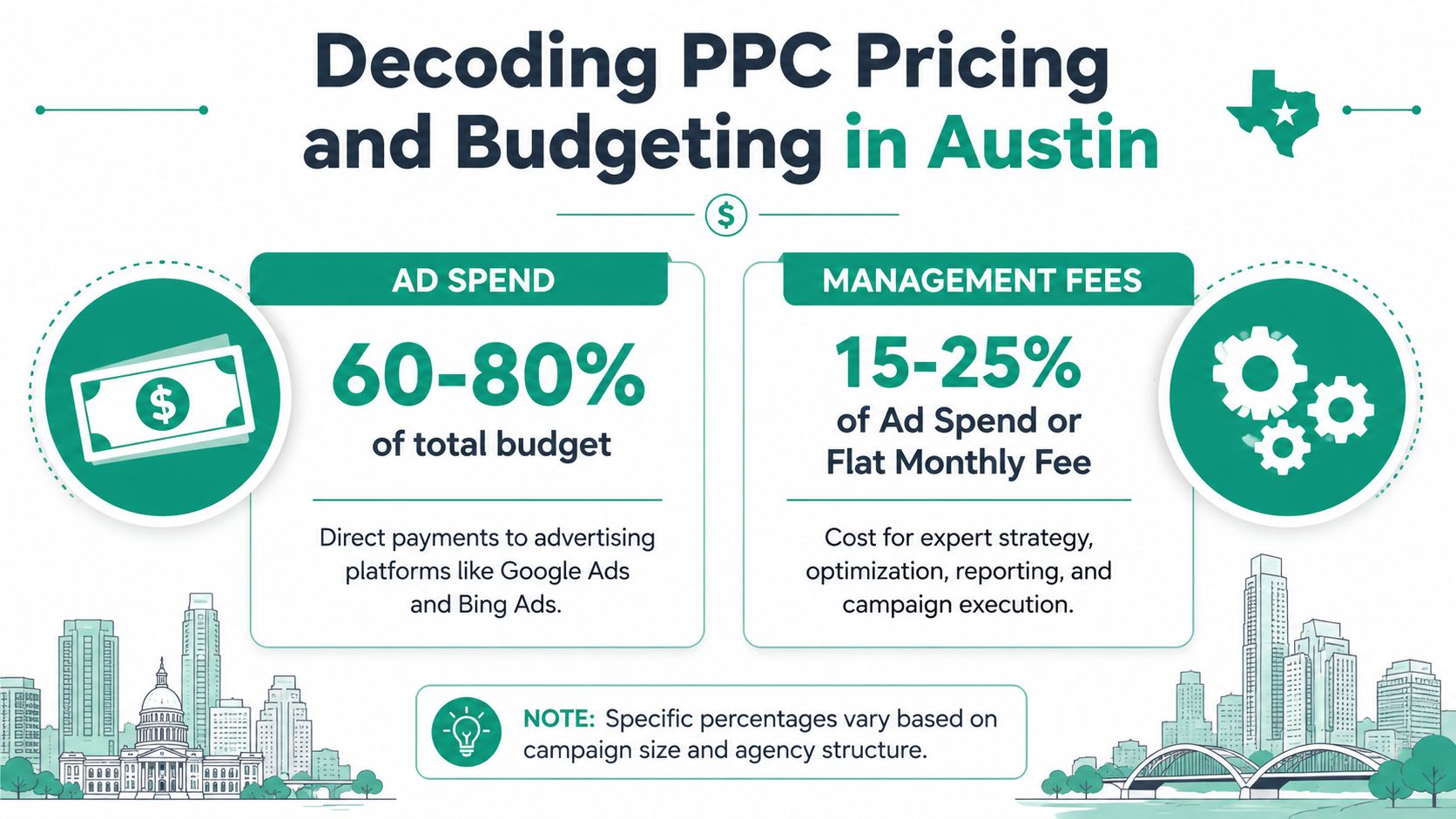
Separate ad spend from management fees
These are two different costs.
Ad spend is the money paid directly to Google or another platform.
Management fees pay for strategy, setup, optimization, testing, tracking, and reporting.
Many owners blur the two and compare proposals badly. A cheaper management fee attached to weak execution can be more expensive than a higher fee attached to disciplined account work.
Common fee models include:
- Percentage of ad spend
- Flat monthly retainer
- Hybrid structure with a base fee plus spend-based pricing
None of those models is automatically right. The core question is whether the scope matches what your account needs.
Austin budgets need room to learn
For market expectations, Level Nine Media reports minimum effective monthly ad spend ranges of $1,500 to $3,000 for service businesses, $3,000 to $10,000 for legal, and $2,000 to $5,000 for e-Commerce in Austin. That same source says campaigns can generate leads within 24 to 48 hours, often take 60 to 90 days to reach peak performance, and a healthy return on ad spend is often 4x to 8x for service businesses.
Those figures should shape your expectations.
A campaign can start producing signals quickly. That does not mean it’s dialed in. Early data shows where friction lives. It doesn’t erase the need for testing, exclusions, ad revisions, and landing-page changes.
Fast lead generation and efficient lead generation are not the same thing.
Budget for a decision window, not a single month
If you judge PPC after a few early clicks, you’ll make bad calls. A better approach is to fund enough time for the campaign to collect data and for the manager to act on it.
Ask yourself three practical questions:
- Can I fund both traffic and management?
- Can I stay in long enough to optimize instead of reacting?
- Do I have a landing page and intake process that can convert paid traffic?
If the answer to the third question is no, fix that before scaling spend. Paid traffic exposes operational weakness fast. It doesn’t hide it.
Choosing Your PPC Partner: In-House Agency or Freelancer
Once you’re ready to invest, the operating model matters almost as much as the strategy. You have three realistic paths: hire someone in-house, work with a freelancer, or partner with an agency.
None is perfect. Each comes with trade-offs in control, depth, speed, and oversight. If you want a broader view of the business trade-offs, this breakdown of in-house marketing vs agency is a useful companion.
The model should fit your business, not your ego
Some owners want an in-house hire because it feels more controllable. Others default to a freelancer because the initial price looks lower. Some choose an agency because they want a full team without building one.
The right answer depends on how much complexity your campaigns have and how much internal marketing infrastructure already exists.
| Factor | In-House Specialist | Freelancer | Agency |
|---|---|---|---|
| Day-to-day access | High. They’re inside the business and close to sales feedback. | Moderate. Access depends on responsiveness and workload. | Structured. Regular communication, but not embedded full time. |
| Breadth of expertise | Limited to one person’s skill set. | Varies a lot by individual. | Broader. Usually includes strategy, copy, design, analytics, and CRO support. |
| Scalability | Slower if campaigns or channels expand. | Can hit capacity quickly. | Easier to scale across campaigns, landing pages, and reporting needs. |
| Management overhead | You manage the employee. | You manage the contractor relationship. | The agency manages its own team and process. |
| Business continuity | Risk if that employee leaves. | Risk if the freelancer disappears or gets overloaded. | Usually more stable because more than one person can support the account. |
| Best fit | Companies with enough volume to support a dedicated role | Smaller accounts with narrow scope | SMBs that need multiple skills without building an internal team |
When each option makes sense
- Choose in-house if paid media is becoming a core internal function and you have enough volume, systems, and leadership attention to support a dedicated specialist.
- Choose a freelancer if your account is fairly simple, your budget is tighter, and you personally know how to evaluate the work being done.
- Choose an agency if you need both management and adjacent support like tracking setup, landing-page coordination, reporting, and strategic direction. That’s where firms such as Ascendly Marketing fit, since they offer Google Ad management and broader digital marketing support as part of a larger service mix.
Don’t pick based on presentation style. Pick based on operating fit.
How to Vet and Select the Right PPC Partner
A polished sales call tells you almost nothing. You need to know how the person or team thinks, how they diagnose problems, and what they’ll do when the first month of data doesn’t go as planned.
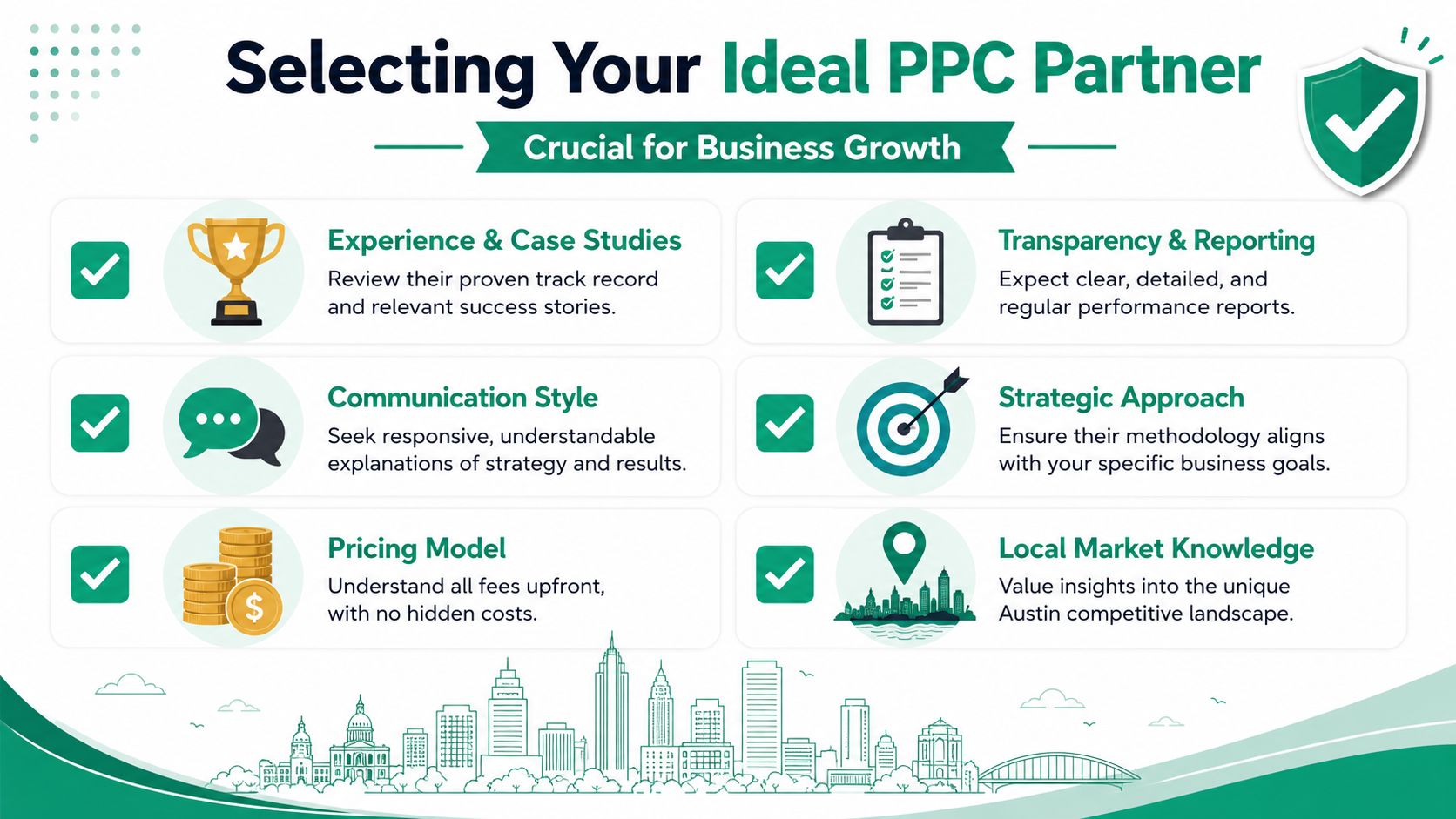
Ask process questions, not vibe questions
Most bad PPC relationships start with soft evaluation. The owner liked the salesperson, liked the deck, liked the confidence, and skipped the hard questions.
Ask these instead:
- How do you structure campaigns around high-intent searches? Listen for specifics about keyword research, segmentation, and exclusions.
- What conversion actions will you track? If they can’t talk clearly about calls, forms, and lead quality, stop there.
- How do you handle landing-page feedback? PPC managers who ignore page performance are only managing part of the funnel.
- What does reporting include? You want performance tied to business outcomes, not vanity metrics.
- How often do you optimize and what usually changes first? Good answers sound operational, not theatrical.
A solid baseline for what management should include appears in The Ad Firm’s Austin PPC overview, which emphasizes keyword research, ad creation, ongoing optimization, detailed reporting, high-intent search campaigns, location assets, and conversion tracking tied to calls or form fills.
Look for red flags in how they answer
You’re not only checking what they say. You’re checking what they avoid.
Watch for these problems:
- They talk about clicks more than qualified leads. That’s a traffic mindset, not a business mindset.
- They can’t explain account structure in plain English. If you can’t understand the logic, you can’t manage the relationship.
- They skip landing pages. That means they’ll blame the platform for conversion issues they didn’t help diagnose.
- They promise certainty. Serious PPC work is structured, measurable, and iterative. It isn’t magic.
- They offer generic reporting. You need to know what happened, why it happened, and what changes next.
The right partner should make the account feel more understandable, not more mysterious.
Use a short selection checklist
Before you sign anything, confirm these points in writing:
- Scope clarity so you know what is and isn’t included
- Ownership of ad account access so you retain visibility
- Reporting cadence with named deliverables
- Conversion tracking plan tied to real lead actions
- Communication rhythm so problems get handled quickly
If a provider resists transparency on any of those points, move on.
Take Control of Your Local Search Presence
If buyers are searching in Austin and your business isn’t showing up where intent is highest, the problem isn’t visibility alone. It’s strategy, structure, and follow-through.
You don’t need more theory. You need a decision. Pick the geography you want to win first. Set a budget that gives the campaign time to learn. Choose a management model that fits your business. Then pressure-test the partner with real questions before any contract gets signed.
Paid search works best when it’s connected to the rest of your local presence. Your ads, landing pages, call handling, and map visibility all need to point in the same direction. If local discovery is part of your growth plan, this guide on how to rank higher on Google Maps is a practical next read.
Waiting won’t make your competitors less visible. It just gives them more time to collect the leads you should’ve been buying.
Ascendly Marketing helps businesses plan and manage PPC campaigns, landing pages, and related digital marketing work with a consultative process focused on strategy, execution, and reporting. If you want a practical conversation about your options for PPC management in Austin, TX, visit Ascendly Marketing.