

You’re probably in one of two spots right now. Either you’ve already run Google Ads for your business, targeted “Chicago,” watched clicks come in, and then wondered why the phone stayed quiet. Or you’re about to launch your first campaign, and you’ve realized that generic local PPC advice doesn’t help much when the market is this crowded.
That’s the core issue with PPC Marketing Chicago. You’re not buying visibility in one clean, uniform city market. You’re bidding inside a dense metro where search intent changes block by block, neighborhood by neighborhood, and often by time of day. The businesses that do well here don’t treat Chicago like a single audience. They build campaigns around micro-markets, track lead quality hard, and cut spend fast when a segment isn’t carrying its weight.
Why Your Current Ads aren’t Working in Chicago
A common setup looks like this. One campaign. A broad Chicago target. Generic keywords. Generic ad copy. A landing page that says the same thing to everyone.
That setup usually produces activity, but not enough business value. You get searches from people with very different needs, levels of urgency, and locations, then send them all to the same message. The account looks busy. The pipeline doesn’t.
Chicago is not one market
Broad city targeting sounds local, but it often hides the differences that decide whether a click becomes a lead. One source on Chicago internet marketing makes the point directly: Chicago PPC is no longer just city targeting. It’s an audience-, intent-, and lifecycle-segmentation problem, with businesses needing tests for ZIP-level performance, search-term decay, and creative variation by local context because broad metro campaigns can hide meaningful differences in cost per qualified lead, according to this Chicago local PPC analysis.
That tracks with what happens inside real accounts. A citywide campaign can blend strong traffic and weak traffic until both look average. The problem isn’t always low volume. It’s blurred intent.
Broad targeting makes weak segments look acceptable for too long.
Generic local advice breaks down fast
Post-2024 platform changes made this harder, not easier. Search campaigns now sit alongside more automation, less clean visibility into some user behavior, and more pressure to feed the platform good conversion signals. If your structure is loose, the system has less context to work with. It starts learning from mixed traffic.
A few patterns show up again and again:
- Broad geography: Downtown demand gets mixed with outer-neighborhood demand and nearby non-core areas.
- Flat messaging: Every ad sounds interchangeable, so the searcher has no reason to trust your relevance.
- Weak conversion setup: Clicks are counted. Calls, form quality, and lead source details are not.
- Budget dilution: Too many keyword themes compete inside one campaign, so spend leaks into lower-intent searches.
What works better
A Chicago account needs tighter segmentation from day one. That means splitting by local intent, not just by service category. A home service business, for example, shouldn’t lump “emergency,” “scheduled estimate,” and “brand comparison” traffic into one ad group. A B2B company shouldn’t run the same offer to every part of the metro and assume demand behaves the same way.
Practical rule: If one campaign serves different neighborhoods, different urgency levels, and different landing page messages, it’s already too broad.
The fix isn’t more ads. It’s a better map.
Building Your Chicago Keyword and Targeting Map
The fastest way to waste budget in PPC Marketing in Chicago is to start with tools before you’ve decided how local intent shows up for your business. Build the map first. Then build the account.
Start with micro-markets, not the full city
A strong Chicago PPC structure starts with hyper-local segmentation by neighborhood or ZIP code, then aligns ad copy, landing pages, and bid modifiers to each micro-market. It also means separating campaigns by intent cluster, such as service plus neighborhood or emergency plus neighborhood, and then shifting budget toward the neighborhoods and keywords producing the best ROI, as described in this guide to structuring Chicago local PPC campaigns.
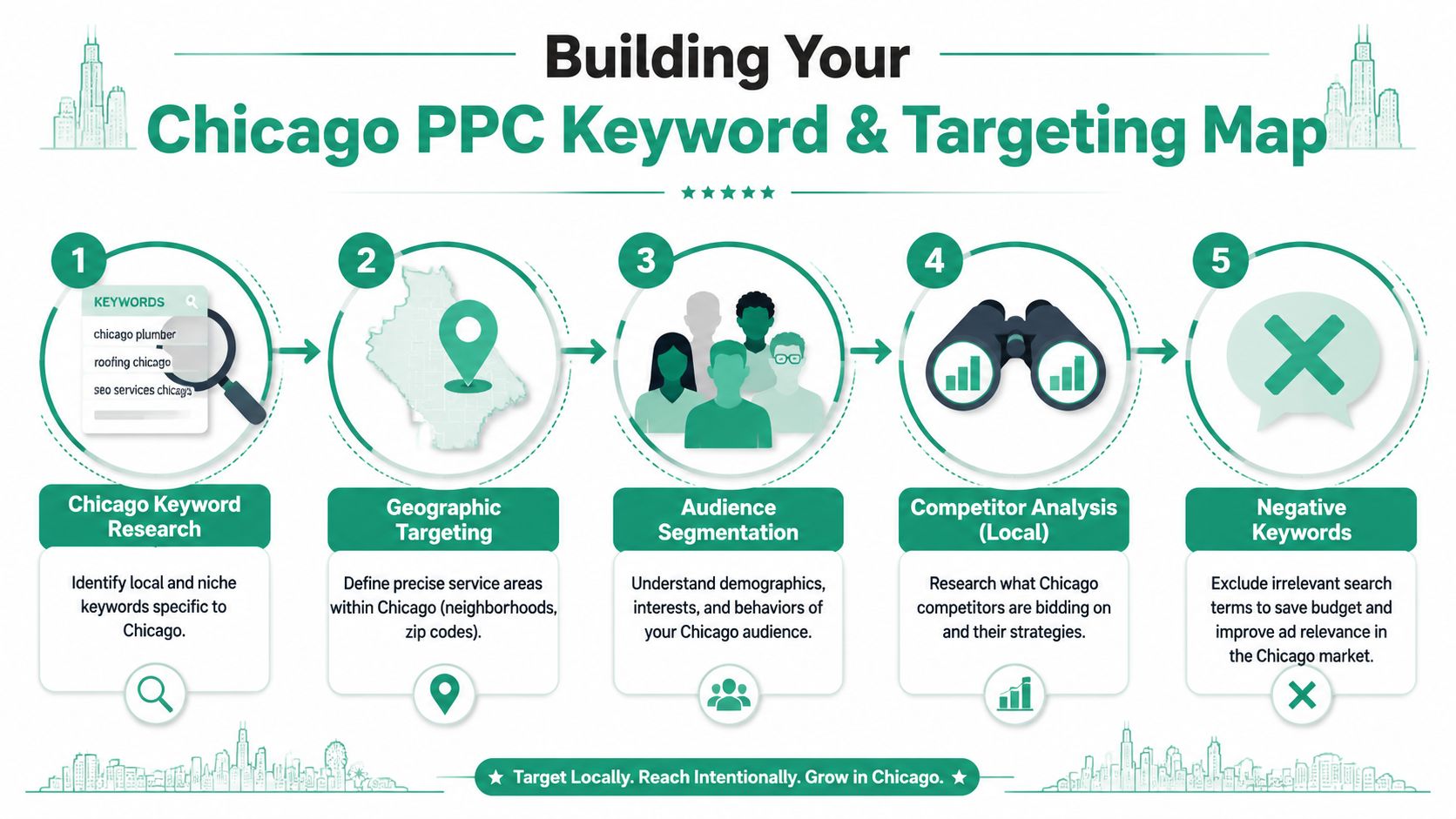
That gives you a cleaner starting point than “all of Chicago.” You’re defining where demand is likely to differ before the platform spends your money finding out the expensive way.
Build keywords in layers
Don’t stop at service terms. Build a local keyword list in layers so the account can match intent with the right message.
Core service terms
Start with what you sell. Plumber, orthodontist, personal injury lawyer, managed IT, commercial cleaning, moving company.Neighborhood modifiers
Add neighborhood names where that reflects how people search or how you want to structure campaigns. Service plus neighborhood usually gives you a better relevance path than a broad city term.Urgency modifiers
Separate emergency, same-day, estimate, consultation, repair, installation, or quote-based searches when those meanings matter to your business.ZIP-based groupings
Use ZIP code segmentation when service coverage, lead value, or customer fit changes by area.Exclusions
Add negative keywords early. If you don’t, broad match and close variants can pull in low-fit traffic before you’ve collected enough data to react.
A simple account map
Here’s a clean way to think about campaign structure.
| Campaign theme | Ad group idea | Landing page focus |
|---|---|---|
| Service + neighborhood | Core service in one local area | Page that names the service and local area |
| Emergency + neighborhood | Urgent searches in one local area | Fast-contact layout, calls prominent |
| Product + neighborhood | Specific offer in one local area | Product page with local trust cues |
| Brand protection | Your business name and variants | High-conversion branded page |
This isn’t about making the account look tidy. It gives you control over search terms, ad copy, budgets, and landing page alignment.
What to watch during research
Some keyword themes sound local but aren’t useful. Others look small and turn out to be highly qualified. That’s why local mapping needs real judgment.
- High-volume terms aren’t always high-value because broad service keywords often carry mixed intent.
- Neighborhood terms can outperform city terms when the searcher wants a nearby provider, and your page matches that expectation.
- One CTA won’t fit every ad group because someone searching for urgent help behaves differently from someone comparing options.
If you want examples of how different paid search messages and landing page pairings work in practice, this roundup of PPC marketing examples is a useful reference point.
Writing Ad Copy that Speaks Chicagoan
Once the targeting map is built, ad copy has one job. Confirm to the searcher that your ad matches what they meant, where they are, and what they need next.
Generic copy fails here. “Trusted service in Chicago” is safe, but safe ads blend into the page.
Before and after ad copy
A weak local ad often sounds like this:
Fast Service Across Chicago. Call Today for a Free Quote.
Nothing in that line tells the searcher that you understand their situation. It could belong to anyone.
A stronger version sounds more grounded in local use cases. For a moving company, that might mean acknowledging the type of move or area-specific friction. For a restaurant, it might mean writing around timing and nearby demand. For a service business, it might mean matching the urgency of the search.

Here’s the shift to make:
- Generic ad: Focuses on your business
- Better ad: Focuses on the searcher’s local situation
A few examples of the difference:
Mover generic: Reliable Chicago Moving Services
Mover improved: Need Help With a Lincoln Park MoveRestaurant generic: Dine With Us Tonight
Restaurant improved: Dinner Spot After the GameHome service generic: Fast Repairs Available
Home service improved: Same-Day Help in Your Area
Those aren’t templates to copy word for word. They show the pattern. Local references work when they sharpen relevance, not when they’re dropped in for decoration.
Match the ad to the click
A Chicago-specific ad only works if the landing page continues the message. If the ad mentions a neighborhood, urgency, or service type, the page should reflect that same angle. Message match is where many local campaigns break.
That same principle shows up in work around optimizing campaign engagement. Higher engagement starts with alignment. The keyword, ad, extension, and landing page need to tell one consistent story.
Use extensions and scheduling with intent
Ad copy isn’t only headlines and descriptions. Extensions and scheduling are part of the selling.
Use sitelinks to separate service paths. Use call extensions if phone calls matter. Use location assets when they support trust. Then look at when searches turn into leads, not just when impressions spike.
A practical schedule review might include:
- Commuter hours: Some businesses see stronger mobile search behavior before work, during lunch, or on the way home
- Weekend shifts: Certain neighborhoods behave differently on weekends than they do on weekdays
- Urgency windows: Emergency services need coverage when intent is highest, not only during office hours
Write ads so the reader feels understood before they click.
Setting Your Budget and Bids for the Windy City
Chicago isn’t a cheap PPC market to learn in. That doesn’t mean every account needs a huge budget. It does mean the underfunded campaigns often fail before the strategy gets a fair test.
What does the market say about the spend?
Single Grain’s 2025 Chicago agency overview reported that PPC management fees in Chicago typically range from $1,000 to $12,000 per month, while most small and medium-sized businesses spend between $2,500 and $7,500 per month for professional management, with enterprise clients spending more for broader programs, according to Single Grain’s Chicago PPC agency overview.
That range matters because it tells you what a serious operating environment looks like. Chicago advertisers aren’t paying only for ad setup. They’re paying for tracking, testing, reporting, search-term review, bid control, and landing page iteration.
Why low budgets struggle
A small test budget can work if the scope is narrow. Trouble starts when businesses combine a limited budget with a broad target, too many keyword groups, and no clear conversion tracking. Then the account can’t collect enough clean signal in any one segment.
A tighter starting model usually works better:
| Budget approach | What happens |
|---|---|
| Broad market, many services, low budget | Data stays thin across too many themes |
| Narrow geography, few high-intent clusters | Faster learning on qualified traffic |
| Mixed campaign goals in one budget | Stronger segments subsidize weaker ones |
| Separate budgets by intent | Easier to see where leads actually come from |
Manual control versus automation
Bidding strategy should match the maturity of the account.
Manual-style control, or tighter campaign-level control, makes sense early when you’re still validating local segments. If one neighborhood or one intent cluster has a much higher lead value, you may want closer oversight before handing too much to automation.
Automated bidding becomes more useful when:
- Conversion tracking is clean
- Lead quality is consistent enough to trust the signals
- Campaign segmentation is already in good shape
- You’ve stopped blending unrelated traffic
If the account is messy, automation learns from messy inputs. That’s the trade-off.
A realistic first move
Start narrower than you think. Pick the service lines with the clearest commercial intent. Limit geography to the areas you can serve well. Build enough budget into that test to collect usable lead data, then expand based on results.
That’s a better way to buy information than launching citywide and hoping the algorithm sorts it out.
Measuring Performance and Optimizing for Leads
Clicks can tell you whether people noticed the ad. They can’t tell you whether the campaign is producing business.
That’s why traffic-first reporting causes so many bad decisions in PPC Marketing Chicago. A keyword can look healthy in the interface and still produce weak calls, poor-fit forms, or leads from areas you don’t want.
Track the full lead path
A technical success framework for Chicago PPC is to implement call tracking, form-submission tracking, and Google Analytics event attribution so every lead can be tied to a keyword, ad group, and neighborhood segment, and optimization usually requires 30 to 60 days of testing and refinement before efficiency stabilizes, according to this Chicago PPC measurement guide.

That setup changes the conversation inside the account. Instead of asking, “Which campaign gets the most clicks?” you ask, “Which keyword and neighborhood combination creates the right kind of lead at an acceptable cost?”
The metrics that deserve attention
You still need standard PPC metrics, but they only matter in relation to lead outcomes.
- CTR: Useful for spotting ad relevance issues
- CPC: Helpful for understanding cost pressure
- Conversion rate: Better than clicks, but still incomplete if lead quality varies
- Cost per lead: More meaningful for budget decisions
- Customer acquisition cost: Stronger for businesses with sales follow-up
- ROAS: Useful when revenue tracking is available and reliable
A higher click-through rate with weak lead quality is not progress. Lower CPC with lower-fit traffic is not savings.
Field note: If you can’t trace a lead back to a keyword and local segment, you can’t optimize with confidence.
What to do in the first optimization window
The first month or two shouldn’t be treated as a final judgment. It’s the period where you remove friction and trim waste.
A practical review cadence looks like this:
Search term review
Cut irrelevant traffic fast. Expand negatives. Split emerging themes when they deserve their own ad groups.Ad and landing page match check
Compare top-spending terms against the pages they land on. A weak match usually shows up before the account says it plainly.Segment performance review
Look at lead quality by keyword theme, device behavior, and local segment. Don’t let blended reporting hide poor pockets of traffic.Lead handling check
Confirm that calls are answered, forms route properly, and follow-up happens. Campaigns are often blamed for sales process failures.
If your team needs cleaner reporting from ad platforms into sales conversations, tools used for pipeline visibility, such as Twizzlo, can help organize what happens after the lead comes in. And if you want a practical framework for tightening account performance over time, these PPC optimization tips for small business success are worth reviewing alongside your own account data.
Deciding Between DIY and Hiring a Chicago PPC Agency
At some point, the decision stops being philosophical. It becomes operational. Do you have the time, tracking discipline, and judgment to manage this account properly, or would a specialist team do it better?

When DIY still makes sense
DIY is reasonable when your scope is narrow, your offer is simple, and someone on your team can review the account consistently. That usually means one or two service lines, one clear conversion path, and enough internal discipline to manage search terms, ad testing, and lead tracking every week.
DIY also works better when your business can tolerate a learning period without overreacting to early noise.
When outside help becomes the smarter move
Once the account grows, the management burden changes. More geographies, more intent clusters, more landing pages, and more lead routing usually push the work beyond casual oversight.
By 2026, Clutch’s Chicago PPC directory was already profiling agencies such as Black Propeller, Galactic Fed, and Marcel Digital, with about 95% of reviewers giving Marcel Digital positive feedback for strategic expertise, communication, and on-time delivery. Semrush’s 2026 list identified 17 Chicago PPC agencies, with some starting from $1,000 in monthly management fees, according to Clutch’s Chicago PPC directory.
That signals a mature agency market. You aren’t forced into trial-and-error with a random freelancer if your account has become too complex to run in-house.
Questions worth asking an agency
Most agency pitches sound polished. The useful questions are operational.
Ask things like:
- How do you structure Chicago campaigns by neighborhood, ZIP, or intent cluster?
- What conversion actions do you track beyond form fills?
- How do you report lead quality, not just lead volume?
- How often do you review search terms and negatives?
- When do you keep tighter manual control versus lean into automation?
If you’re weighing whether to keep management in-house or pass it to a partner, this comparison of in-house marketing vs agency lays out the trade-offs clearly.
A related decision comes up when PPC is tied closely to outbound follow-up and qualification. In those cases, businesses sometimes also review whether to outsource lead generation so ad spend and lead handling don’t operate as separate systems.
Here’s a useful walkthrough before you make the call:
A simple decision test
Use this quick comparison:
| Situation | Better fit |
|---|---|
| Small account, narrow service focus, internal time available | DIY |
| Weak tracking, unclear lead attribution, frequent budget waste | Agency help |
| Multiple local segments and landing page paths | Agency help |
| Owner is managing ads between other responsibilities | Usually agency help |
One more practical point. If you do hire, don't buy vague “more traffic” language. Buy process. That means account structure, conversion tracking, reporting clarity, and a plan for pruning low-quality segments. Ascendly Marketing is one option in that category. It offers PPC advertising and Google Ad management services for businesses that want outside support without building a full in-house paid media function.
If you want a second set of eyes on your account, Ascendly Marketing can review your PPC setup, tracking, and local targeting strategy, then help you decide whether to tighten what you have or rebuild it into a cleaner Chicago campaign structure.