

SEO lead generation is the process of attracting people who are searching for the products or services you offer. Instead of using advertisements, you create and optimize your website to appear when a potential customer uses a search engine to find a solution. This turns organic search traffic into a flow of leads for your business.
Why SEO Lead Generation Is a Primary Investment
Businesses often weigh paying for immediate traffic now versus pursuing a long-term SEO strategy. An effective SEO strategy is not just a future plan; it is an investment that builds a cost-effective system for attracting customers.
When you stop paying for ads, your online visibility ceases. With SEO, every piece of content published and every link earned becomes a part of your digital assets. Your website functions as a continuous salesperson, connecting with prospects at their moment of need. You are not interrupting their day; you are providing the solution they are actively seeking. This shift from interruption to intent is a significant change.
The Economics of SEO
The data supports the case for SEO. It is not about "free" traffic—it is about return on investment and securing leads who are more likely to make a purchase.
Data shows that a lead from SEO costs around $647 to acquire and delivers a 748% return on investment over three years. Compare this to PPC ads, which have a cost per lead of $802 and a 36% ROI. Other tactics like webinars ($603 per lead, 430% ROI) and email marketing ($510 per lead, 261% ROI) do not match SEO's long-term financial performance. You can review more of these lead generation trends and findings on Prospeo.io.
Leads from search cost less and have higher closure rates. SEO leads have an average close rate of 14.6%. This surpasses traditional outbound marketing, which has a 1.7% close rate.
This information explains why focusing on seo lead generation is a sound financial decision for a business. The capital invested works more effectively and continues to provide returns long after the initial expenditure.
Comparing Channel Performance
A direct comparison illustrates the performance of different marketing channels. While some provide speed, others deliver more value and efficiency over time.
Here is a breakdown of how major digital channels compare in cost, return, and lead quality.
Digital Marketing Channel Performance Comparison
| Channel | Cost Per Lead | 3-Year ROI | Lead Close Rate |
|---|---|---|---|
| SEO | $647 | 748% | 14.6% |
| Webinars | $603 | 430% | Varies |
| Email Marketing | $510 | 261% | Varies |
| PPC/SEM | $802 | 36% | Varies |
| Outbound | Varies | Varies | 1.7% |
The table indicates that SEO delivers a combination of high ROI and high-quality leads that are prepared to convert.
This chart further highlights the performance gap between SEO and other common tactics.
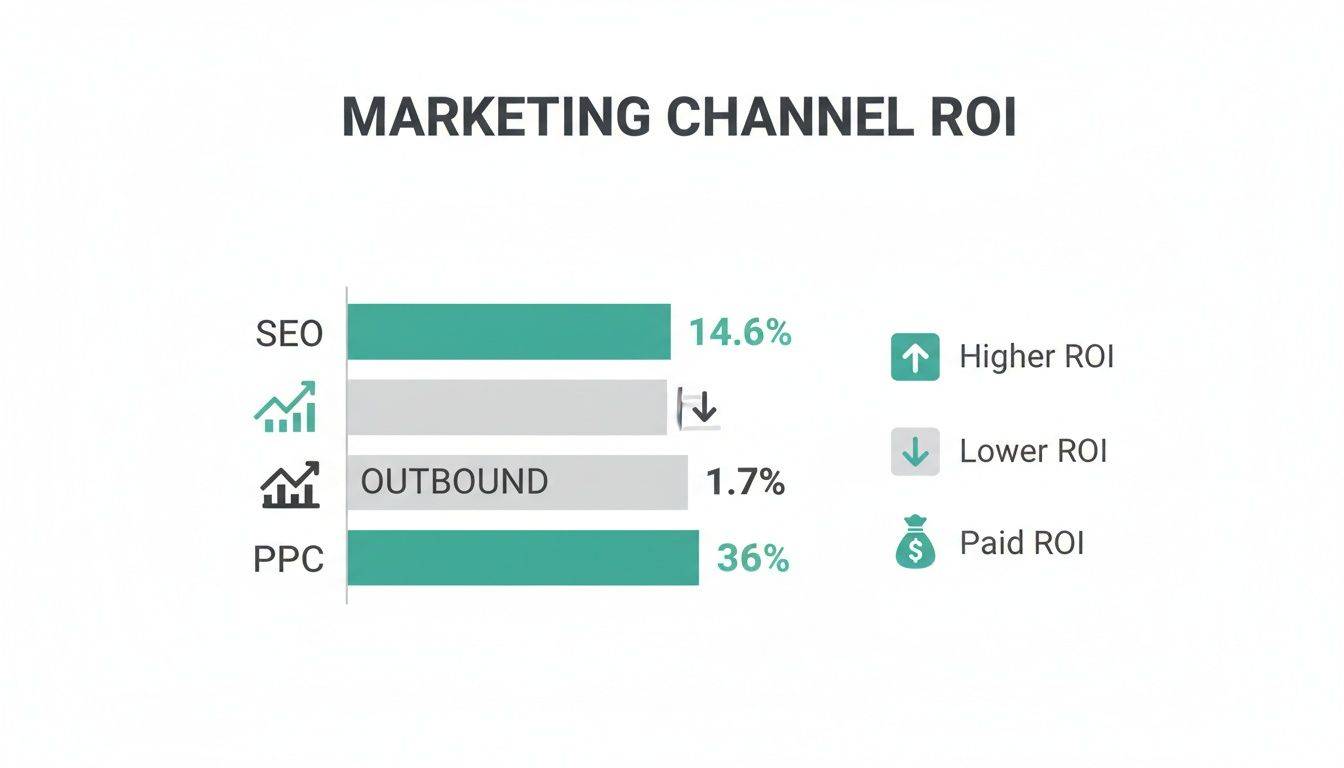
You can observe SEO's 14.6% close rate compared to the 1.7% from outbound efforts. The goal is to obtain the right leads, not just more of them.
Building a Sustainable Growth Engine
An effective SEO strategy is about more than rankings and traffic statistics. It is about building a predictable, scalable system that consistently brings in new business.
Every blog post, service page, and technical adjustment contributes to a digital asset that grows over time. This asset works for you continuously, whether you are a local plumber targeting a neighborhood or a B2B software company pursuing enterprise clients.
The objective is always to connect with people when they need you and show them you have the answer. This is why organic SEO services are essential for sustainable online growth. It is how you transform your website from a static brochure into a powerful sales tool.
Understanding Your Customer's Mindset
SEO for lead generation is not a numbers game; it is a people-focused activity. Many businesses concentrate on traffic statistics and forget that behind every search query is a person with a problem they want to solve.
Before you use a keyword tool or write any copy, you must understand their perspective. Success comes from targeting the right audience, not from casting the widest net. This requires knowing exactly who you are addressing and what they are truly asking for.
From Vague Demographics to Actionable Personas
Avoid surface-level details. "Small business owners" is not a target audience; it is a broad category. You need to develop customer personas with enough detail that they feel like real individuals. This clarity is necessary whether you are selling enterprise software to CTOs or fixing leaky pipes for homeowners. If you are starting from the beginning, it is beneficial to learn how to find your target audience first.
A useful persona is a story, not just a collection of facts. We are not targeting "e-commerce managers." We are targeting "Sarah, the 42-year-old founder of a boutique home goods store. She is overwhelmed, using multiple spreadsheets for inventory, and concerned about overselling her products during the holiday season."
This level of detail makes you consider what truly matters:
- Her Pains: What are her main concerns? The fear of overselling a popular vase, losing money on unsold stock, and spending hours on manual data entry instead of marketing.
- Her Goals: What does success look like for her? She wants to see her profit margins increase and reclaim her weekends.
- Her Language: How does she describe her problem? She is not searching for "enterprise resource planning systems." She is searching for "how to sync Shopify inventory with my warehouse" or "inventory software for small boutique."
Do you see the difference? This is how you shift from pursuing vanity metrics to building a real seo lead generation engine. You start using your customer's language. If you need a structure for this process, our guide on building a content marketing plan template can be helpful.
The Four Types of Search Intent
Every time someone types into Google, they have a purpose. This is "search intent"—the reason behind the search. Matching your content to that intent is a requirement. Attempting to sell something to a person who only wants to learn is ineffective.
Search intent can be divided into four main categories.
Informational: They want answers. Examples include "what is SaaS" or "how to fix a dripping faucet." These are top-of-funnel users at the start of their research.
Navigational: They know their destination and are using Google to get there. Searches like "Facebook login" or "Ascendly Marketing blog" are examples.
Commercial Investigation: The user is comparing options. They use searches like "best CRM for small business" or "Mailchimp vs Constant Contact." This intent is valuable for lead generation.
Transactional: They are ready to act. These are high-value, bottom-of-the-funnel searches like "emergency plumber near me" or "buy Asics running shoes online."
You cannot rank a sales-oriented service page for an informational keyword, nor can you expect a 3,000-word blog post to convert someone who is ready to buy immediately. You must meet them at their current stage.
By determining who your audience is and what they are looking for, you build a keyword strategy that attracts future customers. You create a path that intercepts them at the right moment and leads them to your business.
Building a Content Engine That Converts

You now know who you are talking to and what they are searching for. This is the starting point, but quality content is how you win. It fuels your entire SEO lead generation machine. Without it, a technically sound website is as useful as a silent stage with no performers.
Not all content is created equal. Some companies produce articles that attract thousands of visitors who never convert, while others publish a few pieces that become lead-generating assets. The approach is to build a content engine—a strategic ecosystem where every piece has a specific job.
This is not about random efforts; it is about methodically building a network of content that establishes your authority and guides searchers to your contact form.
The Pillar and Cluster Model in Action
A tested strategy for organizing content is the pillar and cluster model. It is a way to demonstrate to Google that you are an authority on a topic while targeting numerous related keywords. For SEO lead generation, it is a powerful tool.
Here is how it works:
- Your Pillar Page: This is a comprehensive guide on a broad topic central to what you sell. If you are a B2B SaaS company with inventory management software, your pillar could be "The Ultimate Guide to E-commerce Inventory Management." It is your main work on the subject.
- Your Cluster Content: These are smaller, focused articles that branch off the main pillar. They address specific subtopics mentioned in your guide. For the SaaS example, cluster posts might include "How to Calculate Safety Stock," "5 Signs You've Outgrown Spreadsheets for Inventory," or "Barcode vs. RFID Systems: Which Is Right for You?"
Each cluster post links back to the main pillar page, creating a network of internal links. This signals to search engines that you have extensive knowledge of the topic. That perceived expertise helps you rank for high-value, lead-generating keywords.
Crafting Content That Converts Traffic
With the structure in place, the content itself must perform. This means matching what the searcher wants and providing a clear, logical next step.
To do this correctly, your site needs a mix of content types that meet people at various stages of their buying journey.
- High-Intent Service Pages: These are your primary sales pages, targeting people ready to buy. Consider keywords like "roof repair Houston" or "B2B lead generation agency." These pages must be focused, addressing the user's main pain points and featuring a clear call-to-action throughout. Make it simple for them to contact you.
- Detailed Case Studies: Demonstrating your work builds trust. A well-constructed case study outlines a client's problem, your solution, and the results. "How We Increased Client X's Qualified Leads by 150%" is more compelling than simply stating your competence.
- Expert Blog Posts: This is for the long term. These articles answer the questions and solve the problems your audience has before they know they need you. You become their go-to resource, building credibility that pays off later.
A relevant statistic to consider: companies that publish 16 to 20 blog posts monthly generate over 3 times more leads than those that post infrequently. This reflects the cumulative power of a consistent content rhythm.
It is evidence that content marketing is a long-term effort where momentum builds over time. For more on this, explore the full lead generation statistics on seoprofy.com.
The Art of the Irresistible Lead Magnet
A lead magnet is the exchange that turns an anonymous visitor into a tangible lead. It is the valuable item you offer for their name and email. For it to be effective, the offer must feel like a significant value.
Here are a few lead magnet ideas that generally work:
- In-Depth Ebooks: Offer a detailed examination of an industry problem, filled with original data and practical advice.
- Webinar Recordings: Gate a valuable recording with an industry expert behind a form. It is an immediate authority builder.
- Checklists & Templates: Provide a practical tool they can use immediately. An "On-Page SEO Audit Checklist" or a "Content Calendar Template" is highly valuable.
The key is to make the lead magnet the obvious next step. If someone has just read your article on calculating safety stock, offering a free "Inventory Calculation Spreadsheet" is a logical offer. Fine-tuning these offers is a large part of the process, and you can learn more about how to improve website conversions in our detailed guide.
Optimizing Every Page for Clicks and Conversions
Getting traffic is a good start, but it is a vanity metric. A high number of visitors does not generate revenue. The objective of SEO lead generation is to turn anonymous clicks into interested prospects ready to engage.
Many businesses create excellent content but fail at the final stage. They overlook the small but significant technical and user experience details that persuade a visitor to become a lead.
Let's address this. We will start with the required technical aspects that prevent visitors from leaving, then move to the persuasive elements that guide them to your contact form.
Laying the Technical Foundation
Before anyone reads your headline, your website's performance creates a first impression. This is not just about search engine algorithms; it is about user psychology. A slow or poorly designed site undermines your lead generation efforts before a visitor can see your offer.
There are three technical areas you must address:
- Site Speed: A slow site is detrimental to lead generation. If a page takes even a few seconds to load, a potential lead is lost. Optimize your images, set up browser caching, and minify your code. Every millisecond saved helps keep someone engaged.
- Mobile Experience: This is a requirement. The majority of traffic is mobile. Your site must be designed for a thumb, not just a smaller screen. This includes large, tappable buttons, readable text without zooming, and forms that are easy to complete.
- Structured Data (Schema): This is a useful tool in search results. Schema is code that informs search engines about your page's content. In return, they can provide "rich results" like star ratings, event times, or FAQ dropdowns directly on the search page. These attract attention, increase your click-through rate, and bring in more qualified traffic.
A seamless user experience is the foundation of conversion. When a site is fast, easy to navigate on any device, and presents information clearly, you remove friction and build the subconscious trust needed for a user to provide their contact details.
Think of it this way: a fast, mobile-friendly site is a clean, well-lit storefront with an open door. It is inviting. A slow, buggy site is a shop with a sticky door and flickering lights. Most people will not try to enter.
Turning Visitors into Leads (CRO)
Once your technical foundation is solid, you can focus on optimization. This is where Conversion Rate Optimization (CRO) comes in—the science and art of systematically improving your site to get more people to take action.
It is a combination of psychology, smart design, and persuasive writing. Your objective is simple: make filling out your form feel like the most obvious, natural next step for your visitor. Let's review the key elements you can adjust.
Crafting Headlines and CTAs That Work
Your headline has about three seconds to confirm to the visitor that they are in the right place and persuade them to continue reading. It needs to connect directly to their problem or goal.
A generic headline like "Our Services" is ineffective. Something like, "Get a Storm-Proof Roof That Protects Your Home for Decades" speaks their language.
After a strong headline, your Call-to-Action (CTA) must finalize the action. Weak, generic buttons like "Submit" or "Learn More" do not inspire action. You need to use benefit-driven language that tells them exactly what they will receive.
- "Get My Free Roofing Quote"
- "Download Your SEO Checklist Now"
- "Book a 15-Minute Strategy Call"
Do you see the difference? The value is clear. You are not asking them to submit; you are offering them something they want.
A Quick Landing Page Audit
To put this into practice, run your important pages—your service pages and lead magnet landing pages—through this simple audit.
- Headline Impact: Does your main headline instantly connect with the visitor's problem and match what they just searched for?
- The "Above-the-Fold" Test: Is a compelling CTA button visible without scrolling? This is prime digital real estate.
- Skimmability: Is the page easy to read? Use short paragraphs, bold text, and bullet points so people can scan for key information.
- Credibility Boosters: Where is the proof? Add testimonials, reviews, case study snippets, or client logos to show your credibility.
- Form Friction: Look at your contact form. Are you asking for too much information? Every extra field will lower your conversion rate. Ask only for what you need to start a conversation.
- The Thumb Test: Pull up the page on your phone. Can you easily navigate, read, and fill out the form using only one hand?
By systematically addressing these technical and on-page elements, you create an efficient system. You will have a website that not only attracts visitors but also converts that traffic into high-quality leads for your business.
Local vs. B2B SEO: Different Plays for Different Fields
There is no single "SEO for leads" approach. The strategy changes based on who you are selling to. A roofer trying to get calls from homeowners in a 15-mile radius faces different challenges than a software company trying to schedule a demo with a Fortune 500 CTO.
Both use SEO, but they operate in different contexts. One is a local game focused on immediate needs, while the other is a long-term strategy built on establishing deep authority.
The Local Business Playbook: Owning Your Service Area
If you operate a local business, proximity is everything. You succeed by appearing when someone searches for "emergency plumber near me" or "AC repair in Phoenix." This is the world of Local SEO, and it is about capturing customers who need you now and are nearby.
Your command center for this is your Google Business Profile (GBP). This is not just another listing. It is your digital billboard, storefront, and first impression, all located at the top of Google search results.
- Complete Your Profile: Fill out every field. This includes services, hours, photos, Q&As, and a business description with the terms people use to find you.
- Gather Reviews: Make it a habit to ask every satisfied customer for a review. A steady stream of 4- and 5-star reviews is a strong trust signal for both Google and new clients.
- Use Google Posts: Are you running a special? Just finished a project? Post an update. It keeps your profile looking current and active.
Once your GBP is optimized, build a consistent presence across the web. This means listing your business Name, Address, and Phone number (NAP) identically on every relevant directory—like Yelp, Angi, and industry-specific sites. These local citations act as votes of confidence that prove to Google you are a legitimate local business.
Finally, create specific pages for each service in each key location you serve. A page for "Tankless Water Heater Installation in Scottsdale" will outperform a generic page when someone searches for that exact term. Mention local landmarks and specific neighborhoods to show you are part of the community.
The B2B Playbook: Securing High-Value Corporate Deals
B2B is different. You are not pursuing an impulse decision; you are navigating a long sales cycle with a committee of decision-makers and high-value contracts. Your SEO strategy must shift from proximity to authority.
Your mission is to become the recognized expert in your niche. You achieve this by creating industry-specific content that solves the complex problems your target accounts face.
In the B2B world, your content is your top salesperson. It works 24/7, does not require a commission, and must be sophisticated enough to answer the tough questions a CFO or Director of Engineering might ask. Simple blog posts are not sufficient.
This is where your SEO efforts align with Account-Based Marketing (ABM). You can use SEO to identify individuals from your target client list who are actively researching solutions. For example, you create a detailed whitepaper on "A CISO's Guide to Cloud Security Posture Management." When someone from "Global Tech Inc." downloads it, your sales team receives an alert. This is no longer a cold call; it is a warm introduction.
Your content should be designed for this type of targeted outreach:
- In-depth Whitepapers & Ebooks: These are your premium lead magnets. Gate them behind a form to capture contact information from people who are serious about finding a solution.
- Data-Packed Case Studies: Proof is a powerful sales tool. A detailed case study showing how you delivered a 250% ROI for a similar company is your most effective weapon. Show your work.
- Authoritative Blog Posts: Get technical and strategic. Avoid simple listicles and write articles like "A Scalable Framework for Migrating Legacy Systems to Microservices."
Then, amplify this content where your prospects are active: LinkedIn. Sharing your expert guides and case studies on LinkedIn allows you to target decision-makers by job title, company size, and industry, driving hyper-relevant traffic to your lead capture forms. This combination of expert content and targeted distribution is how you fill a B2B sales pipeline with valuable leads.
Let's discuss how to prove your SEO efforts are generating revenue. All the keyword research and content creation is meaningless if you cannot connect it to the bottom line.
You are not just seeking acknowledgment for "good SEO." You are here to turn your search traffic into a predictable source of qualified leads and revenue. This is how you transition from being a "marketing expense" to an integral part of the company's growth strategy.