

SEO is a system for marketing. The goal is to attract people who are already looking for your services. Correctly applied SEO makes a small business a visible option for potential customers.
Why SEO Is Your Digital Growth Engine
The internet contains a vast number of websites. Without SEO, a website may have low visibility in search results. SEO aims to position a website in a prominent location within search engine results pages.
Every day, potential customers use Google to search for products and services. SEO services for small businesses focus on making a website a relevant result for search engines.
Connecting With Customers Who Are Ready to Buy
SEO attracts visitors who have a problem and are actively searching for a solution. This approach connects businesses with people who have demonstrated intent.
Instead of interrupting users with advertisements, you appear as a solution when they are searching. Leads from SEO can have a higher conversion rate because the user’s intent to purchase is often pre-existing.
The Numbers Behind the Opportunity
Data indicates the role of search engines in online experiences. Research suggests that by 2026, 68% of all online experiences will start with a search engine. Google processes over 3.5 billion searches daily, with an estimated 46% of them having local intent. This indicates that customers, whether for local services, e-commerce, or B2B firms, use Google.
Furthermore, 91% of marketers report a positive return on their SEO investment. For more details, you can review SEO statistics on searchlogistics.com.
An SEO strategy can produce several effects:
- Increases Visibility: It places your brand where people are looking when they are ready to make a purchase.
- Builds Credibility and Trust: Appearing on the first page of Google can increase user trust. Users may perceive top-ranking sites as more credible.
- Drives Qualified Traffic: You receive clicks from individuals who have shown interest in your offerings.
- Provides a Lasting Return: The authority and rankings built with SEO can provide benefits over time, unlike paid ads that stop when payment ceases.
SEO is a system designed to generate a stream of customers, which transforms a website from a passive online brochure into an active asset.
The Five Pillars Of A Winning SEO Strategy
Search engine optimization involves multiple concurrent activities. An effective SEO strategy is built upon five core pillars.
Focusing on these five areas helps build a system that generates website visitors, leads, and sales.
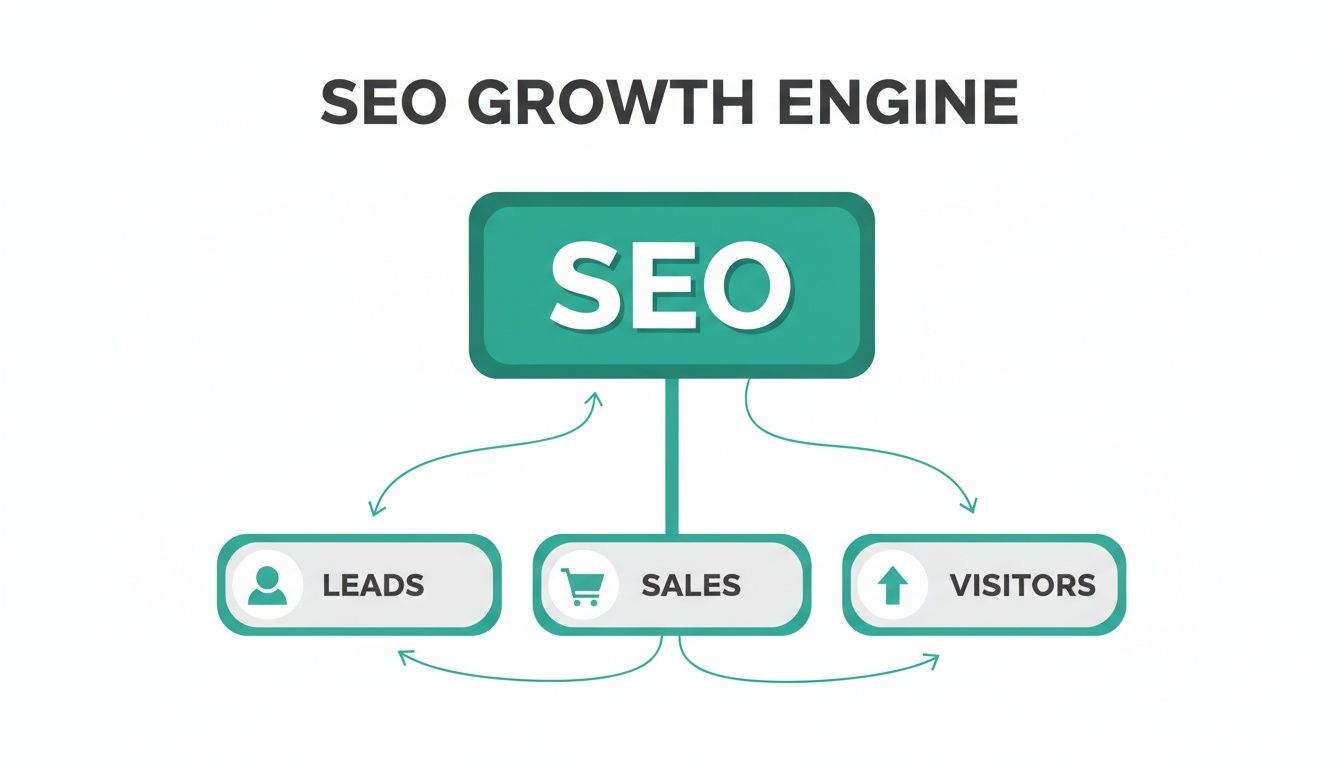
The objective of SEO is to convert clicks into revenue. Each of the following pillars contributes to this process.
Pillar 1: Technical SEO — The Foundation
Before addressing keywords or content, you must ensure search engines can find and understand your website. This is Technical SEO. It is the underlying structure of your online presence.
A website without solid technical SEO will have difficulty ranking. The primary tasks include:
- Improving Site Speed: A slow website can deter users. This involves optimizing images and code to ensure the site loads quickly. A fast site provides a better user experience and is favored by Google.
- Ensuring Mobile-Friendliness: A significant portion of internet traffic comes from smartphones. The website must display and function correctly on small screens.
- Building a Logical Site Map: A well-organized site is easier for search engine bots to crawl and for users to navigate.
Without a solid technical foundation, other SEO efforts may be less effective. Professional seo services for small businesses often begin with a technical audit.
Pillar 2: On-Page SEO — The Interior Design
Once the foundation is secure, the next step is to optimize individual pages. On-Page SEO involves making each page on your site clear, helpful, and optimized to inform search engines and users about its content.
This is where you focus on page-specific details like the title, headlines, and on-screen text to match a search query.
On-Page SEO is the process of communicating to search engines that a specific page is a relevant answer for a user’s search for a product or service.
You are organizing the content on each page to be inviting, easy to understand, and aligned with visitor expectations.
Pillar 3: Content Marketing — The Stuff People Actually Want
The content on your website is what attracts visitors. Content Marketing is the creation of valuable, interesting, and helpful information that makes your site a destination.
This involves creating blog posts, how-to guides, videos, and checklists that address customer problems and answer their questions. High-quality content serves two functions:
- It attracts your target audience by providing answers they are searching for.
- It demonstrates your expertise, which builds trust and establishes you as a resource in your field.
Consistent creation of high-quality content can change a business’s perception from a simple vendor to a trusted resource, which can help convert browsers into buyers.
Pillar 4: Local SEO — Your Digital Storefront
For any business with a physical location or a defined service area, Local SEO is a required component. This is how you appear in “near me” searches. It functions as your digital sign on a local main street.
This pillar is about establishing a presence in your geographic area. The priorities are:
- Optimizing your Google Business Profile: This is your primary asset on Google Maps and in local search results. It must be complete and accurate.
- Building Local Citations: This means listing your business name, address, and phone number correctly across various online directories. Consistency is key.
- Acquiring Customer Reviews: Positive reviews act as social proof. They signal to potential customers and Google that your business is reputable.
When someone in your town needs what you offer, local SEO works to make your business the first one they see.
Pillar 5: Off-Page SEO — Your Street Cred
A website’s reputation extends across the internet. Off-Page SEO relates to signals about your site from other places online.
The main component of this is link building. When a credible, authoritative website links to one of your pages, Google interprets it as a vote of confidence.
The more of these “votes” you accumulate, the more authority your website builds. This increased authority can help all of your pages rank higher. It is analogous to building a positive reputation within a community.
Winning Your Neighborhood With Local SEO Services
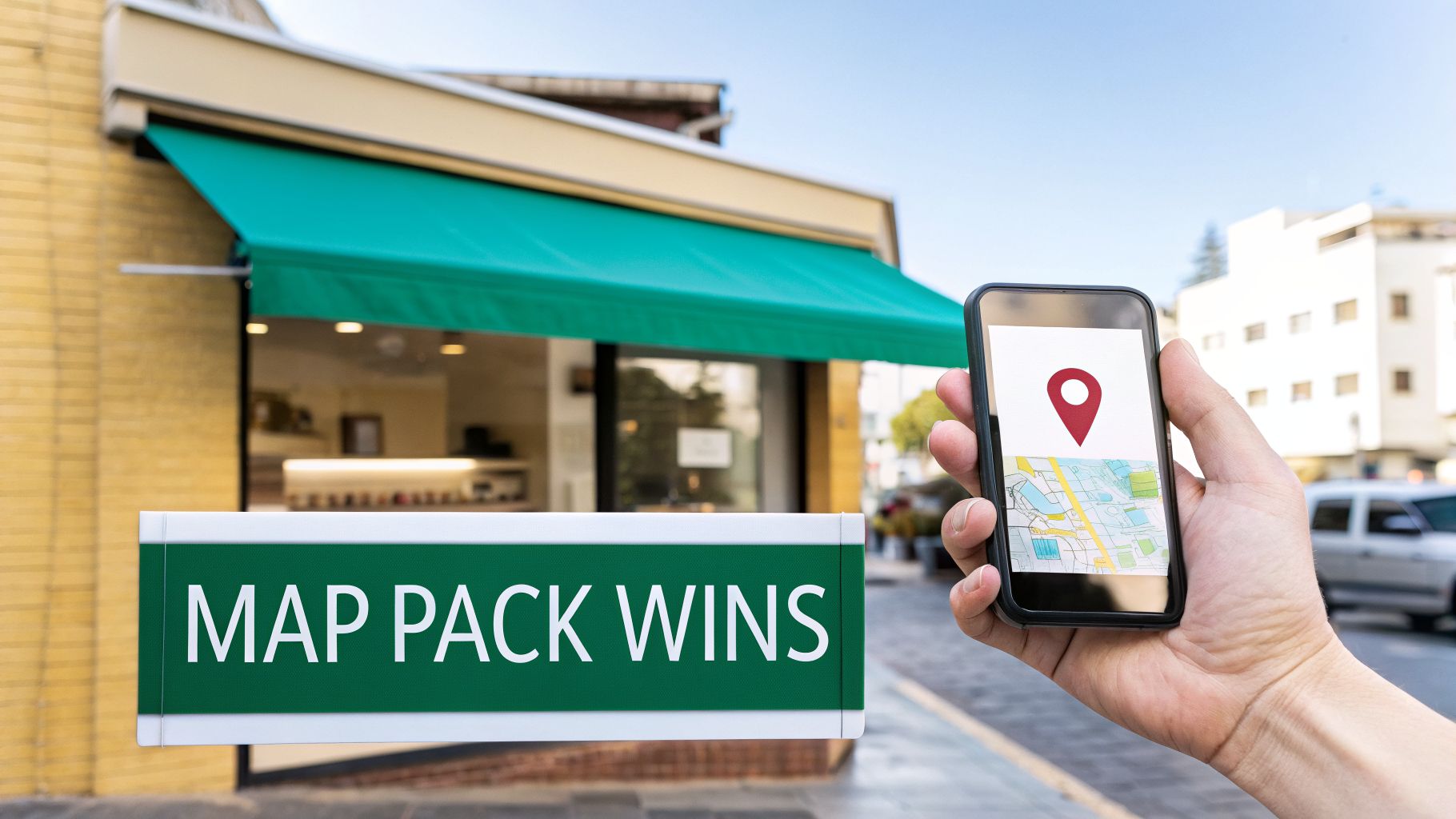
If you operate a business with a physical address or serve a specific area, your customers are likely local. Local SEO focuses on dominating your immediate market. It is the process of getting your business found by people in your community at the moment they need your offerings.
Appearing at the top of local search results is like having a prime retail location on a busy street. The objective is straightforward: when someone nearby searches for your services, your name should be the first one they see.
The Power Of The Google Map Pack
The primary goal of local search is placement in the Google Map Pack. This is the box at the top of Google’s search results that displays a map and a list of three businesses. It is a digital storefront for local customers who are ready to make a purchase.
It is impactful because it provides a potential customer with all the information needed to make a quick decision. They see your business name, star rating, address, and phone number without navigating to another page. This shortens the path from search to sale.
Consider a homeowner with a burst pipe. They will likely search for “emergency plumber near me” on their phone. The Map Pack will be their first point of reference. They will not browse multiple websites; they need a well-rated, local professional they can contact immediately. That is the function of local SEO.
Capturing High-Intent “Near Me” Searches
The proliferation of smartphones has led to an increase in “near me” searches. These searches indicate an immediate need and a strong intent to buy, often within hours.
A local SEO strategy is designed to intercept these motivated customers. The data shows that 46% of all Google searches have local intent, and 42% of those searchers click on Google Map Pack results. Furthermore, 18% of local mobile searches lead to a sale within one day. You can find more information on the impact of local search statistics on seoprofy.com.
Core Components Of A Dominant Local Strategy
Achieving this type of local visibility is not a matter of chance; it requires a focused effort on a few key areas. Any provider of seo services for small businesses will concentrate on these components to establish you as a local leader.
Google Business Profile (GBP) Optimization: Your GBP is your most significant local marketing asset. This involves more than just listing your name and number. It requires a complete profile with high-quality photos, a detailed list of services, and regular posts to keep customers informed.
Customer Review Management: Positive reviews serve as digital word-of-mouth and build instant trust. A strategy should involve encouraging satisfied customers to leave feedback and responding professionally to all reviews.
Local Citation Building: A citation is a mention of your business’s name, address, and phone number (NAP) on other websites, such as Yelp or industry directories. Consistent NAP information across the web sends strong trust signals to Google.
Targeted Local Content: You must demonstrate local relevance. This means creating content specific to your area, such as blog posts about community events, case studies featuring local clients, or service pages dedicated to the neighborhoods you serve. This signals to Google that you are an expert in the area.
How To Choose The Right SEO Partner For Your Business

Selecting a company for your SEO services for small businesses is a significant decision. You are choosing a partner to help drive your company’s growth. A suitable partnership can increase revenue. An unsuitable one can waste time and budget.
How do you identify the right fit? You must look beyond sales presentations and apply critical evaluation. The goal is to find a team that functions as an extension of your own, one that is focused on your business goals.
Moving Beyond The Sales Pitch
Your initial task is to look for evidence to support claims. Any agency can talk about results, but a true partner will demonstrate their process. This requires asking direct questions to understand their operations.
A professional SEO team will welcome this scrutiny. They understand that a good client relationship is built on trust and transparency. You just need to ask the right questions.
Here are the questions every small business owner should ask a potential SEO provider:
- “Can you walk me through a few case studies for businesses like mine?” You are looking for verifiable stories that show more than just rankings. Ask about measurable results like lead generation, phone calls, and sales growth.
- “How do you define a ‘win’ and what KPIs will you show me?” Their answer should focus on metrics that affect your bottom line—leads, conversions, and revenue—not “vanity metrics” like temporary traffic spikes.
- “What’s your communication and reporting style?” A good partner provides regular, clear updates that connect their work directly to your goals. You should expect scheduled calls and understandable reports.
- “How will you build a strategy just for my business?” A standardized plan is a red flag. A top-tier agency will research your customer base, your competitors, and your unique value proposition before developing a strategy.
This line of questioning helps differentiate between qualified and unqualified providers.
The SEO Agency Evaluation Checklist
Vetting an SEO agency involves identifying positive and negative indicators. Some claims should be cause for concern, while other signs indicate a good fit.
Before the checklist, there is one important point.
The single largest red flag in the SEO industry is a guarantee. No reputable agency can guarantee a #1 ranking on Google. The algorithm is complex and controlled solely by Google. Anyone promising a specific rank is either inexperienced or dishonest.
Knowing what to look for—and what to avoid—is key. This checklist will help guide your conversations and compare your options.
| Evaluation Criteria | What to Look For | Red Flag to Avoid |
|---|---|---|
| Strategy Approach | A customized plan built after they’ve learned about your business goals, target audience, and competition. | A generic, “cookie-cutter” package that they offer to every single client, no matter the industry or need. |
| Transparency & Reporting | Clear, goal-focused reports that connect SEO tasks directly to business results like leads, calls, and revenue. | Vague reports focused only on traffic and keyword rankings, with no connection to what actually matters to your business. |
| Communication Style | Proactive, consistent communication with a dedicated point of contact who knows your account inside and out. | Spotty communication, unanswered emails, or being passed between different people who are unfamiliar with your account. |
| Proven Results | A solid portfolio of verifiable case studies and client testimonials that show a track record of real, measurable success. | A total lack of concrete proof or a refusal to share specific examples of their work and the results they delivered. |
Choosing the right SEO partner is a significant commitment. By asking these questions and watching for these critical signals, you will find a team that can become an engine for your business’s growth.
Let’s address the question of cost.
What’s This SEO Thing Going to Cost Me? (And What’s My ROI?)
“What is the price?” is a common and valid question. There is no single price for SEO. Viewing SEO as a cost is not the most effective perspective; it is an investment in a system that generates visibility and customers over time.
Let’s examine how agencies price their services and what you might expect to pay for tangible results.
How SEO Agencies Bill for Their Time
When researching providers, you will encounter a few common pricing models. None are inherently superior; they are suited for different requirements. Understanding these models helps you compare quotes.
- Monthly Retainer: This is the most common model in the SEO industry. You pay a fixed fee each month, and the agency manages all aspects of the campaign—content creation, technical site health, link building, and reporting. It is a suitable option for a long-term growth plan.
- Project-Based Fee: This model is for specific, one-time needs. Examples include a full website audit, a local SEO setup for a new location, or recovery from a Google penalty. You receive a fixed price for a clearly defined scope of work.
- Hourly Consulting: This is for obtaining strategic advice or training your in-house team. You pay for an expert’s time on an hourly basis.
What Drives the Price Up (or Down)?
Why might one business receive a quote for $1,000 per month while another is quoted $5,000? It depends on the level of effort required. Gaining visibility in a highly competitive market requires a more aggressive and resource-intensive approach. The current condition of your website and the extent of any necessary remediation also affect the price.
Data shows that 74% of small businesses invest in SEO. The average monthly spend is around $497, but for comprehensive SEO services for small business, the range can be from $500 to $7,500 per month. It appears to be a worthwhile investment, as 71% of businesses using SEO are satisfied with their results. You can find more of this data on WordStream’s SEO statistics page.
Setting Realistic Goals for Your Return
SEO is a long-term strategy. If you need immediate traffic, paid advertising is a more appropriate tool. SEO is about building a permanent asset that attracts customers organically over time. Patience is required.
The purpose of SEO is not just to achieve a #1 ranking. It is to generate business activity. Your ROI should be tied to actual business results, not abstract metrics.
Instead of focusing on your rank for a single keyword, concentrate on the Key Performance Indicators (KPIs) that correlate with revenue.
KPIs That Show SEO is Actually Working:
- More Qualified Leads: Are you receiving more calls or contact form submissions from prospective customers?
- Growth in Organic Traffic: Are more of the right people finding your site through Google?
- Better Conversion Rates: What percentage of visitors from search engines are taking a desired action, like booking a service or purchasing a product?
- Revenue from Organic Search: How much revenue can be directly attributed to your SEO efforts?
When you frame SEO as a strategic investment and track these bottom-line metrics, you can see the return it generates over time.
Your Questions About SEO For Small Business, Answered
Let’s address common questions from small business owners about SEO. The topic can seem complex, but straightforward answers are needed.
Here are answers to some of the most frequent questions.
How Long Does It Take To See Real Results From SEO?
This is a primary concern. SEO is a long-term process. While minor positive indicators may appear sooner, you should plan for 4 to 6 months before seeing significant results.
The initial months are for foundational work—fixing technical issues, developing a keyword strategy, and creating a content plan. This work is not immediately visible but is necessary.
Around the 3-month mark, you might see early progress, like ranking for some long-tail keywords. The main benefits, such as increased organic traffic and a steady flow of leads, result from consistent effort over time. The timeline can vary based on market competition, the initial state of your website, and the intensity of the campaign.
Can I Do SEO Myself Or Should I Hire An Agency?
This is the “DIY vs. hire a pro” question. The answer depends on the trade-off between your time and your budget.
You can perform SEO yourself, as many resources are available. However, you must assess if you have sufficient time each month to learn and execute a complex marketing discipline. SEO is not a one-time task; it requires ongoing effort.
Hiring a professional agency means you are acquiring a dedicated team, access to specialized software, and the experience of professionals. For many small business owners, partnering with an agency is the most direct path to a return on investment, which allows you to focus on running your business.
The approach is to find a partner who functions as an extension of your team and is invested in your business goals.
What Is The Difference Between SEO And PPC Advertising?
This is a key distinction. Both SEO and PPC (Pay-Per-Click) are search marketing tactics, but they operate differently.
SEO (Search Engine Optimization): This is about earning placement in search results. You build organic, unpaid traffic by creating a valuable, authoritative website that Google’s algorithm favors. It is a long-term investment that builds upon itself, creating a sustainable asset.
PPC (Pay-Per-Click): This involves renting ad space at the top of the search results page. You pay Google each time someone clicks your ad. It is effective for immediate traffic and for testing. When you stop paying, the traffic stops.
Effective strategies often incorporate both. SEO provides a foundation for sustainable, cost-effective growth, while PPC can be used for immediate results or to promote specific campaigns.
How Much Should A Small Business Budget For SEO?
There is no single answer. The cost of SEO is analogous to the cost of a car; it varies widely.
SEO pricing is tied directly to the scope of work. A local business in a small town has different needs and competition than a national e-commerce brand.
You will typically encounter these models:
- Monthly Retainer: A fixed monthly fee for an ongoing strategy. This is the most common model.
- Project-Based: A one-time fee for a specific task, such as a website audit or a local SEO setup.
- Hourly Consulting: Paying for an expert’s time for strategic guidance or training.
It is useful to view SEO not as a cost, but as an investment in a customer acquisition channel that you will own.
How Is SEO Success Measured?
Rankings and traffic are intermediate metrics. Real SEO success is measured by its impact on your business’s bottom line.
A good SEO partner will focus on these Key Performance Indicators (KPIs):
- More Qualified Leads: A tangible increase in phone calls and contact form submissions from potential customers.
- Bottom-Line Revenue Growth: The ability to trace sales and revenue directly back to organic search efforts.
- Higher Conversion Rates: An increase in the percentage of website visitors who become customers.
- Lower Customer Acquisition Costs: As free, organic traffic increases, reliance on paid ads can decrease, making each new customer less expensive to acquire.
Focusing on these business outcomes provides clarity on whether your SEO investment is generating a return.
Ready to see how a results-driven strategy can transform your business? The team at Ascendly Marketing builds customized SEO campaigns that deliver measurable growth in traffic, leads, and revenue. Schedule your free consultation today to start your journey.