

93% of people who follow a small business on Twitter plan to buy from them in the future, based on data cited by Vocalcom on Twitter and customer service behavior. That number should end the lazy debate about whether Twitter marketing services still matter.
If you’re a business owner, the question isn’t whether Twitter is alive. The question is whether you can turn attention on the platform into leads, sales, and customer conversations you can track. Done badly, Twitter becomes a time sink managed by someone posting random updates. Done well, it becomes a direct-response channel, a customer service line, and a traffic source with clean attribution.
A lot of agencies still sell Twitter management like it’s a content hobby. That’s the wrong frame. You should buy Twitter marketing services for measurable business outcomes. For SMBs, that means inquiries and repeat customers. For e-commerce brands, it means product clicks and purchases. For B2B teams, it means traffic to landing pages, webinar registrations, and pipeline support.
Why Twitter Still Commands Attention for Business Growth
93% of people who follow a small business on Twitter plan to buy from them in the future. That stat was already established earlier, and it matters for one reason. Intent this high gives the platform commercial value if your team can convert attention into action.
Twitter still earns a place in the mix because it compresses the path from discovery to response. A prospect can see a post, click through, check your replies, and decide whether your company is credible in minutes. Few channels expose your message, your social proof, and your responsiveness this fast.
That speed has direct ROI implications.
For SMBs, Twitter can drive quote requests, bookings, and repeat purchases when posts point to a clear offer, and replies are handled quickly. For B2B firms, it supports pipeline by turning expert commentary, event promotion, and founder visibility into landing page visits and demo interest. For e-commerce brands, it creates short buying windows around launches, promotions, and customer questions that would otherwise stall a sale.
The platform also rewards what I would call algorithmic engineering. That means designing content, timing, engagement patterns, and reply strategy to increase qualified visibility instead of chasing vanity metrics. A good Twitter marketing service does not post for the sake of activity. It builds a system that earns impressions from the right audience, captures intent, and pushes users toward a measurable next step.
Customer service matters here too. Public replies shape buying decisions because prospects read them before they contact you. Fast, useful responses reduce friction, protect conversion rates, and give existing customers a reason to stay.
If you want a broader view of how social platforms contribute to measurable growth, review these advantages of social media marketing in 2026 and judge Twitter by the same standard. Revenue impact, retention, and attributable traffic. Those are the metrics that justify the spend.
The Core Components of a Twitter Marketing Service
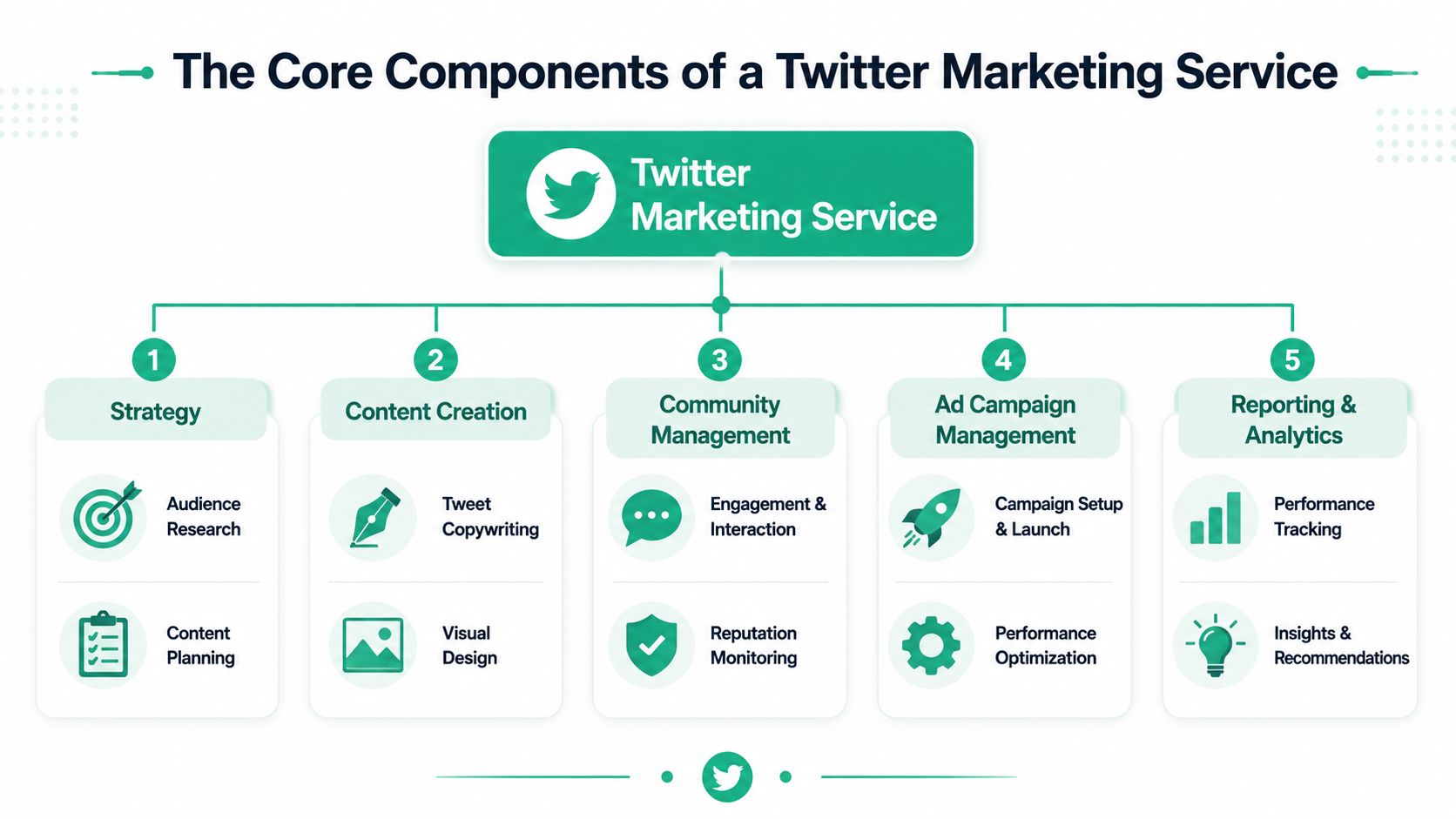
A Twitter marketing service should do five jobs, and each one should tie back to revenue, pipeline, or retention. If an agency cannot explain how its work affects clicks, leads, purchases, or customer response time, you are paying for motion, not outcomes.
Strategy
Strategy sets the commercial target before a single post goes live. That includes audience research, offer alignment, content themes, posting cadence, campaign goals, and a clear definition of success. For an e-commerce brand, success may mean product page clicks and assisted purchases. For a B2B firm, it usually means demo visits, lead magnet downloads, or qualified traffic from decision-makers. For an SMB, it may be calls, bookings, or quote requests.
A competent agency should answer three questions without rambling. Who are you targeting? What offer are you pushing? What action should the right user take next?
That is the baseline.
Strong strategy also includes message testing by segment. A founder-led B2B account needs a different angle than a local service business or a DTC product brand. If the agency gives every client the same posting formula, it is running a content factory.
Content creation
Content has one job. Hold attention long enough to earn the next action.
That means building a mix of formats and themes instead of pushing constant promotions. A balanced content plan usually performs better because it gives your audience a reason to follow, engage, and trust your expertise before you ask for the click. It should include promotional posts, industry commentary, proof points, customer-focused education, and point-of-view content that makes the account feel informed rather than scripted. If you need a clearer framework for planning that mix, review these types of content for social media.
Hashtags deserve the same discipline. Use a small number of highly relevant tags when they improve discovery. Do not stuff posts with generic terms that attract the wrong audience and weaken intent.
A solid content service usually includes:
- Tweet copywriting: Short-form posts, threads, replies, and campaign-specific messaging.
- Visual support: Graphics, product images, simple animations, or screenshot-based posts.
- Editorial planning: A calendar tied to launches, events, seasonal pushes, and recurring offers.
Practical rule: If every tweet reads like a sales pitch, reach falls and conversion intent weakens. Variety keeps the feed credible.
Community management
Community management protects the value of the content after publishing. Cheap providers skip this step, which is a mistake. Replies, mentions, direct questions, and complaint handling affect buyer trust in public.
For SMBs, fast replies can turn interest into booked work. For B2B companies, smart engagement with prospects, partners, and industry voices can increase visibility with the right buyers. For e-commerce brands, handling product questions and shipping concerns in public can prevent abandoned carts and reduce support friction.
This is also where audience insight gets sharper. Agencies that monitor replies and conversation patterns can spot objections, buying triggers, and topic opportunities faster than teams that only schedule posts. Use tools that help you understand your X audience with analytics so community management informs future campaigns instead of staying reactive.
Ad campaign management
Paid X campaigns need tighter control than organic posting because wasted spend shows up fast. The work includes audience targeting, campaign setup, creative testing, landing page alignment, tracking, and weekly optimization based on cost and conversion quality.
Good operators treat paid and organic as one system. Organic posts identify angles that earn response. Paid campaigns then scale the strongest messages to a defined audience. That matters for ROI. You should not spend budget testing weak offers that could have been filtered out through organic response first.
Here is a simple way to judge this service area:
| Service area | What you should expect |
|---|---|
| Campaign setup | Audience targeting, clear objective selection, clean tracking |
| Creative testing | Variations in copy, visuals, and calls to action |
| Budget control | Spend pacing, waste reduction, and bid adjustments |
| Optimization | Ongoing changes based on actual response data |
Reporting and analytics
Reporting should explain business performance, not decorate a slide deck. Likes, impressions, and follower growth have context value, but they are not the reason to hire a service.
Ask for reporting tied to traffic quality, lead actions, assisted conversions, customer response time, and cost per result. Ask which posts drove the strongest downstream behavior. Ask which audience segments converted. Ask what the agency changed based on the data.
That is how you separate reporting from analysis. A useful Twitter marketing service shows what happened, why it happened, and what the team will change to improve ROI.
Advanced Strategy Beyond Organic Best Practices
Posting consistently is table stakes. It does not create growth by itself, and it certainly does not justify an agency retainer.
What drives results now is algorithmic engineering. I mean deliberate planning around how a post earns early replies, quote posts, saves, profile visits, and click activity so the platform gives it more distribution. If a service cannot explain how it handles those mechanics, it is selling content production, not performance.
Organic reach is unstable. Engineered distribution closes the gap.
The smart play is coordinated engagement from real accounts with real context. That can include your founder, sales team, customer success team, partner network, and subject matter experts responding quickly to priority posts. The goal is simple. Create enough relevant activity early that the post earns broader visibility and pulls the right audience into the thread.
That approach matters even more for businesses that need measurable outcomes, not vanity metrics.
For an SMB, this can mean giving a promotion, event post, or booking push enough early traction to produce calls and site visits before the post disappears. For a B2B company, it can mean using employee and executive replies to turn one insight post into meetings, demo requests, and warmer outbound conversations. For e-commerce, it can mean building momentum around a product drop, restock, or bundle so the post drives traffic while purchase intent is high.
A stronger service usually includes three things:
- Reply orchestration: Relevant replies from the right internal and partner voices within the first engagement window
- Post-tier strategy: More support behind launch posts, offers, lead magnets, and event content than routine publishing
- Signal analysis: Tracking which topics and formats generate replies, profile visits, clicks, and conversion-oriented behavior
If you want a practical way to understand your X audience with analytics, that resource is helpful because it focuses on response patterns, not just post volume.
The feed rewards coordinated relevance
Agencies that only talk about authenticity are skipping the hard part. Authenticity helps with tone. It does not solve distribution, and it does not improve ROI on its own.
A capable partner plans content by objective, audience behavior, and feed mechanics. Some posts should be short and built for fast reactions. Some should be threads designed to hold attention and qualify intent. Some should be quote-post prompts aimed at industry voices who can expand reach through credible discussion. If your agency has not mapped format to business outcome, it is guessing. This guide to types of content for social media is a useful reference for planning content around specific goals instead of posting out of habit.
Here is the standard I recommend: your Twitter service should know how to create visibility, shape interaction quality, and connect both to revenue actions. Anything less is social media maintenance dressed up as strategy.
Connecting Services to Your Specific Business Goals
A Twitter service should be built around how your business makes money. If an agency cannot tie content, paid support, response handling, and reporting to revenue, you are buying activity, not growth.
The right setup looks different for an SMB, an e-commerce brand, and a B2B company because the buying cycle, margin structure, and conversion path are different. Good agencies know that. Strong ones go further and use algorithmic engineering to improve distribution around the actions that matter most, such as clicks to a booking page, product page visits, or demo requests.
For SMBs that need calls, bookings, and repeat business
Small and local businesses should use Twitter as a response channel with promotion built in. That means timely offer posts, visible replies, service updates, and fast handling of public questions. The goal is simple. Turn attention into inquiries, and turn inquiries into booked revenue.
A local HVAC company, dental practice, or home services brand does not need broad awareness for its own sake. It needs high-intent visibility in the moments when people are ready to act. Your agency should prioritize posting around demand windows, promoting seasonal offers, and managing replies like a sales assistant, not a community vanity project.
Ask for a service plan tied to these outcomes:
- Offer promotion: Seasonal campaigns, limited-time discounts, booking pushes
- Response management: Fast replies to pricing, availability, and service questions
- Reputation visibility: Public interactions that show reliability before a prospect clicks
- Conversion tracking: Clicks to calls, form fills, booking completions, repeat visits
If an SMB-focused agency reports impressions but cannot show inquiry volume, it is missing the job.
For e-commerce brands that need traffic and purchases
E-commerce brands should treat Twitter as a demand capture and demand creation channel. Product launches, restocks, creator mentions, customer questions, and offer-driven paid campaigns all belong here. The point is not to post more. The point is to move qualified traffic into product pages and lift conversion volume.
Execution quality rapidly becomes evident. Weak partners publish attractive product posts and stop there. Strong partners test hooks, audience segments, reply strategy, and landing page alignment. That is algorithmic engineering in practice. They shape distribution and ad delivery around signals that correlate with revenue, not surface-level engagement.
A workable e-commerce service usually includes:
- Launch and restock campaigns: Clear product angles with direct destination links
- Reply handling: Public answers on shipping, sizing, ingredients, returns, or product fit
- Paid amplification: Budget behind proven posts, creator assets, or high-conviction offers
- Creative testing: Variations in copy, visuals, and calls to action tied to conversion data
For e-commerce, ask one hard question: which campaigns produced profitable traffic, not just cheap clicks?
For B2B firms that need qualified interest
B2B companies should use Twitter to reach buyers, influencers, partners, and category observers who can move deals forward. Viral reach is optional. Qualified attention is the target.
Your service mix should support authority and conversion at the same time. That usually means leadership posts with a clear point of view, event commentary, insight threads, selective paid promotion, and distribution around lead magnets, webinars, case studies, or demo pages. An agency that only promises follower growth does not understand B2B buying behavior.
B2B also benefits the most from precision. The best agencies map topic clusters to funnel stages, then build posting and paid support around those stages. Top-of-funnel content earns attention. Mid-funnel content earns clicks. Bottom-funnel content earns hand-raisers.
Consider how this plays out in practice:
| Business type | Useful service focus | Likely business outcome |
|---|---|---|
| Local SMB | Offers, replies, customer service visibility | Calls, visits, repeat customers |
| E-commerce | Product posts, promoted campaigns, rapid response | Traffic, purchases, cart starts |
| B2B | Thought leadership, event commentary, lead content | Demo interest, lead form traffic, pipeline support |
If you’re in B2B, do not ask whether Twitter gets likes. Ask whether the right buyer clicked through to your offer, entered your funnel, and showed buying intent.
Decoding Service Packages and Pricing Models
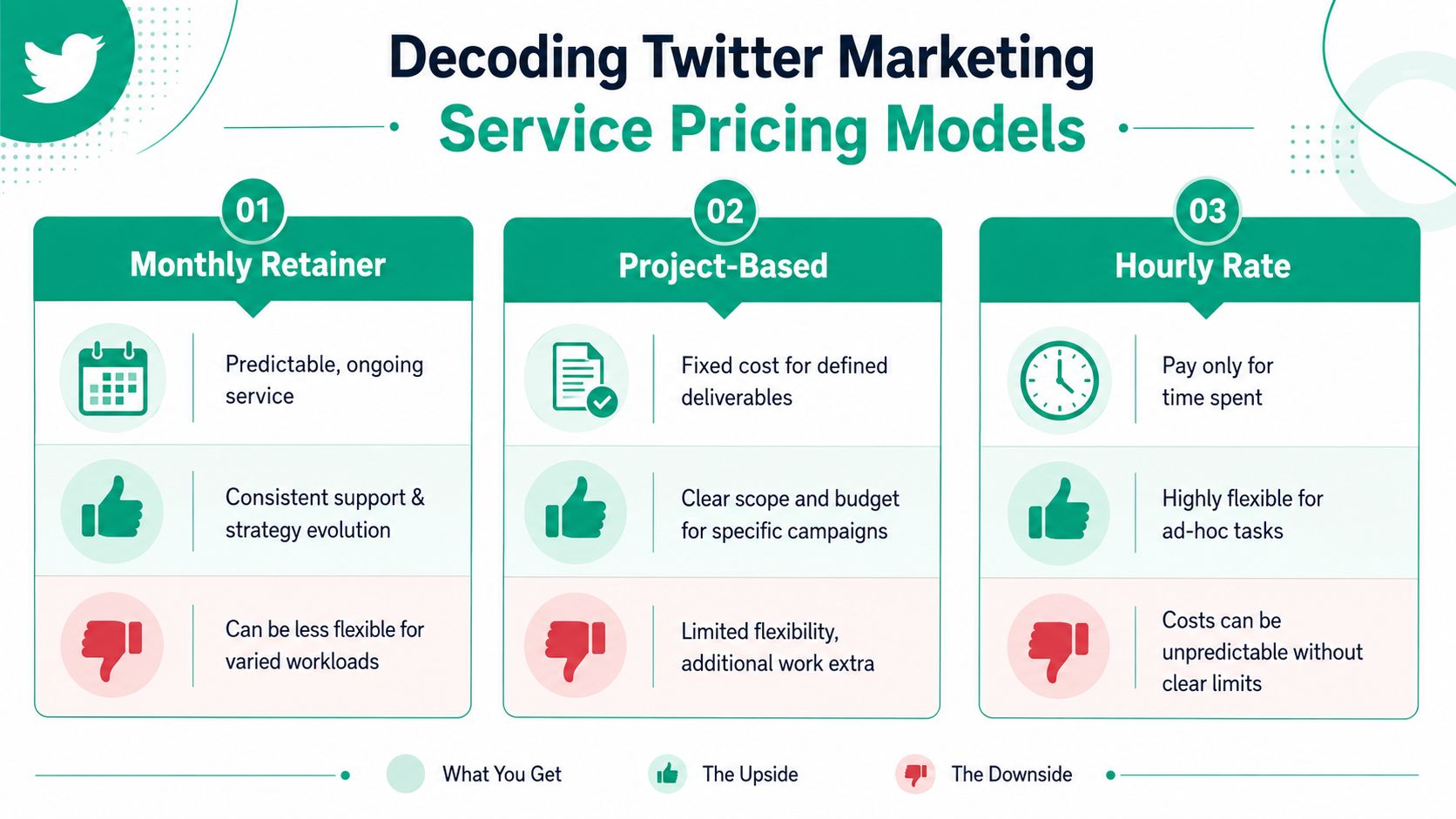
Most Twitter marketing services are sold in one of three ways. Monthly retainer. Project-based work. Hourly support. None of these is automatically better. The right choice depends on whether you need continuity, a fixed campaign, or flexible specialist help.
How the common models differ
A monthly retainer fits businesses that need ongoing execution, regular reporting, content planning, and ad management. This model works best when Twitter is part of a broader growth system and not just a side project.
Project-based pricing works for a product launch, event campaign, seasonal promotion, or account reset. You define the scope up front, the agency executes against that scope, and extra work gets priced separately.
An hourly model can make sense if your team already handles most activity and only needs expert help with audits, campaign troubleshooting, or analytics setup.
Here’s the clean comparison:
- Monthly retainer: Best for consistency, optimization, and strategic continuity.
- Project-based: Best for contained campaigns with fixed deliverables.
- Hourly support: Best for advisory work and uneven workloads.
A short video can also help when you’re comparing service structures and expectations:
What should actually be inside a package
Forget labels like starter, growth, or premium. Ask what work is included. A lower-tier package may cover content and scheduling only. A stronger package should include strategy, publishing, engagement, paid support, reporting, and optimization decisions.
Ask for package details in plain language:
- Posting scope: How many posts, what formats, and who approves them?
- Community coverage: Who handles replies, mentions, and issue escalation?
- Ad management: Is campaign setup included, and who monitors spend?
- Reporting depth: Will you see traffic and conversion data, or just platform activity?
If the pricing conversation stays vague, the service will stay vague too.
Measuring what Matters with Performance KPIs
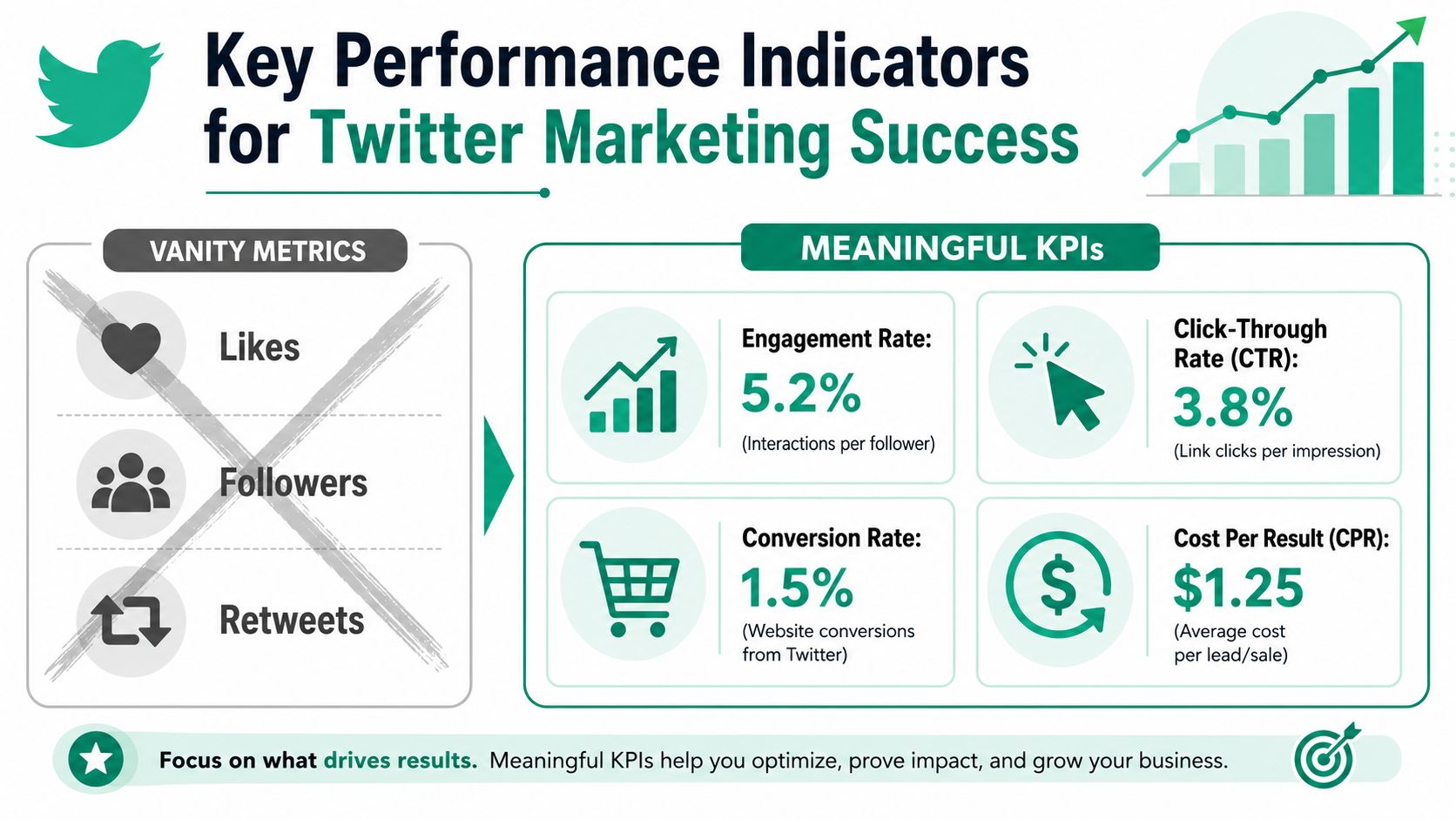
A Twitter program that cannot tie activity to pipeline, sales, or support outcomes is a cost center. Treat KPI reporting as ROI control, not a recap of what got posted.
Measure business outcomes by model
The right KPIs change by business type. A B2B company should care about demo requests, sales-qualified traffic, and assisted pipeline. An e-commerce brand should watch product page sessions, add-to-cart rate, checkout starts, and revenue per visit. An SMB with a local or service model should focus on booked calls, lead form completions, and response time tied to retention.
That is the standard.
A strong Twitter marketing service builds reporting around commercial intent, then uses algorithmic engineering to improve distribution, click quality, and conversion path visibility. If your provider reports impressions without showing what happened after the click, they are reporting platform activity, not business performance.
Use questions like these in every review:
- Traffic quality: Did Twitter send visitors who stayed, viewed key pages, and converted at an acceptable rate?
- Offer response: Which posts, threads, creatives, or ads drove high-intent action?
- Conversion path: Which campaign, audience, and landing page produced leads, purchases, or qualified inquiries?
- Cost efficiency: What did each result cost, and did the economics support scaling?
UTM tracking is the baseline
UTM-tagged links improve attribution because they separate Twitter traffic from other channels inside your analytics stack. Without that setup, you blur source data, misread performance, and keep weak campaigns alive longer than they deserve.
Use a naming system for source, medium, campaign, and content. Then match those links to landing pages, offers, and audience segments. That is how you isolate what worked by post, campaign, and objective.
If your provider has not configured that foundation, start with a social media audit for tracking and channel performance before you spend more.
Reality check: If a partner cannot trace clicks to outcomes, they cannot defend your budget.
Here is the KPI split that matters in client reviews:
| Weak reporting | Useful reporting |
|---|---|
| Likes | Landing page visits |
| Followers | Qualified clicks |
| Retweets | Form fills or purchases |
| Impressions | Cost per result and conversion path |
Your Agency Selection and Onboarding Checklist
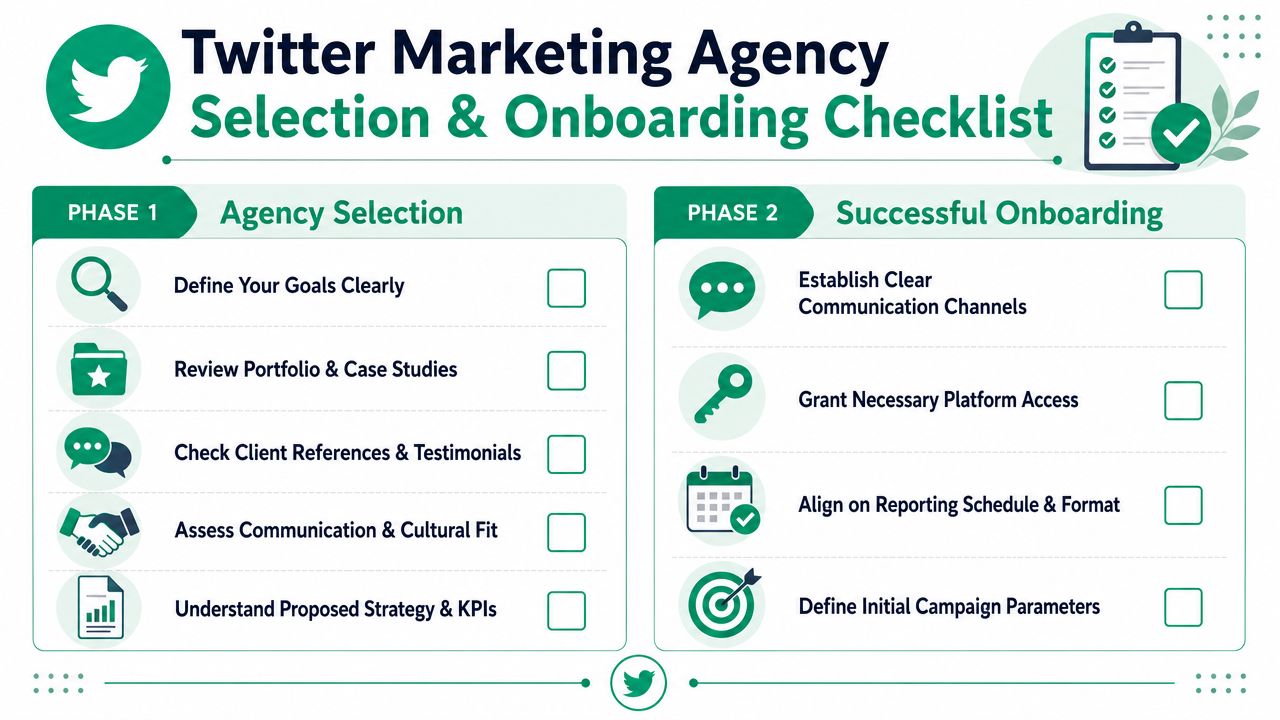
Choosing a Twitter partner shouldn't feel mysterious. Ask direct questions, watch how they answer, and pay attention to whether they talk about outcomes or just activity.
What to ask before you sign
Start with the basics, but don't stop there.
- Goal fit: Ask how they'd use Twitter for your exact business model, not for "brands" in general.
- Tracking setup: Ask how they handle UTM parameters, campaign naming, and conversion reporting.
- Engagement method: Ask who manages replies, escalation, and community interaction.
- Paid capability: Ask how they decide when a post should stay organic and when it deserves ad spend.
- Optimization process: Ask what changes after the first month if results are weak.
A good agency will answer plainly. A weak one will hide behind jargon.
What onboarding should look like
The first phase should be structured. You want discovery, access setup, audience review, content planning, tracking configuration, and agreement on reporting cadence. Then execution starts. If they start posting before the measurement framework is set, the order is wrong.
Use this quick checklist:
- Define the business outcome first. Sales, leads, bookings, support deflection, or another target.
- Confirm platform access and permissions. No delays, no missing logins, no confusion.
- Approve content themes and campaign priorities. Random posting kills momentum.
- Set reporting expectations early. Decide what you'll review and how often.
- Establish response rules. Know who handles complaints, questions, and sensitive issues.
The right partner makes Twitter easier to evaluate, not harder.
If you're weighing whether Twitter marketing services deserve budget, talk with Ascendly Marketing. Their consultative approach focuses on planning, execution, reporting, and continuous optimization, which is the structure business owners need when they care about measurable growth rather than empty platform activity.