

Your website is either your best 24/7 salesperson or an expensive, underperforming brochure that’s actively sending customers to your competitors. Let's be real—effective web design for electricians isn't about just having a site. It’s about building a strategic digital tool that screams trust, professionalism, and reliability to homeowners in your service area.
Why Your Generic Website Is Costing You Jobs
Think about the modern customer journey for a second. When a homeowner's lights start flickering or a breaker won't stop tripping, they aren't reaching for the Yellow Pages. They're grabbing their phone for a frantic Google search for "electrician near me."
In that moment, they get a list of local options, and your website has less than three seconds to make a winning impression.
This is where a generic, template-based site falls flat. It just blends in, looks untrustworthy, and doesn’t have the specific, reassuring information a stressed-out customer needs right then and there. A strategic website, on the other hand—one designed specifically for an electrical contractor—works tirelessly to build that instant confidence and turn a desperate visitor into a booked job.
The Real Cost of a Poor First Impression
A lot of electricians are stuck with websites that fail to generate a single lead. Worse, you have to go out of your way to learn how to boost your small business online presence just to compensate. A subpar website isn't just a dead asset; it actively hurts your business by:
- Creating Doubt: An old, clunky design makes customers question your skills. If you can't manage a modern website, can they really trust you with their home's complex wiring?
- Hiding Your Value: It fails to prominently display your licenses, insurance, glowing reviews, and photos of your actual team on the job—the very things that overcome a homeowner's hesitation.
- Frustrating Mobile Users: Most urgent electrical searches happen on a smartphone. If your site is slow or a pain to navigate on a small screen, potential customers will hit the "back" button and call your competitor without a second thought.
A professional website isn't an expense; it's a core marketing investment. It's the digital storefront that determines whether a potential customer walks in or keeps scrolling to the next electrician on the Google results page.
The Data-Backed Case for Professional Design
In today's expanding electrical services market, a professional online presence is completely non-negotiable. The 2025 Electrician Industry Market Report found that 93% of customer experiences start with a search engine, and another 84% of homeowners check out multiple contractors online before making a call.
This is precisely why a professionally designed website is a critical tool for capturing leads in a market projected to hit $295 billion by 2034. You can dig into more of this data by checking out the electrician industry's digital shift.
Here’s a quick glance at the core components that turn a website from an online brochure into a lead-generating machine.
Core Components of a High-Converting Electrician Website
| Component | Why It Matters for Electricians |
|---|---|
| Mobile-First Design | The majority of emergency service searches happen on a phone. Your site must be flawless on mobile. |
| "Click-to-Call" Buttons | Makes it effortless for a stressed homeowner to contact you immediately, reducing friction. |
| Trust Signals | Prominently displaying licenses, insurance, and certifications builds instant credibility. |
| Authentic Photos/Videos | Shows real technicians and completed projects, proving you’re a legitimate, local business. |
| Customer Reviews | Social proof is powerful. Featuring 5-star reviews overcomes homeowner hesitation. |
| Service Area Pages | Critical for local SEO. Helps you rank in the specific cities and neighborhoods you serve. |
| Clear Service Offerings | Visitors need to see you handle their specific problem (e.g., panel upgrades, EV chargers) right away. |
| Simple Contact Forms | Easy-to-use forms for non-urgent inquiries capture leads you might otherwise miss. |
These elements work together to create an experience that doesn't just inform visitors, but actively converts them into paying customers.
Take a look at the example below. It’s a modern, professional design that gets straight to the point: building immediate trust with clear calls-to-action.
Notice how the design uses strong imagery, makes contact information impossible to miss, and sprinkles in trust signals. This is the kind of approach that transforms a simple website into a powerful lead-generation machine. If you're curious about the impact this can have, it's worth understanding why working with a professional web design agency pays off.
Planning Your Website to Attract the Right Customers
A powerful website isn't something you just throw together; it's engineered with a precise plan. Before a single line of code gets written or a color palette is even considered, the most successful electrical contractors I've worked with lay a strategic foundation. This blueprint is what ensures every single element of your site is designed to attract and convert your most profitable customers.
Think of it like wiring a new home. You wouldn't just start pulling cable without a detailed electrical plan, right? The same exact principle applies here. Your website plan dictates the structure, content, and the journey a visitor takes, making the difference between a site that just sits there and one that actively generates high-quality leads for your business.
Pinpointing Your Ideal Customer
First things first: stop thinking about "everyone" and start focusing on your ideal customer. Are you aiming for homeowners in affluent suburbs who need complex smart home installations and EV charger setups? Or is your sweet spot commercial clients who need routine maintenance and large-scale wiring projects?
Defining this target is critical because it shapes every decision you'll make from here on out.
- Residential Focus: If you're going after homeowners, your website's language needs to be straightforward, reassuring, and focused on their problems (think: "Fast & Reliable Emergency Repairs"). Trust signals like customer reviews, photos of your clean-cut team, and clear pricing are everything.
- Commercial Focus: If you're targeting businesses, the tone can be more technical. You'll want to emphasize efficiency, compliance, and long-term reliability. Case studies, detailed lists of your commercial services, and testimonials from other business owners become way more influential.
Don't build a website for every possible customer. Build it for the best customer—the one whose projects are most profitable and enjoyable for your team. This focus is the secret to attracting more of the work you actually want.
This simple visual breaks down the modern customer's path from having a problem to picking up the phone and calling you.
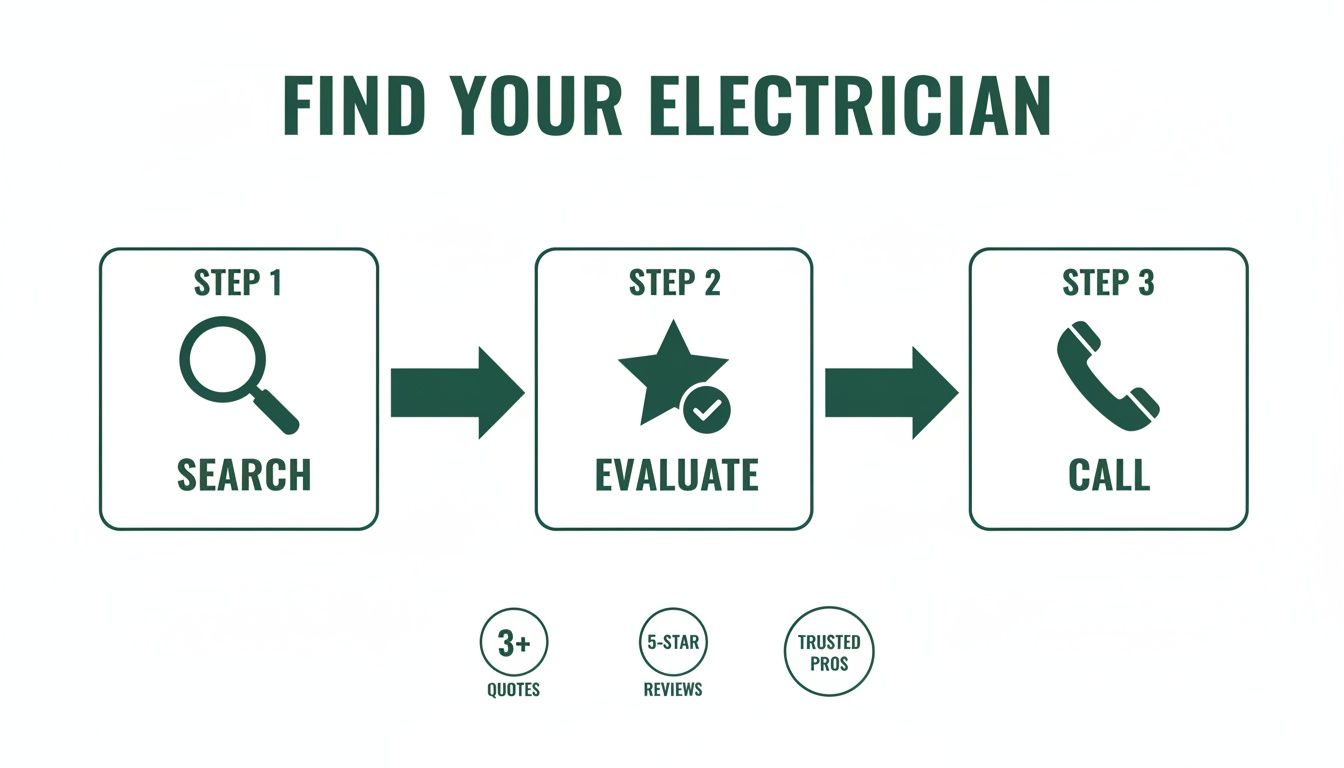
Your website absolutely must crush it at that "Evaluate" stage. It needs to provide instant trust signals that convince a searcher to choose you over the three other guys they just looked at.
Mapping Out Your Essential Website Pages
With your ideal customer locked in, you can now map out the essential pages your site needs. A classic mistake I see is cramming everything onto one or two pages. A well-structured site uses dedicated pages to guide visitors and, just as importantly, to dramatically improve your local SEO.
At a minimum, your website should have these core pages:
- Homepage: This is your digital storefront. It has to quickly answer four questions: who you are, what you do, where you operate, and why a customer should trust you with their home or business.
- About Us Page: Tell your story. This is where you build a real, personal connection by showcasing your team, your company's history, and your commitment to the local community.
- Detailed Service Pages: This is huge. Create a separate page for each primary service you offer (e.g., Panel Upgrades, EV Charger Installation, Landscape Lighting). This strategy allows you to rank for specific search terms and give customers the exact information they're looking for.
- Service Areas Page: A local SEO goldmine. List the specific towns, neighborhoods, and counties you serve. A map is a nice visual touch, but the text is what helps Google understand your exact geographic focus.
- Contact Page: Make it incredibly easy for people to get in touch. Include your phone number (make it clickable!), your email, a simple contact form, and your physical address if you have an office.
This clear structure makes your site a breeze for customers to navigate and for search engines to crawl and index effectively. The web design industry is booming, with projections showing over 205,000 web developers in the U.S. by 2030. This growth gives electricians like you access to incredible tools and expertise to build sites that truly stand out.
To see the power of a well-planned site, look at a case study of a Cleveland-based glass repair company. After a strategic redesign, they saw 90% of their internet leads convert to sales. That's the kind of tangible impact we're talking about. You can dig into more powerful web design statistics and their impact to see what's possible.
Designing a Site That Builds Instant Trust
You've got about three seconds. That’s all the time it takes for a potential customer, likely stressed out about an electrical issue, to land on your website and make a snap judgment. Is this business legit? Do they look professional?
An outdated, clunky, or generic website immediately plants a seed of doubt. If you can’t get your website right, how can they trust you with their home’s wiring? But a clean, professional, and easy-to-navigate site does the opposite. It instantly signals that you’re a serious, detail-oriented professional—exactly who they want handling a critical job.

Ditch Stock Photos for Authentic Imagery
Want to look like every other electrician in your town? Use the same generic stock photos of smiling actors in pristine hard hats. Customers can spot these fakes from a mile away, and they do absolutely nothing to build a personal connection.
Instead, get professional photos taken of your actual team, your branded trucks, and your crew on the job.
Showing your real operation is a game-changer. It accomplishes a few critical things:
- It proves you’re a real, local business—not some faceless lead-gen farm.
- It puts a human face to your company, letting customers see who they’ll be inviting into their homes.
- It’s a powerful visual portfolio, showcasing the quality of your work.
Scatter these authentic photos everywhere—your homepage, your about page, and especially your service pages. A real picture of your team installing a new panel is infinitely more convincing than a stock photo of a random circuit breaker.
Display Trust Signals Prominently
Homeowners are rightfully cautious when hiring any contractor. They’re silently asking themselves: Are you licensed? Are you insured? Are you reputable? Your website needs to answer these questions before they even have to ask.
Think of these as your digital credentials. Don’t bury them. Put them right where people can see them, like in your website’s header, footer, or a dedicated "Why Choose Us" section on the homepage.
Your website’s design is the single most important factor for building credibility. When a visitor feels confident in your professionalism from the moment they land on your site, they are far more likely to pick up the phone and call you instead of your competitor.
Here’s a look at the trust signals every electrician's website needs.
Essential Trust Signals for Your Website
A checklist of the critical trust-building elements your website must feature to convert hesitant visitors into confident customers.
| Trust Signal | Example | Impact on Customer Confidence |
|---|---|---|
| License Number(s) | "State Electrical License #12345" | Instantly verifies your legal qualifications and professionalism. |
| "Licensed & Insured" Badge | A clear graphic or bold text in the header | Provides immediate peace of mind, removing a major hiring barrier. |
| Industry Certifications | "Certified Generac Installer," "Tesla Wall Connector Certified" | Highlights specialized expertise and manufacturer endorsement. |
| Awards & Affiliations | Logos for BBB, Chamber of Commerce, "Best of" awards | Leverages third-party validation to build your reputation. |
| Real Customer Reviews | "John did a fantastic job…" – Sarah P., Your Town | Authentic social proof that shows you deliver on your promises. |
By making these elements a core part of your design, you preemptively address a customer’s biggest concerns and make it easier for them to choose you.
Craft Irresistible Calls to Action
Once you’ve earned that initial trust, you have to tell people exactly what to do next. A Call to Action (CTA) needs to be clear, compelling, and impossible to miss. “Learn More” is weak and passive. You need strong, action-oriented language that speaks directly to a customer’s immediate need.
Think about what a customer in a jam is looking for:
- “Get a Free Estimate” is a winner. It’s low-risk and high-value.
- “Schedule Service Now” is perfect for those who are ready to book.
- “Call for 24/7 Emergency Service” is a lifeline for urgent, high-value jobs.
Place these CTAs everywhere. Your phone number must be in the top right corner of every single page and be a click-to-call link on mobile. Add big, bold CTA buttons on your homepage, after you describe a service, and in your header. A visitor should never be more than a single click away from contacting you.
This focus on trust is critical, as research shows 48% of consumers consider website design the number one factor in deciding a business’s credibility. You can explore more about how design drives conversions for electricians and see real-world examples of its impact.
Creating Content That Connects and Ranks on Google
A sharp-looking website will get a potential customer to stop and look, but it’s the words on the page that convince them you’re the right person to call. Your content is the bridge between a homeowner’s flickering lights and you showing up at their door. It’s how you turn a curious visitor into a paying customer who trusts you.
The trick is to talk like your customers, not like an electrician talking to another electrician. A homeowner with a dead outlet doesn’t need to hear about “non-metallic sheathed cable” or “ampacity.” They want to know you can make their outlet work again, safely and quickly.
Your website copy has to reflect that. Always focus on the benefits you provide—safety, peace of mind, convenience—not just the technical tasks you perform. This approach builds an immediate connection and makes your services feel essential.
Writing Service Descriptions That Sell
Stop listing your services like a hardware store inventory. Instead, you need to frame every service you offer as the solution to a real-world problem. Each service page is a golden opportunity to show you understand what your customer is going through and that you have the expertise to fix it.
Here’s a simple but incredibly effective framework for your service pages:
- The Problem: Kick things off by describing the exact symptoms a customer is probably dealing with. For a panel upgrade, you could say, “Are your breakers constantly tripping? Do your lights dim every time you turn on the microwave?”
- The Solution: Next, clearly explain how your service fixes their issue. “A modern electrical panel upgrade gives your home the reliable power it needs, eliminating overloaded circuits and keeping your family safe.”
- The Proof: Drop in a short testimonial from a happy customer who had that exact service done. Even better, include a crisp photo of a clean, professional installation you recently completed.
This structure transforms a boring, technical page into a powerful sales tool. It proves you get their frustration and have a track record of making it disappear.
Dominate Local Search with Hyper-Specific Content
When someone desperately needs an electrician, they search locally. They’re typing in “electrician in Springfield” or “EV charger installation near me.” If you want to capture that high-intent traffic, your website content needs to be intensely local.
This means creating dedicated pages for the main towns and even specific neighborhoods you serve. But don’t just list the town names on a single “Service Area” page—that’s a rookie mistake. Write a short, unique paragraph for each location, maybe mentioning a local landmark or the common type of homes in that area.
For example, writing “Proudly serving the historic homes of Oakwood with expert knob-and-tube wiring replacements” is infinitely more powerful for local SEO than just listing “Oakwood.” It signals to Google that you are a true local authority.
Making sure your electrician website gets found means optimizing it for search engines. Using tailored SEO for static websites is a critical piece of that puzzle. It helps Google understand your geographic relevance, making you the obvious choice for the customers that matter most. If you want to dive deeper, you can also learn more about the fundamentals of organic SEO and why it’s a priority.
Establish Expertise with Helpful Content
Beyond just describing your core services, a simple blog or a robust project gallery is your chance to stand out as the undisputed local expert. You don’t have to be a professional writer; you just need to share what you already know.
A project gallery filled with high-quality before-and-after photos is incredibly persuasive. It’s visual proof of your craftsmanship and the real difference your work makes.
Just look at how a simple case study can showcase results and build instant trust.
This visual format makes tangible outcomes, like a 540% increase in organic traffic, immediately obvious. It shows potential customers the real value you bring to the table.
On top of that, a blog with just a few helpful articles can attract customers who have questions but aren’t quite ready to call. Think about topics like “5 Signs You Need a Panel Upgrade” or “Is a Whole-Home Surge Protector Worth It?” Answering these common questions builds trust and keeps your business top-of-mind for when they finally are ready to hire someone.
The Technical Must-Haves for a High-Performance Website
A slick-looking website is useless if it’s slow, broken on a phone, or completely invisible to Google. The technical foundation of your site is just as crucial as its design—it’s what determines whether you attract and keep customers or just send them scrambling to your competitors.
This isn’t about becoming a coding expert. It’s about understanding the core technical elements that directly translate into more booked jobs for your electrical business. This is your straightforward checklist for building a website on a rock-solid, search-engine-friendly base.
Embracing a Mobile-First Philosophy
Think about your last customer who had an emergency. They didn’t boot up a desktop; they grabbed the closest device—their smartphone—to find help. It’s no surprise that over 60% of all website traffic now comes from mobile devices, and for local service searches, that number is even higher. Your website absolutely must be built for a small screen first.
A “mobile-first” approach isn’t just about making your desktop site shrink to fit. It’s about designing the experience intentionally for a phone user from the ground up.
This means focusing on things like:
- Large, Tappable Buttons: No one should have to pinch and zoom just to hit your “Call Now” button.
- Simple Navigation: Menus need to be clean and easy to use with one thumb.
- Readable Text: Fonts have to be large enough to read comfortably without straining.
- Click-to-Call Numbers: Your phone number should be a link that immediately opens their phone’s dialer.
Google itself uses a mobile-first index, meaning it primarily looks at the mobile version of your site for ranking. If your site offers a poor mobile experience, you’re not just losing customers; you’re losing visibility in search results.
The Critical Need for Speed
In this business, speed is a feature. A one-second delay in page load time can cause a 7% reduction in conversions. When a homeowner is dealing with a tripped breaker in the dark, they don’t have the patience to wait for a slow website to load. They’ll just hit the “back” button and call the next electrician on the list.
A slow website is the digital equivalent of putting a customer on hold for five minutes. Most will hang up and call someone else. Your site must load in under three seconds to be competitive.
Several factors kill site speed, from your hosting provider to the massive image files your last web guy uploaded. Optimizing images, using clean code, and choosing a reliable host aren’t optional—they’re fundamental. A fast site keeps visitors engaged and signals professionalism and reliability, which is exactly what every customer wants in an electrician.
On-Page SEO and Local Schema Markup
Even with a fast, mobile-friendly site, you still need to give Google the right signals to understand what your business does and where you operate. This is where on-page SEO comes in. It’s all about structuring your pages in a way that search engines can easily digest.
A key part of this is using header tags correctly. Your page titles and subheadings (the H1, H2, and H3 tags) should organize your content logically and include relevant keywords, like “EV Charger Installation in [Your City].” This simple structure makes your content scannable for both users and search engines. If you want to dive deeper, you can learn more about what heading tags are and why you should use them.
Beyond that, implementing LocalBusiness schema markup is an absolute game-changer for electricians. Think of schema as a special vocabulary you add to your website’s code that tells search engines exactly what your business information means, leaving no room for interpretation.
Here’s what LocalBusiness schema clearly communicates to Google:
- Business Name: Your official company name.
- Address: Your physical location, which is vital for map rankings.
- Phone Number: Your primary contact number.
- Hours of Operation: Your business hours, including 24/7 emergency availability.
- Service Area: The specific geographic locations you serve.
By spoon-feeding this data to Google in a structured format, you make it incredibly easy for them to feature your business in the local map pack and other prime search spots. This one technical step directly boosts your visibility to customers searching for an electrician in your area, turning your well-built website into a powerful local marketing tool.
Common Questions We Get About Electrician Websites
Investing in a pro website is a big step, and it’s smart to have questions. We’ve heard just about all of them from electrical contractors over the years. Here are some of the most common ones, with straight answers to help you figure out the best path forward for your business.
How Much Should I Expect to Invest in a Professional Website?
For a serious, lead-generating website built for an electrical contractor, you should plan on investing somewhere between $5,000 and $15,000+. That range typically gets you a custom design, mobile-first build, foundational SEO, and professional copywriting.
I know that number can cause a bit of sticker shock. But think of it this way: you’re not buying a brochure, you’re investing in a 24/7 sales and marketing machine. Be very skeptical of those “website for a few hundred bucks” offers. They’re almost always cheap, generic templates that look amateur, never show up on Google, and end up costing you more in lost business than you ever saved.
How Long Does It Take to Build a New Electrician Website?
From our initial kickoff call to flipping the switch and going live, a standard custom website project usually takes 6 to 12 weeks. This isn’t just one long slog; it’s broken down into distinct phases like discovery and strategy, design mockups, development, adding all your content, and finally, testing everything to make sure it works flawlessly on phones, tablets, and desktops.
The biggest factor that can stretch or shrink that timeline? You. The faster you can provide feedback on designs or send over things like photos of your team and trucks, the smoother and quicker the whole process goes. When we work together and stay responsive, we can hit that launch date right on schedule.
Can I Just Use a DIY Website Builder Like Wix or Squarespace?
Look, DIY builders are fine if you just need to get something online quickly and cheaply. But for a competitive local business like an electrical company, they almost always fall flat. They just don’t have the technical SEO muscle, deep customization options, or strategic layout needed to actually compete for customers in local search.
A professional website is a targeted marketing tool, engineered from the ground up to attract and convert local electrical jobs. A DIY site is just an online brochure that rarely gets seen by the customers who are actually looking to hire you.
A professional web firm isn’t just focused on making things look pretty. Their entire goal is fundamentally different: they’re building an asset that actively generates leads for your business.
What’s More Important for My Website: Design or SEO?
That’s the classic question, but it’s a false choice. The real answer is that they are equally critical and completely dependent on each other. You simply can’t have one without the other and expect to get any real results.
Great SEO is what gets a homeowner to find your website when they type “electrician near me” into Google. But it’s the great design, clear messaging, and easy user experience that convinces them you’re the right pro for the job and makes them pick up the phone.
Think of it like this: SEO is the engine that drives traffic to your front door. Design is the expert salesperson who greets them, builds trust, and closes the deal. You absolutely need both working in perfect harmony. A website only succeeds when it attracts the right local traffic and then efficiently turns that traffic into profitable leads.
Nowhere is this relationship clearer than with site speed and mobile experience. Especially for electricians in major cities, mobile is everything—it drives 50% of e-commerce revenue. Even a one-second delay in page load time can slash your conversions by 7%, and slow sites contribute to a staggering $2.6 billion in lost sales for businesses every year. To see more on this, check out how these market dynamics impact electricians.
At Ascendly Marketing, we build high-performance websites that don’t just look great—they generate leads and grow your business. If you’re ready to turn your online presence into your most powerful marketing tool, schedule your free consultation today.