

Your CRM says the pipeline is healthy. Forms are coming in, webinar signups look decent, and someone on the team keeps saying demand generation is working. Then sales asks a simple question: why are there so many leads and so few real conversations?
That gap usually comes from one problem. Too many names are being treated like opportunities.
A business owner sees downloads, contact forms, and email replies. A sales rep sees no budget, no authority, no urgency, and no clear problem to solve. Both are looking at the same list, but they are not looking at the same reality.
That’s where what is a sales-qualified lead stops being jargon and starts becoming a working rule for the business. A sales-qualified lead, or SQL, is a lead that sales has vetted and decided is ready for active sales engagement. This person or company has moved past casual interest. They show buying intent and fit the conditions your team uses to decide whether a deal is worth pursuing.
Without that filter, marketing stays busy, and sales stays frustrated. With it, the pipeline gets smaller, cleaner, and more useful.
From Busy to Profitable: Understanding Your Leads
A familiar pattern shows up in small and mid-sized businesses.
Marketing launches campaigns. Traffic grows. A gated guide gets downloads. A paid search campaign sends in form fills. Cold outreach gets replies. On paper, everything looks active. In practice, the founder or sales rep spends the week chasing people who want information, not a buying conversation.
One lead wants a price list for “future planning.” Another downloaded a checklist for school research. A third booked a call but can’t bring in the person who approves the budget. The calendar fills up, but the deal pipeline doesn’t.
That’s the point where teams need a harder definition of a good lead.
What changes when a lead becomes sales qualified
An SQL is not just someone who clicked around your site. Sales has looked at the lead and confirmed a few things. There’s a business problem. There’s likely authority or access to it. There’s money available or a path to it. There’s timing that makes follow-up worth the rep’s effort.
In plain English, an SQL is a lead that has earned a salesperson’s time.
Practical rule: If a rep can’t answer “why this lead, why now, and why us,” the lead is not ready to be treated like an opportunity.
That sounds strict. It should be. Loose qualification creates a fake pipeline. A fake pipeline causes bad forecasting, slow follow-up, and arguments between sales and marketing.
Why SMBs need this filter more than larger teams
Enterprise teams can afford some waste. They often have SDRs, automation specialists, rev ops support, and layers of pipeline review. Smaller teams usually have one account executive, a founder handling sales, or a marketer doing partial qualification before handing leads over.
That setup punishes sloppy handoffs. Every weak lead consumes time that should go to a real buyer.
A useful SQL process does three things for an SMB:
- Cuts noise: Reps stop treating every responder as a prospect.
- Creates consistency: Marketing knows what sales will work.
- Improves prioritization: The hottest leads move first, instead of whoever filled out a form most recently.
Busy is easy to create. Profitable takes qualification.
Marketing Qualified vs Sales Qualified Leads
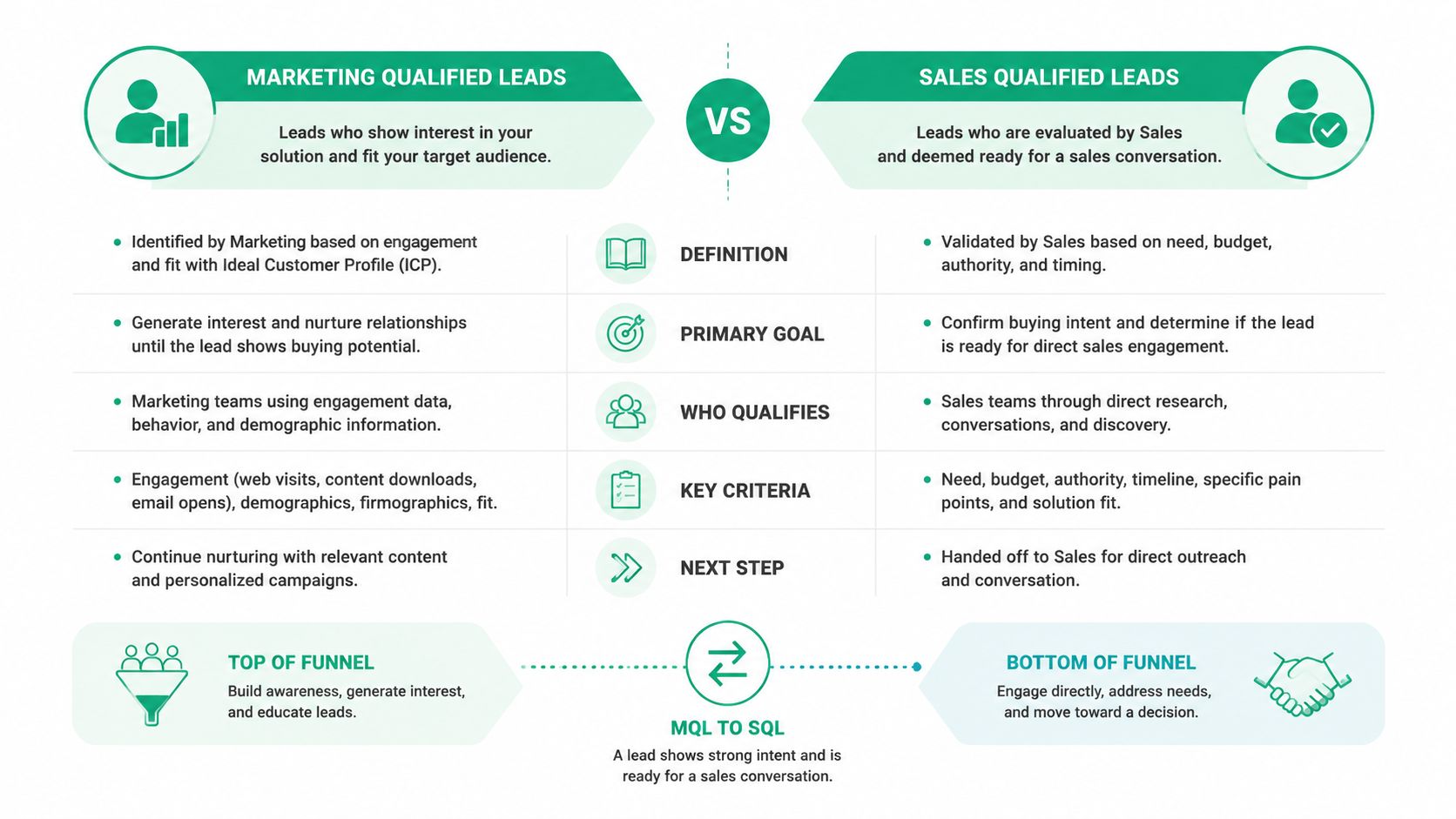
A lot of friction starts because teams use MQL and SQL like they mean the same thing. They don’t.
A marketing qualified lead, or MQL, has shown enough interest for marketing to say, “This person is engaged.” A sales-qualified lead goes further. Sales has reviewed the lead and confirmed there’s a reasonable chance of a real buying process.
An MQL is someone browsing the store and asking where a product is. An SQL is someone asking whether you can get the item ready because they want to buy it.
The real difference is intent
Interest creates MQLs. Intent creates SQLs.
An MQL may have downloaded a guide, opened several emails, or attended a webinar. Those actions matter, but they don’t prove a purchase is near. An SQL usually shows bottom-funnel behavior or answers discovery questions in a way that tells sales the lead is worth active pursuit.
That distinction matters because conversion rates are not close. SQLs typically convert to closed-won deals at 20 to 35 percent, while MQLs convert at 2 to 5 percent. On average, only 13 percent of MQLs advance to SQL status, according to Monday.com’s SQL benchmarks.
What marketing should treat as a hand-raise
If you already understand what a marketing-qualified lead is, the next step is to stop assuming engagement equals readiness.
Use MQLs to identify who deserves more attention from marketing. Use SQLs to identify who deserves real sales time.
A simple side-by-side view helps:
| Lead stage | What the behavior usually means | Who owns the next action |
|---|---|---|
| MQL | The lead is engaged and looks promising | Marketing continues nurture or sends for review |
| SQL | The lead has been vetted and appears sales-ready | Sales starts active outreach and discovery |
Where teams get this wrong
The common mistake is pushing leads over the wall too early. Marketing wants speed, sales wants quality, and the handoff becomes a guessing game. Then sales rejects leads, marketing gets defensive, and reporting becomes political.
A high lead count can hide a weak pipeline. A smaller list with clear intent is easier to close and easier to forecast.
A clean definition fixes that. Marketing can still generate interest at scale. Sales just shouldn’t inherit every signal as if it were revenue.
Core Qualification Criteria Your Team Must Use
The best SQL process is simple enough to use every day and strict enough to protect sales time. Achieving this often involves frameworks like BANT or MEDDIC. The framework matters less than the discipline. You need a repeatable way to check fit, urgency, and deal reality before a lead enters active sales work.

Start with BANT in plain English
Budget asks whether the buyer can pay for the solution.
That doesn’t require a blunt question in the first minute. You can ask what they’ve set aside for the problem, whether this purchase is already planned, or what level of investment they’re comparing. When budget is missing entirely, the lead may still be real, but it usually belongs in nurture until conditions change.
Authority asks who can approve the purchase.
You don’t need the final signer on every first call, but you do need access to the decision process. A contact who can’t bring in the budget owner often stalls the deal. Sales should know whether they’re talking to the decision-maker, an influencer, or a researcher.
Need asks whether there is a problem worth solving.
Weak qualifications quickly become evident. “Just exploring” is not the same as “our current process is breaking.” The lead should be able to describe the issue, its impact, and why change is under consideration now.
Timeline asks when the action is likely.
Urgency separates active deals from future possibilities. Zendesk reports 25% higher close rates when SQL criteria enforce budget alignment and urgency, with a purchase timeline under 90 days, and early disqualification cuts churn risk by 18%, as summarized in Amplitude’s SQL overview.
Use MEDDIC when the sale has more moving parts
BANT works well for many SMBs. MEDDIC is stronger when deals involve multiple stakeholders, formal buying criteria, or longer evaluation cycles.
Here’s the plain-English version:
- Metrics: What result does the buyer want?
- Economic buyer: Who controls the money?
- Decision criteria: What standards will they use to choose?
- Decision process: How will approval happen?
- Identify pain: What is broken or costly today?
- Champion: Who inside the account wants this solved?
If your team needs help operationalizing this with software, tools for AI-driven lead qualification can support triage, enrichment, and routing. They work best when your qualification criteria are already clear. Software won’t fix a fuzzy definition.
Questions that produce useful answers
Most bad qualifications come from vague discovery. Ask direct questions.
- For need: “What problem are you trying to fix right now?”
- For authority: “Who else needs to be involved before a decision is made?”
- For timeline: “Are you trying to solve this quarter, or is this still early research?”
- For budget: “Have you already set aside a budget for this, or are you building the case first?”
A short call can do the job if the questions are pointed and the rep records answers consistently.
Here’s a quick walkthrough for teams that want to train reps visually:
What doesn’t work
Many teams qualify on activity alone. That fails.
A lead can open emails every week and still have no budget, no authority, and no urgency. Another common mistake is treating one strong action, like a demo request, as automatic SQL status without confirming fit. Good qualification combines behavior with conversation.
Building Your SQL Scoring Model
Once your team agrees on what a sales-qualified lead is, stop relying on gut feel. Build a scoring model.
A scoring model gives structure to the decision. It tells marketing when a lead is warming up, tells sales when a lead deserves immediate follow-up, and gives both teams a shared language for handoff. You don’t need a complex rev ops stack to start. A spreadsheet, HubSpot, Salesforce, or another CRM can handle the first version.
Separate fit from behavior
Good scoring has two inputs.
The first is explicit data, which is what the lead tells you or what you know about the company. Job title, company size, industry, market, and service fit all belong here.
The second is implicit data, which is what the lead does. Pages visited, forms submitted, webinar attendance, replies to outreach, and demo requests are behavioral signals.
Behavior without fit creates false urgency. Fit without behavior creates stale lists. SQL scoring needs both.
Assign heavier points to buyer-intent actions
Not every action means the same thing. A blog visit is a light interest. A pricing page visit or purchase inquiry is much stronger.
Typical scoring models weight high-intent behavior heavily. A demo request might be worth 40 to 50 points, a pricing page visit 30 points, and a direct purchase inquiry 50+ points, according to Salesforce’s SQL guidance.
If you’re setting up automation in a CRM, this kind of logic fits naturally into marketing automation for B2B. The model doesn’t have to be fancy. It has to be consistent.
Sample SQL Qualification Scorecard
| Category | Attribute/Behavior | Points | Threshold for SQL: 80+ |
|---|---|---|---|
| Fit | Right industry or market | 10 | |
| Fit | Decision-maker or strong influencer | 20 | |
| Fit | Clear use case for your offer | 15 | |
| Behavior | Visited pricing page | 30 | |
| Behavior | Requested a demo | 40-50 | |
| Behavior | Sent a direct purchase inquiry | 50+ | |
| Behavior | Replied with active buying questions | 15 | SQL at 80+ |
This is a working template, not a law. A local service business may score contact-form intent differently from a SaaS company. An e-commerce brand may prioritize wholesale inquiry forms, repeat visits to shipping or pricing content, or outreach from retail buyers.
How to tune the model without overcomplicating it
Start with a version your team can explain in one minute.
Next, review the leads that sales accepted, the ones sales rejected, and the deals that moved. If leads are hitting the threshold but going nowhere, tighten fit criteria. If sales keeps finding good leads below the threshold, give more credit to the behaviors that preceded real conversations.
Keep the score visible, but never let the score replace judgment. A lead score should trigger review, not blind trust.
The best model is the one your team uses every day.
Mastering the MQL to SQL Handoff
A good SQL can still die in transit.
The lead was qualified. Marketing captured the right context. The contact asked for next steps. Then nobody followed up quickly, the CRM owner field stayed blank, or sales opened the record with no clue what the lead had already seen or said. That’s not a lead quality problem. It’s an operating problem.

Build a simple SLA, even if the team is small
A service level agreement sounds formal, but for most SMBs, it can fit on one page.
It should answer four questions:
- What qualifies for a handoff
- Who owns the lead after the handoff
- How fast must sales follow up
- What happens if sales rejects the lead
Without this, “sales-ready” becomes subjective again. Marketing says the lead asked for a quote. Sales says the account isn’t a fit. Both may be right, but the process is still broken if nobody has defined the rules in advance.
What information must travel with the lead?
A handoff should include more than contact details. Sales needs context that saves time and sharpens the first conversation.
At minimum, include:
- Source: Paid search, SEO, referral, email outreach, or another channel
- Intent signal: Demo request, pricing page visit, quote form, or direct inquiry
- Qualification notes: Budget status, timeline, pain point, stakeholders
- Recent engagement: Last meaningful action or message
- Recommended first angle: Why this lead appears worth contacting now
That handoff package lets sales start where marketing left off instead of restarting discovery from zero.
Nurture still matters after qualification
The handoff doesn’t replace lead nurturing. It changes the purpose of nurturing.
Forrester Research says companies that excel at lead nurturing generate 50% more sales-ready leads at 33% lower cost, according to Salesgenie’s summary of lead nurturing data. In practice, that means marketing should keep supporting sales with relevant follow-up content, reminders, and re-engagement when timing slips.
The cleanest handoff happens when marketing sends context, sales responds fast, and both teams agree on what “not ready yet” means.
Where handoffs usually break
Three failure points show up often.
One, marketing hands off too early because a form fill looks promising. Two, sales doesn’t respond while intent is still fresh. Three rejected leads disappear instead of returning to a structured nurture path.
A working handoff process closes all three gaps. It tells marketing when to send, sales when to act, and the CRM where the lead goes next if the answer is “good fit, wrong time.”
Essential SQL Metrics and How to Avoid Pipeline Killers
Tracking too much and learning too little is a common pitfall. For SQL management, you need a short list of metrics that tells you whether qualification is producing revenue opportunities or just producing activity.
Start with stage movement. Then look for places where the numbers are being inflated.
The metrics that actually help
Track these first:
- MQL to SQL conversion rate: This shows whether marketing is passing leads that sales can validate.
- SQL to customer conversion rate: This shows whether your qualification standards are identifying real opportunities.
- Sales cycle length: Shorter cycles usually point to a better fit and clearer intent.
- Sales acceptance or rejection reasons: These tell you whether the issue is fit, timing, authority, budget, or process.
For e-commerce teams blending lead capture with revenue reporting, it also helps to track e-commerce success on Shopify using operational KPIs tied to conversion behavior and order outcomes. That’s useful when SQLs feed both sales outreach and online purchase paths.
If you need the broader financial lens, connect these pipeline metrics to marketing ROI calculations. That’s where lead quality stops being a sales debate and becomes a budget decision.
The modern pipeline killer is blind trust in AI scoring
AI scoring can speed up sorting and prioritization. It can also create a polished version of bad data.
Gartner projects that 75% of B2B sales teams will use AI for lead scoring by 2026, but Forrester reports that 52% of users already experience false positives that can inflate SQL counts by 30%, as cited by Ortto’s review of sales qualified lead trends.
That trade-off matters. AI is good at pattern detection, but it can overvalue noisy behavior. A contact who clicks often may look hot in the model and still be a poor buyer. If your team promotes those leads automatically, the SQL count rises while actual deal quality falls.
How to avoid the common failures
Use AI for prioritization, not final approval. Keep a human review step on high-value leads.
Also watch for these issues:
- Definition drift: Sales and marketing start using different standards again.
- Static scoring models: The scorecard never changes, even when buying behavior does.
- Missing rejection feedback: Sales declines leads, but nobody records why.
- Vanity reporting: Teams celebrate SQL volume without checking close quality.
A pipeline gets healthier when rejected leads teach the system something. If rejection reasons stay hidden, the same bad leads keep returning with new labels.
Strong SQL programs are not built on more dashboards. They are built on cleaner definitions, disciplined review, and fast correction when the data starts lying.
How Ascendly Marketing Optimizes Your SQL Pipeline
Many businesses don’t need more leads. They need a cleaner path from traffic to qualified conversations.
That work usually starts upstream. SEO, PPC, content, email, and outreach bring in potential MQLs. Then the middle of the funnel determines whether those leads mature into real sales opportunities or just sit in the CRM as hopeful noise. Conversion-focused website improvements, tighter forms, better offer structure, clearer calls to action, and targeted outreach all shape that outcome.
Ascendly Marketing is built around that full-path view. Its services cover traffic generation, website design, content, paid media, email marketing, conversion rate optimization, and lead generation programs such as cold email outreach. That combination matters because SQL creation isn’t one tactic. It depends on attraction, qualification, routing, and follow-up working together.
The consultative process is straightforward. Discover clarifies goals, audience, and sales realities. The plan defines channels, qualification logic, and conversion paths. Execute puts campaigns, content, landing pages, and outreach into the market. The report shows what’s producing qualified activity and where the funnel needs adjustment.
For SMB and B2B teams, that kind of structure helps in a few practical ways:
- Lead definitions get documented: Sales and marketing stop improvising.
- Scoring becomes usable: Behavioral and fit signals can be built into forms, CRM workflows, and outreach sequences.
- Handoffs improve: Qualified leads reach the right person with context attached.
- Optimization becomes ongoing: Campaigns can be adjusted based on lead quality, not just volume.
The result is a more disciplined SQL pipeline. Traffic sources are judged by the quality of leads they produce. Sales gets cleaner opportunities. Marketing gets feedback that can improve targeting and messaging instead of just increasing top-of-funnel activity.
If your team is generating interest but struggling to turn that interest into real sales conversations, Ascendly Marketing can help you tighten the path from first click to qualified lead. A focused strategy across SEO, PPC, CRO, website performance, and outreach gives your sales team fewer dead ends and more leads worth working.