

TL;DR:
- Successful email marketing requires a strategic foundation including goal setting, audience targeting, and authentication.
- List growth should focus on opt-in methods and segmentation to improve engagement and deliverability.
- Regular testing, data analysis, and list hygiene are crucial for continuous campaign optimization.
You craft the perfect email, hit send, and wait. Then nothing. Low open rates, zero clicks, and revenue that stays flat. If that sounds familiar, you’re not alone. Most small and medium-sized business owners struggle with email marketing, not because they lack creativity, but because they lack a system. A scattered approach leads to inconsistent results. This guide walks you through every critical step, from setting goals to refining your campaigns, so you can build an email program that consistently drives engagement and sales.
Table of Contents
- Define your goals and build your foundation
- Grow and segment your email list
- Create, personalize, and automate your campaigns
- Test, analyze, and refine your process
- Our perspective: What most guides miss about email marketing success
- Take your email marketing further with expert help
- Frequently asked questions
Key Takeaways
| Point | Details |
|---|---|
| Start with strategy | Defining clear goals and your target audience sets the foundation for successful campaigns. |
| Segment for results | Using simple segmentation boosts engagement and prevents waste. |
| Automate and personalize | Automated, personalized campaigns deliver better ROI and save time. |
| Test and improve | Track your results, run A/B tests, and refine your process for steady improvement. |
Define your goals and build your foundation
Let’s start with what successful email marketers do before sending a single message. They get clear on purpose, audience, and infrastructure. Skipping this step is like building a house without a blueprint.
The step-by-step process for email marketing always begins with defining goals and identifying your target audience. Without both, you’re guessing. Your goal might be increasing sales, nurturing leads, re-engaging lapsed customers, or driving traffic to a new product page. Each of these goals requires a different approach to content, frequency, and metrics.
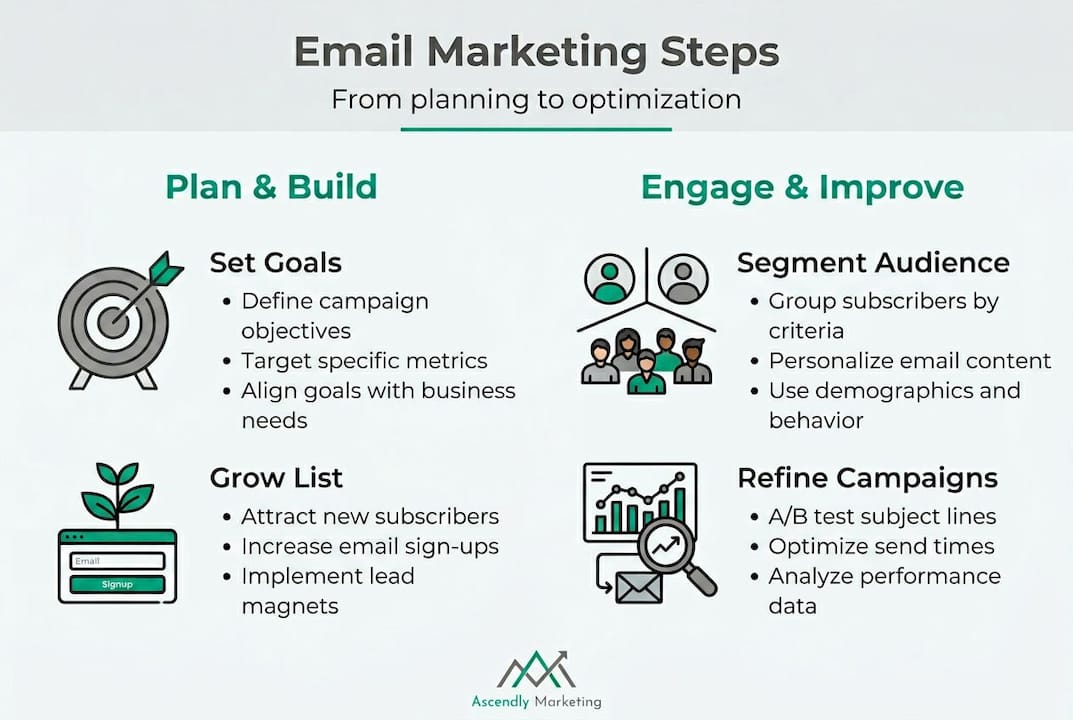
Once you know your goal, identify exactly who you’re speaking to. Build a picture of your ideal subscriber: their pain points, purchase behavior, and what they need from your brand. This shapes every decision you make later.
Next, choose a reliable email service provider (ESP). Popular options include:
- HubSpot: Strong CRM integration and automation capabilities
- Mailchimp: User-friendly interface with strong free-tier features
- Klaviyo: Excellent for e-commerce and behavioral triggers
- ActiveCampaign: Powerful automation at a mid-market price point
After choosing your ESP, set up domain authentication. This includes three technical protocols:
- SPF (Sender Policy Framework): Verifies your sending server
- DKIM (DomainKeys Identified Mail): Adds an encrypted signature to your emails
- DMARC: Instructs receiving servers how to handle failed authentication
Skipping authentication is one of the most common reasons emails land in spam folders. Most ESPs walk you through setup, so it’s not as technical as it sounds.
“Your email program is only as strong as the foundation you build before sending the first message. Goals, audience clarity, and proper authentication are non-negotiable starting points.”
Pro Tip: Start with your ESP’s free tier. Most platforms allow up to 500 or 1,000 contacts for free. Test your strategy there before committing to a paid plan. Once you’re ready to build an email list at scale, you’ll have a much clearer picture of what you need.
Grow and segment your email list
With your foundation set, you need a high-quality list. Here’s how to grow and leverage it.
Building an opt-in list with forms and targeted popups is the most sustainable way to grow your audience. Compliant list-building means every subscriber has actively agreed to hear from you. This protects your deliverability and your brand reputation. Lead magnets like discount codes, free guides, or exclusive content are highly effective at driving sign-ups.
Here’s a quick comparison of list-building methods:
| Method | Cost | Speed | Quality |
|---|---|---|---|
| Website opt-in forms | Low | Slow | High |
| Exit-intent popups | Low | Medium | Medium |
| Lead magnet landing pages | Medium | Fast | High |
| Social media lead ads | Medium | Fast | Medium |
| Purchased lists | Low | Instant | Very low |
Never buy email lists. They tank your deliverability, invite spam complaints, and often violate CAN-SPAM and GDPR.
Once your list starts growing, segmentation is your highest-leverage move. Here’s how to approach it step by step:
- Segment by demographics: Age, location, and job role help you send relevant content
- Segment by behavior: Separate those who opened last month from those who haven’t opened in six months
- Segment by purchase history: Separate first-time buyers from repeat customers
- Segment by preferences: Use survey data or click behavior to infer content interests
- Suppress inactive contacts: Remove or suppress anyone who hasn’t engaged in over 90 days
Double opt-in is worth implementing. It sends a confirmation email before adding someone to your list, which reduces fake sign-ups and improves list quality over time.
Pro Tip: When you grow your email list with segmentation in mind from the start, you’ll see higher open rates and click-throughs from day one—segment early, not as an afterthought.

Create, personalize, and automate your campaigns
Now that you have a segmented audience, your next move is to create emails they can’t ignore.
Start with a content calendar built on the 80/20 rule: 80% of your emails should deliver value (education, tips, resources), and 20% can be promotional. Subscribers who only receive sales pitches disengage fast. But those who receive consistent value stay loyal and convert more readily.
Personalization is where most SMBs leave serious money on the table. Adding a subscriber’s name to a subject line is the floor, not the ceiling. Consider personalizing based on past purchases, browsing behavior, geographic location, or lifecycle stage. Automations like welcome emails and abandoned cart sequences use this data to send exactly the right message at exactly the right moment.
Here’s a quick look at automation types and what they do:
| Automation type | Trigger | Goal |
|---|---|---|
| Welcome series | New subscriber | Introduce brand, build trust |
| Abandoned cart | Cart left empty | Recover lost revenue |
| Re-engagement | 60-90 days inactive | Win back lapsed contacts |
| Post-purchase | Order confirmed | Upsell, gather reviews |
| Birthday/anniversary | Date-based | Strengthen loyalty |
For timing, most audiences respond best to emails sent Tuesday through Thursday between 9 and 11 AM. But treat that as your starting point, not gospel. A/B testing different send times reveals what actually works for your specific subscribers.
You can also test subject lines, preview text, button colors, and call-to-action wording. Check out drip campaign examples to see how a sequenced approach guides subscribers toward conversion without feeling pushy.
- Use first-name personalization in subject lines when you have the data
- Write preview text that builds on the subject line rather than repeating it
- Keep your primary call-to-action above the fold
- Match the email’s visual tone to your landing page for consistency
Pro Tip: Start with just one automation, a welcome sequence, before building out a full automation library. Get that one right, then expand. Learning to boost email engagement often comes down to mastering the basics before adding complexity.
Test, analyze, and refine your process
Execution is only half the battle. Consistent improvement separates good from great marketers.
You need to track the right numbers. Here are the core metrics every SMB email marketer should monitor:
- Open rate: Measures subject line effectiveness and sender reputation
- Click-through rate (CTR): Indicates how compelling your content and calls-to-action are
- Bounce rate: Hard bounces signal invalid addresses; keep this under 2%
- Spam complaint rate: Must stay below 0.1% to protect deliverability
- Unsubscribe rate: A spike here usually signals a mismatch between content and audience expectation
“Deliverability is the silent killer of email programs. You can write brilliant emails, but if they’re landing in spam, nobody reads them.”
Inbox placement depends on several technical practices beyond just good content. Warm new IP addresses gradually by starting with small sends and increasing volume slowly. Avoid URL shorteners in email body copy because spam filters flag them. Practice consistent list hygiene by removing hard bounces immediately and suppressing long-term inactives.
Here’s a simple framework for your monthly optimization routine:
| What to review | What to change | Why it matters |
|---|---|---|
| Subject line open rate | Test new angles or hooks | Improves subscriber engagement |
| CTR by segment | Adjust content per segment | Increases relevance and clicks |
| Bounce and complaint rates | Clean list and check sending settings | Protects deliverability |
| Unsubscribes by campaign | Review content-audience fit | Reduces list churn |
For broader context on setting meaningful benchmarks, explore success measurement strategies that align marketing activity with real business outcomes. You can also review email marketing case studies to see how these principles play out in real campaigns.
A/B testing should become a habit, not an occasional exercise. Change one variable at a time. If you test subject lines, keep everything else identical. Over time, these small experiments compound into significant performance improvements.
Our perspective: What most guides miss about email marketing success
We’ve covered the playbook. Here’s what experience tells us really moves the needle.
Most SMB marketers obsess over design templates and clever copy while completely ignoring deliverability and list hygiene. We’ve seen beautifully crafted campaigns fail because the sender’s domain reputation was quietly suffering. Open rates tank, and business owners blame the subject line when the real problem is that emails never reached the inbox in the first place.
The uncomfortable truth is that a plain-text email from a healthy, authenticated domain will outperform a gorgeous HTML newsletter sent from a flagged IP every single time.
Long-term email marketing success is 40% creative, 60% disciplined execution. That means cleaning your list even when it shrinks your subscriber count. It means reviewing your complaint and bounce rates monthly. It means checking practical email marketing tips not just when results drop, but as a regular practice. The marketers who win aren’t always the most creative. They’re the most consistent.
Take your email marketing further with expert help
If you’re ready to accelerate your results, here’s how we can help.
Building a high-performing email program takes time, testing, and a solid strategy behind every send. At Ascendly Marketing, we’ve helped small and medium-sized businesses move from flat open rates to campaigns that consistently drive leads and revenue.
We don’t just manage email. Our full suite of digital marketing services means your email strategy works alongside your SEO, paid advertising, and content marketing for compounding results. If you’re curious whether your current approach has gaps, reach out for a free strategy session. We’ll give you clear, honest feedback, no pressure.
Frequently Asked Questions
What is the most important first step in email marketing?
The most important first step is defining your goals and clearly identifying your target audience. The email marketing process always begins here because every tactical decision flows from these two answers.
How often should I clean my email list?
You should suppress or clean inactive contacts at least every 90 days. Keeping complaint and bounce rates low is essential to maintaining strong inbox placement and sender reputation.
Does personalization really make a big difference?
Yes. Personalization lifts opens and CTR by 20 to 26% according to industry data, making it one of the highest-return tactics available to email marketers.
What’s the best time to send marketing emails?
Testing consistently shows that Tuesday through Thursday between 9 and 11 AM yields the strongest results for most audiences, though your own list data should guide final timing decisions.