
TL;DR:
- Brand visibility encompasses a brand’s overall presence across all channels where customers make decisions, extending beyond social media. It influences trust, credibility, and competitive advantage by ensuring consistent, multi-channel exposure that builds long-term recognition. Measuring and consistently optimizing visibility strategies through content, backlinks, PR, and engagement are essential for sustainable growth.
Most business owners assume brand visibility means posting on Instagram three times a week or running a few Google Ads. That assumption is expensive. Brand visibility is your business’s total presence across every channel where your customers make decisions, and it goes far deeper than social media. This guide breaks down what brand visibility actually means, how it differs from brand awareness and brand recognition, why it drives real growth, and which strategies work in 2026’s marketing environment. You’ll leave with a clear framework you can apply immediately.
Table of Contents
- Key takeaways
- What is brand visibility, really?
- Why brand visibility matters for your business
- How to improve brand visibility in 2026
- Measuring brand visibility
- My take on what SMBs consistently get wrong
- Ready to build real brand visibility?
- FAQ
Key takeaways
| Point | Details |
|---|---|
| Visibility spans all channels | Brand visibility includes search engines, social media, offline media, events, and physical locations. |
| It precedes trust and sales | Customers can’t buy from a brand they’ve never seen. Visibility is the first step toward brand equity. |
| Measurement drives improvement | Track frequency, sentiment, and citation quality using a brand visibility score to guide your strategy. |
| Content freshness protects your score | Outdated content can reduce citation rates by 30 to 50% within just 90 days. |
| Strategy depends on your domain authority | Brands below DR 35 should prioritize link building; those above DR 40 should focus on content optimization. |
What is brand visibility, really?
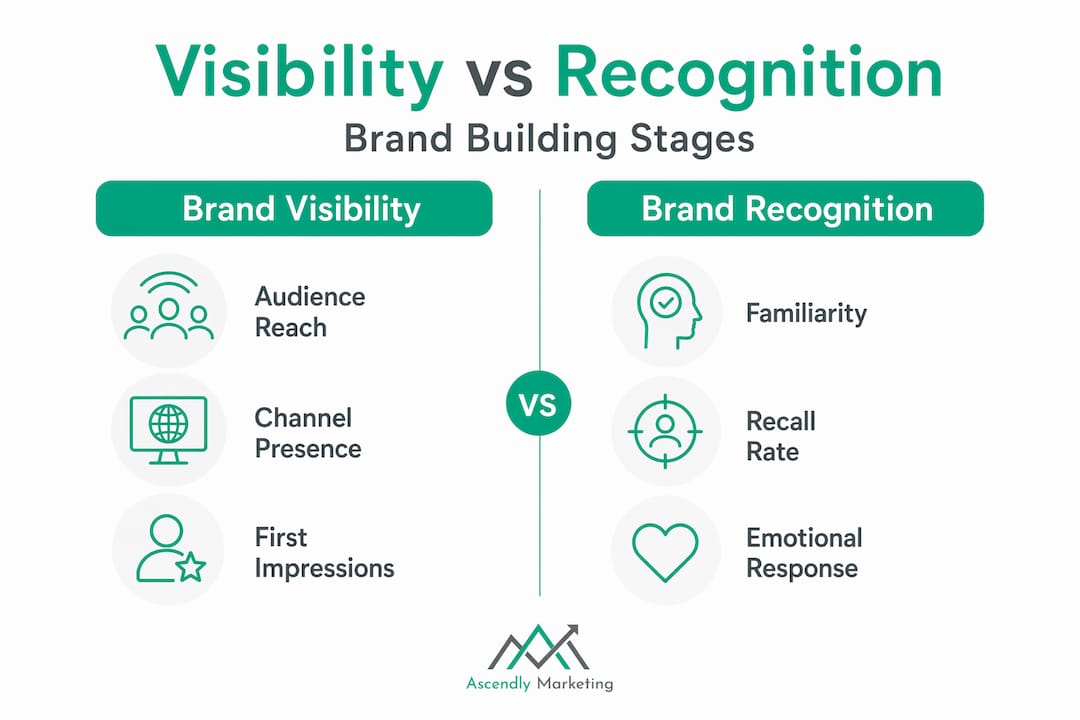
Brand visibility is the measurable degree to which your brand appears in front of your target customers across all relevant channels. Brand visibility encompasses presence across every platform where your audience is active, including search engines, social media, offline media, paid ads, events, and physical locations. It is not a single metric. It’s a composite picture of how often and how prominently your brand shows up.
Here’s where many people get confused. Brand visibility, brand awareness, and brand recognition are three different things, and mixing them up leads to wasted budget.
| Concept | What it means | Example |
|---|---|---|
| Brand visibility | How often your brand appears in front of people | Your business shows up on page one of Google |
| Brand awareness | Whether people know your brand exists | A shopper has heard of your company before |
| Brand recognition meaning | The ability to identify your brand from a cue | A customer sees your logo and knows who you are |
Think of it as a funnel. Visibility comes first. Without it, awareness can’t form, and recognition is impossible. A bakery that runs a great Instagram account but doesn’t appear in local Google searches is limiting its own reach. Someone hungry for a birthday cake at 9 p.m. isn’t scrolling Instagram feeds. They’re typing “birthday cake near me” into Google.
The practical consequence is significant. Brands that treat visibility as only a social media exercise are leaving out search, PR, directories, podcasts, review platforms, and offline touchpoints. Every one of those channels is a potential first impression.
Why brand visibility matters for your business
The importance of brand visibility is not abstract. It directly affects whether a prospective customer chooses you or your competitor when they’re ready to buy.

Consider the psychology behind purchasing decisions. People gravitate toward brands they recognize. Familiarity reduces perceived risk, and trust begins with repeated exposure. A small accounting firm that appears in Google searches, local directories, a few industry publications, and an occasional podcast reaches that familiarity threshold much faster than one that relies solely on word of mouth.
Here’s what visibility does in practical terms for an SMB:
- It puts your brand in front of people who didn’t know to look for you specifically
- It builds credibility through consistent presence in trusted channels
- It creates competitive separation when customers compare options
- It compounds over time since each new touchpoint reinforces the last
Search engines increasingly prioritize trusted, recognizable brands over pure keyword rankings in 2026. That’s a structural shift, not a trend. If your brand isn’t visible, it’s not just missing attention. It’s missing authority.
The long game matters here. As one sharp analysis of modern branding puts it:
"Attention is fleeting and rented; brand is earned through consistent value, trust, and meaningful identity over time."
That distinction separates businesses that grow from those that plateau. A viral post might spike your traffic for a week. Sustained brand visibility across multiple channels builds the kind of recall and loyalty that converts strangers into repeat customers.
How to improve brand visibility in 2026
Building brand visibility requires a multi-channel approach. No single tactic is enough on its own. Here are the most effective brand visibility strategies you can deploy right now, ordered by impact and practicality for SMBs.
-
Optimize content for direct answers. AI platforms like ChatGPT and Google’s AI Overviews pull answers from structured, authoritative content. Restructuring content to lead with direct answers improves citation rates by 20 to 40% within two to three weeks. That means your articles, service pages, and FAQs should answer the key question in the first sentence, not the fifth paragraph.
-
Build quality backlinks. Links from high-authority sites tell both search engines and AI platforms that your brand is a credible source. Building 5 to 10 quality backlinks from sites with a Domain Rating above 40 can increase your visibility score by 10 to 20% over four to six weeks. Guest posts, digital PR, and industry directories are the fastest paths there. You can explore how off-page SEO works and why it’s central to this effort.
-
Refresh your content consistently. Content decay is a real, measurable threat. Without refreshing content, visibility and citation rates drop by 30 to 50% within 90 days. Update statistics, revise outdated sections, and update publication dates on high-value pages at least every quarter.
-
Leverage PR alongside SEO. Digital public relations earns placements in media outlets that carry existing authority. When a respected publication mentions your brand, it creates a backlink and a brand impression simultaneously. That combination is more efficient than either tactic alone.
-
Stay consistent across social media. Social doesn’t exist in isolation, but it reinforces visibility on channels your audience checks daily. Use it to distribute content, engage directly, and create additional indexed pages that appear in search results.
-
Show up in your industry’s conversations. Podcasts, webinars, guest posts, and community forums place your brand in front of engaged audiences. These are ways to enhance brand visibility that most SMBs ignore entirely.
Pro Tip: Your strategy priority should depend on where your brand currently stands. Brands with Domain Rating below 35 should put link building first. Once you cross DR 40, shift your focus to content optimization and source gap outreach for AI citation improvement.
| Tactic | Timeframe for results | Best for |
|---|---|---|
| Content restructuring | 2 to 3 weeks | Brands with existing content |
| Backlink building | 4 to 6 weeks | Brands with DR below 40 |
| Content refreshing | Ongoing | All brands |
| Digital PR | 1 to 3 months | Brands targeting media coverage |
| Social media consistency | Ongoing | All brands |
Understanding digital branding methods gives you the foundation to execute these tactics with a coherent identity rather than isolated campaigns. SEO builds brand awareness in ways that paid advertising cannot replicate, because earned rankings carry long-term credibility.
Measuring brand visibility
You can’t improve what you don’t measure. The challenge with brand visibility is that it spans many channels, so your measurement approach needs to match that breadth.
Start with the brand visibility score. This metric measures AI platform mentions on a scale of 0 to 100, tracking how often your brand is cited, in what position, and with what sentiment across platforms like ChatGPT and Google’s Gemini. It’s a modern visibility metric built for how people actually search in 2026.
Beyond that, here are the core data sources and metrics worth tracking:
- Search impressions and rankings. Google Search Console shows how often your brand and branded keywords appear in search results.
- Share of voice. Compare how often your brand appears in search or social conversations relative to competitors.
- Backlink profile growth. Track the number and quality of sites linking back to you using tools like Ahrefs or Moz.
- Mention frequency and sentiment. Tools like Google Alerts, Mention, or Brand24 surface how often your brand is discussed and whether the tone is positive or negative.
- Direct traffic trends. Rising direct traffic often indicates growing brand recall. People who know your name type it directly rather than finding you through search.
| Metric | What it tells you | Tool to use |
|---|---|---|
| Brand visibility score | AI platform citation frequency and quality | AI tracking platforms |
| Search impressions | How often your brand appears in Google | Google Search Console |
| Share of voice | Your brand’s presence vs. competitors | SEMrush, Ahrefs |
| Mention sentiment | Whether brand mentions are positive or negative | Brand24, Mention |
| Direct traffic | Level of unprompted brand recall | Google Analytics |
The most common mistake SMBs make in measuring brand visibility is checking metrics once and never returning. Set a monthly review cadence. Compare against your baseline from three months prior. Competitive benchmarking adds a second layer of context because improving in isolation doesn’t tell you whether you’re keeping pace with your market.
Understanding brand recognition is the next logical step after you’ve established visibility measurement, because recognition is what good visibility eventually produces.
My take on what SMBs consistently get wrong
I’ve worked with hundreds of small and medium-sized businesses since 2013, and I see the same pattern repeatedly. Owners invest in one channel, see modest results, get frustrated, and pivot to something new. The problem isn’t the channel. The problem is expecting a single tactic to do the job that only a coordinated presence can do.
Here’s what I’ve learned. Brand visibility isn’t a campaign. It’s a system. Businesses that grow consistently aren’t the ones with the cleverest ads. They’re the ones that show up reliably across search, social, PR, and content over months and years. That consistency is what converts strangers into buyers and buyers into advocates.
The other misconception I encounter constantly is treating visibility and attention as the same thing. They’re not. A trending post gets you attention for 48 hours. A well-optimized page on a topic your customers search monthly gives you visibility for years. Sustainable brand influence comes from consistent delivery of meaningful value, not from chasing spikes.
My honest advice: map every channel where your prospective customers make decisions. Then ask yourself honestly where your brand is absent. That gap is your real visibility problem. Start closing it one channel at a time, measure your progress monthly, and resist the urge to abandon a strategy before it has had time to work.
— Ascendly
Ready to build real brand visibility?
If you’ve recognized gaps in your brand’s visibility while reading this, you’re not alone. Most SMBs have them. At Ascendlymarketing, we’ve been closing those gaps for clients since 2013 through SEO, content marketing, digital PR, and paid advertising. Each service is built around one goal: making sure your brand shows up where it matters most.
Our team of SEO specialists, content creators, and PR strategists has helped businesses across industries grow their presence and generate measurable results. If you want a clear picture of where your brand stands and a plan to improve it, explore our digital marketing services or visit Ascendlymarketing to book a consultation.
FAQ
What is brand visibility in simple terms?
Brand visibility is how often and how prominently your business appears in front of potential customers across all channels, including search engines, social media, PR, and offline touchpoints. It is the foundation of brand awareness and recognition.
How is brand visibility different from brand awareness?
Brand visibility is about how often your brand appears in front of people. Brand awareness is whether those people know your brand exists. Visibility must come first because you cannot build awareness without exposure.
What affects brand visibility most?
The biggest factors include your search engine rankings, backlink profile, content quality and freshness, social media consistency, and PR presence. Brand visibility spans all platforms where your audience is active, so gaps in any channel reduce your overall score.
How do you measure brand visibility?
Track metrics like search impressions, share of voice, mention frequency and sentiment, direct traffic trends, and your brand visibility score, which measures how often AI platforms cite your brand on a 0 to 100 scale.
How long does it take to improve brand visibility?
Content restructuring can show results within two to three weeks. Backlink building typically takes four to six weeks. Broader visibility gains from consistent PR and content efforts usually become measurable within three to six months.