

Some weeks feel full until you look closer. The calendar has a few good jobs, a few price shoppers, and a few no-shows from web forms you paid for. Then the phone rings with a customer who already called three other repair companies and just wants whoever can get there first.
That’s the appliance repair lead problem in one sentence. Volume isn’t the issue. Control is.
A lot of owners buy whatever leads are available, then try to work harder at the back end. That usually means more follow-up, more chasing, and more wasted spend. A better approach is to build a system that attracts the right calls, routes them fast, and turns them into booked appointments before the customer keeps shopping.
Stop Buying Leftover Leads and Build Your Own Engine
Shared leads feel convenient because they let you buy demand without building anything first. The downside shows up fast. You pay for the inquiry, your office calls back, and the customer says they already booked with someone else. That isn’t a sales problem most of the time. It’s a channel problem.
This market is large enough to justify building your own pipeline. The U.S. appliance repair sector generated $7.0 billion in revenue in 2025 and supported 37,769 appliance repair businesses in the United States, according to this appliance repair industry roundup citing IBISWorld. In plain terms, there’s demand, but it’s spread across a crowded field of small operators.
That changes the game. You don’t need every search in your market. You need the searches with urgency, clear intent, and a straight line to your dispatcher.
Practical rule: If a lead source gives the customer to multiple shops, assume your margin drops before your tech even leaves the driveway.
Owners who get predictable work usually stop thinking in terms of “buying leads” and start thinking in terms of building a lead engine. That engine has a few parts: your local visibility, your paid demand capture, your intake system, and your phone process. When those parts line up, you stop depending on whatever an aggregator sends over.
If you want a broader look at how local service companies structure that system, this guide to effective marketing for contractors is useful because it frames lead generation as an operating model, not just a list of tactics. The same logic applies to appliance repair. You’ll also want to think in terms of channel mix and owned assets, which this resource on lead generation marketing strategies lays out well.
Build Your High-Trust Local Foundation
A weak website and an unfinished Google Business Profile make every other channel more expensive. Paid traffic leaks. Map searches don’t convert. Referral partners hesitate to send business because your online presence looks thin.
The foundation has three pieces, and each one affects bookings.
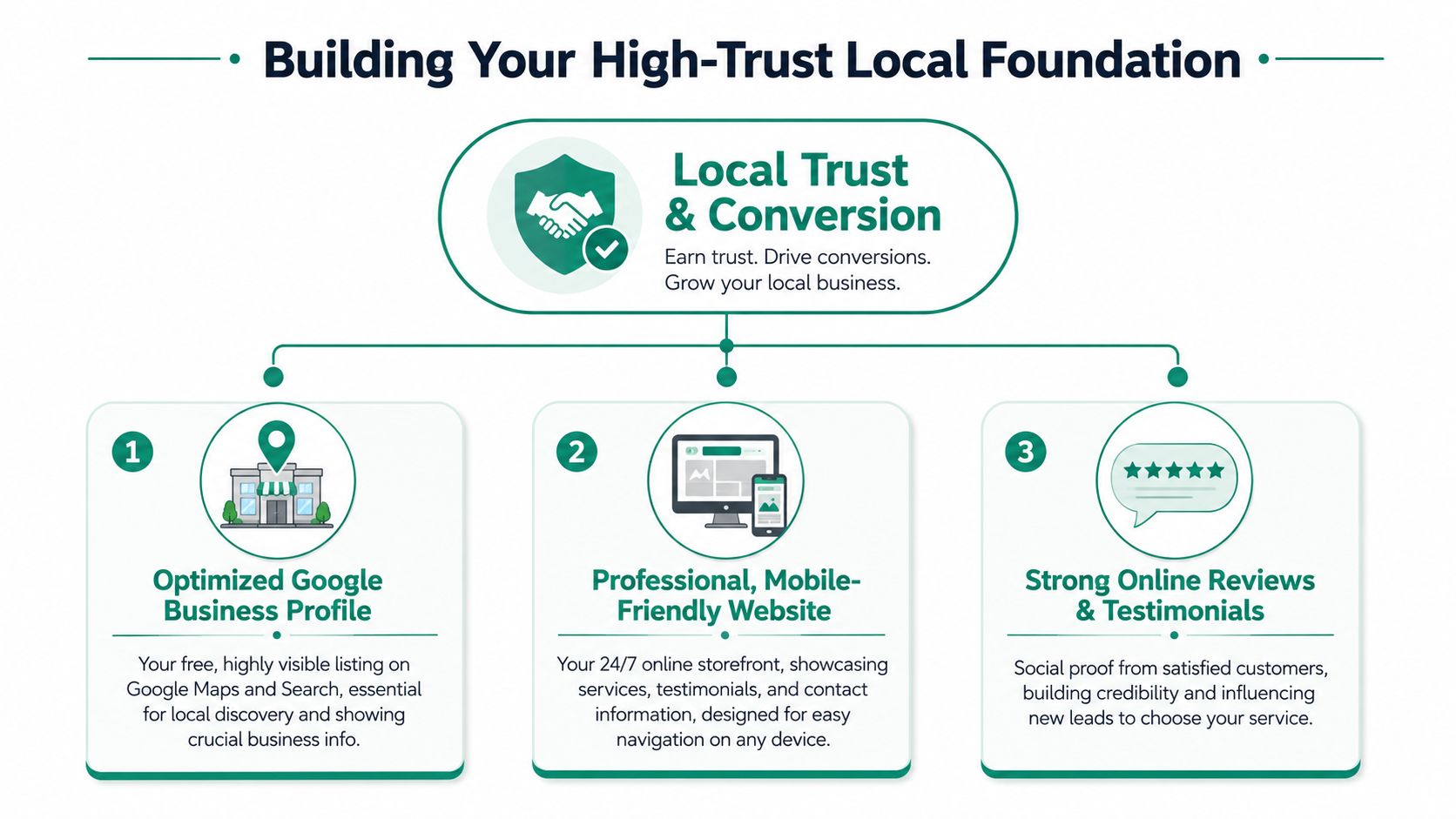
Fix the website first
Most appliance repair searches happen when something stopped working, and the customer wants help now. That means your site has one job. Help people decide quickly and contact you without friction.
Use a mobile-first layout. Put the phone number at the top. Add a visible click-to-call button. Keep forms short. List the appliance categories you service in plain language. If someone lands on your site from a paid ad for refrigerator repair, don’t make them dig through a generic homepage to figure out whether you handle refrigerators.
The same applies to trust signals. Use real customer feedback, real service area information, and clear calls to action. Don’t bury contact details in the footer and hope people hunt for them.
Tighten your Google Business Profile
For many local service businesses, Google Maps is the front door. A customer searches from a phone, scans a few listings, checks reviews, and taps call. That’s why profile completeness matters.
Practitioner guidance highlights click-to-call, Reserve with Google, short forms, consistent NAP data, and reviews as key conversion levers, and notes that homeowners often search on mobile for immediate help. That’s why businesses need to capture both Google Maps demand and paid search demand, as outlined in this Housecall Pro guide on getting appliance repair leads.
Here’s what to clean up:
- Service areas: Define them clearly so your listing matches where you dispatch.
- Business details: Keep your name, address, and phone data consistent everywhere.
- Primary actions: Make calling and booking easy from the profile itself.
- Photos and updates: Add current visuals and regular posts so the profile doesn’t look abandoned.
If your Maps presence needs work, this walkthrough on how to rank higher on Google Maps gives a useful framework.
A good Google Business Profile doesn’t just help ranking. It filters customers. People see your service area, reviews, and contact path before they call.
Build a review process that actually runs
Most shops say they want more reviews. Fewer have a system that makes reviews happen after the job.
Keep it simple. Ask after a successful visit, while the customer still remembers the result and the technician’s name. Send a direct review request through text or email. Train the office to ask in the same calm, plain language every time. If the request depends on memory, it won’t happen consistently.
A workable process looks like this:
- Trigger the request after job completion: Don’t wait days.
- Use one main review destination: Too many options reduce follow-through.
- Mention the technician or service provided: Specific requests feel more natural than canned ones.
- Monitor and respond: Thank customers and address issues without arguing.
Reviews do two jobs at once. They improve trust, and they improve the performance of every other channel sending traffic into your business.
Mastering Paid Channels for Immediate Demand
Paid channels are where many appliance repair companies either print money or burn it. The difference usually isn’t the platform itself. It’s whether the channel matches the way your office handles incoming demand.
This visual helps frame the two main Google options before you spend.
Google Local Services Ads
Local Services Ads work well for operators who want direct lead flow from local searchers without building a full search campaign first. They sit high in results and are designed around service intent.
Their appeal is simple. The customer sees the listing, checks basic trust signals, and calls. Fewer steps. Less friction.
That said, LSAs still need management. If your business profile is weak, your service settings are messy, or your team misses calls, the channel won’t save you. Paid demand only works when the operation behind it is tight.
Google Ads with dedicated landing pages
Traditional Google Ads give you more control. You choose the search terms, ad copy, and landing pages. That control is useful when you want to separate refrigerator repair from dishwasher repair, or push harder into certain ZIP codes.
The trap is sending ad traffic to a broad homepage. A user who searched for a specific repair issue should land on a page that matches that intent, with a short form, a clear phone option, and service details that line up with the search.
Use paid search when you want to shape demand instead of just accepting it. That includes:
- Service-specific campaigns: Separate campaigns by appliance type or service line.
- Location-focused pages: Match ad groups to the areas you serve.
- Message control: Speak to urgency, availability, and next steps in plain terms.
For examples of how campaign structure and landing page alignment work together, review these PPC marketing examples.
Here’s a useful video if you want a broader paid search view before building campaigns:
Lead marketplaces and purchased leads
Often, owners get stuck because the upfront cost can look lower. But the economics only make sense when you look at conversion, not just lead price.
A lead-generation guide for appliance repair reports that exclusive live calls commonly cost $20 to $100 per lead and convert at 40 to 60%, while shared web form leads often cost $10 to $30 per lead and convert at only 10 to 20%. The same source says exclusivity and response time drive ROI, as detailed in this appliance repair leads cost and conversion breakdown.
That’s why cheap leads often become expensive jobs to win. You save on the front end, then lose on speed, competition, and call quality.
Buy channels that give your team a chance to win. Don’t buy channels that turn your office into a callback race.
A practical way to think about channel choice:
| Channel | Best fit | Main strength | Main weakness |
|---|---|---|---|
| Google Local Services Ads | Shops that want direct local lead flow | High-intent visibility | Less control than full search campaigns |
| Google Ads | Shops that want targeting control | Strong message and landing page control | Easy to waste spend with poor setup |
| Lead marketplaces | Shops that need quick volume | Fast launch | Lower control and more competition on each lead |
If your intake process is slow, start with fewer channels, not more. More volume won't fix weak handling.
Generate Free Leads with SEO and Partnerships
Free leads aren't really free. You pay in time, process, and follow-through. That trade is still attractive because these channels can produce exclusive inquiries without tying your business to a constant ad budget.
Local SEO that matches real search behavior
A lot of appliance repair SEO fails because it's written like a textbook. Customers don't search that way. They search with a broken machine in front of them.
Build content around problems people type into Google. Good examples include issue-based pages such as a dishwasher not draining, a refrigerator not cooling, or a washer that won't spin. Write them in plain English. Explain the symptom, what the customer should notice, and when to call.
Then add location structure. If you serve multiple areas, create service pages that match those areas and the jobs you want. Keep each page specific. Generic city pages with swapped-out place names rarely help.
A practical local SEO stack looks like this:
- Problem pages: Answer common appliance failure questions in short, useful articles.
- Service pages: Create dedicated pages for repair categories customers search for.
- Location pages: Match service areas to real dispatch coverage.
- Local citations: Keep business information consistent in trusted directories.
- Internal linking: Send users from symptom content to service booking pages.
Write for the customer who needs a technician, not for the marketer trying to hit a word count.
Partnerships that send better leads than ads
A strong referral network can outperform paid channels on lead quality because the customer arrives with trust already attached. The best partners are businesses that see the problem before you do, but don't solve it themselves.
Property managers are a natural fit. So are real estate agents, general contractors, plumbers, and cleaning companies that work inside homes. These relationships don't need elaborate programs. They need clarity, reliability, and a fast response when a partner sends someone over.
When you reach out, don't pitch like a marketer. Keep it practical. Explain what you handle, where you service, and how easy it is to send a customer your way.
Partnership outreach script templates
| Partner Type | Outreach Channel | Script Template |
|---|---|---|
| Property manager | “Hi [Name], I run an appliance repair company that handles residential service calls in [service area]. We help with common breakdowns that need quick scheduling and clear communication. If you ever need a repair option for tenants or owners, I’m happy to share our service details and booking process.” | |
| Real estate agent | Phone | “Hi [Name], I’m reaching out because buyers and sellers sometimes need appliance issues handled fast before a closing or listing. We work on in-home repair calls and keep scheduling straightforward. If that ever comes up, I can send over our contact details.” |
| Plumber | In person | “We run into overlap sometimes when the issue looks plumbing-related at first but turns out to involve an appliance. If you want, let’s swap info so either of us can send the customer to the right place fast.” |
| General contractor | “Hi [Name], if your team comes across appliance problems during remodeling or punch-list work, we can be a repair contact for those homeowners. We focus on quick intake and direct scheduling. Let me know if you want a simple referral contact sheet.” |
Partnerships stick when you make the other business look good. That means answering referred calls promptly, communicating clearly, and keeping the handoff simple.
Don’t split your effort too early
SEO and partnerships work best when someone owns the follow-up. One person should publish or update content on schedule. One person should manage outreach and maintain the referral list. If everybody owns it, nobody owns it.
The upside is straightforward. You reduce dependence on rented channels and bring in leads that aren’t already being sold to the shop down the street.
Optimize Your Lead Intake System
Most lead loss happens after the click and before the conversation. A customer fills out a form, the office doesn’t see it right away, and the opportunity dies unnoticed in an inbox.
That’s avoidable if the intake system is built around speed and routing.
Route leads by service reality
A high-performing lead funnel for appliance repair is defined by operational details such as ZIP-level and appliance-brand-level routing, along with forms that capture intent signals before a human engages the lead, according to this Dolead guide on appliance repair lead generation. That same guidance treats each lead as time-sensitive and operationally pre-qualified.
The idea is simple. Don’t dump every inquiry into one general queue. Route by the factors that matter to dispatch.
Examples:
- ZIP code routing: Send leads to the right territory or scheduler immediately.
- Appliance category routing: Separate kitchen and laundry issues if different teams handle them.
- Urgency flags: Push no-cooling refrigerator issues ahead of lower-urgency requests.
Use forms that pre-qualify instead of just collect names
A generic contact form creates extra phone work because your team has to re-ask basic questions. A better form gathers booking information upfront.
Include fields like:
- Appliance type
- Brand
- Issue summary
- ZIP code
- Preferred contact method
- Preferred appointment window
Short forms still win. But short doesn’t mean vague. Ask only for what helps your team decide whether the lead fits your service area, service line, and schedule.
The best form does two jobs at once. It makes it easy for the customer to ask for help, and it gives your office enough context to act fast.
Connect forms, phones, and CRM records
If your web form lives in one tool, your call tracking lives in another, and your office keeps notes in text messages, you can’t judge channel quality accurately. You’ll end up making budget decisions based on guesswork.
Tie every lead source into one CRM or central lead log. Each record should show where the lead came from, what the issue was, whether contact was made, and what happened next. Use simple outcome codes such as booked, not serviced, duplicate, no answer, and lost to competitor.
That does more than clean up admin work. It shows which channels produce booked jobs and which ones only produce activity.
Turn Every Call into a Booked Appointment
The phone is where the lead becomes revenue or disappears. Owners spend hours discussing ad budgets and almost none listening to calls. That’s backward.
For inbound phone-driven appliance repair leads, one set of operational benchmarks gives you a clear target: a 95%+ answer rate, under 5% hang-up rate, and a 30 to 40% booking rate from calls to appointments. Missed calls should be returned in under 5 minutes, according to this call handling benchmark guide for appliance repair businesses.
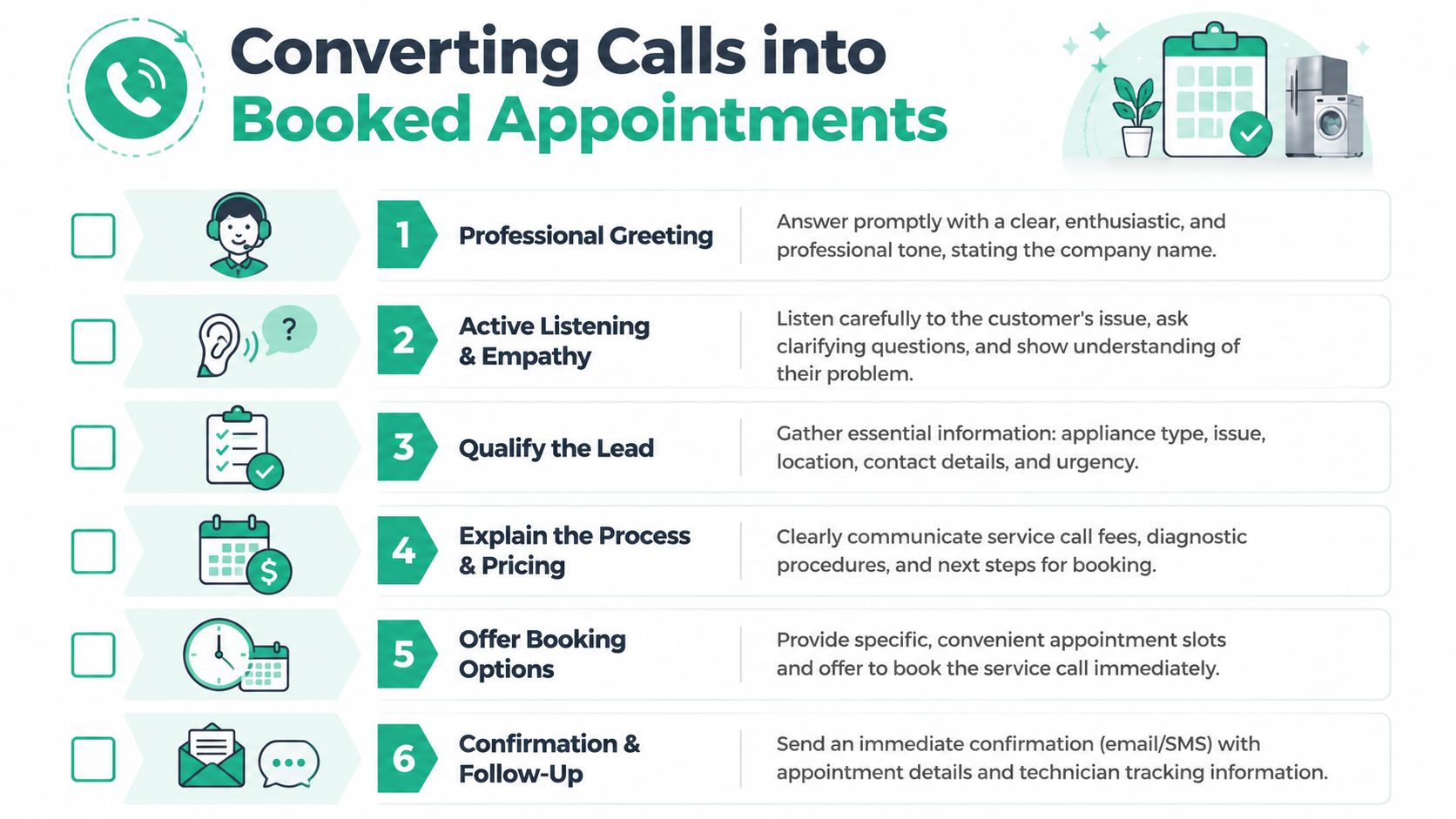
What good phone handling sounds like
Customers calling for appliance repair usually want three things fast. They want to know you handle the issue, you serve their area, and you can move the process forward without making them repeat themselves.
That means the person answering the phone isn’t just doing admin work. They’re qualifying, reassuring, and closing.
A simple booking script works better than a clever one:
Greeting
“Thanks for calling [Company Name], this is [Name]. How can I help with your appliance today?”Qualify
“What appliance is giving you trouble?”
“Can you tell me the issue you’re seeing?”
“What ZIP code is the service address in?”Capture contact details
“What’s the best phone number for updates?”
“What’s the customer name on the appointment?”Move to scheduling
“We can help with that. I can get you scheduled for the next available appointment window.”Confirm
“I’ve got you set for [time]. We’ll send confirmation right away.”
Missed calls need a system, not good intentions
A missed call should trigger immediate action. Not a sticky note. Not a mental reminder. A real process.
Use voicemail-to-text, SMS alerts, or call forwarding so someone sees the missed lead at once. Then document every callback attempt in the same system where you track web leads. That stops repeats, confusion, and lost accountability.
Here’s the standard worth enforcing:
- Answer live whenever possible
- Return missed calls fast
- Book on the first conversation when the lead fits
- Confirm by text or email immediately after booking
Customers don’t grade your phone team on politeness alone. They judge whether your company reduced friction.
Train from recordings, not assumptions
If you want higher booking rates, review call recordings weekly. Listen for where the conversation breaks. Did the rep sound uncertain? Did they fail to ask for the appointment? Did they over-explain instead of booking?
The fixes are usually basic. Better greeting. Better question order. Better urgency handling. Better close.
Treat the phone like a sales function, because that’s what it is.
If your appliance repair business needs a lead system that covers visibility, paid demand, intake, and conversion, Ascendly Marketing can help build the structure behind it. Their team works on the channels and site experience that turn local searches into qualified inquiries, then helps tighten the path from click to booked job.