

You’re probably in one of two spots right now.
Either your team wants to launch something tied to a social cause because it feels overdue, or someone already floated a nonprofit partnership and now you need to figure out whether this is a real growth move or a brand-risky side project. That tension is normal. Most first-time cause marketing efforts fail at the same point. The company picks a cause before it picks a business objective.
That’s backwards.
A cause marketing agency can help, but only if you hire one for the right job. You are not buying goodwill in a box. You are hiring a specialist to design a program that connects brand values, customer behavior, partner governance, and measurable outcomes. If the agency can’t do all four, keep looking.
What is a Cause Marketing Agency Anyway
A cause marketing agency sits between your business goals and a social-impact partnership. It helps you turn “we want to stand for something” into a campaign with a clear offer, a partner structure, and a reporting plan.
That sounds obvious. It usually isn’t.
A lot of brands treat cause marketing like PR with a donation attached. That approach produces vague messaging, weak partner fit, and internal confusion about what success even means. A specialist agency fixes that by forcing discipline early. Which audience are you trying to move? What action should they take? What cause connection will make sense to them and still hold up under scrutiny?
This field didn’t stay niche. Penn State Extension’s overview of cause marketing notes that cause marketing grew from $120 million in 1990 to more than $2 billion in 2017, or 1,567% growth. The same source says 86% of Americans expect companies to do more than make a profit. That changes the job of marketing. Buyers don’t just evaluate your offer. They also judge what your company is doing with its position.
What the agency actually does
A serious agency won’t start with slogans. It starts with fit.
It looks at your product, audience, sales motion, margins, partner options, and channel mix. Then it recommends a campaign structure that your team can execute. For many brands, that’s a better starting point than broad “purpose” messaging.
Practical rule: If an agency leads with creative concepts before it asks about revenue goals, margins, approvals, and reporting, you’re talking to the wrong agency.
A good way to frame this internally is to think of cause marketing as one part of a broader values-based approach to demand generation. If that language is useful for your team, this overview of conscious marketing and why it matters gives a broader strategic frame.
What it isn’t
It isn’t corporate philanthropy. It isn’t sponsorship. It isn’t a random donation button added to checkout.
It is a commercial campaign with a social partner or social objective built into the mechanics. That distinction matters because customers can spot the difference between a designed program and an afterthought.
Decoding Agency Services and Campaign Models
When you hire a cause marketing agency, you’re paying for more than a nonprofit introduction and a nice landing page. You’re paying for campaign architecture. That means someone has to define the mechanism, the partner rules, the message approvals, the launch sequence, and the reporting logic before money is spent.
The core services are worth paying for
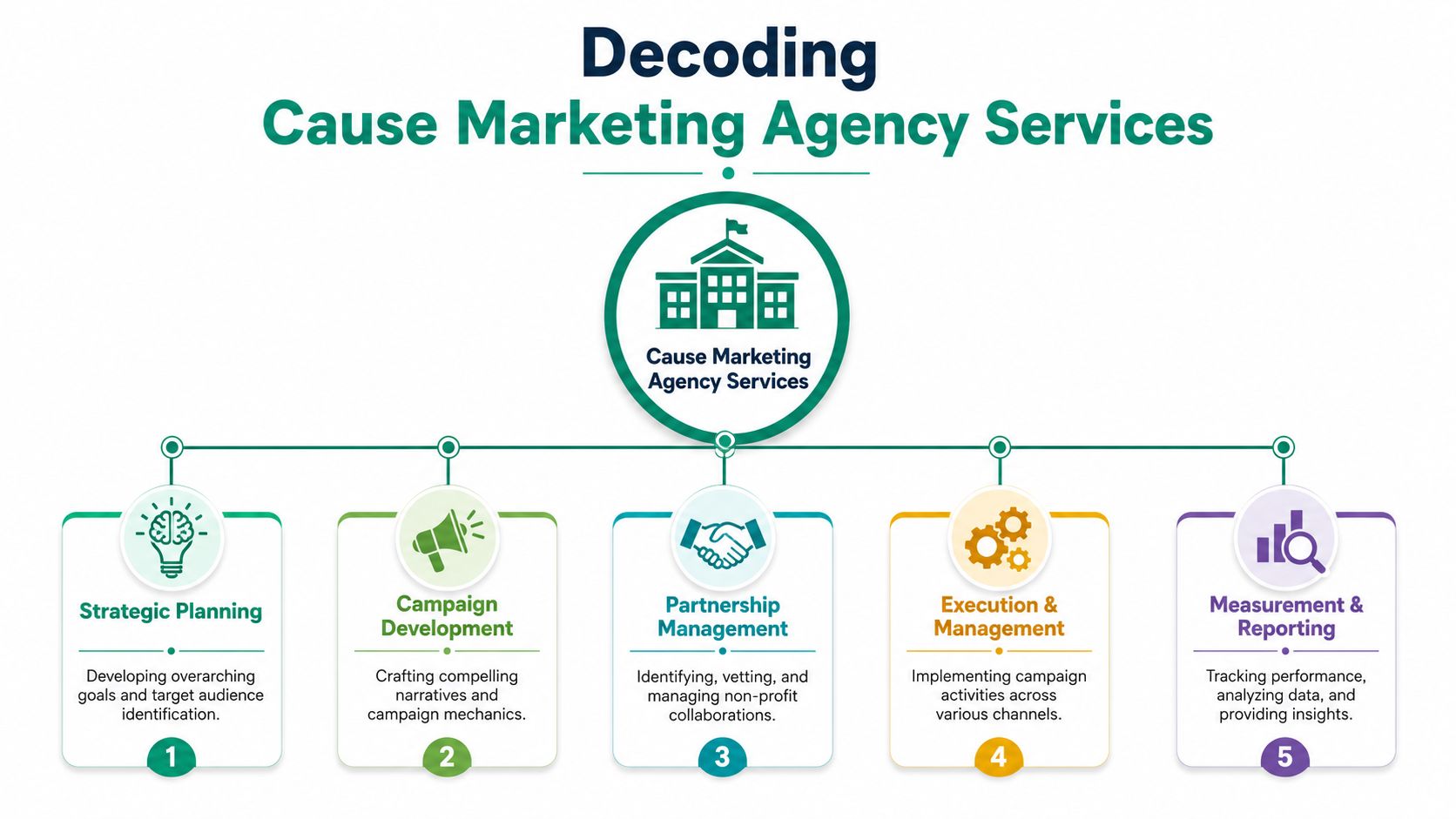
Most capable agencies bundle five workstreams.
Strategy and goal setting
They define the business goal first. That might be stronger purchase intent, lead generation, retention, or account expansion. The cause angle supports the goal. It doesn’t replace it.Partner identification and vetting
They shortlist nonprofits or cause partners that fit your audience, brand, and legal requirements. This matters more than is commonly expected. A cause can be admirable and still be a poor fit for your buyers.Campaign design
They build the actual offer. That includes donation mechanics, customer action points, messaging, creative themes, and channel roles.Operational management
Someone has to manage approvals, asset reviews, timelines, and partner coordination. This is where many internal teams underestimate the workload.Measurement and reporting
The agency should define what gets tracked before launch. If reporting starts after the campaign ends, the campaign wasn’t built properly.
If you need a broader picture of where this overlaps with general performance work, this guide on what a digital marketing agency does helps clarify what should stay with your existing team and what needs a specialist.
The campaign models that show up most often
Labyrinth’s guide to cause marketing formats notes that the market expanded from about $1.11 billion in 2005 to $1.85 billion by 2014, and highlights common formats such as transactional donations, message-focused campaigns, point-of-sale asks, and buy-one-give-one. That list is useful because these are not interchangeable. Each model pushes different buyer behavior.
| Model Type | How It Works | Best For |
|---|---|---|
| Transactional donation | A sale or contract triggers a donation tied to a defined action | E-commerce, retail, promotional periods, product launches |
| Message-focused campaign | The campaign centers on awareness, education, or advocacy rather than a direct donation trigger | Brand repositioning, category leadership, audience education |
| Point-of-sale ask | Customers add a contribution during checkout or payment | Retail, hospitality, online checkout flows |
| Buy-one-give-one | A purchase funds a product or service for someone else | Product brands with simple unit economics and clear fulfillment |
| Digital engagement model | Shares, signups, or participation actions support the cause message or partner activity | Community building, social-first brands, awareness programs |
Which model fits which business
For an SMB with a simple product catalog, transactional donations are usually the cleanest starting point. The customer understands the action. Your finance team understands the accounting. Your agency can measure purchase-linked behavior without acrobatics.
For a B2B brand, message-led campaigns often work better. A software company, manufacturer, or professional services firm may not want to tie every contract to a donation mechanic. In those cases, the stronger move is often a cause-linked content program, event partnership, or customer/community initiative with clear conversion paths nearby.
The right campaign model should match how your customers already buy. Don’t force a retail mechanic into a long sales cycle.
The Business Case for Doing Good
If your leadership team still sees cause marketing as a soft idea, use hard commercial logic.
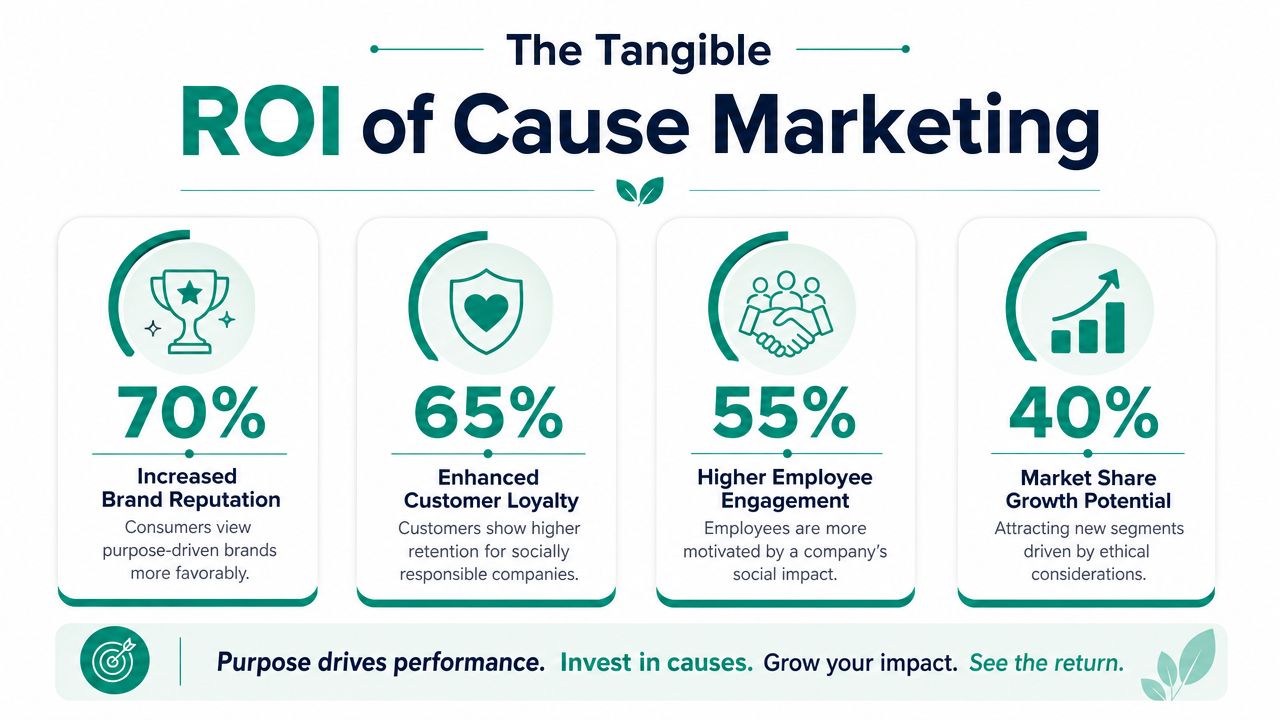
The category is already large enough to matter. A PMC-reviewed article on cause-related marketing reports that U.S. firms spent $2.14 billion on cause marketing in 2018. The same source says 91% of consumers are more likely to buy from a company that supports a social or environmental issue, and 64% of Americans choose, switch, avoid, or boycott brands based on their stance on societal issues.
That means silence is not neutral. Customers are making judgments either way.
What ROI looks like in practice
You shouldn’t judge a cause program only by funds raised for the partner. That’s one output, not the whole business case.
A competent team will tie the initiative to metrics such as:
Brand lift
Are more people aware of you, and do they describe the brand differently after exposure?Lead generation
Did the campaign create qualified inquiries, event registrations, demo requests, or sales conversations?Retention and loyalty
Did existing customers engage more, stay longer, or buy again at higher rates?Channel efficiency
Did cause-linked creative improve response in paid, owned, or partner channels?
Here, many companies undersell the opportunity. A well-structured cause campaign doesn’t sit outside your marketing system. It gives your content, paid media, email, and social channels a more compelling reason to earn attention.
Why B2B brands shouldn’t dismiss this
B2B leaders often assume cause marketing is for consumer brands with donation popups and holiday promotions. That’s too narrow.
In B2B, cause alignment can support employer brand, customer community, account-based campaigns, partner events, executive visibility, and trust-building content. If your buyers are people, and they are, values still affect how they choose, refer, and stay.
For nonprofits and mission-led organizations trying to build audience momentum, the same logic applies to digital reach. If your team is looking for practical ways to grow your church’s reach online, that framework shows how mission-centered messaging and digital distribution work together.
Buyers don’t split your company into separate boxes called product, ethics, and reputation. They evaluate the whole thing at once.
Real-World Cause Marketing Success Stories
Examples help because abstract advice is cheap. Execution is where this either becomes credible or becomes embarrassing.

Product launch tied to a public cause
Ben & Jerry’s used a limited-edition flavor called Empower Mint to support a democracy-focused message around voting access. The product and cause were linked in a way customers could understand fast. The company didn’t hide the point. It used the launch itself as the campaign vehicle.
That’s a useful lesson for SMB brands with seasonal products or promotional windows. Don’t bolt a cause onto a standard promotion after the fact. Build the campaign mechanic into the offer from day one.
Platform economics tied to customer welfare
Bandcamp ran Bandcamp Fridays by waiving its share of sales on select days so artists kept more of the revenue. The cause wasn’t random. It directly matched the pain point of the audience using the platform.
That’s the part many first-time campaigns miss. The best cause programs don’t always pick the biggest social issue in the news cycle. They pick a cause adjacent to the customer’s lived experience. If you sell to independent contractors, manufacturers, school communities, or healthcare teams, you probably already know where the overlap lives.
A campaign feels authentic when the cause sits close to your customer, your product, or your company history. If it connects to none of the three, expect skepticism.
Community voice as campaign fuel
Squarespace’s #ActWithPride campaign centered on LGBTQIA+ stories and invited audience participation through user-generated content. That’s a smart model when your brand already has an engaged digital community. Instead of forcing a donation mechanic, the company built visibility and participation around representation.
The same approach can work for smaller brands. A local service company can spotlight community stories. A B2B firm can feature customers, staff, or partner organizations tied to the cause. The point is not to mimic the scale. It’s to copy the logic.
This short video gives a useful visual sense of how cause campaigns are framed in the market and why the mechanics matter as much as the message.
What these examples have in common
They all do three things well.
Clear alignment
The cause fits the brand and audience.Visible mechanism
People understand what happens when they buy, participate, or share.Simple story
The campaign can be explained in a sentence without jargon.
That’s the bar. If your proposed campaign needs a five-minute internal explanation, customers won’t get it either.
How to Choose the Right Cause Marketing Partner
Most agency selection processes are too polite. You sit through a capabilities deck, hear nice language about impact, then pick the firm with the strongest presentation. That’s how you end up with a campaign nobody can operationalize.
Pick the agency that can reduce ambiguity fastest.
The first screen
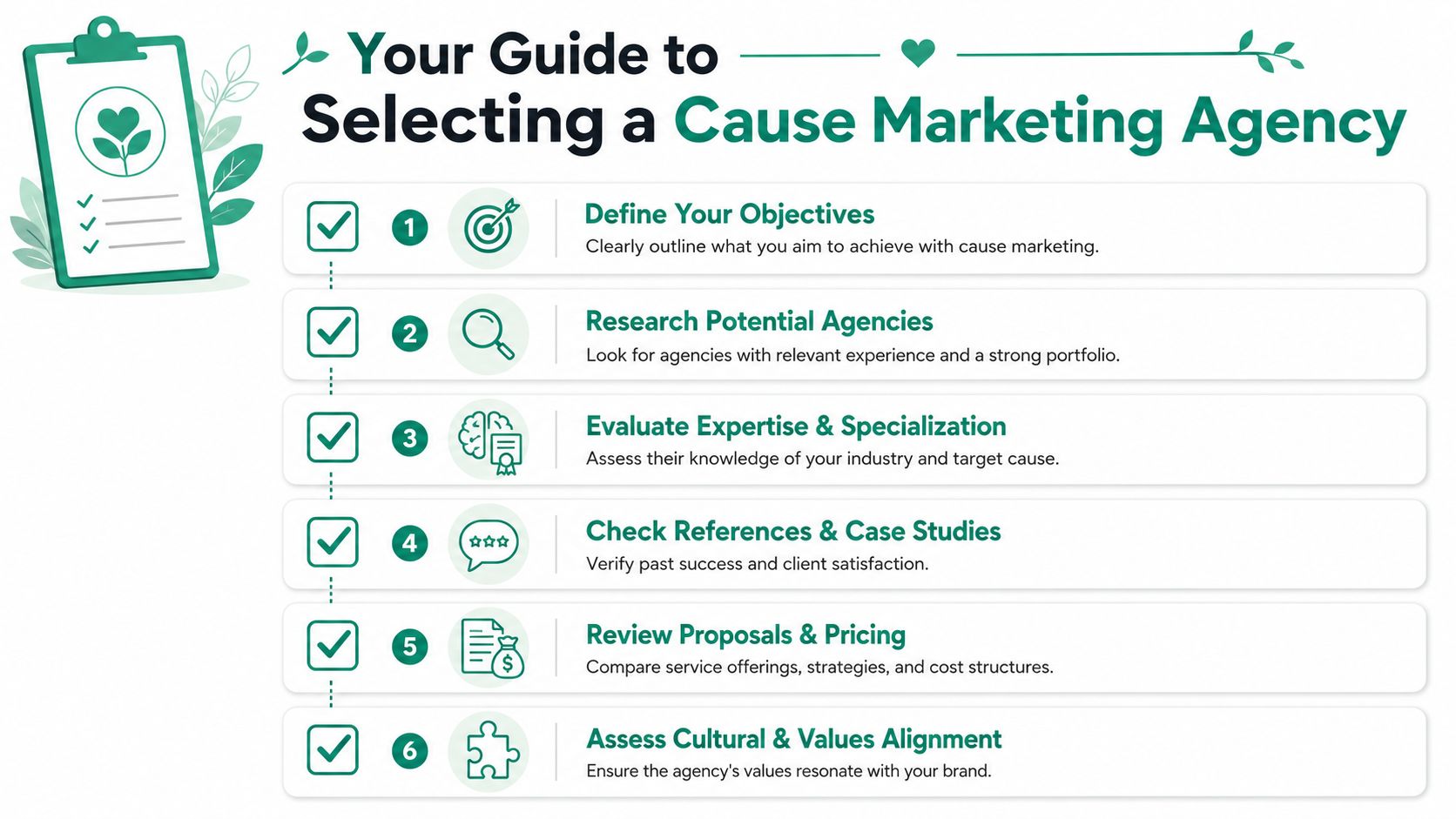
Start with four questions before you even ask for a proposal.
Can they define the business goal without drifting into vague purpose language?
If they can’t connect the campaign to revenue, retention, demand generation, or brand position, the engagement will stay fuzzy.Do they have a process for partner vetting?
You need to know how they evaluate nonprofit fit, reputational risk, review cycles, and co-brand use.Will they build measurement before launch?
This should include baseline metrics, channel roles, and post-campaign reporting.Can they handle execution details, not just ideas?
Someone has to manage approvals, copy review, legal coordination, and launch timing.
If your company already has a broader agency review process, this checklist for how to choose a digital marketing agency is a useful companion.
Governance is not optional
Grounded’s guidance on cause marketing campaigns makes the operational point clearly. Strong agencies define business goals and social-impact goals upfront, put written terms in place, create transparent reporting, and establish approval workflows. That structure reduces legal risk and improves trust and conversion.
That sounds administrative. It is. It also protects the campaign.
Here’s what to ask about directly:
Written terms
Ask who drafts them, who approves them, and what they cover. You want clarity on campaign duration, use of names and logos, asset approvals, and how the commercial arrangement works.Approval workflow
Ask how co-branded content gets reviewed and how long approvals typically take. Slow approvals kill momentum.Reporting cadence
Ask what the dashboard will show, when updates arrive, and who owns the interpretation of results.Escalation path
Ask what happens if the campaign receives criticism, partner circumstances change, or a claim needs to be corrected.
The red flags that should end the conversation
Not every bad fit is dramatic. Some are just expensive.
Non-negotiable: If an agency can’t explain exactly how it will measure both business results and campaign activity, don’t hire it.
Watch for these signs:
They pitch causes before they understand your customers
That’s ideology first, strategy second.They avoid legal and governance questions
They may be creative. They are not ready.They promise authenticity
Authenticity is not a deliverable. It comes from fit, clarity, and follow-through.They show only awareness examples
Nice videos are not a business case.
The right partner will sound more like an operator than a cheerleader.
Your Agency Engagement Toolkit
Before you contact any cause marketing agency, write a one-page brief. Not a polished deck. Not a manifesto. A working document that forces your team to make decisions.
That brief will save time, expose disagreements, and improve the quality of every agency conversation that follows.
A simple brief template
Use this structure.
Business objective
Write one sentence. Example: increase qualified leads in a target segment, support retention in a customer base, or improve brand perception in a category.
Audience
Name the buyer, customer, or community you want to move. Be specific enough that media, messaging, and partner choice can follow.
Cause territory
List two or three issue areas that fit your brand. Don’t jump to one yet. Keep options open until you validate partner and message fit.
Campaign action
Define the customer behavior you want. Buy, register, donate, attend, share, refer, renew, or participate.
Offer or mechanism
Describe the likely structure. Transactional donation, event partnership, content series, point-of-sale ask, employee activation, or customer community initiative.
Channels
List where this will run. Your website, email, LinkedIn, paid social, retail location, event booth, sales outreach, partner channels.
Internal constraints
Include timeline, approvals, legal review, budget limits, and any brand restrictions.
Success measures
Pick a small set of KPIs tied to your goal. Don’t drown the project in dashboards.
First-call questions that reveal whether an agency can actually do the work
Don’t ask, “Have you done cause marketing?” Ask better questions.
- How do you decide whether a brand should use a transactional model or a message-led model?
- What needs to be true before you recommend a nonprofit partner?
- How do you handle written terms and approval workflows?
- What would you test in a pilot before recommending a larger rollout?
- Which channels would you use first for our type of audience, and why?
- How do you separate business results from feel-good engagement metrics?
A scoring method that keeps the decision honest
Use a simple scorecard after each call.
| Evaluation area | What to look for |
|---|---|
| Strategic clarity | They can state your likely business case in plain English |
| Partner discipline | They have a real vetting process, not just a contact list |
| Operational strength | They can explain approvals, reporting, and execution ownership |
| Measurement quality | They define KPIs before launch and talk about pilots sensibly |
| Communication fit | They answer directly and don’t hide behind buzzwords |
This process does something useful. It stops the flashiest presentation from winning by default.
Frequently Asked Questions About Cause Marketing
What’s the difference between cause marketing and sponsorship
Sponsorship usually buys association or visibility. Cause marketing ties the cause to a customer-facing campaign mechanic, message, or participation model. One is often media or event support. The other is a structured commercial program.
Can a small business do this without a huge budget
Yes. The first campaign should be smaller anyway.
A smaller pilot forces focus. It also keeps your team from overcommitting before you know whether the cause, message, and channel mix resonate. Big launches create noise. Tight pilots create a signal.
How do we choose a cause without looking opportunistic
Start with overlap. Look for a cause that connects to your customer, your product, or your company’s actual history. If you can’t explain the fit in one sentence, the audience will question it.
Short-term trend chasing is usually the wrong move. A cause doesn’t need to be fashionable. It needs to be credible.
Should we launch one big campaign or test first
Test first.
The University of Phoenix’s overview of cause marketing points to a common problem. Brands get generic advice when they need a testable business case. The stronger agency partners structure a pilot with clear KPIs tied to objectives such as brand lift, lead generation, or customer retention.
That’s the right approach for first-time campaigns. A pilot answers the essential questions. Did people care? Did the mechanism make sense? Did the campaign support a business goal? Should you scale, adjust, or stop?
What if our leadership team is split on the idea
That usually means the proposal is too vague.
Bring the discussion back to three items. The business objective, the campaign mechanic, and the reporting plan. Once those are clear, cause marketing stops sounding like an abstract values debate and starts sounding like a marketing program with rules.
What should we expect from an agency in the first month
You should expect a diagnosis, not a finished creative.
A strong agency will pressure-test your objective, review audience and channel fit, assess likely campaign models, flag governance issues, and recommend a pilot path. If you get a glossy concept before those basics are settled, slow the process down.
If you want help pressure-testing your first cause marketing initiative, Ascendly Marketing can help you map the business case, tighten the campaign structure, and build a launch plan that’s clear enough to execute and strict enough to measure.