

TL;DR:
- Customer testimonials are powerful tools that significantly increase conversion rates by providing authentic social proof. They influence buying decisions through credibility transfer and are most effective when recent, relevant, and strategically placed at high-intent moments. To maximize their impact, businesses should continuously collect, structure, and test testimonials, emphasizing specific outcomes, proper placement, and varied formats like video.
Customer testimonials are defined as authentic, first-person endorsements from real buyers that reduce purchase uncertainty and directly increase conversion rates. The role of testimonials in marketing goes far beyond decoration on a homepage. According to the Medill Spiegel Research Center, displaying reviews can increase conversions by up to 270%, particularly for higher-priced products where buyer hesitation runs highest. Platforms like Google Seller Ratings, BrightLocal, and Salesforce CRM have each built entire frameworks around capturing and deploying this kind of social proof. If you are a business owner or marketer who has not yet treated testimonials as a conversion asset, this guide changes that.
How do testimonials influence consumer trust and buying decisions?
Testimonials work because they transfer credibility from a satisfied customer to a skeptical prospect. Marketing copy tells buyers what you want them to believe. A testimonial tells them what someone like them has already experienced. That distinction matters enormously in purchase psychology.

Reviews influence buying behavior more than traditional advertising across virtually every industry. The mechanism is straightforward: when a prospect sees that someone with a similar problem found a real solution, their anxiety about making the wrong choice drops. That drop in anxiety is what converts browsers into buyers.
The data from BrightLocal makes the stakes concrete. 85% of consumers are more likely to use a business after reading positive reviews, while 77% are deterred by negative ones. Even more telling, 54% of those positive-review readers then visit the business’s website to research further. Testimonials do not just close sales. They drive qualified traffic deeper into your funnel.
Three factors determine how much a testimonial actually moves the needle:
- Recency: Buyers discount reviews older than six months, especially in fast-moving categories like software or services
- Volume: A single glowing review reads as an outlier. Ten consistent reviews read as a pattern. Volume, recency, and diversity together form a system-level trust signal that individual reviews cannot replicate alone
- Relevance: A testimonial from someone in the same industry or role as the prospect is far more persuasive than generic praise from an unnamed customer
Pro Tip: Place your most relevant testimonial directly adjacent to your primary call-to-action. The first testimonial a visitor sees can deliver a 65% average conversion increase compared to showing none at all.
What are the best practices for collecting and using testimonials effectively?
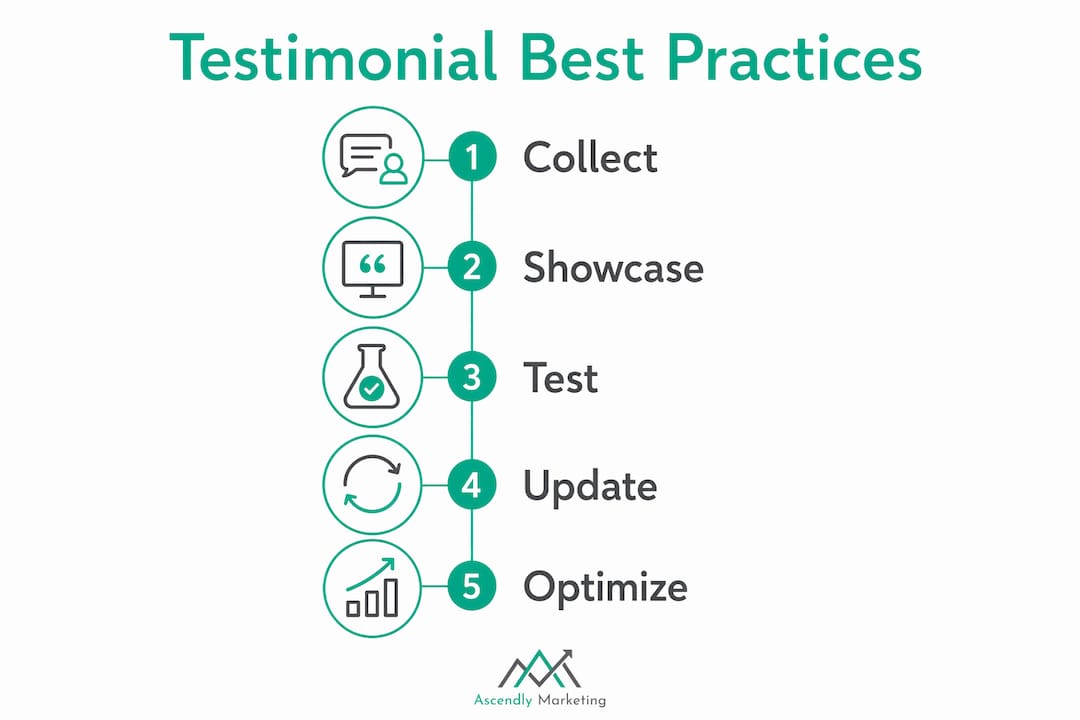
Collecting testimonials is not the hard part. Collecting the right testimonials, then deploying them where they count, is where most businesses fall short. Many companies gather testimonials but fail to integrate or reuse them effectively, leaving credibility and conversion improvements on the table.
Follow this sequence to build a testimonial system that actually performs:
- Ask at the right moment. Request a testimonial immediately after a customer achieves a measurable result. That is when enthusiasm is highest, and the outcome is freshest in their mind.
- Guide the structure. Give customers a simple prompt: describe your role, the problem you faced, how you solved it, and the specific outcome. This “objection-to-proof” format answers buyer questions before they are even asked.
- Identify the reviewer. Full name, job title, and company name transform a quote into a credible reference. Anonymous praise reads as invented.
- Use a CRM to organize and track. Tools like Salesforce, HubSpot, or Zoho CRM let you track testimonial sources and performance by customer segment, so you know which testimonials convert which audience types.
- Place testimonials at high-intent moments. Pricing pages, checkout flows, and landing pages next to CTAs are where buyer hesitation peaks. That is exactly where social proof reduces uncertainty and tips the decision.
- Collect continuously, not in batches. A review page showing only 2022 dates signals stagnation. Automate post-purchase review requests through your CRM or email platform to maintain a steady, current stream.
- Respond to every review. Responding to reviews signals accountability to prospects reading them. Silence reads as indifference. A brief, professional response to even a negative review demonstrates that your business takes customer experience seriously.
Pro Tip: Integrate A/B testing tools like Google Optimize or VWO to test testimonial placement and format on key landing pages. Pairing testimonial data with A/B testing is the fastest way to identify which formats and positions drive the most conversions for your specific audience.
For a deeper look at how testimonial placement connects to overall site performance, the conversion rate optimization strategies guide from Ascendly Marketing covers the full picture.
How do different testimonial formats compare in marketing effectiveness?
Not all testimonials carry equal weight. The format you choose determines how much trust it transfers and where it performs best. Here is how the main formats stack up:
| Format | Best use case | Conversion impact |
|---|---|---|
| Text testimonial | Product pages, email campaigns, landing pages | Baseline lift; strong when specific and role-identified |
| Video testimonial | Homepage, social media, paid ads | ~80% higher conversion uplift than text reviews |
| Case study | B2B sales pages, proposal support, long sales cycles | Highest depth; addresses complex objections in detail |
| Star ratings / Google Seller Ratings | Paid search ads, local listings | Boosts ad click-through rates by ~10% |
| Social media mentions | Retargeting ads, Instagram stories, Facebook | High authenticity; strong for consumer brands |
Video testimonials are the standout performers. The 80% conversion uplift over text is not a marginal difference. It reflects the fact that video communicates tone, emotion, and authenticity in ways that a written quote simply cannot. For B2B marketers, a two-minute customer video on a pricing page can do more work than three paragraphs of feature copy.
Google Seller Ratings deserve special attention for paid search. To qualify, a business needs at least 100 recent unique reviews and a minimum average rating. The payoff is a roughly 10% lift in ad click-through rates, which compounds significantly at scale. If you run Google Ads and have not yet pursued Seller Ratings, you are paying for clicks that a competitor with ratings is winning more cheaply.
Case studies occupy a different category entirely. They are not testimonials in the traditional sense, but they function as extended, structured proof. For B2B buyers researching software, 91% read reviews before purchasing. A case study that walks through a specific client’s challenge, the solution applied, and the measurable outcome addresses every objection a sophisticated buyer brings to the table.
What common mistakes weaken testimonials’ marketing power?
Most testimonial failures come down to one of five predictable errors. Recognizing them is the first step to fixing them.
- Generic praise with no specifics. “Great service, highly recommend!” tells a prospect nothing useful. Generic testimonials rank poorly in persuasiveness compared to structured, outcome-focused ones. A testimonial that names the problem, the solution, and the result is five times more convincing than a vague compliment.
- Missing reviewer identity. A testimonial attributed to “John D., satisfied customer” carries almost no weight. Full name, title, and company are the minimum for B2B credibility. For consumer brands, a photo and first name with location significantly increase believability.
- Outdated reviews. Prospects notice dates. A page full of 2021 testimonials signals that either the business stopped collecting them or recent customers are not happy enough to comment. Consumers expect fast, current responses and recent proof. Stale testimonials actively undermine trust.
- No response strategy. Leaving negative reviews unanswered is a conversion killer. A thoughtful, professional response to a critical review demonstrates maturity and accountability. Prospects read negative reviews specifically to see how a business handles problems.
- Legal and compliance gaps. The FTC requires that paid or incentivized testimonials be disclosed. Fabricated or selectively edited reviews violate both FTC guidelines and platform terms of service. Beyond the legal risk, fake reviews are increasingly detectable by consumers and review platforms alike. Authenticity is not just ethical. It is strategically necessary.
Building transparent marketing practices around your testimonial strategy protects your brand and compounds trust over time.
Key takeaways
Testimonials are conversion assets that work by reducing buyer uncertainty at the exact moments when purchase decisions are made, and their impact scales directly with specificity, recency, and strategic placement.
| Point | Details |
|---|---|
| Testimonials drive measurable conversions | Displaying reviews can increase conversion rates by up to 270%, with the first testimonial alone delivering a 65% average lift. |
| Format determines impact | Video testimonials outperform text by roughly 80%; Google Seller Ratings lift paid ad click-through rates by about 10%. |
| Specificity is the differentiator | Outcome-focused testimonials that name the buyer’s role, problem, and result outperform generic praise in every measurable way. |
| Placement at high-intent moments | Testimonials on pricing pages, checkout flows, and next to CTAs reduce hesitation where it matters most. |
| Continuous collection beats batch campaigns | A steady stream of recent, responded-to reviews builds system-level credibility that individual reviews cannot replicate. |
Why most businesses are sitting on an untapped conversion asset
At Ascendly Marketing, we have worked with businesses since 2013 across dozens of industries, and the pattern is almost universal. Companies have good testimonials. They just bury them on a “Reviews” page that nobody visits, or they paste one quote in the footer and call it done.
The uncomfortable truth is that most businesses treat testimonials as a credibility checkbox rather than a conversion tool. They collect them, they display them somewhere, and they move on. What they miss is the compounding effect of a testimonial system: the right format, in the right place, for the right audience segment, updated continuously, and tracked against actual conversion data.
We have seen clients double their landing page conversion rates not by rewriting their copy, but by replacing a generic text quote with a specific, role-identified video testimonial placed directly above the CTA. That is not a small tweak. That is a structural change in how the page communicates trust.
The other thing I would push back on is the idea that testimonials are only for B2C brands. 91% of B2B buyers who read reviews before software purchases are not looking for star ratings. They are looking for case studies, named clients, and specific outcomes. If your SaaS or professional services website shows generic quotes without names or results, you are losing deals to competitors who have done the work to make their proof credible.
Treat your testimonials like a product. Audit them quarterly. Retire the vague ones. Recruit specific ones from your best clients. Test their placement. Measure the results. That is not extra work. That is the difference between a testimonial that sits there and one that sells.
— Ascendly Marketing
How Ascendly Marketing helps you turn testimonials into revenue
Ascendly Marketing builds digital marketing strategies that put your best customer proof to work across every channel. From SEO and content marketing that surfaces your reviews in search results to PPC campaigns that leverage Google Seller Ratings for higher click-through rates, the team connects testimonial strategy to measurable business outcomes. Since 2013, Ascendly Marketing has helped small and medium-sized businesses grow by treating credibility as a conversion driver, not an afterthought. If you want a strategy that integrates testimonials into your full digital marketing services mix, book a consultation and see exactly where your social proof is being underused.
FAQ
What is the role of testimonials in marketing?
Testimonials serve as social proof that reduces buyer uncertainty and builds trust in a brand’s claims. They influence purchasing decisions more directly than traditional advertising by providing real customer experiences as evidence.
How do testimonials boost sales and conversion rates?
Displaying testimonials can increase conversion rates by up to 270%, with even a single testimonial delivering a 65% average lift over no reviews. Placement at high-intent moments like pricing pages and checkout flows amplifies this effect.
What makes a testimonial effective vs. ineffective?
Effective testimonials name the buyer’s role, describe the specific problem, and state a measurable outcome. Generic praise without context or identity ranks poorly in persuasiveness and does little to address prospect objections.
Are video testimonials worth the extra effort?
Video testimonials deliver roughly 80% higher conversion uplift than text reviews, making them the highest-performing testimonial format available. For homepage and paid ad placements, the investment in video pays back quickly in conversion gains.
How often should businesses collect new testimonials?
Businesses should collect testimonials continuously rather than in periodic campaigns. Consumers notice review dates, and outdated testimonials signal stagnation. Automating post-purchase review requests through a CRM keeps your social proof current and credible.