Marketers sometimes produce blog posts, videos, and social updates with no clear purpose. This method is a drain on time and money, and it rarely produces the intended results. What separates different marketing outcomes is often a documented plan.
This is an actionable blueprint for organizing your content operations.
The following sections will walk through each piece of this template step-by-step. First, review the main components. Understanding how these sections interrelate is the initial step toward building a cohesive plan. For more information on the subject, explore the full benefits of content marketing .
The upcoming sections will detail each of these areas with tips and examples to help you construct a plan that produces results.
Before any writing begins, your content needs a mission. A content mission statement is the direct line connecting every piece of content you create to your company’s primary goals.
This is the first section to complete in your content marketing plan template . A functional mission statement is specific. It states who you are addressing, what you are providing, and how their lives will improve as a result.
For instance, a B2B tech firm’s mission is not just "to create tech content." A more specific mission would be: "To give IT managers practical frameworks that simplify managing cloud infrastructure, helping them reduce operational costs."
With a focused mission, you have a filter for your content ideas. If an idea does not serve that purpose, you discard it. This prevents the creation of content that does not contribute to business objectives.
Aligning Content Goals With Business Objectives
After establishing the mission, the next step is to tie it to business results. This means focusing on tangible outcomes.
Content is a tool. Identify what your business needs to achieve. This could be generating new leads, increasing revenue, or improving customer retention. Your content goals must directly support these core business objectives.
A useful technique is to work backward. If a business requires $100,000 in new revenue from content and the average customer value is $5,000 , then 20 new customers are needed. If the lead-to-customer conversion rate is 10% , the target is 200 qualified leads.
This calculation provides a clear objective for your content: generate 200 qualified leads. Every decision about content creation and distribution now has a concrete number to measure against. To learn more about this, you can investigate how to calculate marketing ROI to connect your work to financial results.
Identifying Your Key Performance Indicators
How do you know if you are on track to meet the 200 -lead goal? Key Performance Indicators (KPIs) provide the answer. These are specific metrics you will monitor closely.
Selecting the right KPIs is fundamental. If your goals and KPIs are misaligned, you will be operating with inaccurate data. A B2B company focused on lead generation and an ecommerce store aiming for sales have different objectives and require different metrics.
Consider two common scenarios.
Scenario A: B2B Tech Firm (Goal: Generate 200 Qualified Leads)
Primary KPIs:
Marketing Qualified Leads (MQLs): The total count of leads from content downloads.Cost Per Lead (CPL): The expenditure required to acquire each lead.Lead-to-Customer Conversion Rate: The percentage of leads that become customers.
Secondary KPIs:
Organic Traffic: The volume of visitors finding lead-generation pages through search.Email Subscribers: The growth of your newsletter list from content offers.
Scenario B: Ecommerce Store (Goal: Increase Online Sales by 15%)
Primary KPIs:
Conversion Rate: The percentage of content readers who make a purchase.Average Order Value (AOV): The average amount spent per purchase by those who engage with content.Revenue from Content: The total dollar amount directly attributable to a piece of content.
Secondary KPIs:
Product Page Click-Through Rate (CTR): The rate at which users click from content to product pages.Time on Page: A measure of user engagement with the content.
Choosing the right KPIs in your content marketing plan template turns marketing from an unpredictable activity into a systematic growth process.
Getting to Know Your Audience and Defining Your Core Topics
If you produce content but receive no engagement, it might be because you are trying to communicate with a broad, undefined audience.
Content designed for "everyone" is often effective for no one. Stop guessing about your audience. It is time to develop a deep understanding of who you want to reach. Completing this section of your content marketing plan template is what distinguishes content that is ignored from content that builds a community.
Go beyond surface-level demographics. Knowing your ideal customer's age and job title is a starting point. The next step is to understand their motivations and problems. What challenges do they face? What are their professional aspirations?
Turning Vague Demographics into Actual Humans
To build buyer personas, you must gather real-world intelligence. The information needs to be rooted in data, not assumptions. This process transforms a flat description into a character you can write for.
Here is how you can start gathering information:
Interview your customers. Ask them about their daily challenges, what they seek in a solution, and what kind of content they find valuable.Conduct a survey. Use tools like SurveyMonkey or Typeform to poll your email list or website visitors. Ask specific questions about their pain points and information needs.Analyze your website data. Your analytics contain valuable insights. Identify which pages your most loyal visitors frequent and what search terms they used to find you.Consult your sales team. Sales representatives interact with customers and hear their objections, questions, and frustrations. Their insights are valuable, so schedule regular meetings to gather this information.
Once you have the data, give your persona a name, a job, and a background. What are their goals? What are their main frustrations?
A well-developed persona serves as a benchmark. Before publishing, ask: "Would [Persona's Name] care about this?" If the answer is no, reconsider the content.
Pinpointing Your Content Pillars
Now that you understand your audience, you need to decide what topics your brand will be known for. These are your core content pillars —the three to five main subjects your brand will focus on.
Think of these pillars as the main trunks of a tree. Every piece of content is a branch extending from one of them. This approach keeps your content strategy focused and prevents you from pursuing irrelevant topics. Your pillars should be at the intersection of your audience's needs and your business's expertise.
Let's consider two examples.
Example 1: A Local Home Service Business
Pillar 1: Home Maintenance 101: Seasonal checklists, simple how-to guides for minor issues, and articles on when to call a professional.Pillar 2: Neighborhood Project Spotlights: Feature completed jobs in specific local areas to build social proof and demonstrate local knowledge.Pillar 3: The DIY vs. Pro Debate: Help homeowners understand what they can handle themselves versus when professional help is necessary, positioning you as a trusted advisor.
Example 2: A B2B Software Company
Pillar 1: Next-Level Productivity: Content about team collaboration, time management techniques, and conducting effective meetings.Pillar 2: Mastering Agile: In-depth articles on frameworks like Scrum or Kanban for professionals looking to advance their project management skills.Pillar 3: Real-World Wins (Customer Stories): Detailed case studies showing how companies used the software to achieve their goals and solve project challenges.
By defining these pillars in your content marketing plan template, you are not just listing ideas. You are building a strategic framework that ensures your content speaks directly to your personas and establishes your authority on relevant topics.
Building Your Content Production and Promotion Machine
A plan requires a system for implementation. Without a system, the plan remains a document.
This is where you build your content factory. You need to determine what to create, who will create it, and how to deliver it to your audience. Without a solid process, good ideas can be lost in daily operations.
Picking Your Content Playground
Not all content formats are equally effective. The right format depends on your message, your audience's consumption habits, and your resources.
Video content is a significant part of internet consumption. It is projected to account for 82% of all consumer web traffic. This is a shift in how information is consumed.
So, what are your options?
Blog Posts & Articles: These are effective for SEO, answering audience questions, and demonstrating expertise.Video (Short & Long): Use short-form videos for social media to capture attention. Use longer tutorials or webinars for in-depth instruction.Proprietary Research & Reports: Creating original data through surveys or industry analysis can generate interest and links, which signals authority.Webinars & Live Events: Live events are a way to interact with your audience, generate leads, and present the people behind the brand.
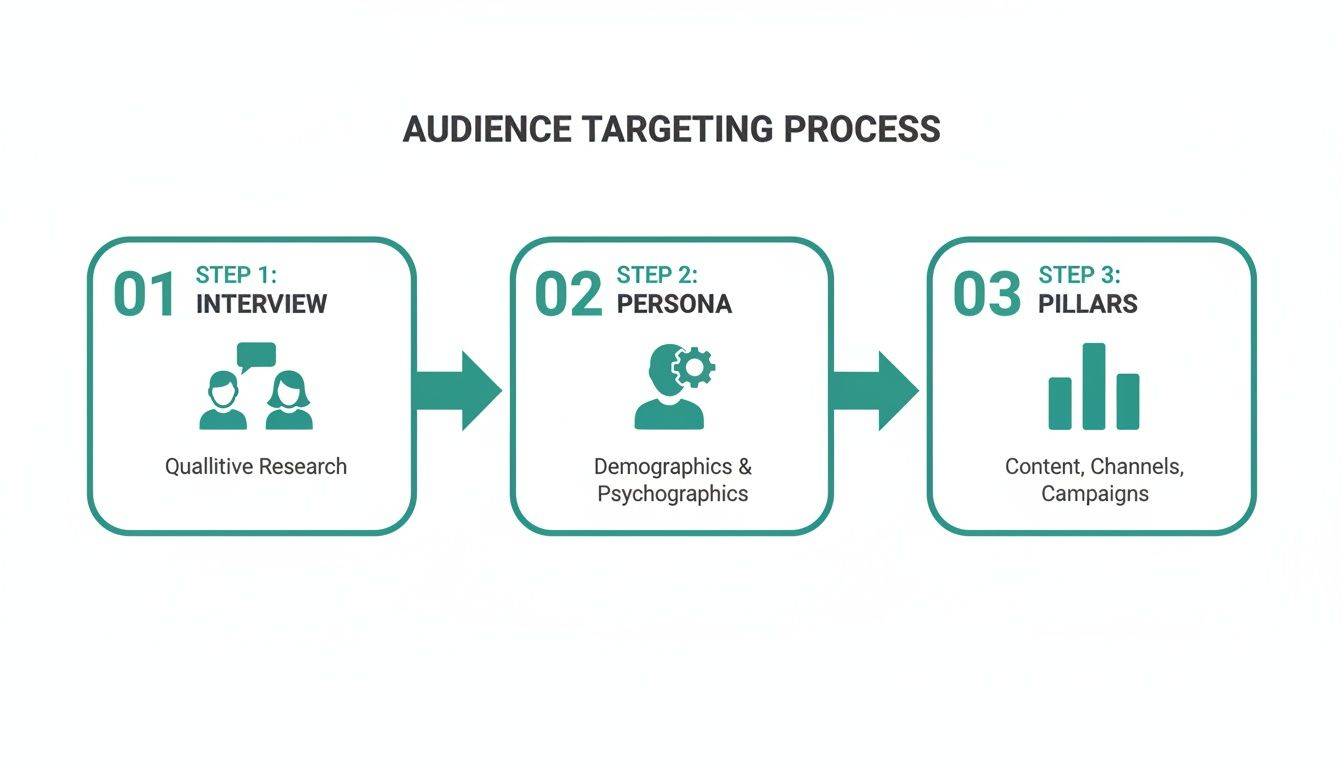
This entire process—from understanding individuals to building core topics—is a structured method.
You begin by understanding individual needs and conclude with a strategic framework that serves your entire audience.
Your Editorial Calendar: The Content Command Center
An editorial calendar is the master plan for your content. It is a schedule that outlines what will be created, who is responsible, and when it will be published. It brings order to the creative process.
A good calendar is more than a list of deadlines. It is a strategic map that helps you plan around industry events, coordinate product launches, and ensure a varied content mix. For a detailed guide, you can learn how to create a content calendar that is effective.
A well-managed editorial calendar facilitates strategic thinking, encouraging you to plan months ahead and ensure every published piece contributes to your goals.
Getting Your Content Out There (The Distribution)
Creating high-quality content is only half the battle. If it is not seen, it has no impact. Your distribution strategy is your plan for ensuring the right people see your content.
Distribution can be categorized into three types of channels: owned, paid, and earned.
Owned Channels: These are platforms you control.
SEO: Optimizing content for search engines can generate a steady stream of visitors over time.Email Marketing: Your email list is a direct communication channel to your most engaged audience. Use it to announce new content.Your Social Media Profiles: Share your content on your own channels to engage with your existing community.
Paid Channels: This involves paying to reach a new audience.
Social Media Ads: Platforms like Facebook and LinkedIn allow for precise audience targeting.Search Engine Marketing (SEM): Paid search ads can drive immediate traffic to your key content.
Earned Channels: This is free promotion from other sources.
Public Relations (PR): Media coverage from reputable outlets provides a significant credibility boost.Community Engagement: Share your content in relevant online communities like Reddit or industry forums to start conversations.Influencer Outreach: A mention from a respected figure in your niche can introduce your work to a large, qualified audience.
When distributing content via email, pay attention to details. Following email subject line capitalization best practices can affect open rates.
When you establish a repeatable system for both creation and distribution, your content plan transforms from a document into a business growth engine.
Give Your Plan an Advantage with AI and Original Research
You have filled out your content marketing plan template . This puts you ahead of many. To further improve your position, consider integrating artificial intelligence and original research.
When used correctly, these elements can strengthen your plan, transforming a solid strategy into a more effective one.
Let AI Do the Heavy Lifting
AI is a tool for efficiency. It can handle repetitive tasks, freeing up your time for strategy, creativity, and human interaction.
Instead of starting with a blank page, you can use an AI tool to brainstorm blog topics based on your audience persona's pain points. It can analyze top-ranking articles for a target keyword and generate a comprehensive outline in seconds. The benefits are speed and precision.
Here are a few ways AI can be applied:
Smarter Ideation: Use AI to analyze Reddit threads or Quora questions in your niche. This will provide a list of topics that real people are discussing.Overcome Writer’s Block: Use AI to generate a first draft. It will not be perfect, but editing an existing draft is often easier than starting from scratch.Headline Generation: Generate multiple headline variations and use AI to predict which ones are likely to get the most clicks based on sentiment and structure.Next-Level Personalization: Some advanced platforms use AI to display different content to different website visitors based on their past behavior, creating a tailored experience.
AI is a collaborator. The quality of its output depends on the quality of your prompts. Learn to communicate with it, guide it, and refine its output. The primary skill lies in editing.
Your competitors are likely adopting these tools. By 2026, 45% of B2B marketers plan to increase their spending on AI tools, making it their top investment priority. These content marketing statistics from Typeface.ai provide more insight into this trend.
Become The Source with Original Research
While AI improves efficiency, original research establishes authority. It is a way to make your content stand out. In a market saturated with generic content, publishing unique data makes you the source.
When you become the source, other publications, blogs, and influencers will link back to you. These backlinks are valuable for SEO, signaling to Google that you are a trusted authority. This helps improve your search rankings.
Creating original research does not have to be a large-scale, expensive project.
Start with a question your audience has. Is there a common assumption in your industry that you could test? For example, a project management software company could survey managers to identify the primary reason projects exceed their budget.
Then, collect the data. You can use a tool like SurveyMonkey or analyze your own customer data. Once you have the results, identify the most surprising or useful statistic and build a campaign around it.
Do not just publish a report. Turn it into a press release, a series of social media graphics, a webinar, and an infographic. Maximize its value.
By combining the efficiency of AI with the authority of original research, your content marketing plan template becomes a more powerful growth machine.
Got Questions About Your Content Plan? Let's Get Them Answered.
You have your new content plan template. Some questions may arise as you begin to use it. This section addresses common questions that users have.
How Often Should I Actually Update This Thing?
A common mistake is to create a plan and then not revisit it for a long period. Your content plan should be treated as a dynamic document.
A major review once a year is a minimum requirement. This is an opportunity to look at the big picture and align your content with the upcoming year's business goals and budget.
However, waiting a full year to make adjustments can result in missed opportunities. Quarterly check-ins are where you can make more timely adjustments:
Analyze performance. Evaluate what content is performing well and what is not. Be objective. If certain content formats are not providing a return, it is time for a discussion.Hunt for new keywords. SEO is not static. New search trends emerge constantly.Shuffle the calendar. If a competitor launches a major product or a new trend emerges in your industry, adjust your content to remain relevant.
Do not be rigid with your original plan. If your blog posts are driving significant organic traffic, consider increasing their frequency. Agility is an advantage.
What's the Difference Between a Content Strategy and a Content Plan?
This is a point of confusion for many marketers. They are related but distinct concepts.
Your content strategy is your "why." It is the high-level vision. It answers foundational questions like: Who is our audience? Why should they care? What do we want to be known for?
Your content marketing plan , the template you are using, is the "how." It is the step-by-step roadmap that puts the strategy into action.
This table clarifies the distinction:
Aspect
Content Strategy (The "Why")
Content Plan (The "How")
Focus The big vision, core message, and overarching goals.
The day-to-day execution, deadlines, and specific to-dos.
Document Your mission statement, brand voice guide, customer personas.
Your editorial calendar, distribution checklist, and KPI dashboard.
Timescale Long-term, think 1-3 years .
Short-to-mid-term, usually monthly or quarterly .
Example "Become the #1 trusted resource for first-time homebuyers."
"Publish two blog posts per week targeting 'first-time homebuyer mistakes'."
A strategy without a plan is an idea that is not implemented. A plan without a strategy is just content creation without a purpose. You need both.
How Do I Actually Measure the ROI of My Content?
Measuring the Return on Investment (ROI) of your content is possible. The key is to tie your metrics directly to the goals you established in your plan.
Your ROI calculation will differ depending on whether your goal is lead generation or brand awareness.
Let's look at a few common goals:
1. If Your Goal is Lead Generation:
Cost-Per-Lead (CPL): Calculate the time and money invested in a piece of content and divide it by the number of leads it generated.Lead-to-Customer Conversion Rate: Determine how many of those leads became paying customers. This shows the monetary value of the content.
2. If Your Goal is Brand Awareness:
Organic Traffic & Rankings: Are more people finding you through search engines? Are you ranking for your target keywords?Social Media Share of Voice: Are people discussing your brand more than your competitors? Tools like Brand24 can help you track this.Branded Search Volume: Are more people searching for your company's name directly? This indicates brand recall.
3. If Your Goal is Direct Sales (Hello, Ecommerce!):
Attributed Conversions: Use your analytics to see how many sales came from visitors who first engaged with a specific piece of content.Content Conversion Rate: What percentage of people who view a product demo video click "Add to Cart"?
The key to measuring ROI is to select your KPIs at the beginning and use the right tools to track them. This is how you change content from a cost center into a revenue-generating asset.
At Ascendly Marketing , we build data-driven content marketing engines that attract visitors, convert customers, and accelerate your revenue. Get your free consultation today!