

Struggling to generate quality leads without draining your marketing budget? You’re not alone. Many small to medium-sized businesses find themselves trapped in a cycle of expensive paid advertising that delivers disappointing returns. Content marketing generates 3x more leads than traditional paid ads while costing 62% less, making it the smart choice for resource-conscious SMBs. This comprehensive guide walks you through building a content marketing strategy that attracts qualified leads, establishes your authority, and drives sustainable growth without breaking the bank.
Table of Contents
- Key takeaways
- Understanding the problem: why traditional ads fall short for SMBs
- Preparing your content marketing strategy: Defining goals, audience, and content audit
- Executing your strategy: Content creation, format focus, and distribution planning
- Verifying results: Measuring success and avoiding common pitfalls
- Boost your content marketing with expert SEO and digital services
- Frequently asked questions
Key Takeaways
| Point | Details |
|---|---|
| Content marketing outperforms ads | Content marketing generates more leads at a lower cost than traditional paid advertising for small to mid-sized businesses. |
| Define goals and audience | Start with concrete targets tied to business outcomes and define your ideal customer. |
| Limit formats and channels | Choose one to two core formats and primary distribution channels to maximize impact. |
| Measure and adapt with data | Use data to track performance and refine tactics over time. |
| Commit to long term strategy | Invest in a long term strategy and stay committed to content marketing for compounding returns. |
Understanding the problem: Why traditional ads fall short for SMBs
Paid advertising seems like the obvious path to quick leads, but the reality for most SMBs is far less appealing. Click costs continue rising across platforms, competition intensifies daily, and the moment you stop paying, your visibility vanishes completely. Many business owners pour thousands into Google Ads or Facebook campaigns only to see minimal returns, wondering why their competitors seem to thrive while they struggle.
The harsh truth is that content marketing generates 3x more leads than paid advertising while costing 62% less for small businesses. Yet despite this compelling data, countless SMBs continue dumping money into ads because they lack a clear alternative strategy. The immediate gratification of paid traffic feels safer than the longer-term investment content marketing requires, even though the math clearly favors content.
Consider the typical SMB advertising cycle: you launch a campaign, spend $2,000 to $5,000 monthly, generate a handful of leads, and repeat endlessly. The second you pause spending, lead flow stops completely. Compare this to content marketing, where each piece you create continues attracting visitors and generating leads months or even years after publication. A single well-optimized blog post can drive hundreds of qualified leads over its lifetime at a fraction of ad spend.
The benefits of content marketing extend beyond cost savings. Quality content establishes your expertise, builds trust with potential customers, and creates compound growth as your library expands. Search engines reward consistent, valuable content with higher rankings, which drives organic traffic without ongoing ad spend. Social shares amplify your reach naturally, and email subscribers become warm leads who know and trust your brand.
Common pitfalls that keep SMBs stuck in the paid ad trap:
- Believing content marketing takes too long to show results
- Lacking the knowledge to create an effective content strategy
- Underestimating the cumulative power of consistent content creation
- Failing to measure content performance or optimize based on data
- Giving up after a few months without seeing immediate explosive growth
Pro Tip: The businesses winning with content marketing started exactly where you are now. The difference is they committed to a strategic approach and stuck with it long enough to see compounding returns.
Preparing your content marketing strategy: Defining goals, audience, and content audit
Jumping straight into content creation without a proper foundation is like building a house without blueprints. You might produce lots of content, but it won’t align with business objectives or resonate with your ideal customers. Strategic preparation separates content that drives real business results from content that simply fills space on your website.
Start by defining specific, measurable goals tied directly to business outcomes. Vague aspirations like “increase brand awareness” don’t provide actionable direction. Instead, set concrete targets such as “generate 50 qualified leads monthly through organic content” or “reduce customer acquisition cost by 40% within six months.” These clear benchmarks let you track progress and adjust tactics based on what’s working.
Understanding your target audience goes far deeper than basic demographics. You need to know their pain points, questions, objections, and the language they use when searching for solutions. Create detailed buyer personas that capture not just who they are, but what keeps them awake at night and how your expertise can solve their specific problems. This insight shapes every piece of content you create.
Marketing strategy success for SMBs increases dramatically when you document your approach. Yet only 47% of B2B marketers have a documented content strategy, and lack of clear goals remains the primary reason content marketing efforts fail. Taking time to write down your strategy, goals, and tactical plans dramatically improves your odds of success.

Conducting a content audit reveals what’s already working and where gaps exist. Review every piece of existing content, noting traffic levels, engagement metrics, and lead generation performance. You’ll likely discover some hidden gems generating consistent results that deserve more promotion, along with underperforming content that needs updating or retiring. This audit informs your editorial calendar and prevents wasting effort on topics already covered adequately.
Step-by-step preparation checklist:
- Define 3-5 specific, measurable content marketing goals with timeframes
- Create detailed buyer personas including pain points and search behavior
- Audit existing content to identify top performers and content gaps
- Research competitor content to find opportunities they’re missing
- Build an editorial calendar mapping content topics to goals and audience needs
- Document your complete strategy in a shareable format for team alignment
Your editorial calendar should map out at least 90 days of content topics, formats, and distribution plans. This planning prevents the scramble of figuring out what to create each week and ensures consistent publishing. Include key dates relevant to your industry, seasonal trends, and strategic campaigns you want to support with content.
Pro Tip: Schedule a quarterly strategy review to assess performance against goals and adjust your content plan based on what’s resonating with your audience. Markets shift, customer needs evolve, and your strategy should adapt accordingly.
Executing your strategy: Content creation, format focus, and distribution planning
Execution separates dreamers from achievers in content marketing. You’ve built the foundation with clear goals and audience understanding; now it’s time to create content that attracts, engages, and converts your ideal customers. The key is focusing your limited resources on formats and channels where you can consistently deliver quality rather than spreading yourself thin across everything.
Choose one or two content formats to master before expanding. Trying to simultaneously produce blogs, videos, podcasts, infographics, and social content typically results in mediocre output across all formats. Most successful SMBs start with written content like blog posts and email newsletters because they’re cost-effective and support SEO goals. Once you’ve established a rhythm and seen results, you can thoughtfully add video or other formats.
According to content marketing benchmark data, B2B companies produce a median of 11-20 blog posts and 51-100 social posts per quarter. This balanced approach maintains consistent presence without overwhelming small teams. Quality matters far more than quantity, so publishing one exceptional piece weekly beats churning out daily mediocre content that nobody reads or shares.
Your editorial calendar transforms from planning tool to execution guide. Block specific days for research, writing, editing, and promotion. Batch similar tasks together for efficiency, like writing multiple blog posts in one focused session rather than switching contexts constantly. Include deadlines for each stage and assign clear ownership if you’re working with a team or freelancers.
Priority distribution channels for SMB content marketing:
- Search engine optimization to capture intent-driven organic traffic
- Email marketing to nurture relationships with existing contacts and subscribers
- LinkedIn for B2B audience engagement and thought leadership
- One additional social platform where your specific audience actively engages
- Strategic guest posting on industry publications to expand reach
The types of social media content you create should vary to maintain audience interest while supporting your core content. Behind-the-scenes glimpses, customer success stories, quick tips, and curated industry news complement your long-form pieces. Each social post should provide standalone value while driving traffic back to your website for deeper engagement.
Interesting data from recent benchmark research shows social media and video content deliver the highest impact at 32% and 16%, respectively, compared to 11% for blogs. However, blogs remain foundational for SEO and lead generation. The lesson is to create fewer, higher-quality pieces rather than high-volume mediocre content. While 60-70% of marketers now use AI tools heavily, this hasn’t revolutionized outcomes yet, suggesting strategic thinking and genuine expertise still matter most.
| Content Format | Average Time Investment | Lead Generation Potential | SEO Value | Repurposing Opportunities |
|---|---|---|---|---|
| Blog Posts | 4-6 hours | High | Very High | Email, social, infographics |
| Video | 8-12 hours | Very High | Medium | Blog transcripts, social clips |
| Podcasts | 3-5 hours | Medium | Low | Blog posts, social quotes |
| Infographics | 6-8 hours | Medium | Medium | Social, email, blog embeds |
| Case Studies | 6-10 hours | Very High | High | Sales collateral, social proof |
Repurposing high-performing content multiplies your ROI without proportional effort increases. Transform a comprehensive blog post into an email series, pull key statistics for social graphics, record a video discussing the main points, or compile related posts into a downloadable guide. Each repurposed piece reaches different audience segments and reinforces your core messages across channels.
Staying current with digital marketing trends helps you adapt your content strategy as platforms and audience preferences evolve. However, chasing every new trend dilutes focus. Evaluate trends through the lens of your specific goals and audience needs before jumping in.
Pro Tip: Create a swipe file of your best-performing content and successful examples from other industries. When you’re stuck for ideas or need inspiration, this collection sparks creativity and reminds you what resonates with your audience.
Verifying results: Measuring success and avoiding common pitfalls
Creating content without measuring results is like driving blindfolded. You might be moving, but you have no idea if you’re heading toward your destination or off a cliff. Systematic measurement and analysis separate effective content marketing from expensive hobbies. The good news is that 83% of marketers say content is most effective for demand generation, so you’re investing in a proven channel when you commit to measurement and optimization.
Start tracking these essential metrics immediately: website traffic from organic search, time on page, bounce rate, email subscriber growth, and most importantly, leads generated from content. Use Google Analytics to monitor traffic sources and user behavior, and implement clear conversion tracking for newsletter signups, contact form submissions, and content downloads. These data points reveal which content attracts your ideal audience and drives business results.
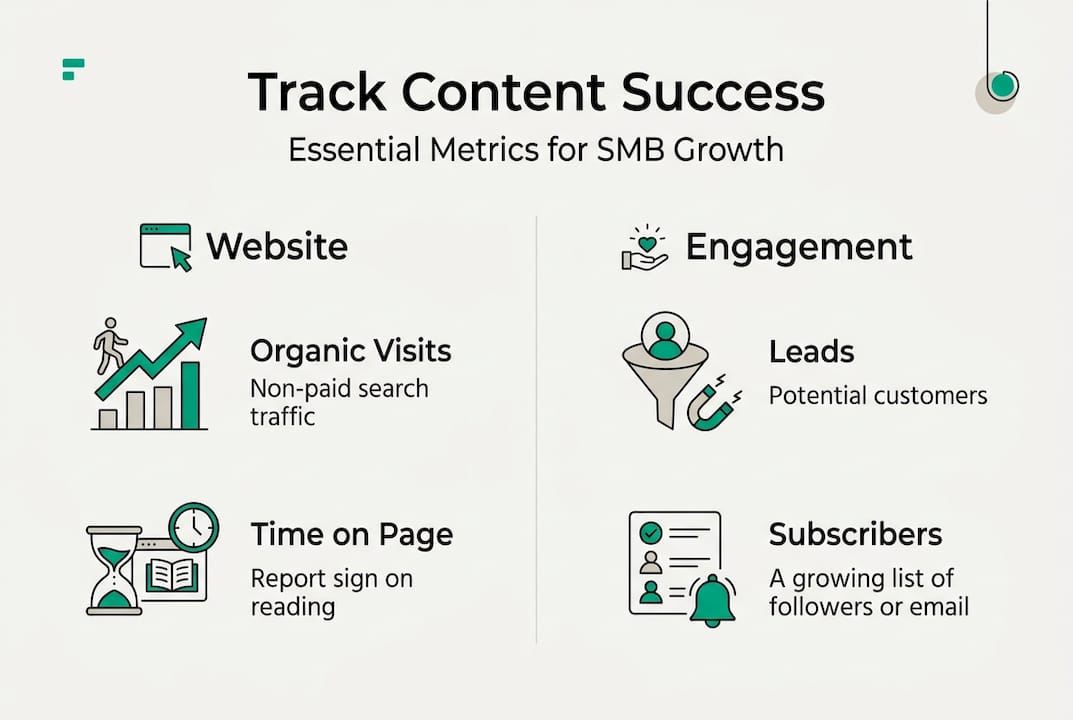
Regular analysis lets you double down on what works and fix what doesn’t. Review your metrics monthly at minimum, looking for patterns in top-performing content. Do certain topics consistently generate more engagement? Does a specific content format convert better? Are particular distribution channels driving higher-quality traffic? Use these insights to refine your editorial calendar and resource allocation.
The path from publishing content to seeing significant results typically spans 6-12 months for most SMBs. This timeline frustrates business owners accustomed to the immediate feedback of paid advertising, leading many to abandon content marketing prematurely. Understanding this reality upfront sets appropriate expectations and prevents the common mistake of quitting just before momentum builds.
Critical metrics to track for content marketing success:
- Organic search traffic growth month over month
- Lead generation from content assets and calls to action
- Email list growth rate and engagement metrics
- Social shares and engagement on published content
- Conversion rate from visitor to lead across content types
- Customer acquisition cost compared to paid channels
Lead generation tactics work best when you optimize continuously based on performance data. If a particular blog post generates exceptional traffic but few conversions, test different calls to action or add lead magnets. When email open rates drop, experiment with subject lines and send times. Small improvements compound over time into significant results.
The role of SEO specialists becomes clear when you’re trying to maximize content visibility and performance. Technical optimization, keyword research, and competitive analysis require specialized expertise that most SMB owners lack time to develop. Partnering with experts accelerates results while you focus on running your business.
| Common Mistake | Recommended Best Practice |
|---|---|
| No documented strategy or clear goals | Write down specific, measurable objectives and tactical plans |
| Inconsistent publishing schedule | Commit to realistic frequency you can sustain long-term |
| Creating content without audience research | Base topics on actual customer questions and search behavior |
| Ignoring performance data | Review metrics monthly and optimize based on insights |
| Quitting after 3-6 months | Commit to minimum 12 months before evaluating overall success |
| Trying to be everywhere at once | Master 1-2 formats and channels before expanding |
Avoid the perfectionism trap that prevents publishing. Done is better than perfect in content marketing, especially when starting. You’ll improve with practice and feedback, but only if you actually publish and learn from real audience response. Set quality standards that represent your brand well without demanding unrealistic polish that delays everything.
Building sustainable content marketing success requires patience, consistency, and willingness to adapt based on evidence. The SMBs winning with content aren’t necessarily more talented or better funded. They simply committed to a strategic approach, measured what mattered, and persisted long enough for compound growth to kick in. You can do the same by following the framework outlined in this guide.
Boost your content marketing with expert SEO and digital services
Ready to accelerate your content marketing results without the trial and error? Ascendly Marketing specializes in helping SMBs like yours build powerful digital presences that generate consistent leads and sales. Our organic SEO services ensure your content reaches the right audience at the right time through strategic optimization and technical excellence.
Our team combines content strategy, SEO expertise, and conversion optimization to maximize every piece you publish. We handle the complex technical aspects while you focus on running your business. From social media marketing in Dallas, TX to comprehensive web design services that convert visitors into customers, we provide the full digital marketing ecosystem your business needs to thrive online. Let’s build a content strategy that delivers measurable growth for your business.
Frequently Asked Questions
What is the ideal content frequency for SMBs?
Aim for 11-20 blog posts and 51-100 social posts per quarter based on industry benchmarks for balanced productivity. This pace maintains consistent presence without overwhelming small teams or sacrificing quality. Focus on publishing fewer exceptional pieces rather than high volumes of mediocre content that nobody reads or shares.
How to measure content marketing success effectively?
Track website traffic from organic search, lead generation rates, email subscriber growth, and conversion metrics monthly to optimize your strategy. Use Google Analytics for traffic and behavior data, and implement clear conversion tracking for all lead capture points. Review performance patterns to identify top content and double down on what works.
How can SMBs avoid common content marketing mistakes?
Document your strategy clearly with specific goals, maintain realistic publishing schedules you can sustain, and track progress consistently to stay on course. Base content topics on actual customer questions rather than guesses, and commit to at least 12 months before evaluating overall success. Most SMBs quit just before momentum builds, so patience and consistency matter more than perfection.
How long before content marketing shows results?
Most SMBs see meaningful traction within 6-12 months of consistent strategic effort and optimization. Early wins like traffic growth may appear sooner, but significant lead generation and revenue impact typically require sustained commitment. The compound effect of content means results accelerate over time as your library grows and authority builds.
Should SMBs use AI tools for content creation?
AI tools can improve efficiency for research, outlining, and editing, but strategic thinking and genuine expertise still drive results. While 60-70% of marketers now use AI heavily, this hasn’t revolutionized outcomes yet, according to recent benchmarks. Use AI to enhance your process, not replace the human insight and experience that makes content valuable to your audience.