

Leads are sitting in one inbox. Sales notes live in a spreadsheet no one updates. Your email platform has one version of the customer, your ad platform has another, and your team keeps asking the same question in different ways: who owns this contact, and what happens next?
That’s usually the moment a business starts looking for a CRM marketing agency. Not because the software is new or exciting, but because the current setup is leaking revenue through missed follow-ups, weak segmentation, and disconnected reporting.
Buying a CRM doesn’t fix that by itself. A platform can store records, send emails, and automate tasks, but someone still has to decide how leads enter the system, how they move, what data matters, which campaigns trigger when, and how reporting ties back to revenue. That’s the core job.
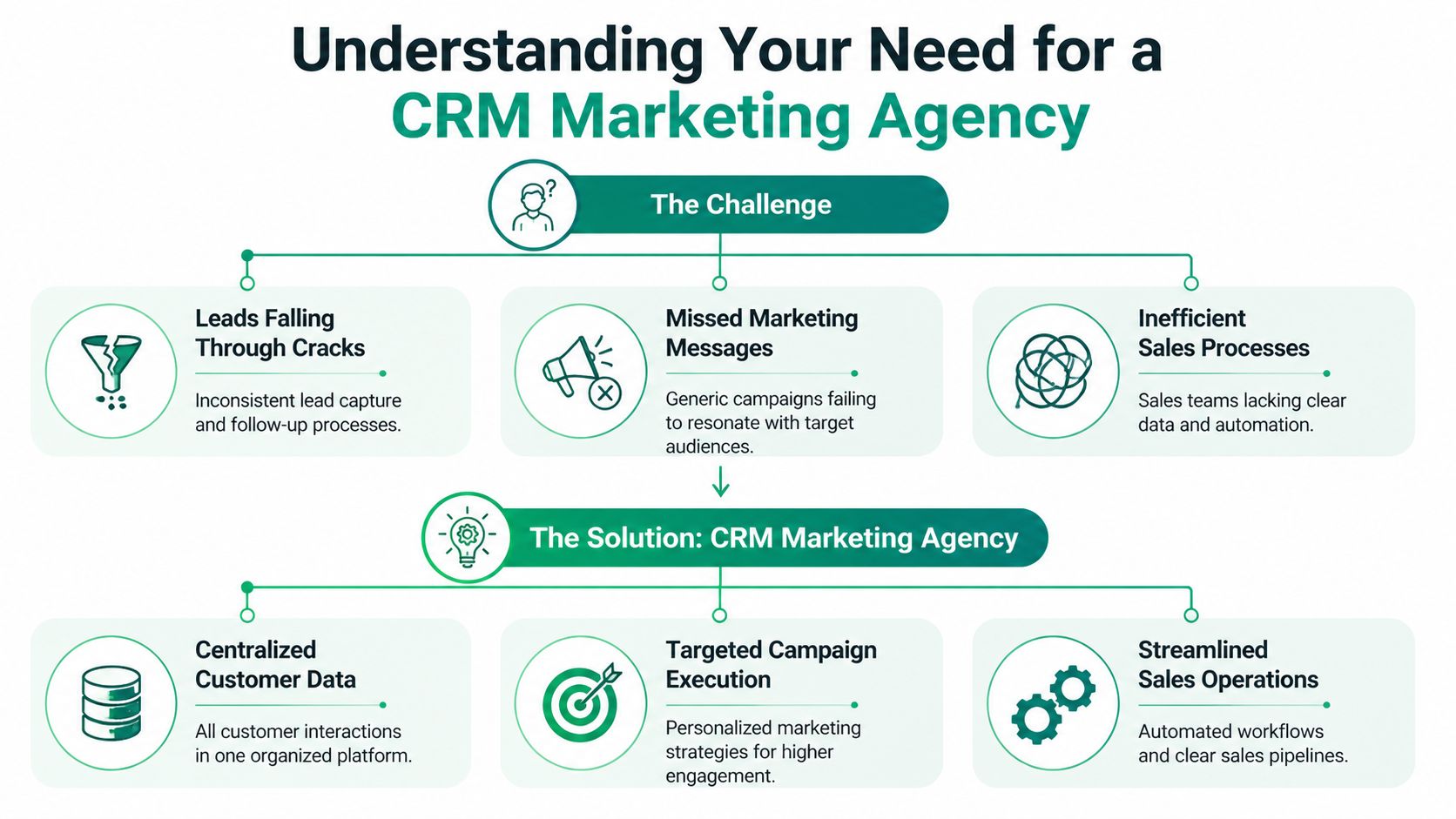
Understanding Your Need for a CRM Marketing Agency
A CRM agency steps in when the system you have stops matching the business you’re running. That often shows up in practical ways. Sales gets leads too late. Marketing can’t tell which campaign produced qualified opportunities. Service teams don’t see the promises made during the sales process.
A good agency doesn’t just “set up software.” It builds the operating model around customer data. Think of the CRM as the central nervous system for growth. If the data flow is broken, every function downstream reacts slowly or incorrectly.
What a business usually gets wrong first
The first mistake is treating the CRM like a contact list. That approach creates a cleaner spreadsheet, not a growth system.
The second mistake is copying another company’s pipeline and workflows. A B2B sales cycle with demos, procurement, and multi-person approvals doesn’t behave like an e-commerce retention program or a local service business with short buying windows.
A third problem shows up later. Teams collect data they never use, while missing the data they need to make decisions.
Practical rule: If a field doesn’t change routing, reporting, segmentation, or follow-up, it probably shouldn’t be required.
What the agency should actually build
A CRM marketing agency should define four things before automation starts:
Cheap setup work often becomes expensive maintenance work.
A practical selection filter
If two agencies look similar, choose the one that can show its method for governance, handoffs, reporting, and change control. Those four areas decide whether the CRM stays useful after launch.
A polished demo can win a meeting. Operational clarity wins a multi-year engagement.
Your Implementation Roadmap From Kickoff to Results
The cleanest CRM projects follow a predictable rhythm. Not because every business is identical, but because good work moves through a sequence: understand the current state, decide what should change, build the system, then measure and refine.
That’s easier to manage when both sides know what happens at each stage.

Discover
This phase is less about software and more about diagnosis. The agency audits your current tools, data sources, forms, campaign flows, pipeline stages, and reporting gaps.
That usually reveals awkward truths. Fields no one trusts. Lifecycle stages that mean different things to different teams. Automations running with outdated logic.
A useful discovery process should answer:
- Where does customer data enter the business
- Who touches it next
- Which reports are missing or misleading
- What manual work keeps repeating
- Which handoffs cost the most time
Plan
Once the mess is visible, the planning phase turns it into decisions. During this phase, the CRM architecture gets defined.
That plan should cover platform structure, data model, user permissions, lifecycle stages, integrations, campaign workflows, reporting design, and ownership rules. It should also say what won’t be done in phase one.
That last part matters. Many teams overload launch with every request they’ve ever had. A good plan narrows the first release to what improves routing, visibility, and follow-up fastest.
Start with the workflows your team uses every day. Leave edge cases for later.
Execute
Execution includes migration, field mapping, pipeline setup, automation logic, integrations, templates, dashboards, and user training.
Businesses often underestimate the human side of implementation. The technical build can be solid and still fail if sales reps don’t trust the stages, marketers can’t segment properly, or managers don’t use the reporting.
What tends to work:
Migrate only necessary data
Old clutter usually doesn’t become useful just because it moved into a new system.Train by role
Sales, marketing, service, and leadership each need different views and actions.Test live scenarios
Run actual lead flows and handoffs before full rollout.Assign one internal owner
Someone on your side has to maintain standards after launch.
Report
Once the system is live, reporting starts feeding optimization. Not every result appears at once. Early wins usually show up first in response speed, stage hygiene, and lead visibility.
Then the second layer begins. Better segmentation. Cleaner nurture. Stronger attribution. More useful sales activity data.
The best implementations don’t end at launch. They move into a review cycle where the agency checks what’s being used, what’s being ignored, and which parts of the process still depend too much on manual effort.
Why Ascendly Marketing Excels at CRM-Driven Growth
A business looking for CRM help usually needs more than platform setup. It needs lead generation, email marketing, conversion support, campaign reporting, and a process that keeps those parts aligned. That’s where a full-service operating model makes sense.
Ascendly Marketing fits that model because its work spans website design, SEO, PPC, email marketing, conversion rate optimization, content, video, public relations, and lead generation programs including cold email outreach. Those functions matter in CRM work because the platform only performs well when acquisition, nurture, and conversion data are connected.
The company’s discover, plan, execute, report process also matches how CRM projects should be run. Discovery finds the data and workflow gaps. Planning defines architecture and reporting. Execution handles implementation and campaign activation. Reporting creates the feedback loop for optimization.
That structure is useful for businesses with mixed needs, especially B2B brands, e-commerce companies, and service businesses that need both marketing execution and CRM discipline under one roof.
A second advantage is breadth of team capability. CRM work often stalls when strategy, creative, analytics, and technical execution sit in separate vendors. Ascendly’s multidisciplinary setup reduces that friction because campaign messaging, web conversion paths, lead generation programs, and reporting can be adjusted together instead of through long handoffs.
The final point is practical. A CRM partner should support measurable outcomes and clear communication, not just tickets and platform changes. Ascendly’s published approach emphasizes transparency, detailed reporting, and continuous optimization, which aligns with how a CRM engagement needs to operate after launch.
Common Questions About CRM Marketing Agencies
How long does it take to see results
You’ll usually see operational changes before financial ones. Faster lead routing, fewer duplicates, cleaner segmentation, and better follow-up can show up early. Revenue effects take longer because the CRM has to influence enough real opportunities to change the pattern.
If an agency promises instant transformation, that’s a bad sign. Good CRM work compounds through process improvement.
Can a small business benefit from a CRM agency
Yes, especially if sales and marketing are already feeling friction. Smaller teams often gain the most from clear stages, automated follow-up, and cleaner reporting because they don’t have spare time for manual coordination.
The key is scope. A small business doesn’t need enterprise architecture. It needs a system it will use.
What’s the difference between a CRM consultant and a CRM marketing agency
A consultant often focuses on platform setup, process design, or administration. A CRM marketing agency usually works across the full customer journey, including segmentation, nurture campaigns, reporting, attribution, and conversion support.
If you need someone to configure fields and permissions, a consultant may be enough. If you need the CRM tied directly to lead generation and lifecycle marketing, an agency is the better fit.
Does CRM matter as much for B2B as it does for e-commerce
Yes, but the use case changes. In B2B, the CRM often becomes the operating record for longer sales cycles, shared account context, and multi-touch follow-up.
There’s also a strong case for connecting CRM with social selling in B2B. A 2022 study on CRM use, social media, and sales performance found that combining CRM technology with social media use can yield 15% to 22% gains in sales performance, with CRM usage enhancing co-creation knowledge sharing (β=0.31) and social media amplifying that effect (β=0.24).
What if part of the need is fundraising or investor visibility
That changes the system requirements. Investor pipelines, deal stages, relationship tracking, and communication history need their own structure. If CRM intersects with fundraising, a market map like discover US CRM investors can help you understand the investor side of the category while you shape the operating side.
What should you ask on the first call with an agency
Ask how they define lifecycle stages, how they handle integrations, who owns reporting, how they structure training, and what they do when user adoption stalls.
Those questions get you closer to the actual quality of the engagement than a feature checklist ever will.
If you want a partner that can connect CRM strategy with lead generation, email marketing, website conversion, and reporting, talk to Ascendly Marketing. A focused conversation about your current stack, handoff problems, and reporting gaps will tell you quickly whether your next move is a cleanup, a rebuild, or a full CRM growth program.