

TL;DR:
- Marketing automation is accessible for small businesses and automates repetitive tasks like emails and lead nurturing.
- It relies on data, triggers, workflows, and reporting to deliver timely, personalized messages at scale.
- Proper management, focused strategies, and data hygiene are essential for automation success and avoiding pitfalls.
Small businesses often assume marketing automation belongs to enterprise budgets and large teams. That assumption is quietly costing them customers. The reality is that automation tools have become remarkably accessible, and businesses of every size are using them to send the right message to the right person at exactly the right moment, without adding headcount. This guide breaks down what marketing automation is, how it works, and how you can put it to work immediately to grow faster, reduce manual effort, and compete with brands that have far bigger marketing departments than you do.
Table of Contents
- What is marketing automation?
- How does marketing automation work?
- Benefits of marketing automation for small businesses
- Pitfalls and challenges of marketing automation
- Applying marketing automation: Steps for your business
- Why less is more: The real secret to automation success
- Ready to streamline your marketing? Let us help
- Frequently asked questions
Key Takeaways
| Point | Details |
|---|---|
| Automate key tasks | Automating repetitive marketing processes can save time and improve campaign effectiveness. |
| Personalize with data | Segmentation and behavioral triggers allow for tailored messaging that resonates with customers. |
| Start simple | It’s best to start with one channel and add complexity as you become more comfortable. |
| Avoid over-automation | Too much automation can lead to impersonal communication and missed opportunities. |
| Maintain clean data | Regularly updating and cleaning your marketing data boosts automation reliability. |
What is marketing automation?
Now that we’ve challenged the idea that automation is only for large brands, let’s break down what marketing automation really is.
Marketing automation is software that automates repetitive marketing tasks such as email campaigns, lead nurturing, segmentation, and multi-channel execution using behavioral triggers and data. In plain terms, it means your marketing keeps running even when you’re not sitting at your desk. A new subscriber joins your list, and a welcome sequence fires automatically. A visitor browses your pricing page three times, and a follow-up email goes out without you lifting a finger.
For small and medium-sized businesses, this is a game-changer. You don’t need a marketing team of 20 people to execute sophisticated campaigns. You need the right setup.
Here are the core building blocks of any marketing automation system:
- Data: Information collected from your website, email list, CRM, and social channels. This is the fuel.
- Segmentation: Grouping contacts by behavior, demographics, or purchase history so messages stay relevant.
- Triggers: Rules that fire an action when a specific condition is met (a form submission, a page visit, a purchase).
- Workflows: The sequence of actions that follow a trigger, such as a series of emails or a task assigned to your sales team.
- Reporting: Dashboards that show you open rates, conversions, revenue attributed, and where contacts drop off.
Understanding these building blocks helps you see automation not as a mysterious black box, but as a logical system you can build and improve over time. If you’re new to this space, the SMB digital marketing guide is a great place to orient yourself before you start building workflows.
Pro Tip: Start with one channel, ideally email, before you try to automate everything at once. Master the basics, see results, then expand. Trying to automate every touchpoint on day one is a recipe for a tangled mess.
How does marketing automation work?
With a clear definition in mind, it’s time to see how automation actually works behind the scenes.
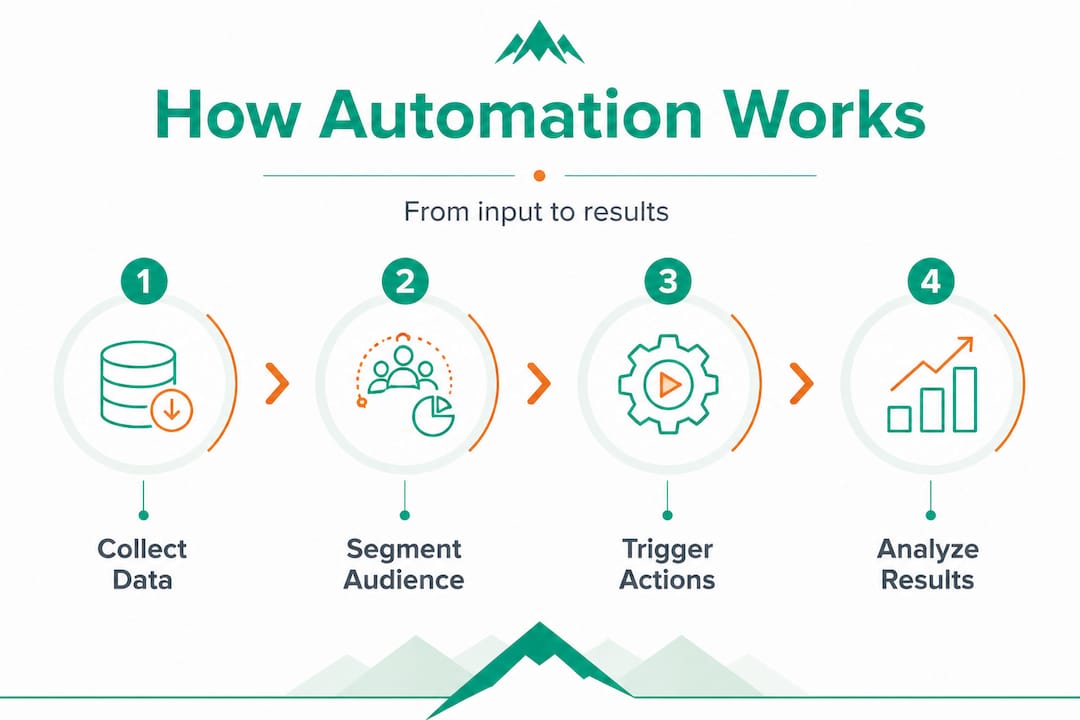
Key mechanics include data aggregation from touchpoints, logic-based triggers (behavioral, time-based, event-based), workflow branching, multi-channel orchestration, and CRM integration. Let’s walk through this step by step.
- Collect data. Every interaction a contact has with your brand generates data. Page visits, email opens, form fills, purchases, and social clicks all feed into your automation platform.
- Apply triggers. You define the rules. If someone visits your pricing page twice in one week, that triggers a specific workflow. If they abandon a cart, a different sequence fires.
- Run workflows. The platform executes the sequence automatically. This might be a three-email nurture series, an SMS reminder, or a task created in your CRM for a sales rep to follow up.
- Track results. Every action is logged. You can see exactly which messages converted, where contacts dropped out, and what needs adjustment.
The logic behind automation is essentially “if this, then that.” It mirrors how a thoughtful salesperson would respond to customer behavior, except it scales to thousands of contacts simultaneously. Maintaining data quality is essential here because bad data produces bad triggers and broken experiences.
Here’s a table that maps each automation component to a real business benefit:
| Component | What it does | Business benefit |
|---|---|---|
| Data aggregation | Collects contact behavior across channels | Builds a full picture of each lead |
| Behavioral triggers | Fires actions based on what contacts do | Sends timely, relevant messages |
| Workflow branching | Routes contacts based on their responses | Personalizes the journey at scale |
| Multi-channel orchestration | Coordinates email, SMS, social, and ads | Consistent experience everywhere |
| CRM integration | Syncs contact data with your sales tools | Keeps marketing and sales aligned |
A well-designed digital marketing workflow connects all these components so nothing falls through the cracks. For businesses selling to other businesses, B2B marketing automation adds an extra layer of lead scoring and longer nurture sequences that match longer sales cycles.

Benefits of marketing automation for small businesses
Understanding the mechanics is powerful, but what does this mean for your business in tangible terms?
Marketing automation enables workflow automation, lead scoring, segmentation, and detailed reporting, saving time and boosting personalization. For a small business owner who is already wearing five hats, that time savings is significant. Let’s make it concrete.
| Task | Manual approach | Automated approach |
|---|---|---|
| Welcome email | Sent manually, often delayed | Fires instantly on sign-up |
| Lead follow-up | Relies on someone remembering | Triggered by form submission |
| Re-engagement | Requires list review and manual send | Runs on a schedule automatically |
| Reporting | Pulled together from multiple tools | Consolidated in one dashboard |
| Segmentation | Done periodically, often outdated | Updates in real time based on behavior |
The differences add up fast. A business sending 500 emails a week manually might spend four to six hours on that task alone. Automation reduces that to setup time and occasional monitoring.
Beyond time savings, here’s what automation genuinely delivers for smaller businesses:
- Personalization at scale. Automation lets you send messages that feel one-to-one, even when you’re reaching thousands of people. A contact who downloaded your pricing guide gets a different follow-up than someone who just signed up for your newsletter.
- Consistent customer journeys. Every new lead gets the same quality experience, regardless of how busy your team is that week.
- Error reduction. Manual processes mean human errors. Wrong names, missed follow-ups, and inconsistent messaging are all reduced when automation handles execution.
- Better reporting. You stop guessing which campaigns work. Automation platforms track every touchpoint and tie actions to outcomes.
- Competitive parity. This is the big one. A well-automated small business can deliver a customer experience that rivals brands with much larger teams.
Poor marketing data issues can undermine all of these benefits, which is why data hygiene is something we’ll return to shortly. For businesses looking to sharpen their overall approach, building a solid small business marketing strategy first will help you know exactly which processes to automate. And when you’re ready to fill your pipeline, pairing automation with strong lead generation tactics multiplies your results significantly.
Pro Tip: Even a basic automated welcome sequence and a cart abandonment email can generate compounding returns over months. You set it up once, and it keeps working. That’s leverage most manual marketing can’t match.
Pitfalls and challenges of marketing automation
But marketing automation isn’t all upside. There are real pitfalls to watch for.
The most common trap is assuming that more automation automatically means better results. It doesn’t. Here are the mistakes that derail even well-intentioned automation programs:
- Impersonal messaging. Automating generic messages to your entire list is just spam with extra steps. Without proper segmentation, you’ll see unsubscribes climb and engagement drop.
- Dirty data. Outdated contact records, duplicate entries, and missing fields cause triggers to misfire. A workflow built on bad data produces bad outcomes at scale.
- Neglected workflows. A workflow you built two years ago may no longer reflect your current offers, pricing, or customer journey. Stale automation quietly damages your brand.
- Wrong trigger logic. Using time-based triggers when behavior-based ones would be more appropriate leads to messages that feel random rather than relevant.
- No suppression rules. Failing to suppress recent buyers from a promotional campaign means you’ll email people to buy something they just purchased. That erodes trust fast.
“Over-automation leads to impersonal communication; dirty data causes failures; unmaintained workflows decay deliverability; enterprise scale breaks without governance.” — Common marketing automation mistakes
The fix for most of these issues is simpler than it sounds: review your automation quarterly, clean your data regularly, and always ask whether a message would feel relevant to the person receiving it. Tracking marketing data errors systematically is one of the most underrated practices in small business marketing. Even businesses running sophisticated enterprise SEO strategies can see their automation results collapse if data quality is ignored.
Applying marketing automation: Steps for your business
With the challenges fresh in mind, let’s explore how to roll out automation the right way for your own business.
Core components include data collection, segmentation, lead scoring, workflow automation, and reporting. Here’s how to put them together in a practical sequence:
- Define your goals. What do you want automation to do? Generate leads? Nurture existing contacts? Recover abandoned carts? Start with one clear objective.
- Gather and clean your data. Import your contact list, remove duplicates, and fill in missing fields. Your automation is only as good as the data it runs on.
- Segment your audience. Divide contacts into meaningful groups. New leads, existing customers, and lapsed buyers all need different messaging.
- Set up your triggers. Decide what actions will fire each workflow. A form submission, a product page visit, or a specific email click are all strong trigger candidates.
- Build your workflows. Start simple. A three-step welcome sequence or a two-email cart abandonment flow is a perfectly valid starting point.
- Monitor and improve. Check your open rates, click rates, and conversion data weekly at first. Adjust subject lines, timing, and content based on what you see.
Using automated marketing observability practices helps you catch problems early before they affect large portions of your audience. As you grow more confident, tools that incorporate AI marketing for SMBs can help you predict the best send times, personalize content dynamically, and score leads more accurately. The step-by-step SMB guide from Ascendly Marketing walks through how to build this kind of momentum across your entire digital presence.
Pro Tip: Schedule a data hygiene session every 90 days. Remove contacts who haven’t engaged in six months, update job titles and company names for B2B lists, and audit your trigger logic to make sure it still reflects your current offers. This one habit prevents most automation failures before they happen.
Why less is more: The real secret to automation success
After all these tactical steps and warnings, let’s get real about what actually makes marketing automation work for growing businesses.
We’ve seen businesses automate 30 different workflows in their first month and wonder why results are flat. We’ve also seen businesses automate three workflows thoughtfully and generate a meaningful increase in revenue within 90 days. The difference is seldom the number of automations. It’s the quality of thinking behind each one.
The temptation when you first discover automation is to automate everything. Welcome sequences, re-engagement campaigns, post-purchase follow-ups, review requests, upsell sequences, referral programs. All at once. The result is usually a chaotic system that nobody fully understands, where contacts receive contradictory messages, and nobody on the team knows which workflow is responsible for what.
For small businesses, especially, restraint is a competitive advantage. When you focus automation on the three or four journeys that matter most, such as converting a new lead, recovering an abandoned cart, and re-engaging a lapsed customer, you can build those workflows with real care and test them properly. A streamlined workflow that you understand deeply will always outperform a sprawling system that nobody maintains.
There’s also a human element that automation cannot replace. Personalization requires genuine insight into your customers. If you don’t know what your best customers care about, no amount of trigger logic will make your emails feel relevant. Automation amplifies your understanding of your audience. It doesn’t substitute for that understanding.
The businesses that get the most from automation are the ones that treat it as a living system. They audit their workflows quarterly, retire sequences that are no longer performing, and update messaging to reflect current offers and customer feedback. Clarity and simplicity, maintained consistently, beat complexity every time.
Ready to streamline your marketing? Let us help
If this article has shown you the potential of marketing automation but the setup still feels overwhelming, you don’t have to figure it out alone. At Ascendly Marketing, we’ve helped small and medium-sized businesses build automation systems that actually work, from simple email sequences to fully integrated multi-channel campaigns.

Whether you’re just getting started or you’ve already built workflows that need a serious audit, our team can help you identify the highest-impact opportunities and set up automation that runs reliably. Explore our digital marketing services to see how we approach automation as part of a broader growth strategy. Or start with our marketing guide for SMBs to build a solid foundation before you automate. We’re here when you’re ready to take the next step.
Frequently Asked Questions
What is the main purpose of marketing automation?
The main purpose of marketing automation is to streamline repetitive tasks so businesses can nurture leads and engage customers more efficiently without increasing headcount or manual effort.
How can small businesses start using marketing automation?
Small businesses should start by automating a single channel like email, using core components such as data collection and basic segmentation, then gradually build more advanced workflows as confidence grows.
What are the most common mistakes to avoid in marketing automation?
The most common mistakes include sending impersonal messages, skipping audience segmentation, and ignoring suppression rules, all of which damage deliverability and erode customer trust over time.
Does marketing automation replace human marketers?
No. Automation handles repetitive execution, but strategy, creative direction, and genuine customer insight still require human judgment. Automation makes marketers more effective, not redundant.