

Many small business owners believe digital marketing is just posting on social media or running a few Google ads. The reality is far more strategic and impactful. Digital marketing encompasses a comprehensive ecosystem of online channels working together to build brand visibility, generate qualified leads, and drive measurable revenue growth. For small to medium-sized businesses competing in 2026’s crowded digital landscape, understanding how to leverage these channels effectively isn’t optional anymore. This guide breaks down what digital marketing truly involves, which channels deliver the best returns, how AI fits into your strategy, and practical steps to build customer-centric campaigns that actually move the needle for your business.
Table of Contents
- Key takeaways
- What is digital marketing and why it matters for small businesses
- Core digital marketing channels and how they drive results
- The role of AI and human insight in modern digital marketing
- Building customer-centric digital marketing strategies for measurable growth
- Elevate your digital marketing with Ascendly Marketing
- Frequently asked questions
Key Takeaways
| Point | Details |
|---|---|
| Channel ecosystem | Digital marketing uses a coordinated mix of online channels to build visibility, generate leads, and drive revenue. |
| Strong ROI focus | Small businesses typically allocate 7 to 12 percent of gross revenue to marketing, with digital channels delivering measurable results. |
| Email ROI | Email marketing yields about $36 in value for every dollar spent, and segmentation greatly improves outcomes. |
| AI supports human | AI tools help optimize campaigns but cannot replace human strategy and creativity. |
| Data driven tracking | Tracking clicks, conversions, and spend gives you clear insight to double down on what works. |
What is digital marketing and why it matters for small businesses
Digital marketing refers to promoting your products or services through online channels and digital technologies. Unlike traditional marketing that relies on print ads, billboards, or direct mail, digital marketing uses the internet and electronic devices to connect with current and prospective customers. This includes everything from your website and email campaigns to search engine visibility, social media presence, and online advertising.
The core digital channels that make up a comprehensive small business digital marketing strategy include:
- Email marketing for nurturing leads and maintaining customer relationships
- Search engine optimization (SEO) to improve organic visibility in Google and Bing
- Pay-per-click (PPC) advertising for immediate traffic and lead generation
- Social media marketing to build community and brand awareness
- Content marketing through blogs, videos, and resources that educate your audience
- Website optimization to convert visitors into customers
For small businesses, digital marketing levels the playing field against larger competitors. You don’t need a Fortune 500 budget to reach your target audience effectively. SMBs allocate 7-12% of gross revenue to marketing, with a substantial portion directed toward digital channels because they offer measurable results and cost-effective reach.
The ability to track every click, conversion, and dollar spent gives you unprecedented control over your marketing investment. You can see exactly which campaigns drive phone calls, form submissions, or online purchases. This transparency lets you double down on what works and cut what doesn’t, making digital marketing not just affordable but essential for sustainable growth. Without a strategic digital presence, you’re invisible to the majority of potential customers who research solutions online before making purchase decisions.
Core digital marketing channels and how they drive results
Understanding which channels deliver the best returns helps you allocate budget wisely and build campaigns that actually generate revenue. Each channel serves distinct purposes in your marketing ecosystem, and the most successful strategies combine multiple touchpoints to guide prospects through the buying journey.
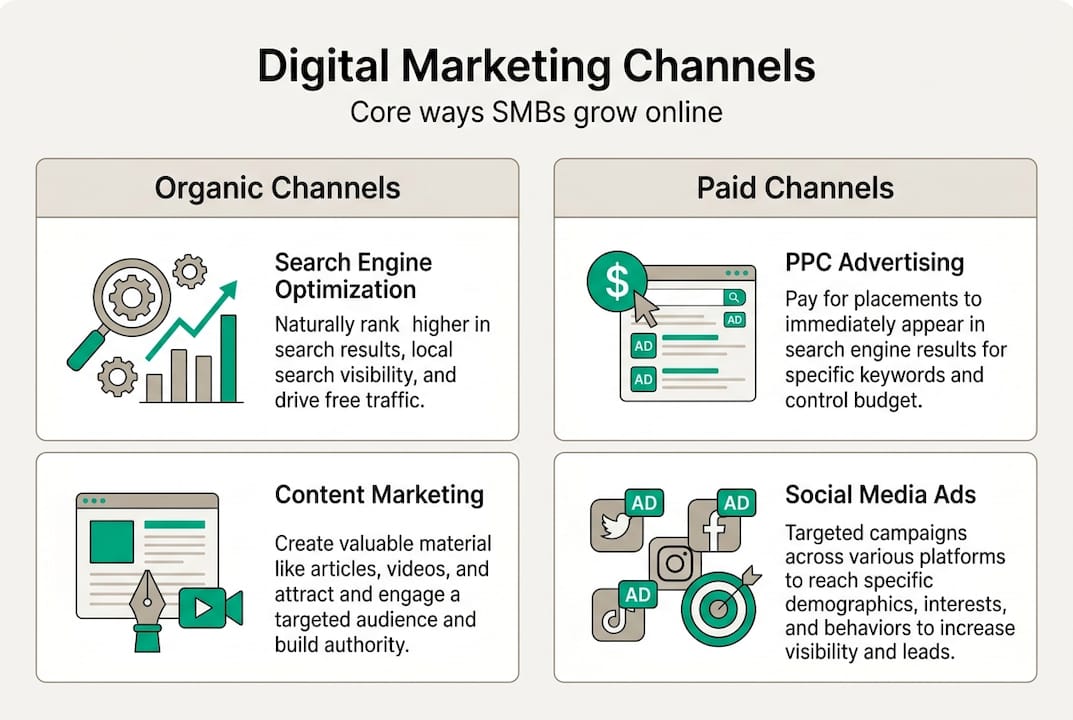
Email marketing consistently delivers exceptional ROI. Studies show email returns $36 for every $1 spent, with average open rates around 55.4%. This channel excels at nurturing relationships with people who already know your brand, whether they’re past customers, newsletter subscribers, or leads who downloaded a resource. Segmented campaigns that speak to specific customer needs dramatically outperform generic blasts.
Pay-per-click advertising through Google Ads and social platforms provides immediate visibility and traffic. You pay only when someone clicks your ad, making it a performance-based investment. Average click-through rates vary by industry but typically range from 2-5% for search ads. The key advantage is speed. While SEO takes months to build momentum, PPC campaigns can start generating leads within hours of launch.

Content marketing establishes your expertise and attracts organic traffic over time. Blog posts, guides, videos, and case studies answer questions your prospects are actively searching for online. This approach builds trust and positions your business as a helpful resource rather than just another vendor. Quality content also supports your SEO efforts by giving search engines fresh, relevant material to index.
Social media marketing creates community and keeps your brand top of mind. Different platforms serve different purposes. LinkedIn works well for B2B relationship building, while Instagram and Facebook excel at visual storytelling and local business promotion. Consistency matters more than perfection here.
| Channel | Primary benefit | Typical conversion rate | Best for |
|---|---|---|---|
| Email marketing | Relationship nurturing | 15-25% | Repeat business, upsells |
| PPC advertising | Immediate traffic | 2-5% CTR, 2-4% conversion | Lead generation, promotions |
| Content marketing | Long-term authority | 2-3% | Education, SEO, trust building |
| Social media | Brand awareness | 1-2% | Community, engagement |
| SEO | Sustainable organic traffic | 2-5% | Long-term visibility |
Different types of digital marketing for SMB growth work synergistically. Your content marketing feeds your SEO strategy. Your SEO brings visitors who join your email list. Your email campaigns drive traffic to landing pages optimized for conversions. Understanding how to improve conversion rates across these channels amplifies your overall results.
Pro Tip: Start by identifying where your ideal customers spend time online and focus your initial efforts on 2-3 channels rather than spreading resources too thin. Master those channels first, then expand your presence strategically based on performance data.
The role of AI and human insight in modern digital marketing
Artificial intelligence has transformed how businesses execute digital marketing campaigns, but it hasn’t replaced the need for human creativity and strategic thinking. Understanding this balance helps you leverage technology effectively without falling into common traps.
AI adoption among SMBs has accelerated dramatically. Approximately 54% of small business owners who use AI tools report feeling optimistic about the technology’s potential to streamline marketing workflows. AI excels at specific tasks like analyzing large datasets, personalizing email subject lines, optimizing ad bidding in real time, and generating initial content drafts. These capabilities free up your team to focus on higher-level strategy and creative work that truly differentiates your brand.
However, AI accelerates workflows but requires human oversight due to a lack of nuance and risks of generic output. AI tools don’t understand your brand voice, your customer relationships, or the subtle context that makes messaging resonate. They can produce technically correct content that completely misses the mark emotionally. Without human review, AI-generated campaigns often sound generic, fail to address real customer pain points, and sometimes include factual errors or outdated information.
The risks of over-relying on AI without proper oversight include:
- Inflated advertising costs from poorly optimized automated bidding strategies
- Generic messaging that fails to differentiate your brand from competitors
- Ethical concerns around data privacy and algorithmic bias
- Loss of authentic brand voice that customers connect with
- Missed opportunities to capitalize on timely trends or local market conditions
“AI is a powerful accelerator for digital marketing execution, but it cannot replace the strategic thinking, empathy, and creative problem solving that human marketers bring to understanding customer needs and building authentic brand relationships.”
The most effective approach combines AI’s efficiency with human judgment. Use AI tools to handle repetitive tasks like scheduling social posts, analyzing campaign performance data, or creating multiple ad variations for testing. Reserve human expertise for developing overall strategy, crafting core messaging, making budget allocation decisions, and building genuine customer relationships. According to the State of Marketing Report, top-performing marketing teams use AI to enhance rather than replace human capabilities.
Businesses that implement a marketing strategy see 331 percent higher success rates compared to those without clear planning. This strategic foundation, created by humans who understand your business goals and customer needs, guides how you deploy AI tools effectively.
Pro Tip: Treat AI as a junior team member who needs clear direction and quality control. Always review AI-generated content for accuracy, brand alignment, and genuine value before publishing. The best results come from using AI to expand your capacity, not replace your expertise.
Building customer-centric digital marketing strategies for measurable growth
Creating a digital marketing strategy that actually drives business results requires putting customer needs at the center of every decision. This customer-centric approach, combined with rigorous performance tracking, separates successful campaigns from wasted budget.
Success depends on personalization, trust-building through reviews and content, and omni-channel consistency. Modern consumers expect brands to recognize them across touchpoints and deliver relevant experiences based on their interests and behavior. Generic mass marketing no longer cuts through the noise. Personalization means segmenting your audience by characteristics like purchase history, engagement level, or demographic factors, then tailoring messages accordingly.
Building trust requires consistent delivery of value before asking for the sale. Share educational content that helps prospects solve problems. Showcase authentic customer reviews and testimonials. Be transparent about your processes and pricing. These trust signals matter more than ever in a digital landscape where consumers research extensively before committing.
An omni-channel strategy ensures customers receive a cohesive experience whether they interact with your brand via email, social media, your website, or in person. This consistency reinforces your messaging and makes it easier for prospects to move through the buying journey.
| Approach | Benefits | Challenges | Best for |
|---|---|---|---|
| Single-channel focus | Easier to manage, lower initial cost, faster to implement | Limited reach, vulnerable to platform changes, missed touchpoints | Testing new markets, very niche audiences |
| Omni-channel strategy | Broader reach, multiple touchpoints, resilient to changes, higher conversion rates | More complex to coordinate, requires more resources, needs integrated tracking | Established businesses, competitive markets, customer retention |
To develop and execute an effective customer-centric digital marketing strategy, follow these practical steps:
- Define your ideal customer profile with specific demographics, pain points, and buying behaviors rather than vague generalities.
- Map the customer journey from initial awareness through consideration to purchase decision, identifying key touchpoints and questions at each stage.
- Select 2-4 digital channels where your target customers actively spend time and are receptive to marketing messages.
- Create valuable content and offers that address specific customer needs at each journey stage rather than only promoting your products.
- Implement tracking systems to measure key metrics like traffic sources, conversion rates, cost per lead, and customer acquisition cost.
- Test different messaging, offers, and creative approaches systematically to identify what resonates best with your audience.
- Analyze performance data monthly and reallocate budget toward highest-performing channels and campaigns.
- Gather customer feedback through surveys, reviews, and direct conversations to refine your understanding of their needs.
Understanding how to calculate marketing ROI lets you make data-driven decisions about where to invest. Track not just vanity metrics like impressions or likes, but business outcomes like qualified leads, sales revenue, and customer lifetime value. This financial perspective keeps your strategy grounded in what actually grows your business.
Your online branding guide should inform how you present your business consistently across all digital channels. Strong branding makes your marketing more memorable and effective by creating clear differentiation from competitors.
Pro Tip: Set up a simple dashboard that tracks your top 5-7 key performance indicators weekly. Regular monitoring lets you spot trends early and make small adjustments before minor issues become major problems. The businesses that win in digital marketing are those that treat it as an ongoing optimization process rather than a set-it-and-forget-it campaign.
Elevate your digital marketing with Ascendly Marketing
Applying everything you’ve learned about strategic digital marketing takes expertise, time, and ongoing optimization. That’s where partnering with experienced professionals makes the difference between sporadic results and consistent growth.
Ascendly Marketing has helped small and medium-sized businesses build powerful online presences since 2013. Our team brings together specialists in SEO, PPC advertising, content creation, and social media management who understand what works for SMBs competing in today’s digital landscape. We don’t believe in one-size-fits-all templates. Every digital marketing services engagement starts with understanding your specific business goals, target customers, and competitive environment.
We implement the customer-centric, data-driven strategies outlined in this guide, handling the technical complexity while keeping you informed with transparent reporting. Whether you need a comprehensive small business digital marketing strategy or specialized support in areas like SEO company Dallas services, we tailor our approach to your needs and budget. Our focus is building long-term partnerships that deliver measurable ROI and sustainable growth, not just generating reports full of vanity metrics.
Frequently Asked Questions
What is digital marketing in simple terms?
Digital marketing is promoting your business through online channels like websites, search engines, email, and social media rather than traditional methods like print ads or direct mail. It lets you reach customers where they spend time online and track exactly which efforts generate results.
How much should a small business spend on digital marketing?
Most small businesses allocate 7-12% of gross revenue to total marketing, with a significant portion going to digital channels. A business earning $500,000 annually might invest $35,000-$60,000 in marketing, with $20,000-$40,000 focused on digital efforts depending on growth goals and industry competition.
Can AI handle my digital marketing completely?
No. AI tools accelerate execution of repetitive tasks like data analysis, ad optimization, and content drafts, but they lack the strategic thinking, creativity, and customer empathy needed for effective marketing. The best results come from combining AI efficiency with human oversight and decision-making.
What digital marketing channel should I start with?
Start where your customers actively look for solutions. For most SMBs, this means a well-optimized website combined with either local SEO if you serve a geographic area, or Google Ads if you need leads quickly. Email marketing should follow once you have a way to capture contacts.
How long before digital marketing shows results?
PPC advertising can generate leads within days of launch. SEO typically takes 3-6 months to show meaningful traffic increases. Email marketing and content strategies build momentum over time, with most businesses seeing significant impact after 6-12 months of consistent effort. The key is starting now and optimizing continuously.