

Customers need to see your business 5 to 7 times before recognizing your brand. Yet many small business owners confuse online branding with just having a logo or a website. Online branding encompasses your entire digital presence, how customers perceive you, and the trust you build across every touchpoint. Mastering it drives growth, loyalty, and revenue for small businesses in 2026.
Table of Contents
- What Is Online Branding and Why Does It Matter?
- How Consistent Online Branding Drives Revenue and Customer Engagement
- Integrating Online Branding With the Marketing Mix for Small Businesses
- Top Channels and Tactics for Building Your Online Brand in 2026
- Boost Your Online Branding With Expert Digital Marketing Support
- Frequently Asked Questions About Online Branding
Key takeaways
| Point | Details |
|---|---|
| Recognition requires repetition | Customers need multiple consistent brand impressions before they remember you. |
| Consistency boosts revenue | Consistent online branding increases revenue by around 20%. |
| Integration raises engagement | Aligning digital marketing with your marketing mix lifts customer engagement significantly. |
| Trust drives purchases | Building trust through strong branding directly influences buying decisions. |
| SMBs are investing more | Proactive small businesses are raising marketing budgets despite economic uncertainty. |
What is online branding and why does it matter?
Digital branding involves creating a consistent brand identity across all online platforms to build trust and recognition. It’s not just your logo, color scheme, or tagline. Branding is the essence of your business, how you communicate your values, personality, and promise to customers everywhere they encounter you online.
Most small and medium businesses assemble their brand piecemeal rather than designing it strategically. This creates inconsistency. One social media profile uses different colors than your website. Your email signature doesn’t match your ads. These disconnects erode trust and make you forgettable.
Your online brand is the sum of every interaction a customer has with your business on the internet. Each touchpoint either strengthens or weakens their perception.
Consistent identity across channels builds recognition and credibility. When your messaging, visuals, and tone align, customers learn who you are faster and trust you more. Trust influences 71% of purchase decisions, making it a revenue driver, not just a nice-to-have.
Effective online branding requires deliberate choices about:
- Visual identity: logos, colors, fonts, imagery style
- Voice and tone: how you speak to customers in writing
- Core messaging: what you stand for and promise to deliver
- Customer experience: how interactions feel at every digital touchpoint
Small businesses that prioritize these elements outperform competitors who treat branding as an afterthought. A clear marketing strategy for SMB success integrates branding with every marketing activity to maximize impact.

How consistent online branding drives revenue and customer engagement
Consistent branding can increase revenue by around 20%. Research shows businesses with consistent branding see an average revenue increase of 23%. These aren’t small bumps. They represent thousands or millions of dollars for growing businesses.
Why does consistency matter so much? Customers engage more when branding is uniform and clear. They recognize you faster, remember you longer, and feel confident choosing you over competitors. Recognition breeds familiarity, and familiarity breeds trust.
Poor branding creates confusion and skepticism. If your website looks professional but your social media seems amateur, customers wonder which version is real. If your messaging changes drastically between channels, they question whether you know what you’re doing. These doubts kill conversions.
Branding mistakes often last longer and cost more than operational ones. A shipping delay frustrates one customer. A brand misstep damages perception for thousands.
The benefits of strong branding extend beyond immediate sales:
- Higher customer lifetime value: trusted brands earn repeat purchases
- Lower acquisition costs: recognition reduces the effort needed to convert prospects
- Premium pricing power: strong brands command higher prices
- Referral amplification: satisfied customers recommend brands they trust
Small businesses often underestimate branding impact because results accumulate over time rather than appearing instantly. But the compound effect is powerful. Every consistent touchpoint strengthens your position. Every inconsistency weakens it.
Investing in digital marketing services that prioritize brand consistency pays dividends through higher engagement, stronger loyalty, and sustainable revenue growth.
Integrating online branding with the marketing mix for small businesses
Your online branding works best when integrated with the traditional marketing mix: product, price, place, and promotion. The marketing mix must be integrated with digital strategies for effective online branding. When these elements align, customer engagement can rise 30% or more.
Think of branding as the thread connecting all marketing decisions. Your product quality should reflect brand promises. Pricing should match the value perception your brand creates. Distribution channels (place) should align with where your target audience expects to find you. Promotional tactics should reinforce your brand personality.
Here’s how each element supports online branding:
- Product: Ensure offerings match brand positioning and quality expectations
- Price: Set prices that reflect the value and prestige your brand communicates
- Place: Choose digital platforms where your audience spends time and expects your presence
- Promotion: Create campaigns with consistent messaging, visuals, and tone across channels
A small business digital marketing strategy integrates these components deliberately. Without integration, you might advertise luxury pricing while your website looks budget. Or promise premium service while operating on platforms known for low-cost providers.
| Marketing Mix Element | Branding Consideration | Integration Action |
|---|---|---|
| Product | Does quality match brand promise? | Audit offerings for consistency |
| Price | Does pricing reflect brand positioning? | Align rates with perceived value |
| Place | Are you visible where customers expect? | Optimize platform presence |
| Promotion | Is messaging uniform across channels? | Standardize campaigns |
Pro Tip: Conduct quarterly brand audits to ensure your marketing mix elements remain aligned. Check that website messaging matches social media, email campaigns reflect current positioning, and every customer touchpoint reinforces the same core identity.
Businesses planning mergers or acquisitions should prioritize digital marketing due diligence to assess brand integration opportunities and risks before closing deals.
Top channels and tactics for building your online brand in 2026
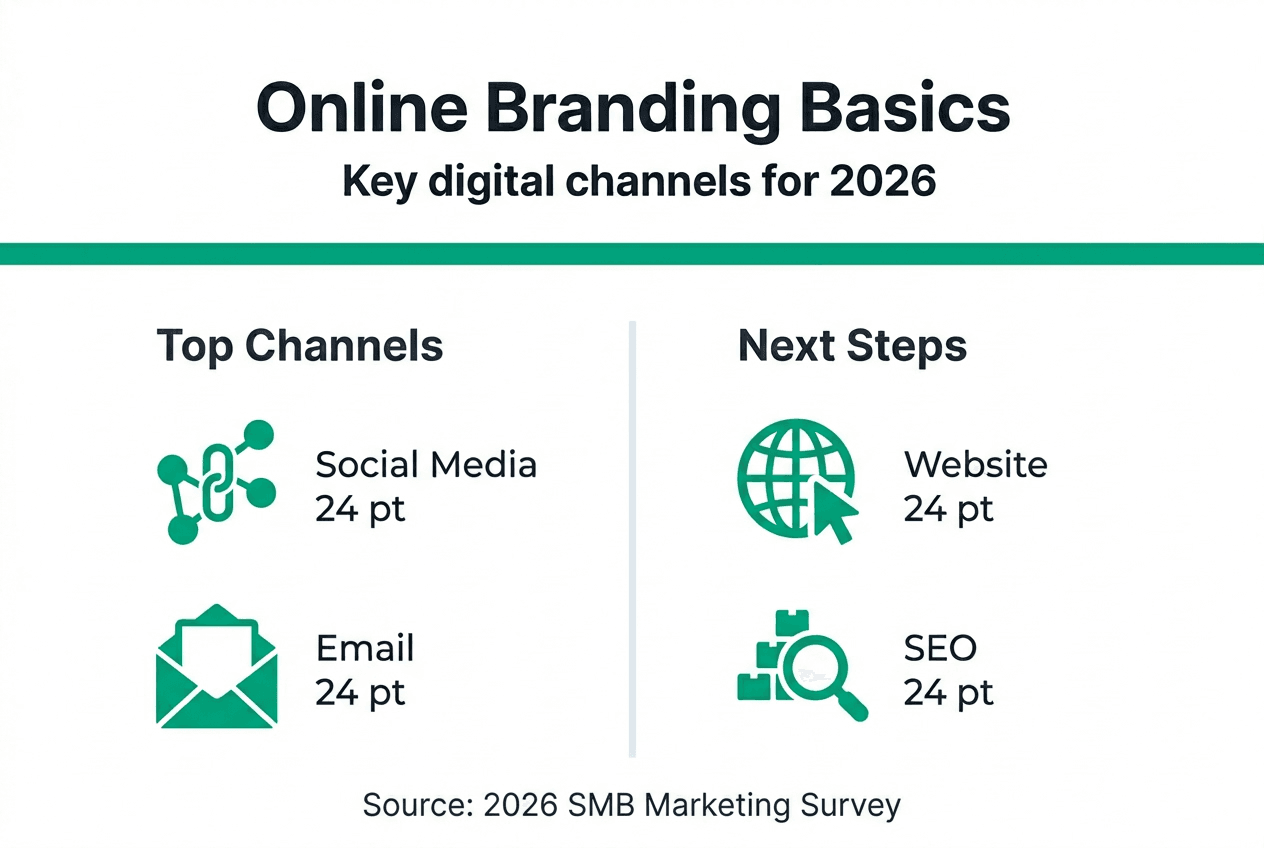
Social media (68%) and email marketing (41%) lead the channel mix for small businesses. These platforms offer direct customer access and repeated brand impressions at relatively low cost. Social media engagement increases customer loyalty by 20%, making it a powerful branding tool.
Artificial intelligence is reshaping how small businesses approach marketing. 54% of SMB owners are using AI marketing tools to personalize content, automate campaigns, and analyze customer behavior. AI helps small teams compete with larger competitors by scaling personalized branding efficiently.
Search engine optimization remains critical for visibility. Most customers never scroll past the first page of search results. Ranking high for relevant keywords puts your brand in front of prospects actively seeking solutions you offer.
| Tactic | Primary Benefit | Best For | Investment Level |
|---|---|---|---|
| Social Media | Direct engagement and community building | B2C and local businesses | Low to moderate |
| Email Marketing | Nurturing relationships and repeat sales | All business types | Low |
| SEO | Long-term visibility and organic traffic | Businesses with online sales or leads | Moderate to high |
| AI Tools | Personalization at scale | Businesses with large customer bases | Moderate |
Effective channel selection depends on where your customers spend time and how they prefer to interact with brands. B2B companies might prioritize LinkedIn and email. Local retailers might focus on Facebook, Instagram, and Google My Business. E-commerce brands need strong SEO and retargeting.
Pro Tip: Start with two or three channels you can manage consistently rather than spreading thin across every platform. Master those channels, build recognition, then expand strategically.
Partnering with specialists in social media marketing and organic SEO accelerates results by applying proven tactics tailored to your industry and audience.
Boost your online branding with expert digital marketing support
Building a strong online brand requires strategy, consistency, and expertise across multiple channels. Professional digital marketing services accelerate your brand growth by ensuring every touchpoint reinforces your identity and connects with your target audience effectively.
Expert agencies bring specialized knowledge in SEO, social media, content creation, and emerging tools like AI marketing. They craft tailored strategies matching your unique business goals and customer needs. This expertise ensures you invest resources where they’ll drive the greatest impact rather than wasting budget on ineffective tactics.
Partnering with specialists frees your time to focus on core business activities while professionals handle the complexity of maintaining consistent branding across platforms. A comprehensive small business digital marketing strategy developed by experienced marketers can transform your online presence from fragmented to cohesive, from forgettable to memorable. Professional social media marketing services ensure your brand personality shines through every post, comment, and campaign, building the recognition and trust that drive revenue growth.
Frequently Asked Questions About Online Branding
What is online branding?
Online branding is the process of creating and maintaining a consistent identity for your business across all digital channels, including websites, social media, email, and online advertising. It encompasses your visual identity, messaging, voice, and the overall experience customers have when interacting with your business online. Effective online branding builds recognition, trust, and loyalty among your target audience.
How is online branding different from traditional branding?
Online branding operates in digital spaces where interactions happen faster, customers have more control, and competition is just a click away. Traditional branding relies on physical touchpoints like storefronts, print ads, and face-to-face interactions. Online branding requires managing multiple digital channels simultaneously, responding to customer feedback in real time, and adapting quickly to platform changes and trends.
What are the biggest online branding mistakes small businesses make?
The most common mistakes include inconsistent visual identity across platforms, irregular posting schedules, ignoring customer comments and reviews, and copying competitor strategies instead of developing unique positioning. Many small businesses also neglect to define their brand voice clearly, resulting in confusing or contradictory messaging that fails to build recognition or trust.
How long does it take to build a strong online brand?
Building meaningful brand recognition typically takes six to twelve months of consistent effort across chosen channels. Customers need multiple impressions before remembering your brand, so patience and persistence matter more than quick wins. However, businesses that invest in strategic branding from the start see measurable improvements in engagement and conversions within the first three months.
Can I build an online brand without a big budget?
Yes, small businesses can build effective online brands with limited budgets by focusing on consistency rather than reach. Choose two or three channels you can manage well, create valuable content regularly, engage authentically with your audience, and use free tools for design and scheduling. Organic growth through genuine relationships and quality content often outperforms expensive advertising with poor branding.
How do I measure online branding success?
Track metrics including brand awareness (search volume for your business name), engagement rates on social media, website traffic growth, customer retention rates, and net promoter scores. Monitor how consistently customers describe your brand and whether their perceptions match your intended positioning. Revenue growth and customer lifetime value ultimately reflect branding success over time.