

Most small business owners don’t fail at digital marketing because they lack effort. They fail because they start in the wrong place. Running paid ads before building a website that converts, or posting on five social platforms before knowing who their customer is, are mistakes that drain budgets and morale fast. The good news is that digital marketing success follows a repeatable sequence. Get the order right and even modest investments produce real, measurable growth. This guide walks you through every essential step, from setting goals and building your website to measuring ROI, so you can stop guessing and start growing.
Table of Contents
- Laying the groundwork: Define goals and audiences
- Building your online foundation: Website essentials
- Getting discovered: SEO and local SEO basics
- Content, social, and paid: Choosing your channels
- Track, measure, and refine: Analytics and ROI
- Our take: What most SMBs get wrong about digital marketing steps
- Partner with experts for your next digital marketing steps
- Frequently asked questions
Key Takeaways
| Point | Details |
|---|---|
| Start with goals | Setting clear objectives and defining your audience sets the stage for success. |
| Build a strong website | A mobile-optimized, fast, and lead-ready site anchors your digital marketing. |
| Prioritize organic channels | SEO, quality content, and local listings drive discoverability and trust. |
| Track and adapt | Measuring results and making improvements keeps your strategy effective. |
Laying the groundwork: Define goals and audiences
Every effective digital marketing campaign starts long before you write a single blog post or run a single ad. It starts with clarity. Without knowing what you want to achieve and who you want to reach, every tactic you try is just noise.
The most reliable framework for setting goals is the SMART method. Your goals should be Specific, Measurable, Achievable, Relevant, and Time-bound. Instead of saying “I want more website traffic,” say “I want to increase organic website visits by 30% in six months.” That kind of precision shapes every decision that follows.
Once your goals are locked in, you need to define your ideal customer. Ask yourself:
- Who are they? (Age, job title, income level, location)
- Where do they spend time online?
- What problems are they trying to solve?
- What objections might they have before buying?
From those answers, you build buyer personas, which are semi-fictional profiles that represent your best customers. A persona might be “Maria, a 42-year-old restaurant owner in Dallas who needs more foot traffic and doesn’t have time to manage social media herself.” That specificity makes your messaging sharper and your targeting more efficient.
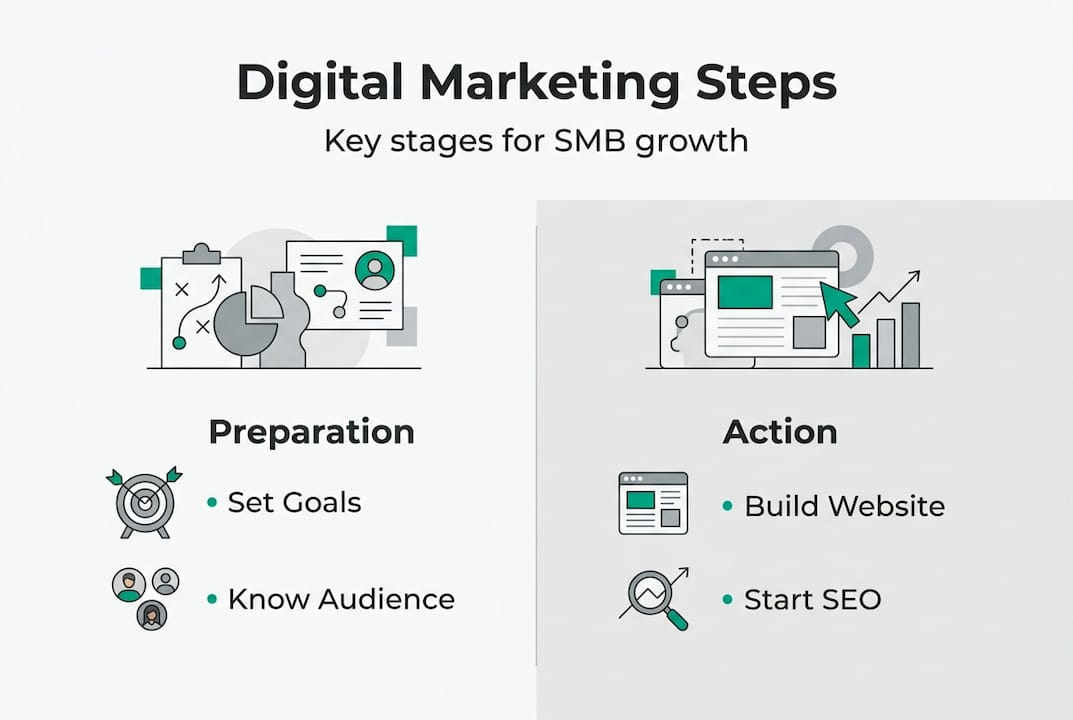
As HubSpot explains, you should define goals, target audience, and build buyer personas before starting any digital marketing efforts. Skipping this step is like driving to a new city without a map. You might eventually arrive, but you’ll waste a lot of fuel getting there.
Pro Tip: Interview 3 to 5 of your best current customers. Ask them why they chose you and what problem you solved. Their exact words become the language of your marketing.
Building your online foundation: Website essentials
With goals defined and personas in hand, the next step is developing a website that supports your business from day one. Your website is your most important digital asset. It works 24 hours a day, seven days a week, and it’s often the first impression a potential customer gets of your business.

A strong SMB website needs a few non-negotiable elements. According to the HubSpot Small Business Marketing Guide, you need a mobile-optimized website with fast load times, clear calls to action, and basic lead capture like email signups. Here’s a quick breakdown of what matters most:
| Website element | Why it matters | Quick win |
|---|---|---|
| Mobile optimization | Over 60% of searches happen on mobile | Use a responsive theme |
| Page load speed | Slow pages lose visitors fast | Compress images, use caching |
| Clear calls to action | Visitors need to know what to do next | Add one CTA per page |
| Lead capture forms | Builds your email list from day one | Embed a simple signup form |
| SSL certificate | Builds trust and improves SEO | Enable HTTPS through your host |
For a deeper look at what makes a business website actually work, the SMB website essentials guide covers the core components in detail. If you’re exploring modern build options, AI web design is also changing how SMBs get professional sites up faster and at lower cost.
Pro Tip: Use Google’s free PageSpeed Insights tool to test your site speed. A score below 50 on mobile means you’re likely losing visitors before they even read your headline.
Getting discovered: SEO and local SEO basics
An effective website is only useful if customers can actually find it, which is where SEO comes in. Search engine optimization is the process of making your site show up when people search for what you offer. For SMBs, local SEO is often even more valuable than general SEO.
Here are the core steps to get started:
- Keyword research: Use free tools like Google Keyword Planner or Ubersuggest to find terms your customers actually search for.
- On-page optimization: Add target keywords to your page titles, meta descriptions, headers, and body content naturally.
- Claim your Google Business Profile: This free listing puts your business on Google Maps and local search results.
- Gather reviews: Ask satisfied customers to leave Google reviews. More positive reviews improve your local ranking directly.
- Build local citations: List your business consistently on directories like Yelp, Bing Places, and industry-specific sites.
As outlined in the Digital Marketing Fundamentals for Small Business guide, SMBs should prioritize SEO and local SEO by conducting keyword research, optimizing on-page elements, claiming their Google Business Profile, and gathering reviews.
| Tactic | Organic SEO | Local SEO |
|---|---|---|
| Target audience | Broad, national or global | Local customers nearby |
| Key tool | Google Search Console | Google Business Profile |
| Primary goal | Rank for informational queries | Appear in map pack results |
| Timeline to results | 3 to 6 months | 4 to 8 weeks |
For a full breakdown, the local SEO guide is a great next read. You can also explore local SEO ranking factors to understand exactly what Google looks for when ranking local businesses.
Pro Tip: Respond to every Google review, positive or negative. Google’s algorithm rewards engagement, and potential customers read your responses carefully.
Content, social, and paid: Choosing your channels
With the technical foundation in place, it’s time to attract and engage audiences using the right content and channels. This is where many SMBs get overwhelmed because the options are endless. The key is to choose strategically, not exhaustively.
Content marketing means creating blog posts, guides, videos, or infographics that answer your customers’ questions at each stage of their buying journey. Awareness content answers broad questions. Consideration content compares options. Decision content makes the case for your specific offer. Match your content type to where your buyer is in that journey.
For social media, HubSpot’s State of Inbound data shows you should focus on 1 to 2 platforms where your audience is active, post consistently using an 80/20 split of value to promotion, and lean into short-form video for maximum reach. Trying to maintain six platforms at once leads to burnout and mediocre content everywhere.
Here’s a simple channel priority checklist:
- Start with SEO and content: These build long-term, compounding traffic
- Add 1 to 2 social channels: Choose based on where your customers actually are
- Build your email list: Email delivers the highest ROI of any digital channel
- Consider paid ads later: Only after organic channels are producing results
As the HubSpot Digital Strategy Guide recommends, create valuable content aligned with customer journey stages and integrate organic strategies before paid ones. For hands-on help with your social presence, explore social media marketing options that fit your business size and budget.
Track, measure, and refine: Analytics and ROI
Bringing all the steps together, success in digital marketing depends on consistent measurement and adaptation. You can’t improve what you don’t measure, and the good news is that digital marketing is far more measurable than traditional advertising.
Here are the five core metrics every SMB should track from day one:
- Website traffic: How many people visit your site and where they come from
- Bounce rate: The percentage of visitors who leave without taking any action
- Conversion rate: How many visitors complete a desired action like filling out a form
- Cost per lead: How much you spend to acquire each new lead
- Return on investment: Revenue generated divided by total marketing spend
Google Analytics 4 is free and gives you all of this data in one place. Set it up on day one and check it weekly. Look for patterns, not just numbers.
“Measuring ROI is the top challenge for 33% of marketers. Tracking KPIs like traffic, conversions, and ROI with tools like Google Analytics is essential for ongoing improvement.”
The real power of analytics is the feedback loop it creates. You run a campaign, measure the results, identify what worked, cut what didn’t, and run a better campaign next time. Over time, that cycle compounds into serious growth. To understand how to calculate your actual returns, the guide on calculating marketing ROI gives you a practical formula you can use right away.
Our take: What most SMBs get wrong about digital marketing steps
After working with hundreds of small and medium-sized businesses since 2013, we’ve noticed a pattern. The businesses that struggle aren’t the ones with small budgets. They’re the ones that skip the sequence.
They launch paid ads before their website converts. They post on Instagram before they know who their customer is. They chase trends before their SEO foundation is solid. The result is a lot of activity with very little return.
The uncomfortable truth is that digital marketing rewards patience and sequence more than speed and volume. Organic and foundational efforts, like a well-optimized website and consistent local SEO, almost always outperform flashy paid campaigns for SMBs in the early stages. The role of SEO specialists in building that foundation is often underestimated until businesses see the compounding results firsthand.
Perfection is also the enemy here. A good website launched today beats a perfect website launched in six months. Start, measure, and improve. That mindset is what separates the businesses that grow from the ones that stay stuck.
Partner with experts for your next digital marketing steps
If this guide has shown you anything, it’s that digital marketing is a layered process. Each step builds on the last, and doing them in the right order makes all the difference.
At Ascendly Marketing, we’ve helped SMBs across industries move through exactly this process faster and with better results than going it alone. Whether you need help building an organic SEO foundation or launching a consistent social media marketing strategy, our team brings the tools, experience, and focus to make it happen. You bring the vision. We handle the execution. Book a free consultation today and let’s map out your next steps together.
Frequently Asked Questions
What are the first digital marketing steps for a new small business?
Start by defining goals and buyer personas, then build a professional, mobile-friendly website before investing in any paid channels. Getting the foundation right saves significant time and money later.
How do I know which marketing channel to focus on first?
Begin with organic methods like SEO and content marketing, and select 1 to 2 social channels where your audience is most active. As the HubSpot Digital Strategy Guide recommends, prioritize SEO before paid ads for sustainable, long-term growth.
How can I measure digital marketing ROI effectively?
Track KPIs like website traffic, conversions, and cost per lead using Google Analytics. Since measuring ROI challenges affect 33% of marketers, setting up tracking from day one gives you a significant advantage over competitors who measure late.
Do I need to hire a digital marketing agency to start?
You can absolutely start on your own using the steps in this guide, but a professional agency accelerates results, reduces costly mistakes, and frees you to focus on running your business.