

Many business owners think digital marketing and digital branding are the same thing. They’re not. While marketing drives immediate sales and clicks, digital branding builds long-term trust that keeps customers coming back. This guide will show you exactly what digital branding is, why it matters for your business, and how to build a brand that stands out online. You’ll learn practical steps to create a memorable presence that turns browsers into loyal customers.
Table of Contents
- What is digital branding?
- How digital branding drives business growth
- Digital branding vs. digital marketing: Key differences
- Core components of digital branding strategy
- Digital branding channels and platforms
- Tracking, measuring, and refining your digital brand
- Ready to build a brand that drives real growth?
- Frequently asked questions
Key Takeaways
| Point | Details |
|---|---|
| Digital branding builds trust | A consistent digital brand increases customer trust and loyalty. |
| Branding vs. marketing | Branding shapes long-term business perception, while marketing boosts short-term results. |
| Integration is key | Align your brand across all platforms for stronger results. |
| Measure and refine | Track brand performance using KPIs and update your strategy regularly. |
What is digital branding?
Digital branding is creating a consistent identity across every online platform where your business appears. It’s not just your logo or website design. It’s the complete experience customers have with your business online, from your social media voice to your email signature.
Think of digital branding as your business personality. Just like people recognize friends by their voice and mannerisms, customers recognize your brand by consistent visuals, messaging, and values across digital channels.
Digital branding shapes how customers perceive your business before they ever make a purchase. It’s the foundation that makes all your marketing efforts more effective.
Here’s what separates digital branding from digital marketing:
- Digital branding builds your reputation and identity over time
- Digital marketing promotes specific products or campaigns for immediate results
- Digital branding focuses on emotional connection and trust
- Digital marketing focuses on conversions and measurable actions
Your digital brand includes everything from your color palette and typography to your brand voice and core values. It’s how you answer customer questions on social media, the tone of your blog posts, and the imagery you choose for your website. When done right, customers should recognize your content instantly, even without seeing your logo.
For small businesses, online branding creates the trust needed to compete with larger companies. A strong digital brand tells customers what you stand for and why they should choose you over competitors.
How digital branding drives business growth
Strong digital branding directly impacts your bottom line. When customers recognize and trust your brand, they’re more likely to choose you over competitors, spend more per transaction, and recommend you to others.

Consider this: branding builds long-term perception that turns first-time buyers into repeat customers. A memorable brand reduces the need for constant advertising because customers actively seek you out. They remember you when they need your services.
Here’s how digital branding creates measurable business value:
- Increased customer loyalty means higher lifetime value per customer
- Brand recognition reduces customer acquisition costs over time
- Consistent messaging makes every marketing dollar work harder
- Trust and credibility lead to more referrals and word-of-mouth growth
When your digital brand is consistent across all channels, customers feel confident doing business with you. Inconsistency raises red flags and sends potential customers to competitors.
Your digital marketing efforts become exponentially more effective when built on a solid brand foundation. Ads perform better, social posts get more engagement, and website visitors convert at higher rates when they recognize and trust your brand.
Pro Tip: Audit your current digital presence by checking if a stranger could identify your business from your website, social media, and emails without seeing your name. If not, your branding needs work.
Small businesses with strong branding strategies report higher customer retention and easier expansion into new markets. Your brand becomes an asset that grows in value as more people recognize and trust it.
Digital branding vs. digital marketing: Key differences
Business owners constantly mix up branding with marketing. Understanding the difference helps you allocate resources effectively and build sustainable growth.
The core distinction is simple: branding builds long-term perception while marketing drives short-term actions. Both are essential, but they serve different purposes in your business strategy.
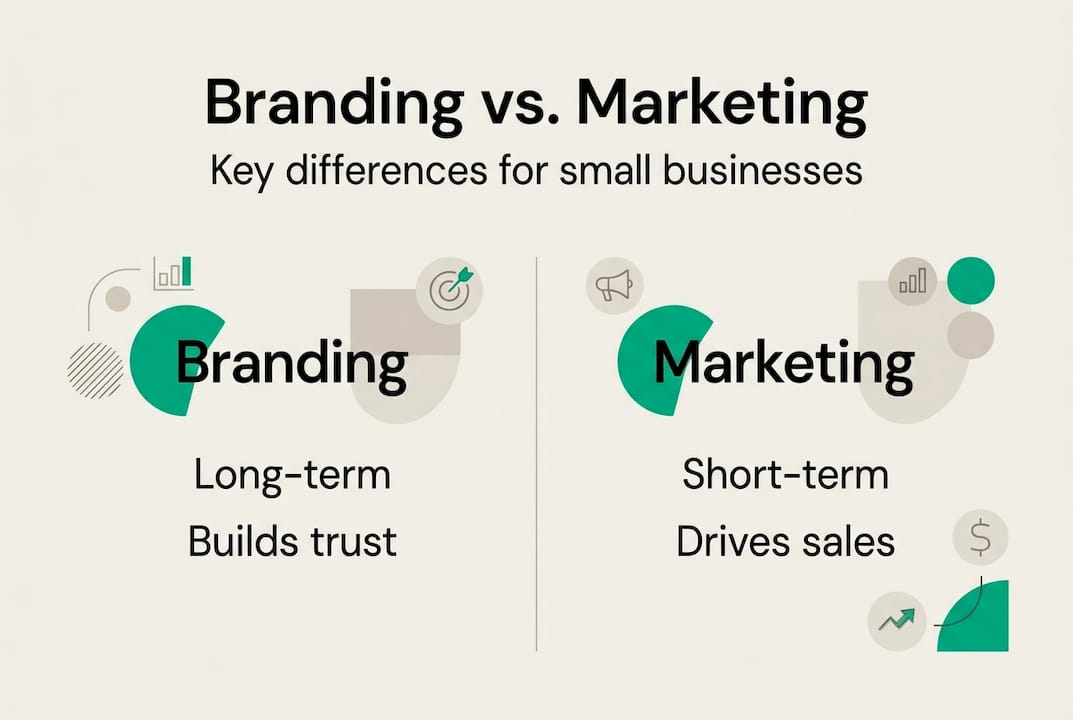
| Aspect | Digital Branding | Digital Marketing |
|---|---|---|
| Primary Goal | Build identity and trust | Generate leads and sales |
| Timeframe | Long-term investment | Short to medium-term campaigns |
| Key Metrics | Brand awareness, sentiment, recall | Clicks, conversions, ROI |
| Focus | Who you are as a business | What you’re selling right now |
| Impact | Emotional connection | Transactional relationship |
| Consistency | Remains stable over years | Changes with campaigns |
Many SMBs make the mistake of jumping straight into marketing without establishing their brand first. This approach might generate some quick wins, but it fails to build the foundation needed for sustainable growth. Without strong branding, you’re constantly competing on price alone.
Think of it this way: marketing gets customers to your door, but branding makes them want to stay. Marketing tells people what you sell; branding tells them why they should care.
Pro Tip: Review your current strategy by listing your activities in two columns. If everything falls under marketing with nothing supporting your brand identity, you’re missing a critical piece. Use brand impact studies to measure how your branding efforts translate into business results.
Successful businesses integrate both. Your marketing campaigns should reinforce your brand values, and your brand should make marketing campaigns more effective. They work together, not in isolation.
Core components of digital branding strategy
Building an effective digital brand requires specific elements working together. Each component strengthens your overall presence and helps customers understand who you are.
Here are the essential pieces every small business needs:
Brand story and values: Your origin story, mission, and what you stand for. This gives customers a reason to connect emotionally with your business beyond products or services.
Visual identity system: Logo, color palette, typography, and imagery style. These elements should be consistent across all touchpoints to build recognition.
Brand voice and messaging: The personality and tone you use in all communications. Are you professional and authoritative, or friendly and casual? Pick one and stick with it.
Unique value proposition: The specific benefit you offer that competitors don’t. This becomes the foundation of all your messaging.
Digital touchpoints: Your website, social media profiles, email templates, and online ads. Each should reflect your brand consistently.
Authenticity matters more than perfection. Modern customers can spot fake corporate speak instantly. They want to do business with real people who share their values. Your brand should reflect your actual business culture, not an idealized version you think customers want.
Integration across channels amplifies your impact. When someone sees your Instagram post, visits your website, and receives your email, they should experience the same brand personality. This consistency reduces marketing costs because each touchpoint reinforces the others.
Pro Tip: Start with free tools to refine your strategy. Google Analytics shows which brand messages resonate most with your audience. Track which pages keep visitors engaged longest and which social posts drive the most meaningful interactions.
Your brand should evolve as your business grows, but core elements like values and visual identity should remain stable. Building your brand on social media requires patience, but the long-term payoff is worth the investment.
Digital branding channels and platforms
Choosing the right platforms for your brand makes the difference between wasted effort and meaningful growth. Not every channel works for every business.
Digital channels amplify branding by reaching customers where they already spend time. The key is selecting platforms that match your audience and maintaining consistent branding across each one.
| Channel | Primary Branding Use | Key Strength | Best For |
|---|---|---|---|
| Website | Central brand hub | Complete control over experience | All businesses |
| Search (SEO) | Brand visibility and authority | Captures high-intent traffic | Service providers, B2B |
| Direct brand communication | Personal, owned channel | Repeat business, loyalty | |
| Community building | Broad reach, diverse demographics | Local businesses, B2C | |
| Visual storytelling | High engagement, younger audience | Visual products, lifestyle brands | |
| Professional credibility | B2B networking, thought leadership | Professional services, B2B | |
| Paid Ads (PPC) | Brand awareness at scale | Targeted reach, measurable results | Growth-stage businesses |
Each platform has unique characteristics that affect how you present your brand. Instagram demands strong visuals, LinkedIn requires professional expertise, and email allows for deeper storytelling.
Common pitfalls to avoid:
- Spreading too thin across too many platforms instead of mastering a few
- Using different brand voices on different channels, confusing your audience
- Neglecting your website while focusing only on social media
- Posting promotional content without providing genuine value
- Ignoring negative comments or reviews damages your reputation
Authenticity drives engagement across all platforms. Research shows that businesses with authentic digital brand orientation see stronger customer relationships and better performance. Fake enthusiasm or corporate jargon pushes customers away.
Your social media checklist should include regular brand consistency audits. Check that profile images, bios, and posting styles align across platforms. Small inconsistencies erode trust over time.
Reputation management on social platforms is part of branding, not just customer service. How you handle complaints and engage with customers publicly shapes brand perception more than any ad campaign.
Tracking, measuring, and refining your digital brand
You can’t improve what you don’t measure. Tracking your digital brand performance helps you make smart decisions about where to invest time and money.
Key performance indicators for digital branding differ from marketing metrics. Instead of focusing solely on conversions, you’re measuring perception, awareness, and long-term value.
Here’s your step-by-step process for brand measurement:
Set clear brand goals: Define what success looks like. Do you want to be known as the most reliable, the most innovative, or the most affordable in your category?
Choose relevant metrics: Track brand awareness (search volume for your name), engagement rates, share of voice compared to competitors, and customer sentiment in reviews and social comments.
Establish baseline measurements: Document where you are now so you can measure progress over time.
Track consistently: Use free tools like Google Analytics, social media insights, and review monitoring to gather data monthly.
Analyze patterns: Look for trends in what content resonates, which channels drive brand awareness, and where customers discover you.
Optimize based on data: Adjust your brand messaging, visual elements, or channel focus based on what the data reveals.
Real examples show the power of data-driven branding. A local service business might discover that customers find them through Google searches but make decisions based on Facebook reviews. This insight shifts branding focus to maintaining an active, authentic Facebook presence.
Another business might learn that their brand voice on Instagram drives higher engagement than their website copy. They can then align all messaging to match that successful tone.
Pro Tip: Schedule quarterly brand audits where you review every digital touchpoint. Check your website, social profiles, email templates, and online listings for consistency. Small drift in messaging or visuals happens gradually but damages brand strength.
You can audit your digital presence systematically by creating a checklist of brand elements. Does every platform use current logos? Is your value proposition stated clearly everywhere? Are colors and fonts consistent?
Look at digital brand measurement examples from businesses similar to yours. Case studies reveal which metrics matter most for different industries and business models.
Brand refinement is ongoing, not a one-time project. As your business evolves and customer preferences shift, your brand should adapt while maintaining core identity elements. The businesses that thrive are those that listen to data and adjust accordingly.
Ready to build a brand that drives real growth?
You now understand what digital branding is and why it matters for your business. The difference between companies that struggle for attention and those that attract loyal customers often comes down to consistent, authentic branding across digital channels.

Building a strong digital brand takes expertise, time, and strategic thinking. At Ascendly Marketing, we’ve helped small and medium-sized businesses create memorable brands that drive measurable growth since 2013. Our team of designers, SEO specialists, and content creators brings experience from major brands to your business. We focus on transparent, results-oriented solutions that build long-term value, not just short-term wins. Whether you need help defining your brand strategy, creating consistent visuals across platforms, or measuring brand performance, we provide the expertise to make it happen. Let’s talk about how we can strengthen your digital brand and turn online visibility into real business results.
Frequently Asked Questions
Why is digital branding important for small businesses?
Digital branding builds credibility and trust that differentiate your business from competitors. It creates customer loyalty that drives repeat business and referrals, essential for sustainable growth.
How does digital branding differ from traditional branding?
Digital branding focuses on online channels with real-time engagement and measurable interactions. Traditional branding relies on offline touchpoints like print, physical locations, and broadcast media with less immediate feedback.
Can digital branding help with customer acquisition?
Yes, strong digital branding makes your business more discoverable through search and social media. It builds the trust that converts website visitors into paying customers.
What is the first step to improve digital branding?
Start by defining your brand story and core values, then ensure visual and messaging consistency across all digital platforms. This foundation makes all other branding efforts more effective.
How often should I update my digital branding strategy?
Review your digital branding quarterly to ensure it stays current and aligned with business goals. Make updates when launching new products, entering new markets, or when customer feedback indicates messaging isn’t resonating.