

Local advertising is about understanding your target audience, having a clear objective, choosing the right channels, and delivering a message that connects with your community. This approach allows businesses to engage in direct conversations with potential customers where they live and work.
Build Your Local Advertising Blueprint
Before allocating funds, a plan is necessary. A blueprint distinguishes strategic spending from inefficient use of resources. It serves as the foundation for optimizing every dollar spent.
Understanding your customer requires more than basic demographic information. Where do they buy coffee? Which local online groups do they use for recommendations? Do they frequent the downtown farmers market or a suburban shopping center? Answering these questions identifies where your brand should be present.
Define Your Ideal Local Customer
Construct a customer persona that represents a real individual from your town, not merely a set of data points.
- Their Local Haunts: Map their daily activities. Identify their grocery stores, gyms, and commute routes.
- Their Digital Backyard: Determine their online behavior. Do they use Nextdoor? Do they follow local bloggers on Instagram or rely on Yelp reviews?
- Community Ties: What are their local interests? Do their children participate in sports leagues you could sponsor? Do they participate in annual charity events?
A detailed picture of your customer eliminates guesswork. It reveals touchpoints where your advertisement will be perceived as a helpful suggestion rather than an interruption.
Analyze Your Local Competitors
The next step involves analyzing your competition. The objective is to identify their local marketing activities to discover opportunities they may have overlooked.
Examine their Google Business Profile and note what customers are saying in reviews. See which community events they sponsor or with whom they partner. Are their ads on local news websites or in community newsletters? Exploring these 10 Localized Marketing Strategies can provide a starting point for your own plan.
Set Meaningful, Measurable Goals
You must define what success looks like. A general goal like “get more customers” is not useful. You need specific, measurable targets that relate to your business’s performance.
For instance, a restaurant could aim to increase lunch orders from a nearby office park by 20%. A boutique might set a goal to boost weekend foot traffic from a specific zip code by 15%. A plumber could want to generate 10 more phone calls per week from their main service area. These concrete goals will shape every advertisement and every dollar spent.
Time to Become a Digital Regular
Your customers use their mobile devices to find their next purchase. Success in the local market means being the first business they see online. A deliberate digital strategy is required, moving beyond random social media posts.
The local advertising market is projected to reach $171 billion by 2025, with $89 billion allocated to digital channels. Short-form video is expected to account for $16.8 billion. Hyper-local ads on search and social platforms are effective, particularly since over 70% of digital ad spend targets mobile users. You can dive into the full breakdown of these numbers on Statista.com.
Deciding how to allocate your budget between digital and traditional methods is a primary step. This table outlines the main differences.
Digital vs. Traditional Local Ad Spend Breakdown
| Channel Type | Projected 2025 Revenue | Primary Strengths |
|---|---|---|
| Digital (Search, Social, Video) | $89 Billion | Hyper-local targeting, real-time tracking, high mobile engagement. |
| Traditional (Print, Radio, TV) | $82 Billion | Broad reach, brand credibility, targets less-online demographics. |
While traditional ads build broad brand awareness, the ability to target specific individuals in specific locations and track spending makes digital a necessary component for any small business.
Get Your Google Business Profile in Fighting Shape
Your Google Business Profile (GBP) is a valuable free marketing asset. It is your digital storefront, appearing in Google Maps and the “map pack” results. When someone searches for “coffee near me,” a complete profile increases your visibility.
You cannot set it up and forget it. It requires ongoing management.
- Fill Out Everything: Complete every field: business name, address, phone (NAP), website, and hours.
- Nail Your Categories: Be specific. Differentiate between being a “restaurant” and a “Neapolitan Pizzeria.” The details are significant.
- Show, Don’t Just Tell: Upload high-quality photos of your space, team, and customers.
- Post Regularly: Use Google Posts to share specials, news, or events. This signals to Google that you are active.
Think of your GBP as a plant. The more you update it with fresh information, new reviews, and photos, the more it grows. Google rewards this effort by showing your profile to people who are ready to make a purchase.
This visual outlines the core of a local advertising plan.
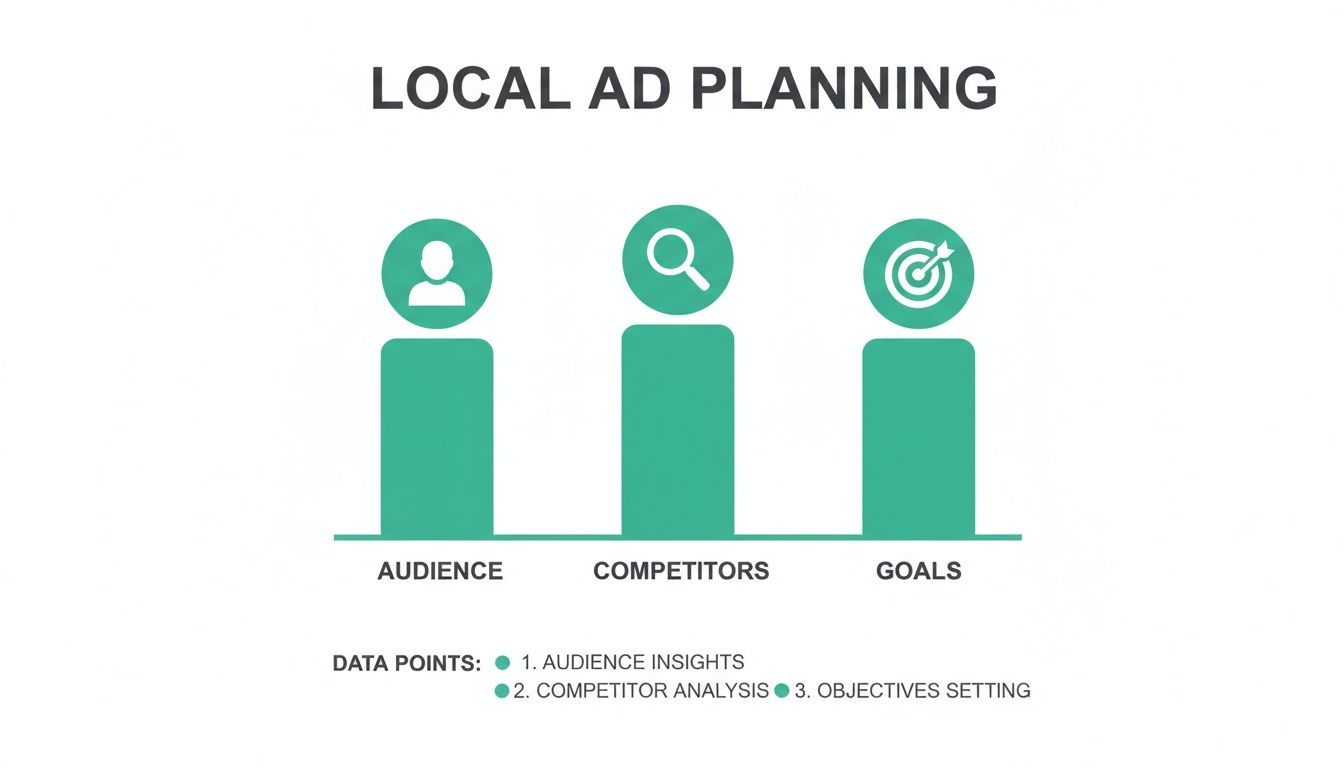
It is based on knowing your audience, observing your competition, and setting measurable goals.
Run Social Ads That Feel Like They’re for Neighbors Only
Platforms like Facebook and Instagram have powerful geo-targeting tools. You can draw a circle around your business, as small as a one-mile radius, and show ads exclusively to people within that area. This allows a local boutique to announce a flash sale to people in the immediate vicinity, creating local interest.
When building these campaigns, focus on a few key elements. First, set your location targeting using zip codes or a radius. Then, add demographics and interests. For example, a hardware store could target homeowners within three miles who have shown an interest in DIY projects. Finally, make your ad creative feel local. Mentioning a neighborhood landmark or a town event shows you are part of the community.
Master Local SEO and Let Your Reviews Do the Talking
Local SEO ensures your business appears when people search for your services in your area. It extends beyond your Google profile to ensuring your business is represented consistently across the web.
A large part of this is building “citations.” These are mentions of your business’s name, address, and phone number (NAP) on other websites like local directories or industry blogs. The key is consistency. Your NAP must be identical everywhere it appears online.
Reviews are also important. They build trust with new customers and signal to search engines that your business is relevant. Encourage satisfied customers to leave a review on Google, Yelp, or other relevant platforms. If you want to explore this topic further, consult our guide on local SEO ranking factors.
Master Real-World Community Marketing
In an era of digital interaction, direct personal engagement remains powerful. Getting involved in your community builds trust and loyalty that digital ads cannot replicate. This means integrating your business into the fabric of your town and becoming a familiar presence.

When you are present where your customers live and work, your business becomes part of the neighborhood. This changes how you are perceived. Here is how to achieve it.
Don’t Underestimate Old-School Mail
Direct mail can be effective. While many businesses compete for attention in digital inboxes, the physical mailbox is less crowded. A well-designed mail piece can stand out from digital noise. The goal is to make it feel like a personal invitation, not junk mail.
Consider what you are more likely to notice. A generic coupon flyer, or a postcard on heavy cardstock with a personalized-style message and an offer specific to your neighborhood? The latter often feels more significant.
When a potential customer holds a well-crafted piece from your business, it creates a physical connection. That tactile experience can make your brand more memorable than a digital ad viewed for a few seconds.
Team Up With Your Neighbors
Partnering with other local businesses is an effective growth strategy. You gain access to their customer base, and they gain access to yours.
The key is to find non-competing businesses that serve a similar customer profile. A new yoga studio could partner with a nearby health food store. The studio could offer a class discount to the store’s customers, and the store could provide smoothies for a studio event. This cross-promotion provides value and builds goodwill. Such collaborations are a foundation of many public relations strategies as they demonstrate community involvement.
Get Your Name on Local Events
Sponsoring a local event is more than placing your logo on a banner. It is a public statement of your investment in the community. Sponsoring a youth sports team, a farmers market stall, or a charity run shows that your business cares about more than just sales.
Do not just provide financial support. To have an impact, choose the right opportunity and get involved.
- Find Your People: Does the event attract your target customers? A family festival is suitable for a pediatric dentist but may not be for a high-end bar.
- Engage, Don’t Just Display: Consider activities beyond displaying a sign. Offer free samples, host a game, or conduct a prize drawing. Active participation is more effective than passive branding.
- Pick a Winner: Sponsor events that add value to the neighborhood. People remember businesses that support things they care about.
These tactics can transform your business from a commercial entity into a local fixture. This can foster a type of loyalty that money alone cannot create.
Create Ads That Speak the Local Language
If your ads could run in any city, they may be too generic. To connect with your community, your message should feel as if it came from a neighbor, not a corporate office.
This requires moving away from generic messaging and starting a direct conversation. Let’s create ads that make people in your town take notice and feel understood.
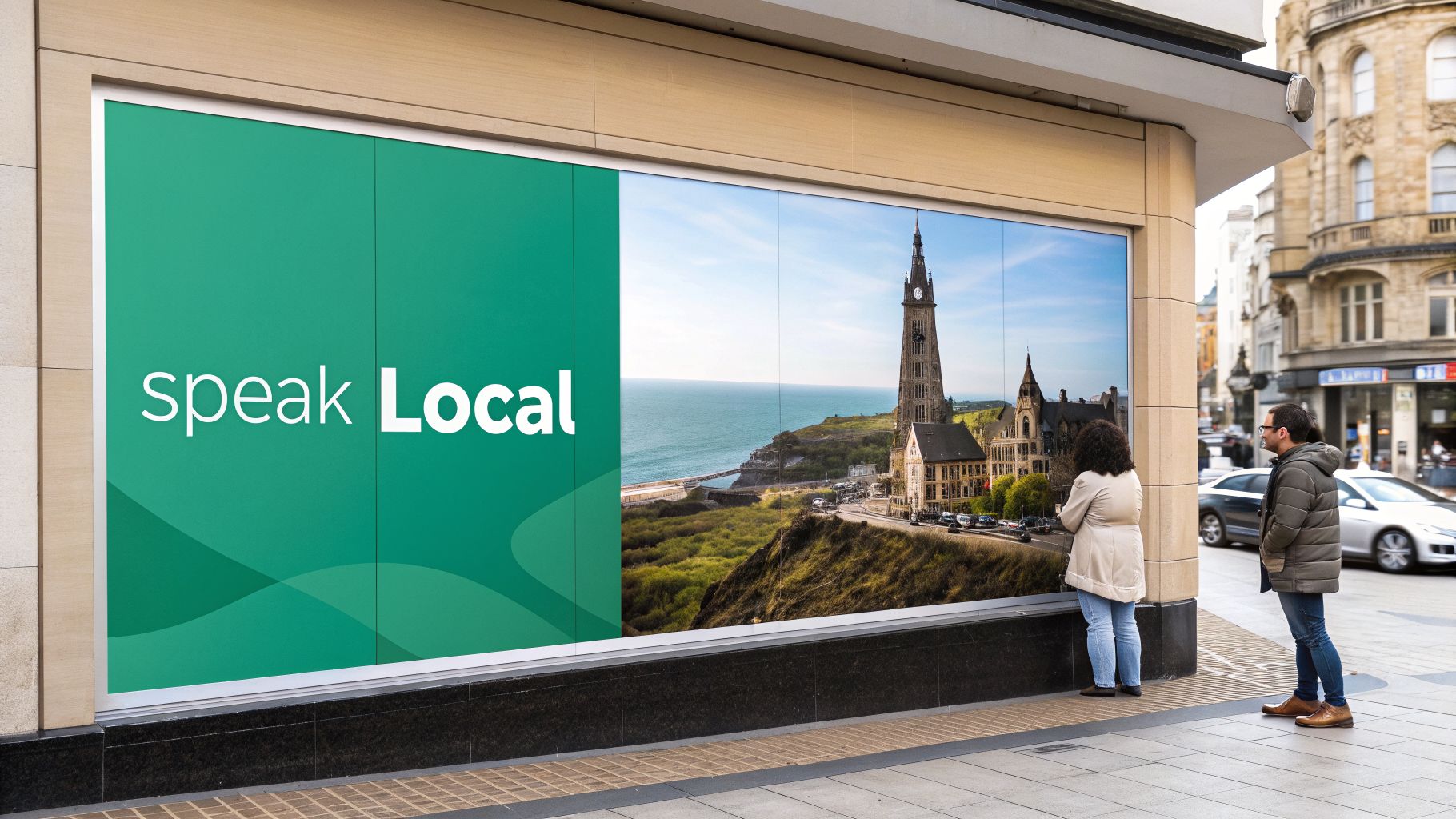
This is about showing you belong, not just that you are present. It is what separates a forgettable ad from one that generates discussion.
Weave Local Flavor into Your Copy
Your ad copy is the first place to establish your local identity. Incorporate shared experiences, inside jokes, and the unique characteristics of your town.
- Reference a notoriously slow traffic light on a main street.
- Acknowledge a successful local high school sports team.
- Mention a beloved landmark, a popular park, or an annual festival.
When you use this type of hyper-local language, your ad feels less like an advertisement and more like a message from a friend. You show that you are a part of the community, not just located in it. That connection is valuable.
Authenticity is a significant advantage in local advertising. Avoid corporate jargon and buzzwords. Write as if you are speaking to a neighbor, because that is your target audience.
Use Visuals That Scream “We’re From Here”
Generic stock photos of unfamiliar cities can detract from a local message. Your imagery should be as local as your copy. You do not need a large budget; a smartphone and some creativity can suffice.
Here are a few ideas:
- Showcase Your Regulars: Feature photos of your actual customers (with their permission). This provides social proof and makes your business seem more genuine.
- Shoot on Location: Take photos in front of a local mural or at a community market. Familiar backdrops ground your ad in reality.
- Capture Community Life: If you sponsor a local sports team, get action shots. If your team is at a community event, document it.
These visual cues build an immediate sense of familiarity and trust. For more ideas on translating these local touches into results, our paid advertising guide offers proven strategies to help connect your creative efforts directly to your sales goals.
Track Your Spend and Measure Your Success
Spending on advertising without tracking results is guesswork. You must know which ads are generating leads and which are not. The objective is to turn your ad spend from an expense into an investment with a measurable return.
This process is about drawing a direct line from every dollar spent to a tangible result, whether that is a new lead, a customer visit, or an online sale. Let’s discuss how to build a budget and focus on what matters.
Setting a Realistic Local Ad Budget
Whether you are starting with $500 or $5,000 a month, the principle is the same. Some recommend allocating a percentage of total revenue, but for a local business, a more direct approach exists.
Start by determining the value of a new customer. If one new customer generates $300 in profit, decide how much you are willing to spend to acquire them. If you decide you can spend $50 to acquire that customer, and your goal is ten new customers a month, your starting budget is $500. This method ties your spending directly to your growth objectives.
The local advertising market is active. Local ad revenue is projected to grow to $171 billion, with sectors like restaurants, real estate, and retail leading this growth. The real estate sector has seen a 9.3% increase. This growth is predominantly digital, with mobile ads now accounting for 70% of digital budgets due to high engagement on these devices. You can discover more insights on these local ad market trends.
Metrics That Actually Drive Decisions
Focus on actions that directly impact your business’s financial performance, not vanity metrics like likes and shares. These are the numbers that indicate if your campaigns are effective.
- Cost Per Lead (CPL): This is the total campaign cost divided by the number of leads generated. It answers the question: “How much did I pay for each potential customer?”
- Customer Acquisition Cost (CAC): This metric measures the total cost to convert a lead into a paying customer.
- Return on Ad Spend (ROAS): This shows the revenue generated for every dollar spent on advertising. A 4:1 ROAS means you earned $4 for every $1 spent.
Focusing on these core metrics removes extraneous information. A campaign with high impressions but no increase in phone calls or foot traffic is not successful.
Simple Tracking Tools and Tactics
You do not need advanced data science skills or expensive software to track results. Some of the most effective tracking methods are simple to implement. The goal is attribution, which is the ability to identify the source of a customer.
Here are a few methods you can use immediately:
- Unique Coupon Codes: Create a different code for each campaign, such as “FACEBOOK20” for social media ads or “MAILER15” for a direct mail piece. When a customer uses a code, you know which ad they came from.
- Dedicated Phone Numbers: Use a service to create unique, trackable phone numbers that forward to your main business line. Assign a different number to your Google Business Profile, website, and print ads to see which channels drive the most calls.
- The “How Did You Hear About Us?” Question: Training your staff to consistently ask this question at the point of sale is an effective way to gather data. Have them log the answers.
- Google Analytics: This free tool from Google is necessary for tracking your website. You can see which platforms or search terms send visitors to your site and which of those visitors complete your contact form.
By combining these tactics, you create a feedback loop. You will see what is working, stop what is not, and reinvest your budget into channels that deliver provable results for your business.
Your Local Advertising Questions, Answered
Local advertising can generate many questions. If you are uncertain about where to invest your money or what to expect, you are not alone. Here are answers to some of the most common questions.
How Much Should a Small Business Spend on Local Advertising?
A common guideline is to allocate 5-10% of your gross revenue for your advertising budget. If you are launching a new product or service, you might increase that to 12-20% for a limited time to gain initial momentum.
A practical approach is to start with an amount you are comfortable with. Begin with low-cost, high-impact activities like optimizing your Google Business Profile and running a small, targeted social media ad campaign. Once you see which activities are attracting customers, you can reinvest the profits. The objective is to create a self-funding growth system.
A well-tracked $500 will be more effective than a carelessly spent $5,000. The size of the budget is less important than the strategy behind it. Start with a smart approach, track everything, and let the data guide your next steps.
What Is the Best Local Advertising for Service Businesses?
For service businesses like plumbers, electricians, and financial advisors, being present at the moment a customer needs you is the primary goal. Local search is your most effective tool. When a pipe bursts, people are not browsing casually; they are searching for “plumber near me.” You need to be at the top of that list.
To achieve this, focus on two areas:
- Become a Review Magnet: Actively ask your satisfied customers to leave a review on Google or Yelp. These reviews act as a strong endorsement for potential customers.
- Build Your Referral Squad: An accountant could partner with a local business lawyer and a financial planner. You are not competitors; you are a support system for the same clients. These warm introductions are valuable.
When you are highly visible in search results and have a positive reputation in the community, you have a strong local presence.
How Long Until I See Results from Local Ads?
The time it takes to see results depends on the channels you use. The timelines for different methods vary.
If you run paid ads on platforms like Google Ads or Facebook, you can see traffic and leads within hours of launching. However, it will likely take a few weeks of testing and optimization to make these campaigns profitable and efficient.
Organic methods, like local SEO, require more time. This is a long-term strategy. Expect it to take 3-6 months of consistent effort, including building local listings, acquiring quality links, and publishing content, before you see significant improvement in search rankings. A balanced approach involves using both paid ads for immediate results and SEO for building a long-term foundation.
Ready to move from guessing to growing? At Ascendly Marketing, we build results-driven local advertising strategies that connect you with your community and drive measurable growth. Let’s build your local marketing plan today.