

A social media strategy is a plan that directs posting activity toward business growth. It converts random posts into a system for acquiring and retaining customers.
Social Media for Small Businesses
Data shows people spend, on average, nearly 2.5 hours daily on social media platforms. A social media strategy provides a direct line to these potential customers.
Small businesses use social media to build connections and a loyal community. This drives results such as increased foot traffic, website purchases, or qualified leads.
The Return on Investment
Social media marketing can yield a return of $5.20 for every $1 spent. This applies to various business sizes.
For e-commerce shops or B2B startups, platforms like Instagram are effective. Reports indicate that 78% of B2C marketers achieve a return from the platform. Targeted ad campaigns running on as little as $5–$10 per day can generate a positive ROI in the first month.
This diagram illustrates the process.
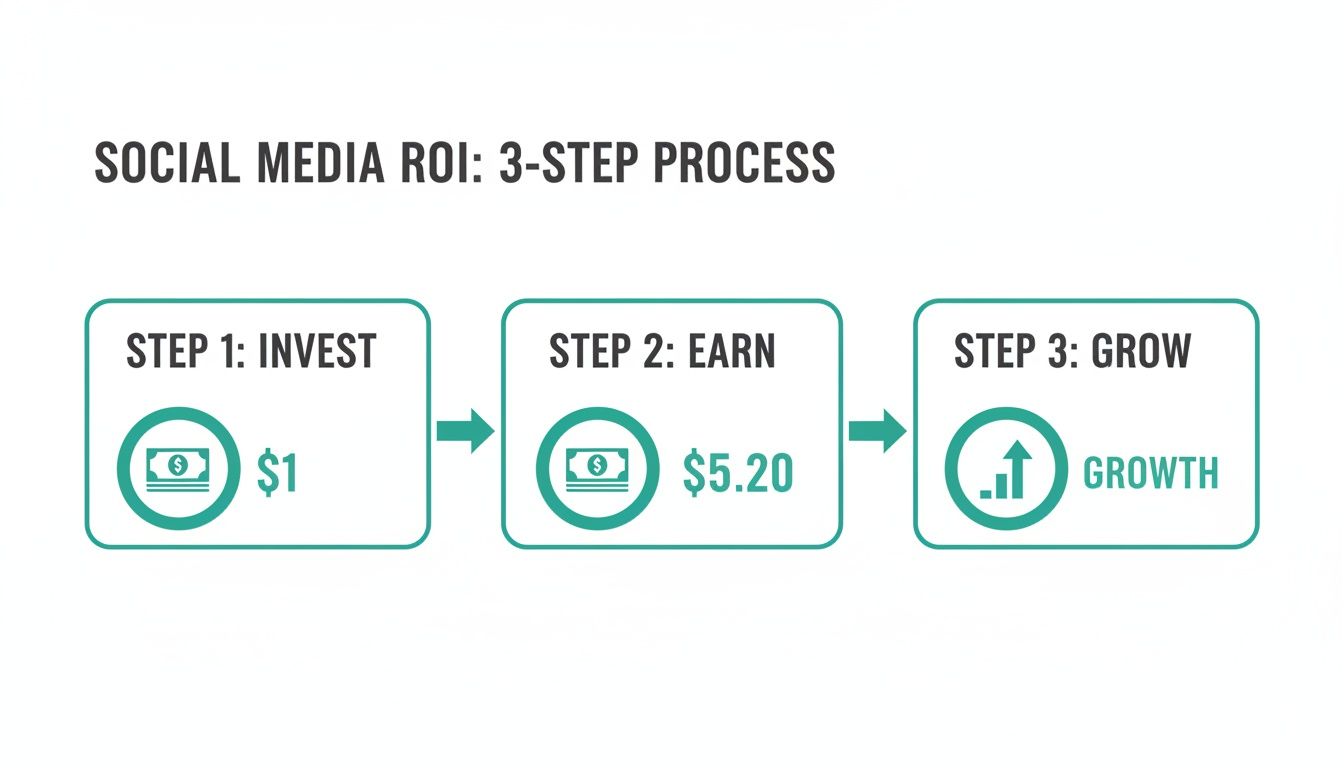
A strategic investment leads to returns, which can then be reinvested into business growth.
Building a Framework for Success
This guide provides a framework for building a social media strategy. It focuses on practical methods without industry jargon.
Here is what this article covers:
- Auditing: An initial audit of social media presence identifies what is working.
- Audience: The guide will help you determine where target customers are active online.
- Content: The process for creating posts that prompt user action is explained.
- Measurement: You will learn to track metrics tied to business goals.
Resources like StartRightNow offer guidance for new businesses. This process is designed for small business owners who need practical methods.
Audit Your Social Media and Set Goals
Before posting new content, an audit of current social media activity is required. Operating without knowing what is performing well is inefficient.
The social media audit begins by listing every social media profile associated with the business.
For each profile, ask specific questions. Who manages the account? Is the branding, including the logo, bio, and voice, consistent with the current business identity? What was the single best-performing post in the last few months? The answer to this question often provides insight into audience preferences.
Analyze Performance Metrics
Once the profiles are listed, analyze the analytics for each platform over the last three to six months to identify patterns.
- Engagement: Identify where conversations are happening. Comments and shares indicate what content captures audience attention.
- Reach & Impressions: Assess how many people see your content. High reach with low engagement suggests the content is not compelling.
- Profile Visits & Clicks: Determine if users are visiting your profile or clicking the link in your bio. This metric measures genuine interest.
This analysis highlights effective and ineffective tactics. You might find that behind-the-scenes Instagram Reels receive three times the engagement of polished photos. This is a strength to leverage. Conversely, a Facebook page with a high follower count but low interaction is a weakness that needs a new strategy.
Set Goals Tied to Business Outcomes
With a clear understanding of your current performance, you can set goals that contribute to business growth. Use SMART goals: Specific, Measurable, Achievable, Relevant, and Time-bound. This framework turns social media from a task into a revenue-generating activity.
Consider these examples:
- For an e-commerce shop: Instead of a general goal like “increase sales,” a SMART goal is: “Increase online sales from social media by 15% in the next quarter by running targeted ads to cart abandoners and promoting three user-generated content campaigns.”
- For a Local B2B Consultant: A goal like “get more leads” is not specific. A better goal is: “Generate 10 qualified leads per month from LinkedIn by publishing two high-value articles and spending 30 minutes a day engaging in industry-specific groups.”
These goals connect daily social media activities to measurable business results. What specific, measurable goal will you achieve this quarter?
Choose Platforms and Identify Your Ideal Customers

Attempting to maintain a presence on all social media platforms can lead to burnout. A more effective approach is to focus time and resources on platforms where your ideal customers are most active.
The question is not whether to use social media, but which platform offers the most return for your investment. This requires a deliberate choice based on your target audience and what you are selling.
Match Your Business to the Right Platform
Each social network has a distinct user base and content style. Content that performs well on one platform may not succeed on another. Understanding these differences is key.
A B2B consultant should use LinkedIn. It is a professional networking platform where in-depth articles and industry insights are valued. A local boutique selling handmade jewelry would find more success on Instagram, where visual content, behind-the-scenes Stories, and shoppable posts are effective.
A common error is to post the same content across all platforms. You must adapt your communication style to the platform you are using. This shifts the objective from being “active” to being effective.
An Overview of Top Platforms
To make an informed decision, you need to know who uses each platform and what they expect. This information helps in selecting your primary social media channel.
Facebook: With over 3 billion monthly users, it is a major platform for reaching a broad audience. It is effective for building communities, promoting local events, and using specific ad targeting.
Instagram: This platform is centered on visual storytelling. It is suitable for businesses with products or services that can be presented visually, such as e-commerce shops, restaurants, and artists.
LinkedIn: As a professional network, it is the primary platform for B2B companies. It is used to share expertise, connect with decision-makers, and build a reputation as a thought leader.
TikTok: The algorithm on TikTok provides an opportunity for brands to gain visibility with authentic and creative videos. Businesses that can show personality and participate in trends can build a large audience.
This comparison table can help you decide where to focus your efforts.
Social Media Platform Selector for Small Businesses
This table outlines the main platforms to help you choose based on your business model and target audience.
| Platform | Best For | Primary Audience | Top Content Formats |
|---|---|---|---|
| B2B lead generation, professional networking, and establishing industry authority. | Professionals, decision-makers, and corporate audiences. | Articles, case studies, text posts, and professional videos. | |
| E-commerce, visual brands, local businesses, and influencer collaborations. | Millennials and Gen Z; highly visual users. | High-quality photos, Reels, Stories, and shoppable posts. | |
| Building community, local marketing, and reaching a broad demographic range. | Wide range of ages, particularly Gen X and Baby Boomers. | Community posts, event promotion, videos, and targeted ads. | |
| TikTok | Brand awareness, showing personality, and reaching a younger audience. | Primarily Gen Z and younger Millennials. | Short, entertaining videos, tutorials, and trend-based content. |
Which platform aligns with your customers and goals? Mastering one or two platforms produces better results than having a minimal presence on five. Focus your energy, learn the platform’s culture, and build connections where it has the most impact.
Create Content That Engages Your Audience

The primary goal of social media content is to stop users from scrolling. This requires giving them a reason to pay attention. This is how you build a memorable brand.
Establish Your Content Pillars
To address the question of what to post, establish content pillars. These are three to five core topics that your brand will focus on, providing helpful or interesting information to your target customer.
They provide focus and structure, so your posts are not random.
For a local coffee shop, the pillars could be:
- The Daily Grind: Content about coffee, such as latte art videos, explanations of different roasts, and home brewing tips.
- Our Neighborhood: Highlighting the local community, such as featuring a local artist, promoting a neighboring business, or featuring a regular customer.
- Life at the Shop: Behind-the-scenes content, such as introducing baristas, showing the morning rush, or sharing the story behind a popular menu item.
This system makes content creation a repeatable, strategic process. For more ideas, read our guide on the different types of content for social media.
The 80/20 rule is a useful guideline. 80% of your content should provide value through education, entertainment, or inspiration. The remaining 20% can be promotional. When you provide more value than you ask for, people are more receptive to your sales messages.
Use User-Generated Content
User-generated content (UGC) is content created by your customers, such as photos, reviews, and videos.
It serves as social proof. When potential customers see a real person using and enjoying your product, it builds credibility more effectively than an advertisement.
You can encourage UGC by running a photo contest with a branded hashtag or by reposting content where customers have tagged your business. A boutique could use customer selfies in shoppable posts, while a landscaper could share a client’s video tour of their new backyard.
Posts with UGC see 4x higher click-through rates and can reduce cost-per-click by nearly 50%. This type of content boosts conversions by an average of 4.6%, making it a low-cost strategy.
Incorporate Short-Form Video
Short-form video on platforms like Instagram Reels and TikTok is about being quick and authentic. It is an effective way to show the personality of your business.
A smartphone is sufficient for creating these videos.
For a service business, ideas include:
- A “day in the life” clip showing a project in progress.
- A 30-second “how-to” video solving a common customer problem.
- Answering a frequently asked question on camera.
For an e-commerce shop, ideas include:
- An “unboxing” video of a new product shipment.
- Showing one product styled in three different ways.
- A quick demonstration of how to use or care for a product.
Authenticity is more effective than high production value. A simple video shot on a phone feels more genuine and trustworthy. People connect with other people, not with logos.
Schedule Content and Launch Your First Ad
With content ideas established, the next step is execution. This involves turning concepts into a schedule and potentially allocating a budget for advertising.
Organic posts and paid ads work together. Scheduled content builds relationships, while ads provide a spotlight to reach a new audience.
Use a Content Calendar to Organize Posts
A content calendar helps manage posting schedules. It is a roadmap that shows what you are posting, on which platform, and when.
This can be a simple spreadsheet or a Google Calendar. The goal is to plan content. If you need help starting, use our guide on how to create a content calendar.
Consistency is a key factor on social media. Regular posting signals to the algorithm and your audience that your brand is reliable. A calendar makes this consistency achievable.
A scheduling tool like the saucial app allows you to batch-create and schedule posts to be published automatically. This frees up time during the week.
Your First Ad Campaign
Paid advertising does not have to be expensive. Starting with a budget of $5-$10 per day is a way to test its effectiveness.
Review your organic posts. If one received significantly more likes and comments, use a small ad budget to promote it to a larger audience similar to those who already engaged with it.
For your first campaign, choose one clear goal. Are you trying to:
- Build Awareness? To introduce your brand to new people.
- Drive Engagement? To get more likes, comments, and shares.
- Get Traffic? To send people to your website for a purchase or more information.
Trying to achieve all three with a small budget is inefficient. Focus on one objective to see measurable results.
Target the Right Audience on a Small Budget
Social media ad platforms allow for precise audience targeting. This prevents wasting money on people who are not potential customers.
Here are two real-world examples:
Scenario 1: A Houston-based landscaper. The goal is to acquire more local clients. They can run an ad with a photo of a recent project and use geo-targeting to show it only to homeowners within a 20-mile radius. Every dollar spent reaches a potential customer.
Scenario 2: An e-commerce shop selling custom pet collars. The goal is sales. They can upload a list of past customers to create a “lookalike audience” of people with similar online behaviors. They can also use retargeting ads that appear to anyone who visited their site and added an item to their cart but did not complete the purchase. This serves as a reminder.
Start with a small budget and experiment. The data from a small campaign is valuable for refining your entire strategy.
Measure Success and Optimize Your Strategy
To determine if your social media efforts are effective, focus on metrics that impact your business results, not just vanity metrics like follower counts.
Your social media strategy should be reviewed regularly. A monthly check-up is sufficient to see what is working, what is not, and where there are opportunities for improvement.
Key Metrics to Track
Focus on data that provides insights into your audience and marketing effectiveness.
Here are three key metrics to monitor:
- Engagement Rate: This measures audience interaction. A high engagement rate indicates your content is resonating with your audience.
- Click-Through Rate (CTR): This shows if your call to action was effective enough to get users to click. A strong CTR means your message was compelling.
- Conversion Rate: This tracks how many clicks resulted in a business outcome, such as a sale, lead, or signup. It is the ultimate measure of a successful strategy.
What gets measured gets managed. An e-commerce client focused on their follower count. An analysis of their analytics revealed that a small segment from Pinterest was driving 40% of their sales. Shifting focus to this channel increased their revenue.
Your Monthly Review Ritual
Set aside time each month to analyze your data. This will inform your strategy for the following month.
Your Monthly Review Checklist:
- Which posts sent the most traffic to our website? Identify your top-performing content. Look for patterns in topics, formats, and visuals, then replicate what works.
- When is our audience online and active? Platform analytics show the peak days and times your followers are active. Schedule your posts for these times.
- Is follower growth leading to sales? If you are gaining followers but not customers, you may be attracting the wrong audience. This indicates your content needs to be more aligned with your ideal customer.
- How are the ads performing? For paid campaigns, monitor the cost per click (CPC) and cost per conversion. Are you getting a positive return on your investment? To learn more, read our guide on how to calculate marketing ROI.
Use A/B Testing to Improve Performance
Once you are tracking your metrics, you can work to improve them. A/B testing is a method for this. It involves testing two versions of something to see which performs better.
This can be simple. For example, you could test:
- Two different headlines on the same Facebook ad.
- A video versus a static image on an Instagram post.
- Two different calls to action, such as “Shop Now” versus “Learn More.”
By methodically testing one variable at a time, you remove guesswork from your marketing. You let audience actions, not your own assumptions, guide your decisions. This cycle of tracking, reviewing, and testing improves your social media strategy.
Your Top Social Media Questions, Answered
Here are answers to common questions from small business owners about social media.
What is a Realistic Budget?
There is no single answer, but a starting point for most small businesses is between $500 and $2,000 per month. This typically covers content creation and initial ad spending.
Start with a small ad budget, such as $10 per day, to test which audiences and creative content are most effective. Once you find a successful combination, you can increase your ad spend.
How Often Should I Post?
Consistency is more important than frequency. Posting three engaging pieces of content per week is better than posting low-quality content twice a day. The goal is to be a welcome presence, not a disruptive one.
Here are general posting frequency guidelines:
- Facebook: 3-5 times per week
- Instagram: 3-5 times per week (plus daily Stories)
- LinkedIn: 2-3 times per week
- TikTok: 4-6 times per week
These are starting points. Your analytics will provide the most accurate answer. Analyze when your audience is online and engaging, and adjust your schedule to match their habits.
Can Social Media Work for a B2B Company?
Yes, it can. The approach for B2B is different. While B2C marketing often focuses on immediate sales, B2B social media, particularly on LinkedIn, is about building authority and trust over time.
An effective social media marketing strategy for a small business in the B2B sector involves educating your audience rather than selling directly. Share your expertise, post case studies, and offer industry insights. This positions your company as an expert, making you the first choice when a potential client has a need. Participating in niche groups and connecting with decision-makers directly is also beneficial.
The team at Ascendly Marketing builds data-driven social media strategies that deliver measurable results for small businesses. Schedule your free consultation today!