

Local SEO isn’t just another marketing buzzword. It’s the difference between your business appearing when nearby customers search for what you offer and being invisible to the people who matter most. While general SEO casts a wide net, local SEO targets the customers within driving distance of your storefront or service area. This guide breaks down exactly what local SEO means in 2026, why it’s evolved beyond simple directory listings, and how small business owners can leverage it to dominate their local market without expensive agency fees or complex technical knowledge.
Table of Contents
- Understanding Local SEO: What It Is and Why It Matters
- Core Components Of Local SEO: Tools, Profiles, and Content
- How AI and Emerging Technology Are Reshaping Local SEO in 2026
- Practical Local SEO Strategies for Small Business Owners
- Enhance Your Local SEO With Expert Digital Marketing Services
- Frequently Asked Questions
Key takeaways
| Point | Details |
|---|---|
| Local SEO targets nearby customers | Focuses on proximity signals, reviews, and location-based search intent rather than broad authority. |
| Google Business Profile is essential | Free tool that controls how your business appears in local search and maps, directly impacting visibility. |
| AI demands unique content | Schema markup and 60% unique content per location page combat thin content penalties in 2026. |
| Free tools empower owners | Google Search Console and Business Profile management let SMBs optimize without agency dependency. |
| Ethical tactics win long-term | Avoid guaranteed results promises and focus on consistent, transparent strategies for sustainable growth. |
Understanding local SEO: What it is and why it matters
Local SEO optimizes your online presence to attract customers searching within a specific geographic area. Unlike general SEO that competes globally or nationally, local SEO differs by focusing on proximity and reviews rather than broad domain authority. When someone searches “plumber near me” or “coffee shop downtown,” local SEO determines which businesses appear in the map pack and organic results.
The mechanics differ significantly from traditional SEO. General SEO prioritizes backlinks, content depth, and technical site optimization across all pages. Local SEO weighs factors like your distance from the searcher, review quantity and quality, citation consistency across directories, and localized content signals. A national brand with massive authority might lose to a small local business in local search because proximity and relevance matter more than pure domain strength.
For small and medium-sized businesses, local SEO directly impacts foot traffic and sales. Consider these realities:
- 76% of mobile users who search for something nearby visit a business within 24 hours
- Local searches convert 5x higher than general searches because intent is immediate
- Appearing in the Google map pack generates more clicks than organic position four or five
- Reviews and ratings influence 93% of local purchase decisions
Many business owners confuse local SEO with simply having a website or social media presence. Others assume expensive national SEO tactics apply locally. The truth sits between these extremes. Local SEO requires specific optimizations around local SEO ranking factors like Google Business Profile completeness, citation accuracy, and location-specific content that general SEO ignores. You don’t need a massive content library or thousands of backlinks. You need precise, local signals that tell search engines you serve a specific area better than competitors.
The misconception that local SEO is automatic hurts businesses daily. Creating a Google Business Profile isn’t enough. Optimization, regular updates, review management, and strategic content separate visible businesses from invisible ones. Understanding these fundamentals positions you to implement tactics that actually move the needle.
Core components of local SEO: Tools, profiles, and content
Successful local SEO builds on four foundational elements that work together to signal relevance and authority to search engines. Each component requires attention, but none demands advanced technical skills or expensive tools.
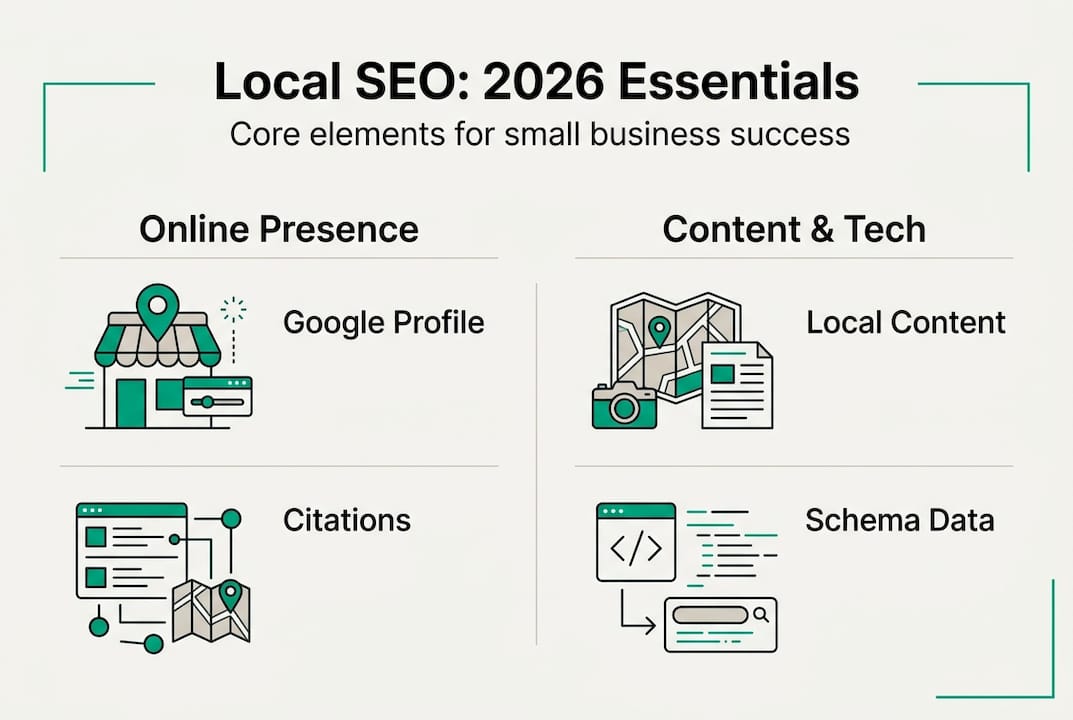
Google Business Profile serves as your primary local SEO asset. This free platform controls how your business appears in Google Search and Maps, displaying your hours, photos, reviews, and contact information directly in search results. Completing every section matters. Businesses with complete profiles receive 7x more clicks than incomplete ones. Add your business category precisely, upload high-quality photos monthly, post updates about promotions or events, and respond to every review within 48 hours. The Google Business Profile benefits extend beyond visibility to customer engagement and trust building.

Local citations are mentions of your business name, address, and phone number across the web. Consistency is critical. If your website lists “123 Main St” but directories show “123 Main Street,” search engines struggle to verify your location. This confusion dilutes your local authority. Audit your NAP data across major platforms like Yelp, Facebook, Apple Maps, and industry-specific directories. Correct discrepancies immediately. Free tools like Google Search Console alert you to citation issues, while manual directory checks ensure accuracy.
Schema markup provides structured data that helps search engines understand your business details. In 2026, schema-rich, unique local content combats thin content penalties and positions your business for AI-generated search overviews. Implement LocalBusiness schema on your homepage and location pages, including your address, phone, hours, and service area. Add Review schema to display star ratings in search results. Product or Service schema highlights specific offerings. Most website platforms offer plugins that generate schema automatically, requiring only basic information input.
Unique, location-specific content separates strong local SEO from weak attempts. Generic pages that swap city names fool no one, especially AI detection systems. Each location or service area needs 60% unique content addressing local customer needs, referencing neighborhood landmarks, and showcasing community involvement. Create blog posts about local events, case studies featuring area customers, and service pages that discuss location-specific challenges. This content depth signals genuine local presence rather than thin spam.
| Component | Primary Function | Free Tool |
|---|---|---|
| Google Business Profile | Controls search/map appearance | Google Business Profile Manager |
| Local Citations | Verifies business location | Manual directory audit |
| Schema Markup | Structures data for search engines | Schema plugin or JSON-LD generator |
| Local Content | Demonstrates area expertise | Google Docs or website CMS |
Pro Tip: Set a monthly calendar reminder to update your Google Business Profile with new photos, posts, or promotions. Regular activity signals an active, relevant business to Google’s algorithm.
These components interconnect. Your Google Business Profile links to your website where schema markup lives. Citations reinforce the NAP data on your profile. Local content provides substance that differentiates you from competitors with similar profiles. Search engine marketing strategies that integrate these elements outperform isolated tactics every time.
How AI and emerging technology are reshaping local SEO in 2026
Artificial intelligence fundamentally changed how search engines process and display local results. Large language models now generate AI overviews that summarize information from multiple sources, appearing above traditional organic results. For local businesses, this shift demands new optimization approaches focused on being the source AI references rather than hoping for a top organic position.
AI-generated search summaries pull from content that demonstrates clear expertise, uses structured data, and provides specific, verifiable information. Generic or thin content gets ignored. The AI shifts requiring schema-rich content mean your location pages must offer substantive value with proper markup. If your content reads like every competitor’s page with minor word swaps, AI systems classify it as low-quality and exclude it from overviews.
The threat to businesses using duplicate or AI-generated content is real. Search engines penalize thin content more aggressively in 2026 because they can detect patterns indicating mass production or template usage. A penalty doesn’t just lower rankings. It removes you from AI overview consideration entirely, cutting visibility by 40% or more for high-intent local searches. Recovery takes months of consistent, unique content publication.
Schema markup evolved from optional to essential. AI systems rely on structured data to understand business details, service offerings, and customer sentiment through reviews. Implementing LocalBusiness, Service, Review, and FAQ schema gives AI clear signals about what you offer and why you’re relevant. Businesses with comprehensive schema appear in AI overviews 3x more often than those without it.
Staying visible in this evolving landscape requires specific tactics:
- Create genuinely unique content for each location, avoiding template structures or repeated phrases
- Implement multiple schema types on every relevant page, not just your homepage
- Focus on answering specific local questions in your content that AI systems can reference
- Build topical authority by covering your service area comprehensively, not superficially
- Monitor Google Search Console for impressions in AI overviews and optimize pages that appear
Pro Tip: Use Google’s Rich Results Test to verify your schema implementation. Errors in structured data prevent AI systems from understanding your content, wasting all optimization effort.
The competitive advantage goes to businesses that leverage AI SEO proactively rather than reactively. Understanding how AI processes local signals lets you optimize for both traditional rankings and AI overview inclusion. This dual approach maximizes visibility across all search result types.
Some worry AI makes local SEO more complex. The opposite is true. AI rewards clear, honest, well-structured information over manipulation tactics. Following SEO best practices that prioritize user value naturally aligns with AI preferences. The businesses struggling are those clinging to outdated tactics like keyword stuffing, thin content, or citation spam that AI easily identifies and penalizes.
Practical local SEO strategies for small business owners
Implementing local SEO doesn’t require technical expertise or large budgets. These actionable strategies deliver measurable results when executed consistently.
Start with free tools that provide professional-level insights. Google Search Console shows which searches trigger your website appearance, identifies technical issues, and tracks performance over time. Google Business Profile management lets you control your local presence directly. Both platforms offer data that agencies charge thousands to interpret, available to any business owner willing to invest 30 minutes weekly reviewing metrics.
Optimizing your Google Business Profile requires regular attention, not one-time setup. Follow this monthly checklist:
- Upload three to five new photos showcasing products, services, or team members
- Create a post highlighting a promotion, event, or helpful tip for customers
- Respond to every new review, thanking positive reviewers and addressing concerns professionally
- Verify your business hours are current, especially around holidays
- Update your service or product list if offerings have changed
- Check insights to see which photos and posts generate the most engagement
Customer reviews directly impact local rankings and conversion rates. Request reviews ethically by asking satisfied customers in person or via email after positive interactions. Never offer incentives for reviews or create fake ones. Both violate platform guidelines and risk permanent penalties. Respond to negative reviews professionally, addressing concerns and offering solutions publicly. This demonstrates customer service to prospects reading reviews before visiting.
Avoiding unethical agencies protects your business from penalties and wasted investment. Practical SMB owners avoid agencies promising guarantees because no one controls search engine algorithms. Red flags include guaranteed rankings, promises of instant results, unwillingness to explain tactics, or pressure to sign long contracts before seeing sample work. Ethical agencies focus on transparent reporting, educational approaches, and realistic timelines for results.
Producing consistent local content builds authority over time. Create a simple content calendar covering:
- Monthly blog posts about local events or industry trends affecting your area
- Quarterly case studies featuring local customers and their success stories
- Annual comprehensive guides addressing common questions from your service area
- Weekly social media posts linking back to your website content
Citation consistency requires periodic audits. Every six months, search for your business name and verify information across the first page of results. Correct any discrepancies immediately. Focus on major platforms first: Google, Bing, Apple Maps, Facebook, Yelp, and industry-specific directories relevant to your business type.
Pro Tip: Create a master document with your exact business name, address, phone number, website URL, and business description. Copy and paste from this document when updating profiles to ensure perfect consistency across all platforms.
Selecting local SEO services becomes necessary when you lack time for consistent optimization or need advanced technical implementations. Look for agencies that educate rather than gatekeep information, provide transparent reporting, and demonstrate a clear understanding of your industry and local market. The role of SEO specialists is supporting your growth, not creating dependency.
These strategies work because they align with how search engines evaluate local relevance. Consistency, quality, and genuine customer engagement always outperform shortcuts. Small, regular efforts compound into significant visibility improvements over three to six months.
Enhance your local SEO with expert digital marketing services
You now understand the fundamentals of local SEO and have actionable strategies to implement independently. For businesses ready to accelerate growth and dominate local search results, professional support makes the difference between incremental improvement and market leadership.

Ascendly Marketing specializes in helping small and medium-sized businesses enhance their local visibility through ethical, results-driven strategies. Our team combines technical SEO expertise with a deep understanding of local market dynamics to create customized approaches that align with your specific goals and budget. We focus on transparent tactics that build sustainable growth rather than risky shortcuts promising impossible guarantees.
Our comprehensive digital marketing services extend beyond local SEO to include content creation, paid advertising, and conversion optimization that work together to maximize your online presence. Whether you need help implementing schema markup, developing location-specific content, or managing your Google Business Profile at scale, we provide hands-on support that empowers your team while delivering measurable results. Discover how a strategic small business digital marketing strategy can transform your local market position and drive consistent customer acquisition.
Frequently Asked Questions
What is local SEO?
Local SEO optimizes your online presence to attract customers searching within a specific geographic area. It focuses on proximity signals, reviews, and location-based content rather than broad domain authority. Businesses use local SEO to appear in map packs and local search results when nearby customers search for relevant products or services.
How does local SEO differ from general SEO?
General SEO targets national or global audiences using backlinks and broad content strategies. Local SEO prioritizes geographic relevance through Google Business Profile optimization, local citations, and proximity to the searcher. Review quantity and quality matter more in local SEO, while general SEO emphasizes domain authority and comprehensive content libraries.
Can I do local SEO without hiring an agency?
Yes, many effective local SEO tactics use free tools like Google Search Console and Google Business Profile. Small business owners can optimize their profiles, manage reviews, ensure citation consistency, and create local content independently. Focus on ethical, consistent strategies rather than complex technical implementations that require specialized expertise.
Why do online reviews matter for local SEO?
Reviews directly influence local search rankings and customer trust. Google considers review quantity, quality, and recency when determining which businesses appear in local results. Positive reviews increase click-through rates by 35%, while responding to all reviews demonstrates active customer engagement that both search engines and potential customers value.
What is Google Business Profile and how does it help?
Google Business Profile is a free tool that controls how your business appears in Google Search and Maps. It displays your hours, photos, reviews, and contact information directly in search results. Complete, regularly updated profiles receive significantly more visibility and clicks than incomplete ones, making it the single most important local SEO asset for small businesses.