

Most advice about startup SEO services gets this backward. Founders are told to “publish more content,” then they get trapped in a pile of blog posts that never rank, never convert, and never justify the retainer. For startups, SEO is not a content machine first. It’s a sequence of trade-offs between technical cleanup, commercial-intent pages, and just enough authority building to make the first two worth the effort.
That’s the part generic agencies usually skip. They sell the same deliverables to everyone, even though startups are buying SEO with tighter budgets, weaker domain authority, and more technical debt than established brands. Search has also become too valuable to treat casually, with one industry estimate putting the global SEO services market at $83.9 billion in 2026 and another projecting $106.9 billion in 2025 with continued growth afterward, based on WebFX’s SEO statistics roundup. That scale says a lot. SEO is no longer a side bet.
Why Startup SEO Services Differ from Generic SEO
Startup SEO services fail when agencies pretend a startup is just a smaller version of an established business. It isn’t. A startup usually has limited budget, a fragile site architecture, near-zero backlinks, and pressure to show commercial traction before patience runs out. That changes every decision, from keyword selection to reporting.
The startup constraint set
Search visibility still matters because organic search drives a huge share of traffic. Estimates put organic search at about 53% of all website traffic and at 64% of all sessions for B2B websites, based on a 2026 SEO statistics roundup from SearchLab. The #1 Google result also captures a disproportionate share of demand, with about 27.6% of clicks according to WordStream’s SEO statistics. Those numbers explain why founders keep coming back to SEO, even when paid channels look easier.
But startup SEO is not about chasing every ranking. It’s about choosing the pages that can matter within a short runway. That usually means fewer targets, tighter keyword clusters, and a heavier emphasis on the pages that connect search traffic to revenue. When an agency leads with broad traffic growth and vague deliverables, they’re usually selling comfort, not progress.
Practical rule: if an SEO proposal starts with a generic blog calendar, ask which pages are supposed to generate qualified demand in the next few months. If they can’t answer cleanly, the proposal is probably built for content volume, not startup constraints.
Why technical work often comes first
Rapid product shipping creates technical messes. That’s normal. What’s not normal is pretending the mess won’t affect search. Independent guidance on startup SEO points to crawlability and indexation issues as the most impactful technical problems, especially robots.txt mistakes, noindex errors, canonicalization problems, orphaned pages, weak internal linking, and faceted URL bloat, because they can block discovery or waste crawl budget on low-value variants instead of revenue pages, as noted by HubSpot.
A generic agency might sell content before fixing those issues. That’s backwards. If Google can’t reliably crawl, index, and understand the site, publishing more pages only increases the mess. Startup SEO services should start by making the site searchable, then move to the pages most likely to convert.
Core Components of Startup SEO Packages
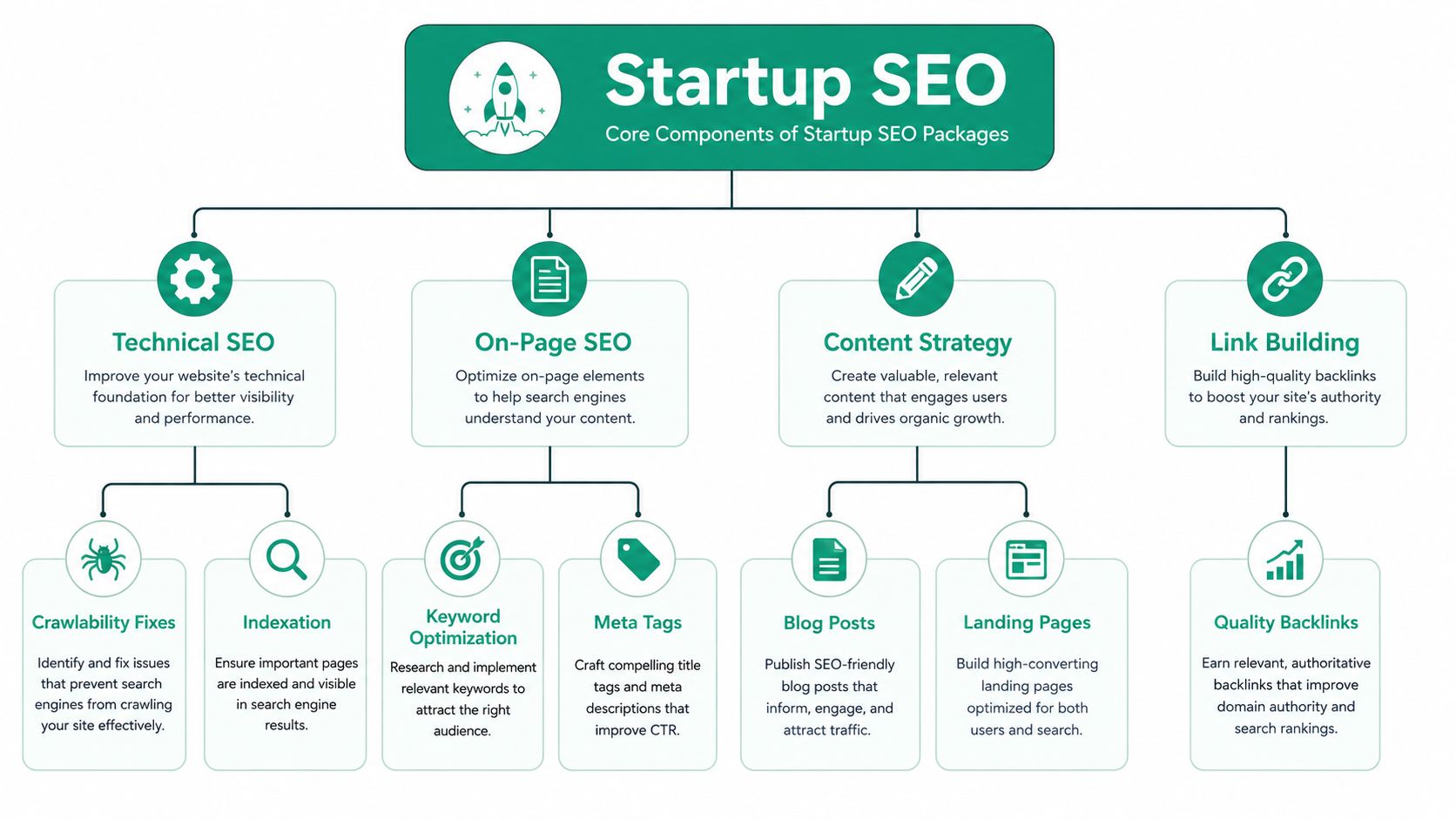
A real startup SEO package has to do four jobs at once. It has to clean up the site, choose the right pages, earn authority, and keep the plan tied to business outcomes. Most agencies claim to do all four, but in practice they overweight the easiest thing to sell, which is content production. That’s why buyers need to inspect the mix, not the pitch.
Technical SEO that removes friction
Technical SEO is the part most startups need first, because product teams create problems faster than marketing teams can fix them. The work should cover crawlability, indexation, canonicalization, internal linking, page templates, and URL structure. If an agency doesn’t talk about those things, they’re skipping the part that keeps everything else from working.
The problem gets worse when feature shipping outruns site maintenance. Rapid releases can create fragmented URLs, improper canonicals, broken links, slow pages, and content that search engines can’t index cleanly. That’s why technical debt is not a side issue in startup SEO; it’s the foundation. One independent startup-focused report argues that these problems directly drag on rankings and become more expensive to repair later, based on GuruStartups’ analysis of why startups fail at SEO.
Content strategy that starts with intent
A startup content plan should not begin with “let’s blog more.” It should begin with the pages buyers are likely to use. That usually means narrow keyword clusters, product-led pages, comparison pages, use-case pages, and landing pages that match buying intent.
If you need a practical reference point for conversion-focused page structure, landing pages that drive growth is a useful model because it keeps attention on the page types that can turn traffic into action. The key point is simple. Early-stage SEO content should reduce the gap between search and purchase, not stretch it out with broad educational posts that sit untouched for months.
Link acquisition that looks like authority building
New domains need authority, but not all links are equal. Startup SEO packages should emphasize digital PR, founder outreach, partnerships, and relationship-based earning over recycled guest-post schemes. The goal is to make the site look like a real company with real signals, not a content farm with a link spreadsheet.
That’s where a lot of proposals drift off course. Agencies love saying “link building,” but few explain what kind, why that kind, and how it fits a startup’s current authority level. If the plan assumes strong rankings before any authority work begins, the sequence is wrong.
Commercial Intent Pages Versus Blog Content Strategy
Startups waste the most money here. Agencies often push blogs because blogs are easy to scope, easy to report on, and easy to inflate with activity metrics. Startups, meanwhile, need qualified traffic and revenue signals. Those aren’t the same thing.
Choose pages by timeline, not by taste
The better question isn’t “Do we need blog content?” It’s “Which pages can rank soon enough to matter?” For a new domain, the answer often leans toward commercial-intent pages. These pages target high-purchase-intent queries, speak in product terms, and give searchers a path to action without extra detours.
That doesn’t make blog content useless. It just changes the order. Informational posts help later, when the site has enough authority to compete more broadly. Several startup-focused guides recommend this narrower opening strategy, especially for companies with near-zero backlinks and limited time to wait for broad informational content to mature, including SEO Page AI’s startup growth guide and LoudFace’s startup SEO guidance.
Use the right mix for the domain you have
A startup with almost no authority should focus on page types that can earn faster relevance. That means product pages, service pages, use-case landing pages, comparison pages, and problem-solution pages built around buyer intent. A more established startup can add broader informational content, but only after the revenue pages are structurally sound.
The trade-off is straightforward:
- Commercial-intent pages work when you need qualified demand quickly, and the offer is already clear.
- Blog content works when you have time to build topical breadth, and the site can absorb slower wins.
- Authority building matters in both cases, but it should support the page strategy instead of replacing it.
If you want a simple filter, use this one. If the keyword suggests someone is close to choosing a vendor, product, or solution, it belongs near the front of the queue. If the keyword only signals curiosity, it can wait.
Don’t confuse motion with momentum
A lot of startup SEO plans look active while doing very little. Thirty blog posts later, there’s traffic, but no pipeline. That usually happens because the agency optimized for volume instead of intent. Startup SEO services should do the opposite. They should make a small set of pages stronger, not just make the site bigger.
Startup SEO Pricing Benchmarks and Timeline Expectations
Pricing only makes sense when you know what the money is buying. A startup can spend too little and get ignored, or spend too much and buy process theater. The right range depends on scope, but the market data gives a useful anchor. Typical startup-level retainers sit around $750 to $1,500 per month, while broader small-business spend often clusters near $500 per month, according to WebFX’s SEO statistics.
What those budgets usually cover
At the lower end, a startup SEO retainer should cover a narrow, practical scope. That means a technical audit, prioritization of fix lists, basic on-page optimization, a focused content plan, and some authority-building work. If the agency promises broad keyword coverage, heavy content production, and serious link acquisition for a tiny budget, the math doesn’t hold.
| Monthly Budget | Typical Deliverables | Best For |
|---|---|---|
| Around $500 | Light audits, basic on-page updates, limited content support | Very early-stage startups testing SEO |
| $750 to $1,500 | Technical fixes, narrow keyword strategy, product-led pages, limited outreach | Startups that need a real SEO program without overcommitting |
| Higher custom retainers | Deeper content production, active link acquisition, more reporting, cross-functional execution | Startups with stronger urgency and more room to invest |
For a wider view of agency cost structure, how much marketing agencies charge is a useful reference point when you’re comparing SEO against other marketing spend.
Set time expectations by work type
Technical fixes move faster than authority gains. That distinction matters. Crawlability and indexation issues can be identified quickly, but rankings from new content usually take longer, and authority building takes longer still. If an agency sells early-stage startups on instant rankings, they’re not being serious.
Rule of thumb: Buy the audit first, then buy the retainer only after the agency shows you what they’d fix, what they’d skip, and what would count as a bad fit.
If you’re putting the budget in front of finance or the board, use a simple narrative. The first phase fixes search access and site structure. The second phase creates pages that can win qualified traffic. The third phase adds authority so the work compounds.
How to Evaluate and Select the Right SEO Agency
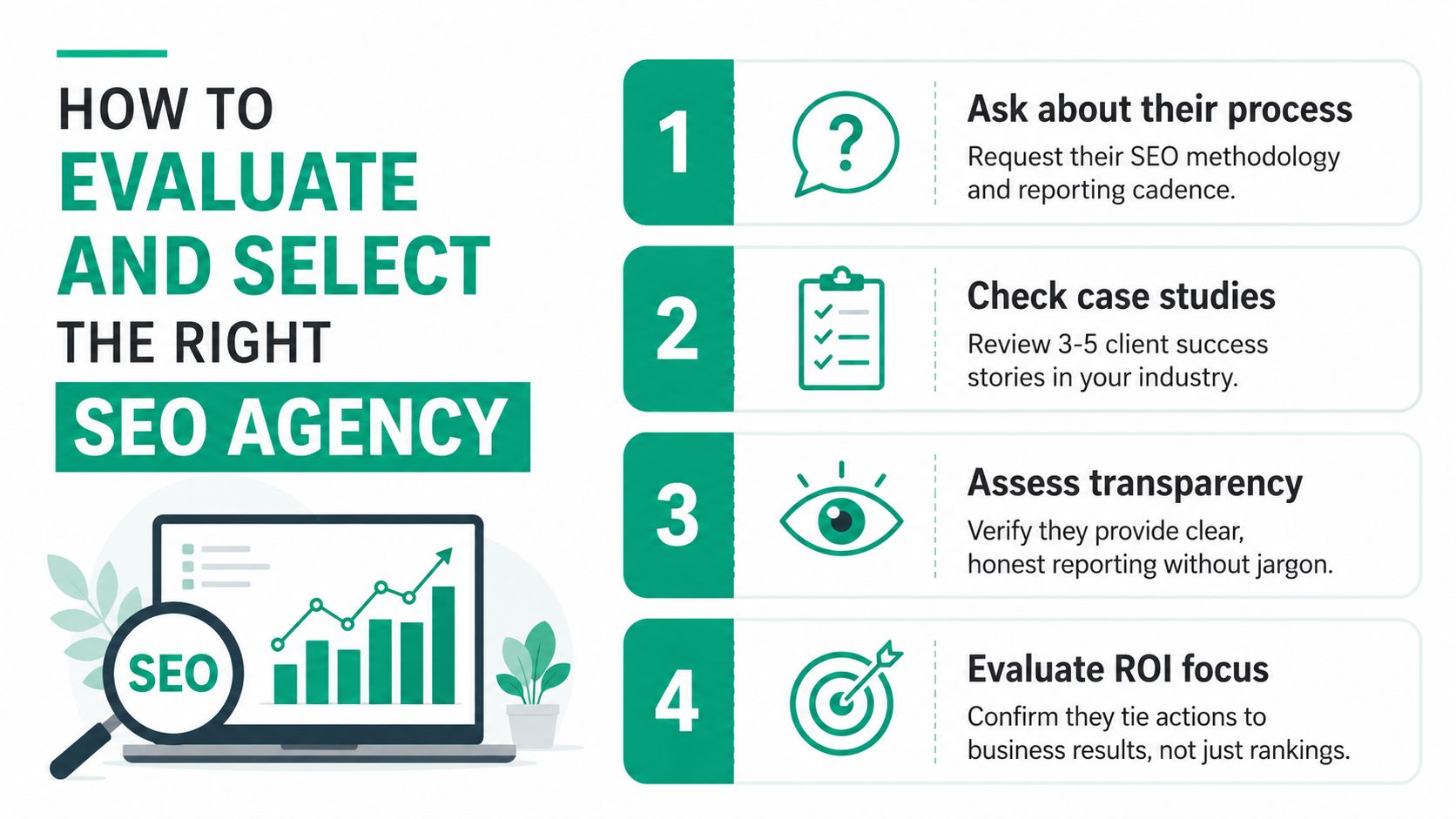
Most bad SEO hires don’t fail because the agency is incompetent. They fail because the startup didn’t ask the right questions. Agency proposals are designed to sound complete. Your job is to find out whether they are specific.
Ask about stage, not just services
The first screen should be about fit. Ask what they’ve done for startups with similar authority, similar product complexity, and similar revenue pressure. If they only show enterprise examples, that’s a warning sign. Enterprise SEO and startup SEO live in different worlds.
You should also ask who does the work, how the work gets reviewed, and what they would not recommend doing right now. That last question matters more than people think. A useful agency can say no to low-value tasks. A weak agency keeps adding deliverables because more tasks make it look bigger.
Look for transparency, not polish
The clearest agencies talk in business terms. They explain how search connects to pipeline, signups, demos, or sales. They also define what failure looks like before the work starts. If they dodge those questions, they’re probably more comfortable selling than operating.
For a wider checklist on vetting agency relationships, how to choose a digital marketing agency gives a broader procurement lens. For search-specific hiring patterns, the 2026 search marketing hiring guide is useful because it reinforces the need to compare process, reporting, and fit rather than accepting a smooth pitch.
Use the right selection signals
A decent RFP process should surface a few things fast.
- Process clarity: Can they describe the first 90 days without jargon?
- Startup relevance: Do they show work from companies near your stage?
- Reporting discipline: Do they tie actions to outcomes, not just activity?
- Team visibility: Do you know who is doing the work?
- Contract flexibility: Does the structure fit startup runway, or does it trap you?
The wrong agency makes you feel informed while learning nothing. The right one makes your next decision easier.
KPIs and Reporting that Actually Matter for Startups
SEO reporting gets messy when teams celebrate the wrong numbers. Rankings are fine as a diagnostic. Impressions are fine as context. Neither one tells you whether the channel is helping the company grow. Startup SEO services should report on outcomes that connect to revenue, not activity that flatters the dashboard.
Measure the pages that matter
The first metric to watch is organic traffic to the pages that can convert. If traffic is rising on irrelevant pages, the channel is busy but not useful. The second is qualified lead generation, because a startup needs visitors who match the offer, not just visitors in general.
The third is attribution quality. Founders need to know whether SEO is affecting signups, demos, pipeline, or sales conversations. That’s the difference between a channel that looks promising and one that deserves more budget. Agencies should also show what changed, why it changed, and what they’d do next.
Keep the reporting cadence tight
Weekly async updates are enough for most startups, with a deeper monthly review tied to agreed KPIs. Anything less structured gets fuzzy fast. Anything more elaborate tends to become presentation theater. The report should tell you what was fixed, what was published, what moved, and what still blocks progress.
If the report can’t be read by a founder in a few minutes, it’s probably tracking the agency’s work more than the startup’s growth.
This is also where tracking setup matters. If attribution is broken, the agency can’t prove impact, and you can’t make smart budget decisions. Fixing that early keeps the rest of the SEO program honest.
Real Startup SEO Examples Across Different Business Models
Different startups need different plays. The mistake is copying tactics across models just because they all wear the startup label. Search behavior, sales cycle, and content fit change the playbook.
A B2B SaaS company usually starts with product-led pages, comparison pages, and integration pages, because those support buyer research and demo requests. A strong technical cleanup matters too, especially when the site has multiple product paths or rapidly changing page structures. Broad educational blogging can come later, but only after the pages that support the pipeline are in shape.
An e-commerce startup often needs a different sequence. Category structure, internal linking, and indexation discipline matter more because product variants and faceted pages can create clutter fast. SEO for e-commerce usually works when the site helps search engines understand which pages should rank and which ones should stay in the background.
A local service business behaves differently again. Local SEO, service pages, and trust signals matter more than a large article library. For a startup in this category, the fastest gains usually come from a clean site structure, clear service pages, and enough authority to compete in local results.
The pattern is the same across all three models. Startups win by matching SEO work to the buying process, not to a content quota.
Ascendly Marketing offers SEO, content marketing, local SEO, and conversion-focused website work that fits this kind of startup trade-off. If you need a team that can turn a messy site, a narrow budget, and a realistic timeline into a practical SEO plan, visit Ascendly Marketing and compare their approach with your current proposal.