

You ask three agencies for a proposal. One quotes a flat monthly retainer that looks manageable. One sends a much higher number with strategy, reporting, creative, and CRO included. A third looks cheaper until you notice setup fees, platform costs, and a percentage of ad spend buried deeper in the proposal.
That spread is normal.
Agency pricing looks inconsistent because the visible fee is rarely the full cost, and two proposals with similar totals can be built in completely different ways. One agency may price for execution only. Another may include senior strategy time, analytics infrastructure, account management, and creative production. A third may keep the retainer lower and recover margin through onboarding fees, reporting tools, call tracking, landing page software, or media management charges.
That is where buyers get misled. The monthly retainer is easy to compare. The hidden costs are not.
Another point many guides skip is how ad spend changes the math. As budgets rise, the agency fee as a percentage of spend often falls. Managing $200,000 in media does not require ten times the labor of managing $20,000, so experienced agencies usually reduce the percentage at higher spend tiers. If a proposal does not make that logic clear, ask how the fee scales and what work increases with budget.
The practical question is not “what do agencies charge?” It is “what, exactly, is included, what is billed separately, and which costs show up after kickoff?” That is how you judge whether a quote is lean, realistic, or expensive for the wrong reasons.
Decoding the Wide World of Agency Pricing
A business owner sends the same brief to three agencies and gets three very different answers. One proposal is a lean monthly retainer. Another folds in strategy, creative, reporting, and CRO. A third looks affordable until the fee schedule reveals onboarding charges, software subscriptions, and a separate percentage on ad spend.
That mismatch is normal.
Agency pricing varies because agencies are not pricing the same unit of work. Some are quoting channel execution. Others are pricing a fuller operating layer that includes planning, analytics setup, testing, creative feedback, weekly calls, and senior oversight. Some keep the headline retainer low and recover margin through setup work, reporting tools, call tracking, landing page software, or media management fees.
That is why quick price comparisons go wrong. The monthly number is visible. The cost structure usually is not.
Range matters, but only as a rough starting point. Mid-market agency engagements are common, and many proposals land higher than buyers expect because the quote includes more than campaign delivery. It may also include onboarding time that is heavy in the first 30 to 60 days, plus technology costs that continue every month after kickoff.
Ad spend complicates the picture further. Many buyers assume that if spend doubles, the agency fee should double with it. In practice, the percentage of spend often drops as budgets rise, because managing larger accounts does not increase labor in a straight line. Budget size matters, but so do campaign count, creative volume, reporting complexity, approval layers, and how much testing the account needs.
A low fee can mean efficiency. It can also mean junior staffing, limited scope, fewer strategy hours, or key work billed elsewhere. A high fee can reflect strong senior involvement and better infrastructure. It can also reflect overhead you will never use.
Use a simple rule. If two proposals are priced far apart, compare line items before comparing totals.
When people ask how much marketing agencies charge, the useful answer is narrower: what is included, what is billed separately, how fees scale with spend, and which costs appear after the contract is signed. That is the difference between a quote that is affordable and one that stays affordable.
The 6 Common Agency Pricing Models Explained
A proposal can quote the same monthly total as another agency and still hide a very different billing structure. That structure affects how fees change when scope shifts, how overruns get billed, and whether onboarding, reporting tools, or creative production sit inside the fee or outside it.
Most agencies use one of six pricing models: hourly, monthly retainer, project fee, performance-based, value-based, or a hybrid of two or more. The model matters because it shapes incentives. It also tells you where extra charges are likely to appear.

Hourly pricing
Hourly billing is straightforward. You pay for time spent.
It fits audits, consulting, analytics cleanup, tracking fixes, and short bursts of senior advice. I usually recommend it when the problem is narrow, and the finish line is clear. It is harder to control ongoing channel work because the monthly bill can swing, and clients end up reviewing timesheets instead of asking whether the work moved performance.
Ask two questions before accepting hourly pricing: who is doing the work, and what is the cap before approval is required? A low hourly rate from junior staff can cost more than a higher rate from a specialist who solves the issue faster.
Monthly retainers
A retainer is a fixed monthly fee for ongoing work. This is the standard setup for SEO, paid media, email, content, and social because those programs need regular attention rather than one-time execution.
Retainers are easier to budget than hourly billing, but only if the scope is specific. A strong retainer spells out deliverables, meeting cadence, reporting, creative support, and what happens when the workload rises. A weak retainer says “optimization” and leaves the client guessing.
This is also where hidden costs often show up. SEO work may sit inside the retainer while technical fixes, content production, or platform subscriptions are billed separately. If you are comparing proposals for SEO services for small business, check whether keyword research, content briefs, implementation support, and reporting are all included or split into add-ons.
Project-based fees
Project pricing works for a defined scope with a start and end date. Common examples include a site migration, brand messaging project, analytics setup, CRM implementation, or a one-time campaign build.
Clients like the predictability. Agencies like the cleaner resource planning.
The risk is change orders. If approvals drag, stakeholders keep adding requests, or the brief was vague to begin with, a fixed fee stops being fixed very quickly. Good project proposals protect both sides by listing assumptions, revision rounds, and what triggers extra billing.
Performance-based pricing
Performance pricing ties some or all of the agency’s compensation to an outcome. That outcome might be leads, booked calls, revenue, qualified pipeline, or another agreed metric.
This model sounds attractive, and in some cases it works well. It also creates the most contract friction. Attribution gets messy fast. If sales follow-up is weak, conversion tracking is incomplete, or multiple channels influence the same deal, disputes start. Performance models are strongest in direct-response programs with clean tracking, short feedback loops, and clear ownership of results.
Read the definition of “performance” closely. The difference between a lead and a qualified lead can change the economics of the entire agreement.
Value-based pricing
Value-based pricing sets the fee according to the commercial value of the work, not the time required to deliver it. Agencies usually use this for high-impact strategy work, positioning, messaging, conversion work, or situations where a small change can produce significant revenue upside.
This can be fair. It can also become speculative if the projected upside is inflated or hard to verify.
For buyers, the main test is simple: can the agency explain the business case in plain terms, and can both sides agree on how value will be measured? If not, value-based pricing becomes a premium with a story attached.
Hybrid models
Hybrid pricing combines structures. This is common because real engagements rarely fit one clean billing method.
A paid media agency might charge a base retainer plus a percentage of ad spend. A search agency might charge a one-time onboarding fee, then a monthly retainer, then separate content production. A growth partner may start with a project to fix tracking and strategy, then move into ongoing management.
Hybrid models are often the most honest because they match how the work is done. They are also the easiest to misread. A proposal can look reasonable at the top line and get expensive once setup fees, software charges, creative requests, and overage rules start stacking up.
| Pricing model | Best fit | Main risk |
|---|---|---|
| Hourly | Audits, consulting, short technical fixes | Cost drift if the scope stays open |
| Retainer | Ongoing channel management | Vague deliverables and add-on fees |
| Project fee | Defined deliverables with a clear endpoint | Change orders and revision creep |
| Performance-based | Direct-response work with reliable tracking | Metric disputes and attribution problems |
| Value-based | High-impact strategic work | Assumptions that are hard to verify |
| Hybrid | Mixed or evolving engagements | Proposal complexity and hidden line items |
What You Can Expect to Pay: A Breakdown by Service
A proposal can say “$6,000 per month” and still leave you unclear on the actual cost. One agency may mean strategy, execution, reporting, creative revisions, and platform setup. Another may mean management only, with onboarding, software, and production billed separately.
That is why service pricing looks inconsistent. You are rarely comparing the same scope.
The market baseline
As noted earlier, agencies often price specialized channel work at a higher hourly rate than general digital marketing support. In practice, that tracks with how the work is staffed. SEO strategy, paid media management, conversion tracking, and performance creative usually involve more senior specialists, tighter QA, and more account coordination than lighter execution work.
Monthly retainers also spread out fast by service type. A lean local SEO engagement might cover technical cleanup, a reporting dashboard, and a small content plan. A broader search program can include site architecture work, content briefs, writing, edits, internal linking, implementation support, and coordination with your web team. Businesses comparing SEO services for small businesses usually find that the monthly fee only makes sense after those pieces are separated.
Where costs rise fastest
Paid media and performance creative usually climb fastest because they combine strategy, execution, testing, and production. Darkroom’s 2026 service pricing breakdown puts performance creative around $5,000 to $15,000 per month and paid media management around $8,000 to $25,000 per month. The same source notes that many agencies also charge 10 to 20% of the monthly media budget as a management fee.
Clients often underestimate what sits inside that fee. Paid media work includes tracking setup, audience structure, bid management, budget pacing, search query review, landing page feedback, weekly optimizations, reporting, and constant creative testing. If those pieces are missing, the cheaper quote is often cheaper because less is being done.
There is another point many pricing guides miss. As ad spend grows, the agency fee percentage often drops. A $10,000 ad account may carry a higher percentage fee than a $200,000 account because the labor does not rise in a straight line with spend. More budget does add oversight and risk, but it does not mean twenty times the hands-on work. That inverse relationship is normal, and it matters when you compare proposals.
Service-by-service quote checks
Use this filter when reviewing channel pricing.
- SEO and content: Confirm whether the fee includes research, technical fixes, content planning, writing, edits, reporting, and implementation help.
- Paid media: Separate management fees from ad spend, creative production, landing page work, and tracking setup.
- Creative production: Check deliverables, revision limits, ad formats, and whether new concepts are included or billed separately.
- Email and social: Look at send or posting cadence, segmentation, design, copy, approvals, and platform management.
- Onboarding and tech: Ask whether analytics configuration, dashboard setup, call tracking, heatmaps, feed tools, or reporting software are included or passed through at cost.
If a proposal combines several services into one monthly number, ask for the workstream split and any one-time setup charges. You do not need the agency’s margin. You do need to know what is recurring, what is one-time, and what turns into an extra invoice later.
Factors That Drive Your Agency Costs Up or Down
A quote changes because the agency itself changes. The team structure, location, specialization, and experience level all shape what you pay.

The biggest pricing drivers
According to Digital Applied’s 2026 pricing analysis, agency pricing can vary by 5–10x by tier, with a boutique firm charging about $1,500 per month for SEO while an enterprise agency charges more than $15,000 per month for similar scope. That gap is driven by geographic location, agency size and overhead, industry specialization, and team experience level.
Those four drivers explain most of what feels irrational in agency pricing.
- Location and overhead: Agencies in higher-cost markets usually have higher pricing because payroll and operating costs are higher.
- Agency size: Larger firms often have more layers, more account management, and broader infrastructure. That can improve coordination, or it can add cost without adding delivery value.
- Vertical specialization: Agencies that know your industry can price higher because they’re not learning your market from scratch.
- Team experience: Senior strategists, technical specialists, and experienced media buyers cost more. You’re paying for judgment, not just labor hours.
A useful explainer on pricing factors sits below.
What the same service can actually mean
“SEO” is a good example. At one tier, it may mean a light monthly package with limited deliverables. At another, it may include technical SEO, content planning, implementation support, conversion analysis, and regular strategic reviews. Agencies can describe both as SEO, but the labor profile is completely different.
That doesn’t mean the expensive option is right. It means you need to check whether the scope matches your business stage.
| Cost driver | Lower end usually means | Higher end usually means |
|---|---|---|
| Location | Lower overhead model | Higher operating costs |
| Agency size | Lean team | More layers and systems |
| Specialization | Generalist approach | Sector-specific expertise |
| Experience | Junior-heavy staffing | Senior-led delivery |
Uncovering the Hidden Costs in Agency Proposals
The retainer is usually the number that gets attention. It often isn't the number that determines your actual first-year spend.

The costs that sit outside the monthly fee
Element Three's agency pricing guide notes that hidden onboarding and technology fees can add 20–40% to base agency quotes. That same source states that discovery and onboarding alone can cost $10,000 to $20,000, while annual technology fees range from $200 to $25,000+.
In this scenario, many budgets go sideways.
A proposal may advertise a monthly retainer that looks manageable, then add a substantial onboarding phase, platform costs, analytics tools, dashboard fees, call tracking, creative subscriptions, or vendor pass-through expenses. None of those charges are automatically unreasonable. The problem is when they're disclosed late or buried in language most buyers skim.
Questions that expose the real total
When you read an agency proposal, separate the cost into three buckets:
- Upfront fees: Discovery, onboarding, account setup, migration work, initial audits
- Recurring non-retainer costs: Software, reporting tools, call tracking, creative platforms, data connectors
- Variable charges: Extra revisions, added campaigns, landing pages, rush requests, out-of-scope work
If you're putting out a formal marketing agency request for proposal, build those categories into the template so every agency has to price them in the same structure. That alone makes proposals easier to compare.
Ask for the all-in first 90-day cost, not just the monthly retainer.
Where clients get caught
The usual mistake is treating onboarding like a minor admin fee. In many agencies, onboarding covers research, strategy, analytics setup, process mapping, team alignment, and account migration. That's real work. It should be priced transparently and judged separately from the monthly run rate.
Another mistake is assuming tools are included. Sometimes they are. Sometimes the agency passes them through. If that isn't explicit, you'll be comparing incomplete numbers.
Decoding Ad Spend Fees and Performance Models
Paid media proposals deserve their own review because the fee structure can look simple while hiding a big pricing swing.
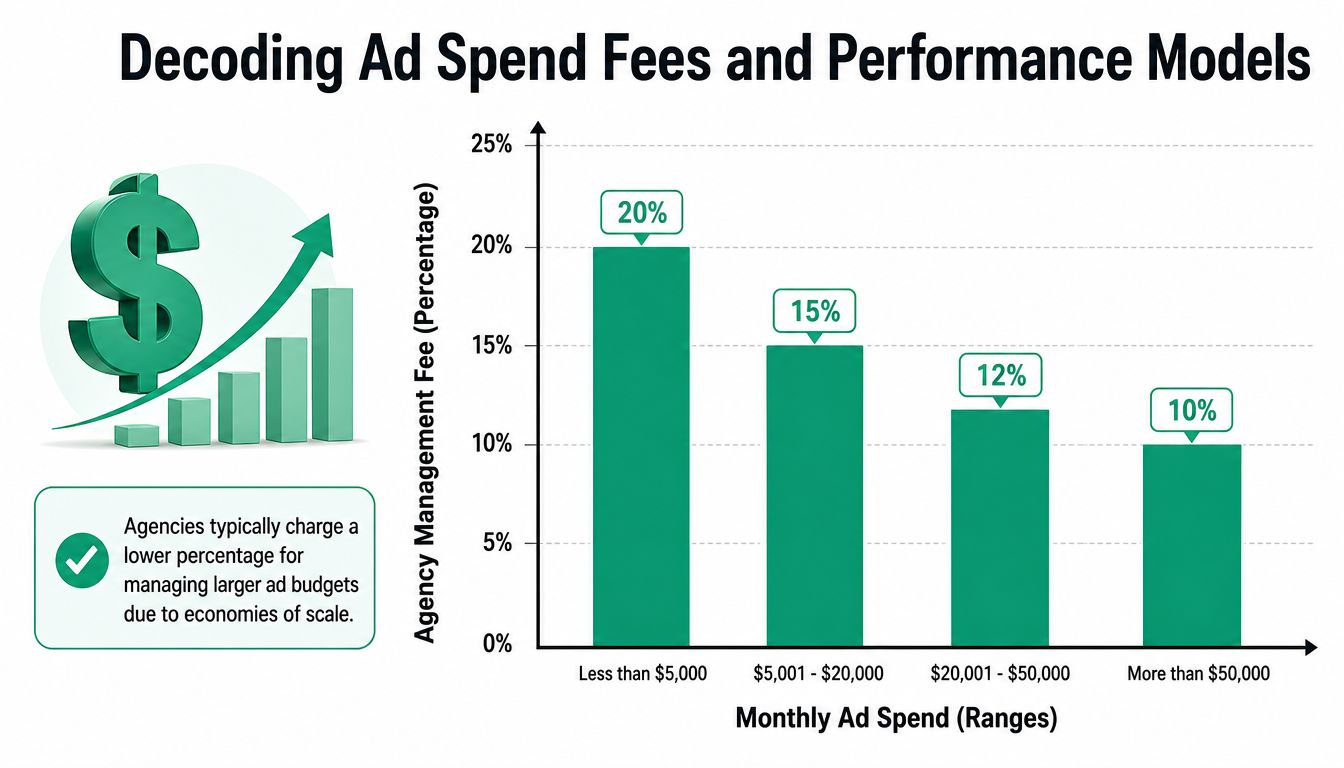
The fee percentage usually falls as spend rises
The part many guides skip is the inverse relationship between budget size and management fee percentage. For ad budgets under $30,000 per month, agency fees can be as high as 20%, while for budgets over $1M per month, the rate often drops to 10%, based on the fee discussion compiled in this PPC industry thread on ad spend pricing.
That doesn't mean larger advertisers pay less in total dollars. They don't. It means they often pay a lower percentage because the account economics change at scale.
Why the percentage changes
A small account still needs campaign setup, tracking, reporting, meetings, optimization, and strategic oversight. Those labor requirements don't shrink in direct proportion to ad spend. In some cases, small accounts are harder to manage efficiently because there is less room for testing and less tolerance for mistakes.
A large account creates different complexity, but the fee as a percentage often comes down because the base spend is higher.
| Monthly ad budget | Fee pattern |
|---|---|
| Lower budgets | Higher percentage fees are common |
| Larger budgets | Lower percentage fees are more common |
A low spend account can be expensive to manage relative to budget, even when the campaign itself isn't large.
Performance models need careful definitions
Some agencies also offer performance-based terms. Those can work when the tracked outcome is clear and when both sides agree on attribution, timeline, and data access.
Problems start when “performance” means one thing in the sales conversation and another thing in the contract. Leads can be low quality. Revenue can be influenced by brand, sales team performance, product changes, and pricing. If a performance proposal sounds attractive, pressure-test the definitions before you compare it with a flat retainer.
How to Evaluate Proposals and Choose Your Partner
You review two agency proposals for the same scope. One is cheaper on page one. By page six, the cheaper option has onboarding billed separately, reporting software marked as a pass-through cost, creative revisions capped so tightly that basic iteration becomes billable, and ad management fees that rise in ways the summary never made clear.
That is a common proposal problem. The headline number gets attention. The operating terms determine what you will pay and how easy the relationship will be to manage.
The best proposal is the one you can audit before you sign. Price matters, but clarity matters just as much.
What to compare beyond price
Start with the full working scope, not the retainer alone. A solid proposal should make it easy to answer these questions:
- Deliverables: What will the agency produce each month, and what is excluded?
- Team access: Who runs the account day to day, and who only appeared during the sales process?
- Onboarding: Is setup included, or billed as a separate project?
- Technology fees: Are reporting tools, call tracking, landing page software, or AI tools included in the fee, or passed through to you?
- Change handling: What happens when priorities shift, approvals stall, or performance drops?
- Measurement: Which metrics define progress, and which ones are only supporting indicators?
I also look for fee mechanics that stay easy to understand after month three. That means clear revision limits, a defined approval process, ownership of accounts and creative assets, and straightforward billing for work outside scope.
If you need a second checklist while comparing options, this guide on how to choose a digital marketing agency is a useful companion.
Red flags that deserve attention
Some of the biggest pricing problems hide inside reasonable language.
- Vague scope: Phrases like “ongoing optimization” or “full-service support” without named outputs, timelines, or channel responsibilities
- Low base fee with stacked extras: A modest retainer that excludes onboarding, tracking setup, reporting software, creative production, or strategy hours
- Unclear ad fee structure: Percentage-based media management with no explanation of how the rate changes as spend increases
- No ownership language: Unclear control of ad accounts, analytics, CRM integrations, landing pages, or creative files
- Strategy-heavy pitch, thin operating detail: Strong recommendations with little explanation of who executes, how often, and under what constraints
That third point gets missed often. Larger advertisers usually pay more in total dollars, but the fee percentage often drops as spend rises. If one proposal keeps the same percentage at every spend tier and another includes breakpoints, ask why. The answer may be reasonable. It may also tell you the pricing model was built for sales simplicity rather than account economics.
Choose the partner that explains costs in plain terms, including setup work, software, approvals, and out-of-scope rates. If an agency cannot explain how billing works during the proposal stage, you will probably get the same lack of clarity in reporting, forecasting, and performance reviews.