

TL;DR:
- Backlink building earns links from external websites, signaling trust and boosting search engine rankings. A diverse, relevant, and natural link profile enhances credibility and organic traffic for small and medium-sized businesses. Regular monitoring and strategic outreach sustain long-term SEO performance.
Backlink building is the practice of earning hyperlinks from external websites to your own, which signals trust and authority to search engines like Google. These links are the industry’s standard term for what SEO professionals call “inbound links” or “link building,” and they remain one of Google’s top three ranking factors in 2026. For small and medium-sized business owners, understanding what backlink building means is understanding how your site earns credibility online. A well-built link profile does not just lift rankings. It drives real, qualified traffic from sites your audience already trusts.
What is backlink building and why does it matter for SEO?
A backlink is an inbound link from one website to another. When a reputable site links to yours, it acts as an editorial vote of confidence. Google reads that vote as a signal that your content is worth ranking.
The numbers back this up. The top-ranking Google result has, on average, 3.8 times more backlinks than pages ranking in positions 2 through 10. That gap shows how much link authority separates the first result from everyone else on the first page.
Not all backlinks carry equal weight, though. Unique referring domains matter more than raw link count. A site with 500 links from 300 different domains will outrank a site with 10,000 links from only 3 domains. Diversity of sources tells Google that many independent publishers find your content credible, not just one site linking repeatedly.
Backlinks persist as a top-ranking signal because they are harder to fake than on-page SEO. A publisher who links to your site makes a deliberate editorial choice. That choice carries weight precisely because it costs the publisher something, whether that is editorial reputation or page space.
Here is what makes a backlink genuinely valuable:
- Topical relevance: The linking site covers a subject closely related to yours.
- Domain diversity: The link comes from a domain that has not linked to you before.
- Editorial placement: The link sits within body content, not a footer or sidebar.
- Natural anchor text: The linked phrase describes your content accurately without keyword stuffing.
- Site authority: The linking domain has its own credible backlink profile.
For a small business, even a handful of strong, relevant backlinks can move the needle on local and niche search results. The role of backlinks in SEO is not theoretical. It is measurable in ranking position and organic traffic within weeks of acquisition.
How does Google evaluate backlink quality in 2026?
Google does not look at backlinks one at a time. Google’s SpamBrain 3.0 evaluates your entire link profile by analyzing link velocity, anchor text distribution, and domain-level signals to detect patterns that look inorganic. A sudden spike of 200 links in one week followed by silence reads as manipulation, not popularity.

Relevance now drives link value more than raw authority. A DR 30 link from a niche site in your exact industry is about 4 times more valuable than a DR 70 link from an unrelated site. That finding flips the old assumption that bigger always means better. A local plumbing company benefits more from a link on a home improvement blog than from a link on a general news aggregator with millions of visitors.
Google also applies diminishing returns to links from the same domain. The first link from a referring domain carries full weight. The second link from that same domain carries less. The tenth carries almost none. This is why building relationships across many different publishers matters more than getting multiple links from one high-profile site.
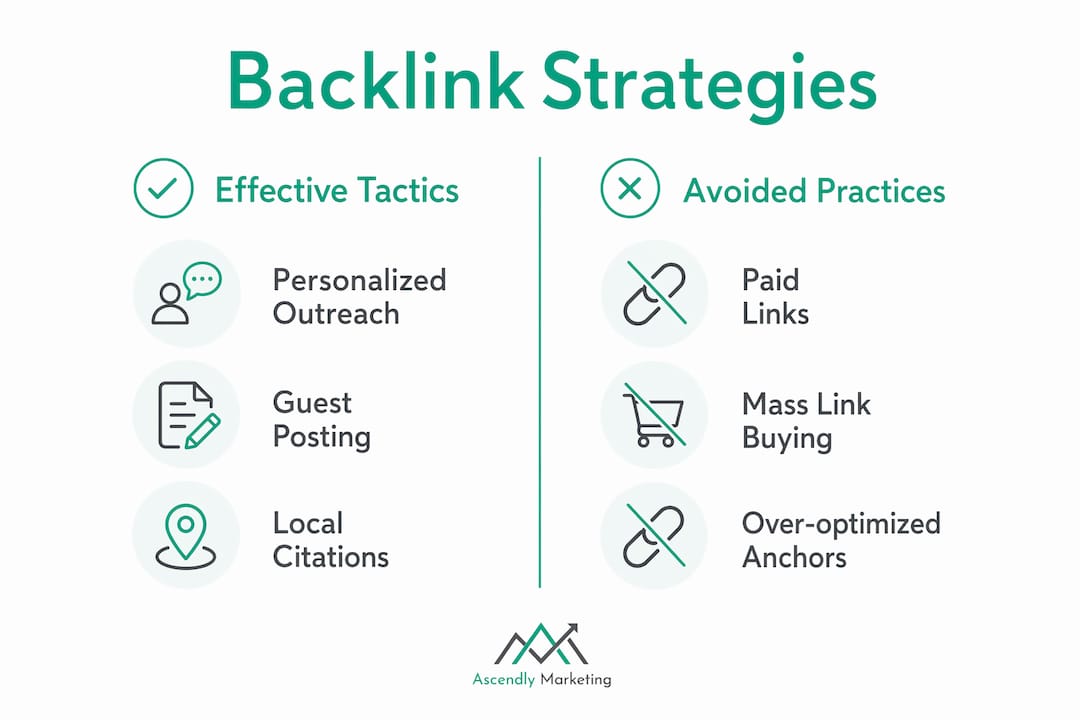
Anchor text still matters, but over-optimized anchor text triggers SpamBrain. If 60% of your backlinks use the exact phrase “best plumber in Dallas” as anchor text, that pattern looks bought, not earned. A natural profile mixes branded anchors, generic phrases like “click here,” partial match phrases, and bare URLs.
Pro Tip: Before you pitch any site for a link, check whether it has already linked to you without a hyperlink. Unlinked brand mentions are a high-conversion outreach opportunity. A site that already references your brand by name is far more likely to add a link than a cold contact who has never heard of you.
Understanding how Google’s algorithm works in detail helps you build a profile that earns rankings rather than penalties.
What are effective backlink building strategies for small businesses?
The best backlink building strategies for SMBs balance low cost with high relevance. Paid backlinks average $361 to $600 per link, which is out of reach for most small business budgets. The good news is that the most durable tactics cost time, not money.
Create a linkable asset. A free tool, a detailed local guide, or a data-driven study gives other sites a reason to link to you without being asked. One well-documented case study showed a skyscraper content asset accumulate over 7,500 backlinks over time. The asset does the outreach work for you.
Targeted guest posting. Writing one well-researched article for a relevant niche publication earns a contextual link and puts your brand in front of a new audience. Mass guest posting with keyword-rich anchor links is penalized by Google. One targeted post on the right site beats 50 generic posts on low-quality blogs.
Broken link building. Find pages on niche sites that link to dead URLs. Reach out to the site owner, flag the broken link, and suggest your relevant content as a replacement. This tactic works because you are solving a problem for the publisher, not just asking for a favor.
Local citations and directory submissions. For businesses serving a specific geography, local citations on platforms like Google Business Profile, Yelp, and industry-specific directories build both backlinks and local search signals. These are low-effort wins that compound over time.
Podcast guesting. Appearing as a guest on a podcast in your industry almost always earns a backlink from the show notes. It also builds brand awareness and positions you as a subject matter expert.
Unlinked brand mention outreach. Search for your business name across the web. When you find a site that mentions you without linking, send a short, polite email asking them to add a link. Conversion rates on this type of outreach are significantly higher than cold pitching.
Pro Tip: Do not pitch a site until you have read at least three of their recent articles. Personalized outreach that references specific content on their site converts at a much higher rate than a generic template.
The common thread across all these tactics is relevance. A link from a site your customers actually read is worth more than a link from a site with a high domain rating but no audience overlap. Quality content is the foundation every one of these tactics depends on.
How do you monitor and maintain a healthy backlink profile?
Earning backlinks is only half the work. Maintaining a clean, growing profile is what sustains rankings over time. Natural link velocity and domain diversity are the two signals Google uses to distinguish organic growth from manipulation.
A regular backlink audit catches problems before they become penalties. The key metrics to track are:
- Total referring domains: This number should grow steadily, not spike and drop.
- Anchor text distribution: Watch for over-concentration of exact-match anchors.
- Toxic link indicators: Links from link farms, private blog networks, or irrelevant foreign directories can drag down your profile.
- Lost backlinks: When a high-value link disappears, reach out to the publisher to understand why and request reinstatement if appropriate.
- New competitor links: Tracking where competitors earn new links reveals outreach opportunities you have not tried yet.
When you identify toxic or spammy links pointing to your site, the Google Search Console Disavow Tool lets you tell Google to ignore them. Use it carefully. Disavowing legitimate links by mistake can hurt your rankings. Reserve it for links that are clearly manipulative or from penalized domains.
The relationship between a healthy backlink profile and site authority is direct. Sites that consistently earn new links from diverse, relevant domains build what SEO professionals call “domain authority,” a measure of how much trust Google extends to your entire site. That trust transfers to every page you publish, including new content that has not yet earned its own links.
Off-page SEO services that include regular audits and profile maintenance protect the investment you make in link acquisition.
Key Takeaways
Backlink building works because it earns editorial trust signals from external sites, and those signals directly determine where Google ranks your pages.
| Point | Details |
|---|---|
| Backlinks are editorial votes | Links from relevant, independent sites signal trust to Google and lift rankings. |
| Diversity beats volume | 500 links from 300 domains outrank 10,000 links from 3 domains. |
| Relevance outweighs authority | A niche DR 30 link is about 4x more valuable than an unrelated DR 70 link. |
| Linkable assets scale naturally | A single strong content asset can earn thousands of backlinks without ongoing outreach. |
| Profile health requires maintenance | Regular audits, disavow actions, and velocity monitoring protect against penalties. |
Why relevance changed everything I know about link building
When I started working on SEO campaigns at Ascendly Marketing, the standard advice was simple: get links from the highest-authority sites you can find. Domain rating was the only number that mattered. That thinking is now outdated, and I have seen it hurt clients who chased big-name links from unrelated industries.
The shift to relevance as the primary value driver is the single most important change in link building over the past few years. A regional accounting firm does not need a link from a national tech publication. It needs links from local business associations, finance blogs, and industry directories its clients actually read. Those links convert better in Google’s eyes and in actual referral traffic.
The other mistake I see constantly is impatience. Business owners want results in 30 days. Sustainable link building takes 3 to 6 months to show meaningful ranking movement. The businesses that win are the ones that treat link acquisition like a long-term relationship program, not a one-time campaign. Consistency beats intensity every time.
My honest recommendation: start with what you already have. Audit your unlinked brand mentions, fix your local citations, and build one genuinely useful piece of content before you spend a dollar on outreach. That foundation will make every future tactic more effective.
— Ascendly Marketing
Ascendly Marketing’s approach to backlink building for SMBs
Ascendly Marketing has worked with small and medium-sized businesses since 2013, and link building sits at the center of every SEO campaign the team runs.

The digital marketing services at Ascendly Marketing cover the full link building process, from identifying relevant link targets and creating linkable assets to outreach, placement, and ongoing profile audits. Every strategy is built around your specific industry and audience, not a generic template. If you want a clear picture of where your backlink profile stands today and what it would take to move your rankings, the Ascendly Marketing team offers a straightforward consultation with no obligation. Reach out through ascendlymarketing.com to get started.
FAQ
What is backlink building in simple terms?
Backlink building is the process of earning links from other websites to yours. Each link acts as a vote of confidence that helps Google rank your site higher in search results.
How many backlinks does a small business need to rank?
There is no fixed number. What matters is earning links from diverse, relevant domains at a natural pace. A site with 50 links from 50 different niche-relevant domains will typically outrank a site with 500 links from 5 domains.
Are paid backlinks worth the cost for SMBs?
Paid backlinks average $361 to $600 per link and carry a real penalty risk if Google detects the pattern. For most SMBs, DIY tactics like linkable assets, local citations, and targeted guest posting deliver better long-term results at a fraction of the cost.
What is the difference between a backlink and a referring domain?
A backlink is a single link pointing to your site. A referring domain is the website that hosts that link. One referring domain can send multiple backlinks, but only the first link from that domain carries full ranking weight.
How long does backlink building take to affect rankings?
Most SEO professionals see meaningful ranking movement within 3 to 6 months of consistent link acquisition. Results depend on your starting authority, the quality of links earned, and how competitive your target keywords are.