

TL;DR:
- Building consistent client visibility helps small and medium-sized businesses become top-of-mind before buyers are ready to buy.
- Persistent, multi-channel efforts increase brand recognition, reduce sales cycles, and boost revenue over time.
Client visibility is defined as the deliberate, consistent exposure of your brand to current and potential clients at every stage of their buying process. For small and medium-sized business owners, this is not a nice-to-have. It is the foundation that determines whether buyers think of you or your competitors when they are ready to spend. The reason to focus on client visibility comes down to one hard truth: buyers choose familiar brands. Understanding how visibility builds demand, shortens sales cycles, and protects client relationships gives you a clear path to growing your market presence in 2026.
Why focus on client visibility before buyers are ready to buy?
Most business owners think about visibility only when they need new customers. That thinking leaves money on the table. 95% of B2B buyers are out of market at any given time, meaning they are not actively shopping. Yet the brands they remember when they finally do enter the market are the ones they have seen consistently.

The data behind this is striking. 68% of B2B buyers already have a preferred vendor before they even begin their search, and they choose that vendor 80% of the time. That means the buying decision is largely made before the first sales conversation happens. Visibility is what earns you that preferred position.
Awareness and visibility are not the same thing. Awareness means someone has heard of you once. Visibility means they encounter your brand repeatedly, across multiple channels, in ways that feel relevant to their situation. A business that publishes consistent blog content, maintains an active social media presence, and appears in relevant search results builds visibility. A business that ran one ad campaign last spring built awareness at best.
Pro Tip: Build a content hub around your core service topics and link each piece together. This signals topical authority to Google and keeps your brand in front of buyers during the long stretches when they are researching but not yet purchasing.
What are the benefits of maintaining strong client visibility?
Strong client visibility produces compounding returns across your entire business, not just your marketing budget. The most direct benefit is pipeline influence. Buyers who already recognize your brand require less convincing, fewer touchpoints, and shorter sales cycles. That translates directly into lower cost per acquisition.
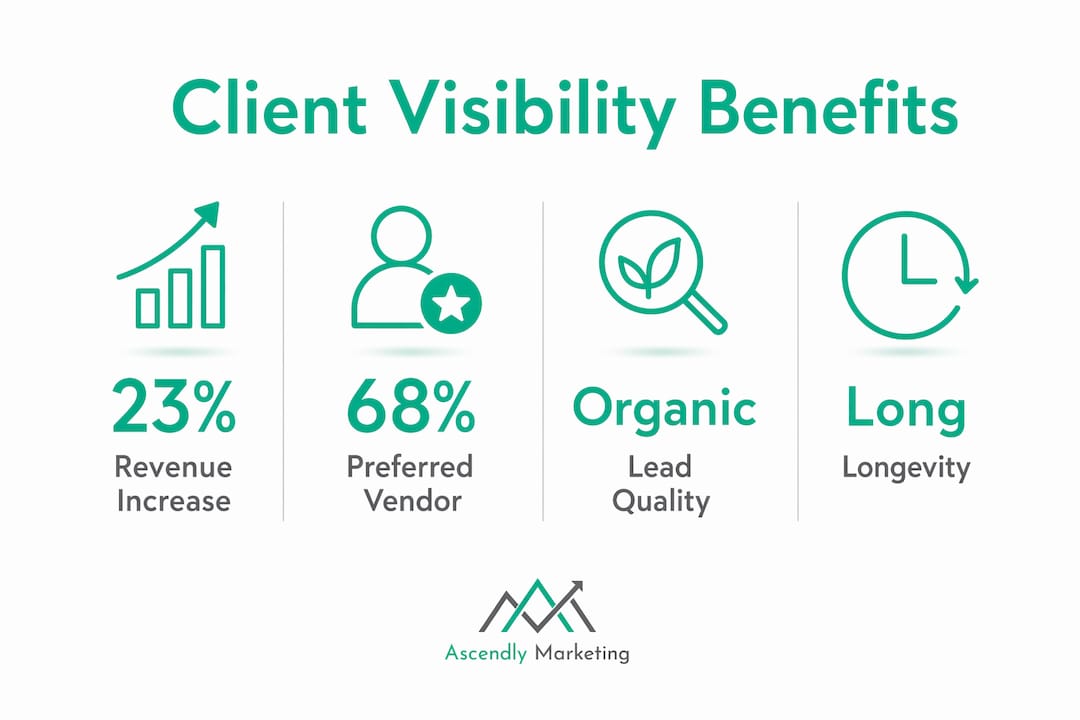
Consistent brand presentation across channels increases revenue by up to 23%. That figure reflects the combined effect of higher brand recall, stronger trust signals, and improved conversion rates when buyers finally engage. A business that looks the same on its website, social profiles, email newsletters, and Google Business Profile builds a coherent identity that buyers trust faster.
The organic visibility advantage is particularly important for SMBs watching their ad spend. Organic search leads generate higher lifetime value and lower churn compared to clients acquired through paid advertising. Paid traffic stops the moment you stop paying. Organic visibility compounds over time, continuing to deliver qualified traffic and leads long after the content or SEO work is done.
| Visibility type | Cost over time | Lead quality | Longevity |
|---|---|---|---|
| Organic (SEO, content, PR) | Decreases as assets compound | Higher lifetime value, lower churn | Continues after investment stops |
| Paid (PPC, social ads) | Constant or increasing | Faster results, shorter retention | Stops when budget stops |
Beyond pipeline and revenue, visibility builds brand equity. Brand equity is the premium buyers are willing to pay simply because they trust and recognize your name. For SMBs, that trust reduces price sensitivity and increases referral rates, two outcomes that no ad campaign can reliably produce on its own.
What practical strategies can SMBs use to improve client visibility?
Improving client visibility requires a coordinated approach across channels, not a single tactic. The following strategies give SMBs the most reliable return on their visibility investment.
Build topical authority through SEO and content clustering. SEO accounts for 53.3% of all web traffic, and 60% of marketers rate SEO leads as the highest quality. Group your content around core topics, link related pieces together, and publish consistently. Google rewards depth and consistency with higher rankings, which means more buyers find you during their research phase. Ascendly Marketing’s organic SEO services are built specifically around this compounding approach.
Use event-driven client communication. Do not wait for monthly reports to update clients or prospects. Send updates when something meaningful happens: a test result comes in, a creative change goes live, a ranking improves. Automated, structured update templates deliver timely status updates without adding workload, and they keep your brand present in the client’s mind between major milestones.
Maintain multi-channel brand consistency. Your brand should look and sound the same across your website, social media profiles, email campaigns, paid ads, and digital PR placements. Inconsistency creates doubt. Consistency creates trust. Assign brand guidelines and audit your channels quarterly.
Frame updates around client outcomes, not agency activity. Client messages focused on the client’s business increase perceived value and retention. “Your top-converting creative is driving 40% of this month’s leads” lands differently than “We launched a new creative this week.” The first message makes the client feel informed and valued. The second makes them feel like a bystander.
Pro Tip: Track branded search volume monthly using Google Search Console. Rising branded search is one of the clearest early indicators that your visibility efforts are building real market presence. Pair it with assisted conversion data in Google Analytics 4 to see how visibility channels influence final purchases.
How does client visibility relate to client retention and perceived value?
Client retention and client visibility are directly connected, and most SMBs do not realize this until they start losing clients they thought were happy. The pattern is consistent: a client signs on, sees activity in the first few weeks, then goes quiet. By month 3 or 4, they start questioning whether anything is actually happening. By month 5, they cancel.
Marketing clients often churn around months 3 and 4 due to a visibility gap. This is not a results problem. It is a communication problem. The work is being done, but the client cannot see it. Their perception of value drops even when actual performance is strong.
The fix is structured, frequent communication. Agencies using consistent, event-driven touchpoints retain clients roughly twice as long as those who report monthly only. That is a significant retention advantage from a process change that costs very little to implement.
| Communication approach | Client perception | Average retention |
|---|---|---|
| Monthly reporting only | Low visibility, uncertainty about progress | Shorter, higher churn risk |
| Event-driven updates plus monthly reports | High visibility, confidence in progress | Longer, lower churn risk |
The lesson for SMBs applies beyond agencies. Any business that serves ongoing clients, whether in consulting, services, or account-based sales, faces the same dynamic. Clients who feel informed stay longer, spend more, and refer others. Clients who feel ignored leave, even when the results are good.
How to measure and track client visibility success effectively?
Measuring client visibility requires looking beyond vanity metrics like follower counts or page views. The metrics that matter connect visibility directly to revenue and pipeline.
- Branded search volume. Track how often people search for your business name specifically. Branded search volume and share of search correlate strongly with revenue share, typically with a 6–12 month lag. Rising branded search means your visibility efforts are building real market recognition.
- Share of search. Compare your branded search volume to the total search volume in your category. A growing share of search signals that you are capturing more mental availability than your competitors.
- Assisted conversions. Use Google Analytics 4 to identify which channels contributed to a conversion even when they were not the final touchpoint. Visibility channels like organic content and social media often assist conversions without getting direct credit.
- Pipeline influence. Track how many deals in your CRM involved a visibility touchpoint, such as a blog read, a social media follow, or an email open, before the first sales conversation. This connects visibility investment to revenue outcomes.
- Client engagement rates. For retention-focused visibility, monitor email open rates, update response rates, and client portal logins. Low engagement signals a visibility gap before churn happens.
Review these metrics monthly and look for trends over quarters, not weeks. Visibility is a compounding asset, and its returns build gradually before they accelerate.
Key Takeaways
Client visibility is the single most important factor determining whether buyers choose your business when they are ready to purchase, and whether existing clients stay long enough to deliver real lifetime value.
| Point | Details |
|---|---|
| Visibility builds demand early | 95% of buyers are out of market at any time; consistent presence earns preferred vendor status before the search begins. |
| Multi-channel consistency drives revenue | Consistent brand presentation across channels increases revenue by up to 23%, according to HubSpot research. |
| Organic visibility compounds over time | SEO and content assets continue generating qualified leads long after the initial investment, unlike paid ads. |
| Communication gaps cause client churn | Clients who feel uninformed churn around months 3 and 4, regardless of actual results. |
| Branded search tracks real progress | Rising branded search volume is an early, reliable indicator that visibility investment is working. |
The visibility mistake most SMBs make
After working with SMBs across industries since 2013, the pattern is clear: most business owners treat visibility as a campaign. They invest for a quarter, expect results, and pull back when the pipeline looks healthy. Then the pipeline dries up three months later, and they wonder why.
Visibility is not a campaign. It is an asset you build over time, and it depreciates the moment you stop maintaining it. The businesses that win long-term are the ones that treat visibility as a fixed operating cost, not a discretionary line item. They publish consistently, communicate with clients between milestones, and show up in search, social, and email whether or not they are actively running promotions.
The other mistake I see constantly is confusing activity with presence. Posting three times a week on social media is activity. Being the brand that buyers think of first when they need your service is presence. Presence comes from depth, consistency, and relevance across every channel your buyers use. It takes longer to build than a campaign, and it is far harder for competitors to copy.
If you are an SMB owner reading this and wondering why your marketing feels like it never quite gains traction, the answer is almost always a visibility gap. You are not showing up consistently enough, in enough places, with enough relevance to build the mental availability that drives preference. The good news is that fixing it does not require a massive budget. It requires a clear strategy and the discipline to execute it over time. You can see real-world examples of what that looks like in practice.
— Ascendly Marketing
How Ascendly Marketing helps SMBs build lasting visibility
Ascendly Marketing has helped small and medium-sized businesses build consistent market presence since 2013. The team combines SEO, content strategy, paid media, social media management, and digital PR into coordinated programs that build visibility across every channel your buyers use.
Every engagement starts with a visibility audit: where you currently appear, where your buyers are looking, and where the gaps are costing you pipeline. From there, Ascendly Marketing builds a plan that fits your budget and compounds over time. If you are ready to stop relying on referrals and start building a presence that works around the clock, explore the full service offering or visit the Ascendly Marketing website to book a consultation.
FAQ
Why does client visibility matter more than advertising?
Advertising generates immediate attention but stops when the budget stops. Client visibility builds brand recognition that persists over time, making buyers more likely to choose you before they even start comparing options.
How long does it take to see results from visibility efforts?
Branded search volume and organic traffic typically show meaningful growth within 6–12 months of consistent effort. Retention improvements from better client communication can appear within the first 60 days.
What is the visibility gap and how does it cause client churn?
The visibility gap is the period when work is being done, but clients cannot see it. Research shows this gap causes most marketing client churn around months 3 and 4, even when results are strong.
Which metrics best measure client visibility success?
Branded search volume, share of search, and assisted conversions in Google Analytics 4 are the most reliable indicators. They connect visibility directly to revenue influence rather than surface-level engagement.
Can small businesses compete on visibility against larger brands?
Yes. SEO and content clustering allow SMBs to build topical authority in specific niches where larger brands are too broad to compete effectively. Consistent, targeted visibility in a defined market beats sporadic broad-reach campaigns.