

The market for AR in social media reached about $12 billion in 2023 and is projected to reach $68 billion by 2032, with mobile AR users growing from 200 million in 2015 to an estimated 2.4 billion by 2023, according to Dataintelo’s AR in social media market report. That changes the conversation.
For a business owner, augmented reality social networking isn’t a side feature anymore. It’s a channel where people can interact with products, brand experiences, and each other inside the same social apps they already use. That’s why this topic matters for revenue, not just reach.
AR is still frequently perceived as funny face filters. That view is outdated. In practice, AR social experiences now sit much closer to product discovery, product trial, and purchase intent.
The New Reality in Social Media
AR in social media moved from novelty to infrastructure. Social platforms now treat camera-based interaction as part of the core experience, not an extra layer for occasional campaigns. That shift matters because buyer attention already lives inside the camera, the story format, and short-form video.

What changed
A few years ago, brands used AR mostly to entertain. Today, the business use is broader.
- User scale changed: A much larger AR-ready audience now exists on mobile devices, which makes social deployment practical at mass scale.
- Platform behavior changed: Major apps built AR directly into their creation tools and camera experiences.
- Buyer expectations changed: People now expect to try, preview, and play with products before buying.
That combination turns augmented reality social networking into a real commercial environment.
Practical rule: If your product benefits from seeing, trying, styling, placing, or personalizing, AR belongs on your channel shortlist.
Why revenue teams should care
AR reduces distance between attention and action. A user doesn’t have to leave the social environment to imagine how a lipstick shade looks, how sunglasses fit, or how a branded effect feels in motion. The product becomes interactive before the click.
For small and mid-sized businesses, that’s the core shift. You’re no longer limited to static posts and standard video. You can place the offer inside an experience.
That doesn’t mean every business should rush into a complex build. It means owners should start asking a sharper question: where would an interactive product view remove hesitation in the buying process?
Defining the AR Social Experience
At the simplest level, augmented reality social networking means people use a social app’s camera to see digital elements layered onto the physical environment in real time. Those elements can be playful, useful, or commercial.
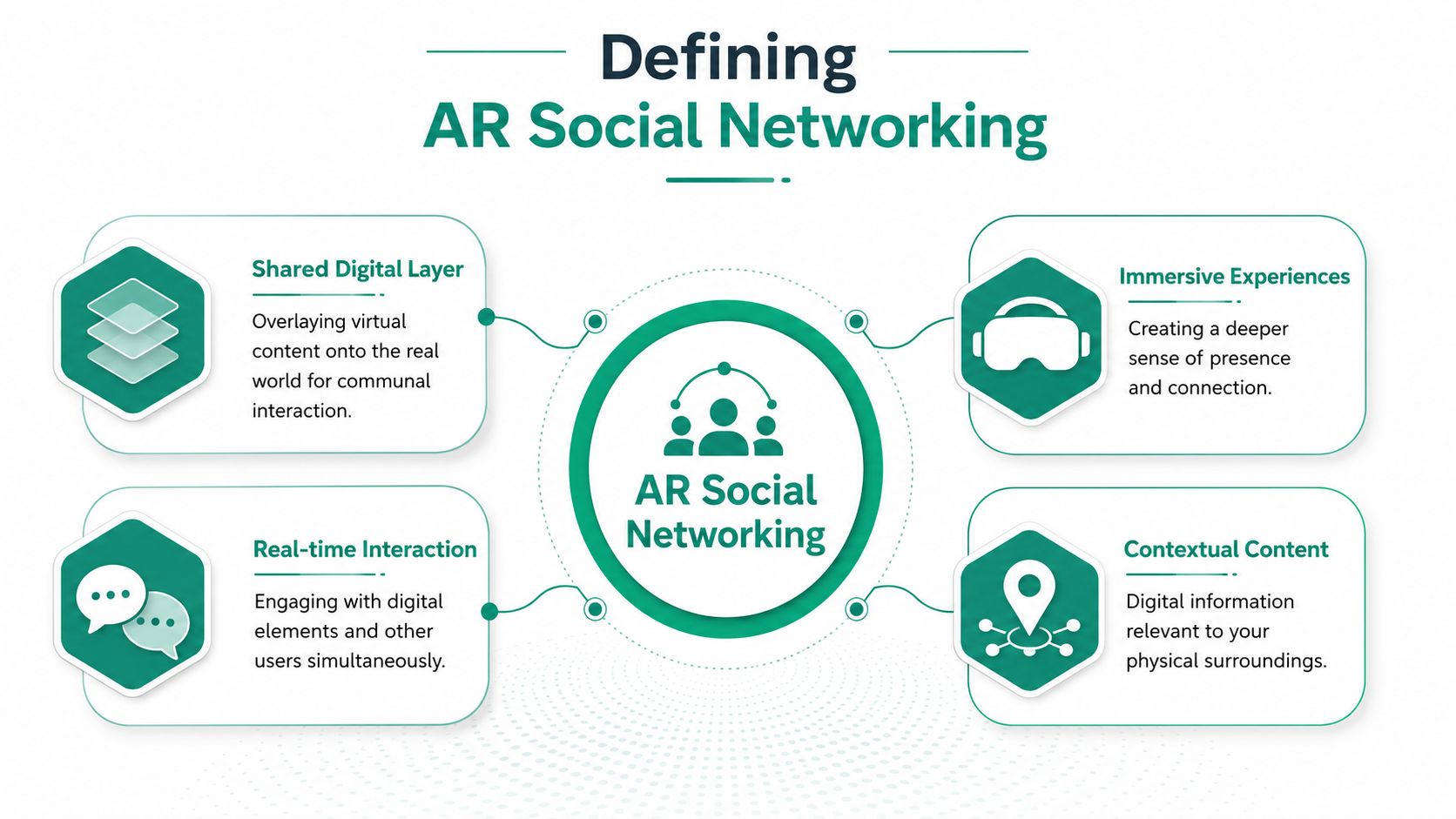
A clean way to think about it is this: standard social content asks people to watch. AR social content asks them to participate.
According to VNTANA’s definition of social AR applications, these experiences function as filters, lenses, and effects on platforms like Instagram, Snapchat, and TikTok that overlay digital elements onto a user’s camera view in real time to enable virtual product try-ons and interactive branded experiences.
The easiest analogy
Think of it as a shared digital layer on top of the camera feed.
A normal photo shows what’s already there. An AR experience adds something that reacts live. A hat appears on your head. A sofa appears in your room. A branded animation follows your face when you smile. The software reads position, movement, and surfaces, then places digital content in a way that feels attached to the scene.
That explains the “augmented” part. The “social” part comes from where it happens and how people use it.
What makes it social
Single-user AR is private. You open an app, point your camera, and interact alone.
Social AR lives inside platforms where people share, remix, respond, and create with others. One person tries on a product and posts it. Another records a reaction. A third shares the same effect in a new context. The content spreads through participation, not just viewing.
Major platforms shaped this behavior by giving users built-in tools to make AR effects themselves. Forbes noted that Facebook, Instagram, and Snapchat provide native development tools for AR camera lenses and effects. That matters because the creation system sits inside the ecosystem where distribution happens.
Where readers usually get confused
People often mix up AR with VR. They aren’t the same.
| Format | What the user sees | Typical social use |
|---|---|---|
| AR | The real world with digital overlays | Filters, lenses, try-ons, effects |
| VR | A fully digital environment | More immersive product demos or virtual spaces |
For most businesses, AR social networking starts with the phone camera. That’s the accessible entry point. The user doesn’t need a headset. They just need a familiar app and a reason to interact.
The best first explanation for AR social isn’t “advanced technology.” It’s “interactive camera content that changes how people evaluate a product.”
Key Platforms and Interactive Use Cases
The practical question isn’t whether AR exists. It’s where your customers will use it.

Snapchat, Instagram, TikTok, and Pinterest in plain terms
Snapchat built early behavior around lenses and camera play. If your product suits face-based interaction, playful effects, or quick visual response, Snapchat makes sense.
Instagram fits businesses that need AR tied closely to brand identity, shopping behavior, and creator content. Beauty, fashion, and lifestyle brands often find the camera-native format useful here.
TikTok works well when the AR idea can become part of a trend, challenge, or repeatable user action. The effect isn’t just viewed. It becomes a format people perform.
Pinterest fits planning behavior. Home, fashion, style, and design brands can use AR to support consideration, not just impulse.
What these use cases look like in the real world
A cosmetics brand can let users test a lipstick shade on their own face through a camera filter. That changes the buying moment. Instead of wondering, the shopper sees an approximation immediately.
A furniture seller can help shoppers visualize an item inside a room. The content becomes more than promotion. It becomes a decision aid.
A beverage or entertainment brand can release a sponsored effect tied to a campaign. Users become distributors because they record themselves inside the experience.
These formats work best when the effect answers a useful question:
- Will this look good on me
- Will this fit my space
- How does this feel in motion
- Would I share this with someone else
Brands also need content support around the effect itself. If you’re mapping AR into a broader channel mix, this guide to types of content for social media helps frame where interactive content fits beside video, short-form posts, and community content.
Platform choice comes down to behavior
Don’t start by asking which platform is hottest. Start by asking what kind of interaction your customer will tolerate and enjoy.
- Face-based products: Makeup, eyewear, accessories, and beauty products often fit camera try-ons.
- Space-based products: Furniture, decor, fixtures, and larger visual products fit placement-based experiences.
- Identity-based campaigns: Entertainment, events, and consumer brands often benefit from branded effects people want to share.
A quick example makes this easier. If you sell sunglasses, an AR try-on inside Instagram or Snapchat lines up with the product. If you sell office furniture, an in-room preview is the better use. If you run a campaign for a seasonal event, a branded TikTok effect may outperform a product-first concept because sharing behavior becomes the main distribution engine.
Video can help make the format feel less abstract before you commit to a campaign.
The Business Case for AR Social Networking
Engagement is nice. Revenue is better.
The strongest business argument for AR social comes from conversion behavior, not novelty. Shopify’s internal e-commerce analysis found that products advertised with VR/AR content on social media platforms achieved a 94% higher conversion rate compared to identical products without AR content, as summarized in this write-up on AR and social media conversions.
Why this affects buying behavior
AR changes the buyer’s job. Instead of translating a flat image into a mental picture, the user interacts with a product more concretely. That lowers uncertainty.
For a shopper, uncertainty often sounds like this:
- Fit uncertainty: Will this look right on me?
- Style uncertainty: Does this match what I already own?
- Context uncertainty: Will this work in my room, office, or routine?
- Confidence uncertainty: Am I making a mistake if I buy now?
AR helps answer those questions before checkout. That doesn’t guarantee a sale, but it moves the customer closer to a decision with less friction.
Why small businesses should pay attention
You don’t need a massive catalog to benefit. A smaller business often has a narrower product set, which can make the first AR campaign easier to focus. One hero product, one use case, one platform, one audience segment. That’s enough to test the commercial logic.
If your social presence still relies on standard posts alone, this is where strategy matters. A structured social media marketing strategy for small business helps you decide whether AR should support product launches, consideration-stage education, or direct-response campaigns.
Revenue lens: AR works best when it helps a buyer make a decision they were already close to making.
AR is stronger when the offer is visual
Some categories fit naturally:
| Business type | Why AR can help |
|---|---|
| Beauty and personal care | Shoppers can preview colors and styles |
| Fashion and accessories | Fit and appearance become easier to judge |
| Home goods | Placement and scale become easier to imagine |
| Promotional campaigns | Branded effects can increase participation and recall |
If your product isn't highly visual, AR may still help, but the business case becomes weaker. In those cases, strong educational content, landing pages, and traditional paid social may deserve priority first.
A Roadmap for Your First AR Campaign
Most businesses make AR harder than it needs to be. They start with the effect. Start with the business decision instead.

Step 1 and Step 2
Start with one commercial goal. Pick the outcome before you discuss creative ideas. Do you want more product page visits, more product trial confidence, more shares, or more direct purchases? A campaign with too many goals usually turns into a weak experience.
Pick the platform that matches the behavior. A try-on belongs where camera use feels natural. A playful branded effect belongs where users already mimic trends and participate in challenges. Don't force the same idea across every platform.
Step 3
Design one action the user can understand in seconds. Good AR social doesn't need a manual. The user opens the camera, sees what to do, and gets a result immediately.
That action might be:
- Try it on
- Place it in your space
- React with a branded effect
- Record and share the result
If you have to explain too much, the concept is too complex for a first campaign.
Step 4
Decide how you'll promote discovery. AR experiences don't succeed just because they exist. They need traffic. That can come from creator posts, paid social, organic stories, product page placement, email, or a launch sequence tied to a specific campaign moment.
A lot of businesses miss this part. They invest in the effect, then underinvest in distribution.
Step 5
Plan measurement before launch. Know which actions count as success. If the goal is product consideration, track interactions that indicate serious interest. If the goal is reach, look for shares and downstream content creation. If the goal is sales, connect the AR touchpoint to visits and purchases in a way your team can review later.
Smart starting point: Your first AR campaign should test one buyer hesitation, not solve your entire social strategy.
A simple decision screen
Use this quick screen before approving creative:
- Is the product visual enough to benefit from AR
- Will users understand the interaction without instruction-heavy copy
- Does the platform match the behavior
- Do we have a plan to drive traffic to the experience
- Can we measure a business outcome, not just views
If you answer "no" to more than one, narrow the idea. The best first move is often smaller, clearer, and easier to distribute.
Measuring Performance Beyond Viral Views
A campaign can get attention and still fail commercially. That's why AR needs its own measurement logic.
Benchmark guidance for AR social campaigns points to average filter usage time and sharing rate as the primary engagement metrics, while UGC creation multiplies organic reach, according to Imascono's overview of AR in social media marketing.
What these metrics actually tell you
Views tell you that people encountered the effect. They don't tell you whether anyone cared.
Average filter usage time shows whether people stayed inside the experience long enough to find value or entertainment in it. Sharing rate shows whether the interaction was strong enough that users wanted other people to see it. User-generated content goes further. It means the customer didn't just use the effect. They turned it into their own content.
For a stronger baseline across channels, it helps to understand your audience's social performance before judging AR in isolation.
Key AR campaign performance metrics
| Metric | What It Measures | Why It Matters for Business |
|---|---|---|
| Average filter usage time | How long people actively interact with the AR experience | Longer use suggests the experience held attention and delivered value |
| Sharing rate | How often users send or post the experience | Higher sharing expands distribution beyond paid or owned reach |
| UGC creation | Whether users create content using the effect | UGC extends reach and signals stronger participation |
| Clicks to site or product page | Whether the experience drives traffic to the next step | This connects AR activity to a commercial path |
| Purchase behavior after interaction | Whether users buy after engaging | This is the clearest test of business impact |
How to connect AR to ROI
Start with the campaign goal, then map one or two supporting metrics to it. Don’t overload the dashboard.
A practical setup looks like this:
- For awareness campaigns: prioritize sharing rate and UGC creation
- For consideration campaigns: prioritize usage time and clicks to product pages
- For sales-focused campaigns: prioritize downstream purchase behavior after interaction
If your reporting is messy, fix that before you add AR. A clean social media audit will show whether your attribution, creative review, and campaign tagging are strong enough to learn from the test.
One viral effect can hide weak business performance. A quieter campaign with stronger product interaction can be the better investment.
Navigating Privacy and User Experience Challenges
AR can lift engagement and still weaken the quality of interaction. That’s the part many marketers skip.
The most useful caution here is the Social Presence Paradox. Data highlighted in this discussion of AR in social media shows that while AR filters boost engagement metrics, AR users report less actual social connection to their partners compared to non-AR users.
What that means for brands
A campaign can feel active without feeling human. People may play with an effect, post it, and move on without forming a stronger bond with the person they’re interacting with or the brand behind it.
That’s a real business issue. Loyalty depends on more than measurable activity.
If your AR concept overwhelms the moment, the filter becomes the point, and the relationship disappears. A better experience supports connection instead of replacing it.
How to avoid the trap
Keep the interaction light and useful. If you’re selling a product, let the effect help the user evaluate it. If you’re building a brand moment, make sure the user still has room to express themselves rather than becoming a delivery system for the effect.
Privacy also shapes adoption. AR requests camera access and sometimes environmental awareness. Users will judge whether the exchange feels fair. Clear context helps. So does keeping the experience easy to exit and easy to understand.
For businesses thinking more broadly about identity, visibility, and user control on social platforms, these Facebook anonymity tips offer useful perspective on why some users care deeply about how they appear and what they share.
A better design question
Don’t ask only, “Will people use this?”
Ask, “Will this make the interaction better?”
That question usually leads to simpler effects, clearer product utility, and less gimmicky execution. It also protects long-term trust, which matters more than a short spike in shares.
If you’re exploring augmented reality social networking and want a team that can connect creative ideas to measurable business outcomes, Ascendly Marketing can help you plan the channel, build the campaign structure, and tie the work back to revenue.